If your 4th graders freeze when they see a sequence like 3, 6, 12, 24… or struggle to explain why a pattern works the way it does, you’re not alone. Teaching patterns and algebraic thinking requires students to think beyond just “what comes next” — they need to understand the underlying rules and identify features that weren’t obvious at first glance.
Key Takeaway
Successful pattern instruction moves students from simply continuing sequences to analyzing rules, making predictions, and discovering hidden relationships within mathematical patterns.
Why Pattern Recognition Matters in 4th Grade
Pattern recognition forms the foundation of algebraic thinking, setting students up for success in middle school mathematics. At the 4th grade level, CCSS.Math.Content.4.OA.C.5 requires students to generate number or shape patterns following given rules and identify features not explicitly stated in the rule itself.
Research from the National Council of Teachers of Mathematics shows that students who master pattern analysis in elementary grades demonstrate 40% better performance in algebra concepts later. This standard bridges arithmetic and algebra, helping students see mathematics as a system of relationships rather than isolated facts.
Pattern work typically appears in your curriculum around October through December, building on place value understanding and multiplication facts. Students need solid number sense and basic operation fluency to analyze numerical patterns effectively.
Looking for a ready-to-go resource? I put together a differentiated pattern practice pack that covers everything below — but first, the teaching strategies that make it work.
Common Pattern Misconceptions in 4th Grade
Common Misconception: Students think all patterns add the same number each time.
Why it happens: Early pattern work focuses heavily on addition patterns, creating this mental model.
Quick fix: Introduce multiplication patterns early and explicitly compare different pattern types.
Common Misconception: Students believe they only need to find the next term, not understand the rule.
Why it happens: Traditional worksheets emphasize “fill in the blank” rather than rule analysis.
Quick fix: Always ask “How do you know?” and require students to explain the pattern rule in words.
Common Misconception: Students think shape patterns and number patterns are completely different skills.
Why it happens: These are often taught separately without making connections explicit.
Quick fix: Show how shape patterns can be described with numbers (position 1, position 2, etc.).
Common Misconception: Students assume growing patterns always increase by the same amount.
Why it happens: Linear patterns are introduced first, creating this expectation.
Quick fix: Include quadratic patterns like 1, 4, 9, 16 to show different growth rates.
5 Research-Backed Strategies for Teaching Patterns
Strategy 1: Pattern Detective with Recording Sheets
Students become mathematical detectives, investigating patterns to uncover hidden rules and relationships. This strategy develops analytical thinking while building pattern vocabulary.
What you need:
- Pattern sequences (start with 3-4 terms shown)
- Detective recording sheets
- Colored pencils or markers
- Chart paper for class discoveries
Steps:
- Present a pattern with some terms missing: 2, 6, __, 18, __
- Students record what they notice in the “Clues” section
- They write the rule in their own words
- Students find the missing terms and extend the pattern
- Partners share discoveries and compare reasoning
Strategy 2: Input-Output Function Tables
Function tables help students see the relationship between position and pattern value, building algebraic thinking through systematic organization.
What you need:
- Two-column charts (Position | Pattern Value)
- Pattern blocks or counters
- Calculators for complex patterns
- Whiteboard for modeling
Steps:
- Start with a concrete pattern: 5, 10, 15, 20…
- Create a table with Position (1, 2, 3, 4) and Value (5, 10, 15, 20)
- Students look for the relationship: “Position times 5 equals the value”
- Test the rule with new positions: “What’s the 10th term?”
- Students create their own patterns and tables to share
Strategy 3: Growing Pattern Investigations
Students build physical patterns with manipulatives, then analyze how the patterns grow, connecting visual, numerical, and algebraic representations.
What you need:
- Pattern blocks, tiles, or linking cubes
- Grid paper for recording
- Digital camera or tablets for documentation
- Chart paper for class patterns
Steps:
- Students build the first 3-4 steps of a growing pattern
- They record how many blocks are in each step
- Students predict the 5th and 10th steps without building
- They test predictions by building or using the rule
- Groups share patterns and explain growth rules
Strategy 4: Pattern Scavenger Hunt
Students hunt for patterns in real-world contexts, connecting mathematical thinking to everyday experiences and building pattern recognition skills.
What you need:
- Clipboards and recording sheets
- Digital cameras or phones
- Access to school hallways, playground, or classroom
- Chart paper for sharing findings
Steps:
- Students search for patterns in tiles, windows, fencing, or artwork
- They photograph or sketch each pattern found
- Students describe the rule for each pattern in words
- They predict what comes next in each sequence
- Class creates a pattern gallery with explanations
Strategy 5: Pattern Creation and Justification
Students design their own patterns following specific rules, then challenge classmates to discover the underlying patterns, building both creation and analysis skills.
What you need:
- Blank pattern cards or paper
- Colored pencils, stickers, or stamps
- Timer for pattern challenges
- Presentation space for sharing
Steps:
- Give students a rule: “Create a pattern that grows by 4 each time”
- Students design and record their pattern sequence
- They write a clear explanation of their rule
- Partners exchange patterns and try to identify the rules
- Students present their patterns and justify their thinking
How to Differentiate Pattern Work for All Learners
For Students Who Need Extra Support
Start with concrete, visual patterns using physical objects before moving to abstract numbers. Provide pattern frames showing the first several terms clearly. Use color-coding to highlight the changing elements in each step. Focus on simple addition patterns initially, ensuring students can explain “what’s happening” before finding missing terms. Offer sentence frames like “The pattern rule is…” and “I know this because…” to support mathematical communication.
For On-Level Students
Students work with both increasing and decreasing patterns, including multiplication and division rules. They should comfortably move between different representations (visual, numerical, verbal) and explain their reasoning clearly. Expect students to identify patterns in function tables and make predictions about terms beyond what’s shown. Students practice with CCSS.Math.Content.4.OA.C.5 expectations, finding features not explicit in the original rule.
For Students Ready for a Challenge
Introduce patterns with two-step rules (multiply then add) or quadratic growth patterns. Students explore patterns in geometry, such as how perimeter changes as shapes grow. Challenge them to create patterns that follow specific constraints or to find multiple patterns within the same sequence. Connect pattern work to real-world applications like population growth, savings accounts, or architectural designs.
A Ready-to-Use Pattern Resource for Your Classroom
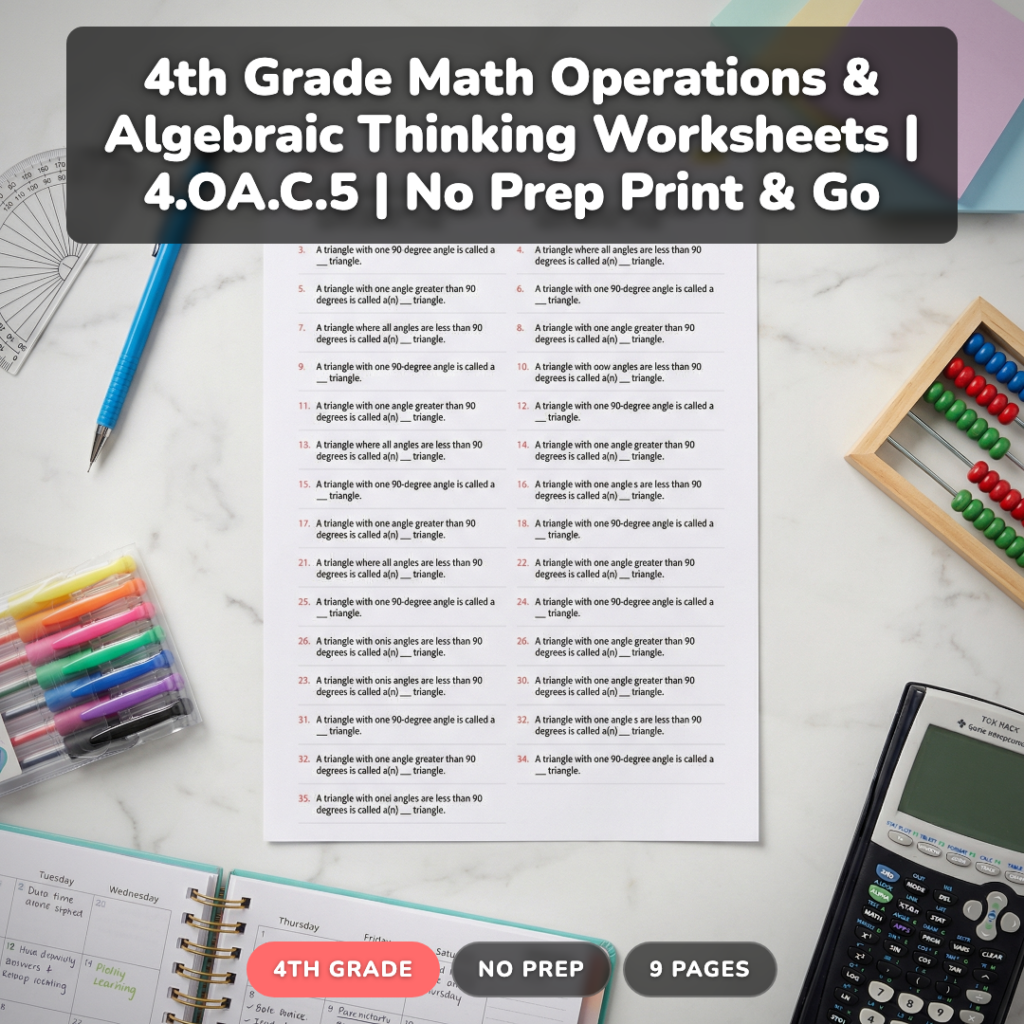
After trying these strategies in my own classroom, I created a comprehensive pattern practice resource that addresses all the challenges we’ve discussed. This 9-page pack includes 132 differentiated problems across three levels: Practice (37 problems), On-Level (50 problems), and Challenge (45 problems).
What makes this resource different is the systematic progression from basic pattern recognition to complex rule analysis. Each level includes answer keys and focuses specifically on the CCSS.Math.Content.4.OA.C.5 standard requirements. The problems move beyond simple “fill in the blank” to require students to identify hidden pattern features and justify their reasoning.
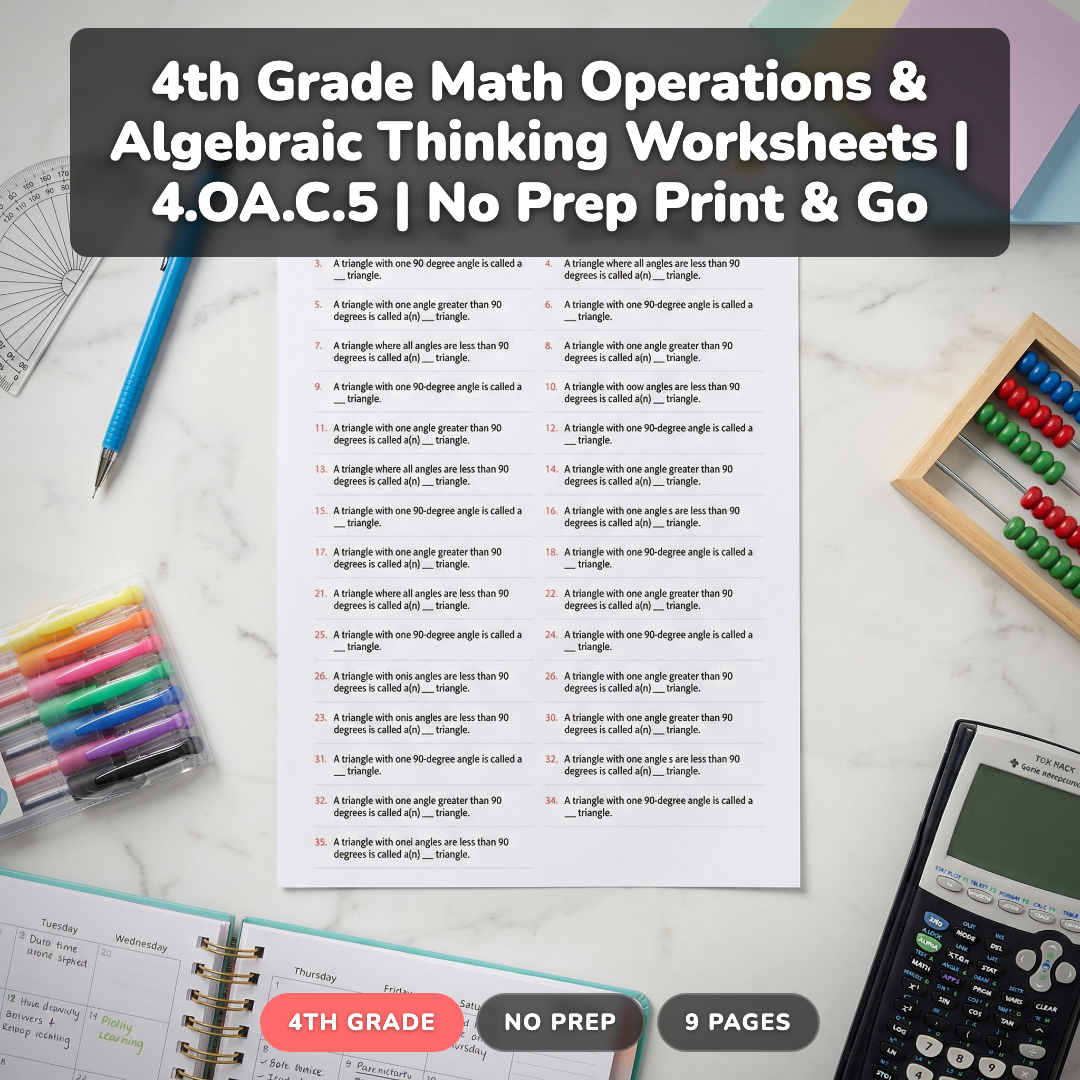
The resource covers number patterns, shape patterns, and growing patterns with clear differentiation for all learners. Students practice explaining rules, making predictions, and discovering relationships that weren’t obvious at first glance.
Grab a Free Pattern Practice Sheet to Try
Want to see how these strategies work in practice? I’ll send you a free sample pattern worksheet that includes all three differentiation levels, plus my favorite pattern investigation recording sheet.
Frequently Asked Questions About Teaching Patterns
What’s the difference between arithmetic and geometric patterns in 4th grade?
Arithmetic patterns add or subtract the same amount each time (2, 5, 8, 11), while geometric patterns multiply or divide by the same factor (3, 6, 12, 24). Fourth graders should recognize both types and explain the rules using appropriate mathematical vocabulary.
How do I help students who can continue patterns but can’t explain the rule?
Use think-alouds to model your reasoning process. Ask “What’s happening from this number to the next?” rather than “What comes next?” Provide sentence frames and require students to use mathematical language like “increases by,” “multiplies by,” or “the rule is.”
Should 4th graders work with decreasing patterns too?
Yes, CCSS.Math.Content.4.OA.C.5 includes all types of patterns. Start with simple decreasing patterns like 20, 15, 10, 5 after students master increasing patterns. This helps them understand that patterns can change in multiple ways, not just grow larger.
How do shape patterns connect to algebraic thinking?
Shape patterns help students see position relationships and variables. When students describe “the 5th shape in the pattern,” they’re using positional thinking that directly connects to algebra. Shape patterns also involve counting elements, creating numerical sequences alongside visual ones.
What’s the most important skill for pattern work in 4th grade?
Students must move beyond finding the next term to identifying and explaining the underlying rule. This analytical thinking — seeing “why” patterns work, not just “what” comes next — builds the foundation for algebraic reasoning and mathematical communication skills.
Teaching patterns effectively requires moving students from passive recognition to active analysis. When students can create, extend, and justify pattern rules, they’re developing the algebraic thinking skills that will serve them throughout their mathematical journey.
What’s your favorite strategy for helping students discover hidden pattern features? Try the detective approach with your class this week and grab that free sample to see these strategies in action.