How to Teach Geometry in Kindergarten: 5 Strategies That Work
If your kindergarten students struggle to see how small shapes can build bigger ones, you’re not alone. Shape composition is one of the trickiest geometry concepts for young learners because it requires spatial reasoning skills that are still developing. This post breaks down exactly how to teach CCSS.Math.Content.K.G.B.6 (composing simple shapes to form larger shapes) using hands-on strategies that actually work in real kindergarten classrooms.
Key Takeaway
Kindergarten geometry success comes from moving from concrete manipulation to visual representation, with plenty of time for exploration before formal practice.
Why Geometry Matters in Kindergarten
Geometry instruction in kindergarten builds the foundation for spatial reasoning, critical thinking, and mathematical visualization that students will use throughout their academic careers. Research from the National Council of Teachers of Mathematics shows that students who develop strong spatial skills in early elementary perform 30% better on standardized math assessments in later grades.
The CCSS.Math.Content.K.G.B.6 standard specifically asks students to compose simple shapes to form larger shapes. This skill typically emerges in the second half of the kindergarten year, after students have mastered basic shape identification and attributes. Students need to understand that shapes can be combined, rotated, and arranged to create new shapes — a concept that bridges concrete and abstract thinking.
Effective geometry instruction at this level follows the Concrete-Representational-Abstract (CRA) model. Students need extensive time with physical manipulatives before moving to drawings, and finally to mental visualization. Most kindergarteners need 4-6 weeks of consistent practice to master shape composition confidently.
Looking for a ready-to-go resource? I put together a differentiated kindergarten geometry pack that covers everything below — but first, the teaching strategies that make it work.
Common Geometry Misconceptions in Kindergarten
Common Misconception: Students think shapes must touch perfectly to “count” as building a larger shape.
Why it happens: They focus on visual gaps rather than overall outline formation.
Quick fix: Use transparent overlays to show how shapes create the boundary of larger shapes.
Common Misconception: Students believe you can only use identical shapes to build larger shapes.
Why it happens: Early pattern work emphasizes repetition and sameness.
Quick fix: Model mixing triangles and squares to create houses, demonstrating variety in composition.
Common Misconception: Students think rotated shapes are different shapes entirely.
Why it happens: They rely on orientation rather than geometric properties.
Quick fix: Practice turning shapes while saying “It’s still a triangle” to reinforce shape constancy.
Common Misconception: Students assume bigger shapes always need more pieces to build.
Why it happens: They confuse size with complexity in their everyday experiences.
Quick fix: Show how one large triangle can equal two small triangles through direct comparison.
5 Research-Backed Strategies for Teaching Geometry Composition
Strategy 1: Pattern Block Picture Building
Pattern blocks provide the perfect introduction to shape composition because their proportional relationships make natural combinations possible. Students can see immediately how shapes fit together to create recognizable pictures and larger geometric forms.
What you need:
- Pattern blocks (wooden or plastic sets)
- Pattern block template cards
- Large floor space or table areas
- Shape composition recording sheets
Steps:
- Start with simple templates showing outlines of familiar objects (houses, flowers, butterflies)
- Demonstrate filling one section, thinking aloud about which shapes might fit
- Have students work in pairs, taking turns placing pieces and explaining their choices
- Progress to creating their own pictures without templates
- End each session by having students describe what shapes they used and how many
Strategy 2: Shape Puzzle Investigations
Shape puzzles challenge students to think systematically about how pieces fit together while developing problem-solving persistence. This strategy builds both spatial reasoning and logical thinking through hands-on exploration.
What you need:
- Tangram sets (simplified 4-5 piece versions for kindergarten)
- Geometric puzzle cards with solution outlines
- Timer for turn-taking
- Recording sheets for successful combinations
Steps:
- Introduce tangram pieces by having students trace and name each shape
- Model solving a simple puzzle, showing how to rotate and flip pieces
- Provide puzzle cards progressing from 2-piece to 4-piece solutions
- Encourage students to find multiple solutions for the same outline
- Have students create their own puzzle challenges for classmates
Strategy 3: Interactive Shape Building Games
Games naturally motivate repeated practice while building social skills and mathematical vocabulary. Competitive elements keep students engaged while they develop shape composition fluency through play.
What you need:
- Shape dice or spinner with basic geometric shapes
- Building mats with target shape outlines
- Small manipulative shapes in multiple colors
- Timer for game rounds
Steps:
- Players take turns rolling dice to determine which shapes they can use
- Goal is to completely fill a target shape outline using only rolled shapes
- Players must announce their strategy before placing pieces
- Successful completion earns points; incomplete attempts earn partial credit
- Rotate target shapes every few rounds to maintain challenge
Strategy 4: Digital Shape Composition Tools
Technology tools allow for infinite experimentation without the physical limitations of manipulatives. Digital environments also provide immediate feedback and the ability to save and share successful compositions.
What you need:
- Tablets or computers with geometry apps
- Interactive whiteboard for whole-class demonstrations
- Screen recording capability for sharing solutions
- Digital portfolio space for saving work
Steps:
- Demonstrate basic app functions: selecting, moving, and rotating shapes
- Start with guided practice using simple composition challenges
- Provide open exploration time for creative shape building
- Have students screenshot and explain their favorite compositions
- Create class galleries of digital shape art with mathematical descriptions
Strategy 5: Real-World Shape Hunt and Build
Connecting geometry to students’ environment makes abstract concepts concrete and relevant. This strategy helps students see that shape composition happens everywhere in their world, from architecture to art to nature.
What you need:
- Clipboards and pencils for outdoor exploration
- Digital camera or tablets for documentation
- Collection bags for natural shape materials
- Large paper for creating shape composition murals
Steps:
- Take students on a “shape hunt” around school grounds and neighborhood
- Identify objects made from multiple shapes (houses, playground equipment, signs)
- Sketch or photograph examples of shape compositions in the environment
- Return to classroom to recreate discoveries using manipulatives
- Create a class book documenting shape compositions found in their world
How to Differentiate Geometry for All Learners
For Students Who Need Extra Support
Students struggling with shape composition benefit from extended concrete manipulation time and simplified tasks. Provide larger manipulatives that are easier to handle, and use templates with thick black outlines that clearly show where pieces should go. Break complex compositions into smaller steps, starting with just two shapes before progressing to three or four. Use consistent vocabulary and provide visual word cards showing shape names with pictures. Consider pairing these students with patient partners who can model thinking aloud.
For On-Level Students
Grade-level expectations for CCSS.Math.Content.K.G.B.6 include composing shapes to form rectangles, squares, circles, triangles, and other familiar shapes using various combinations. Students should be able to explain their thinking using basic geometric vocabulary and recognize that the same larger shape can be created using different combinations of smaller shapes. They should work independently on moderately complex compositions and begin to predict which shapes might work before testing their ideas.
For Students Ready for a Challenge
Advanced students can explore symmetrical compositions, create original shape puzzles for classmates, and investigate how many different ways they can compose the same target shape. Challenge them to use specific numbers of pieces (“Can you make a hexagon using exactly 6 triangles?”) or work within constraints (“Build a house using only squares and triangles”). These students often enjoy teaching strategies to struggling peers and creating instructional videos explaining their problem-solving approaches.
A Ready-to-Use Kindergarten Geometry Resource for Your Classroom
Teaching shape composition effectively requires a variety of practice opportunities at different difficulty levels. You need problems that build systematically from simple two-shape compositions to more complex multi-shape challenges, plus clear answer keys that show multiple solution possibilities.
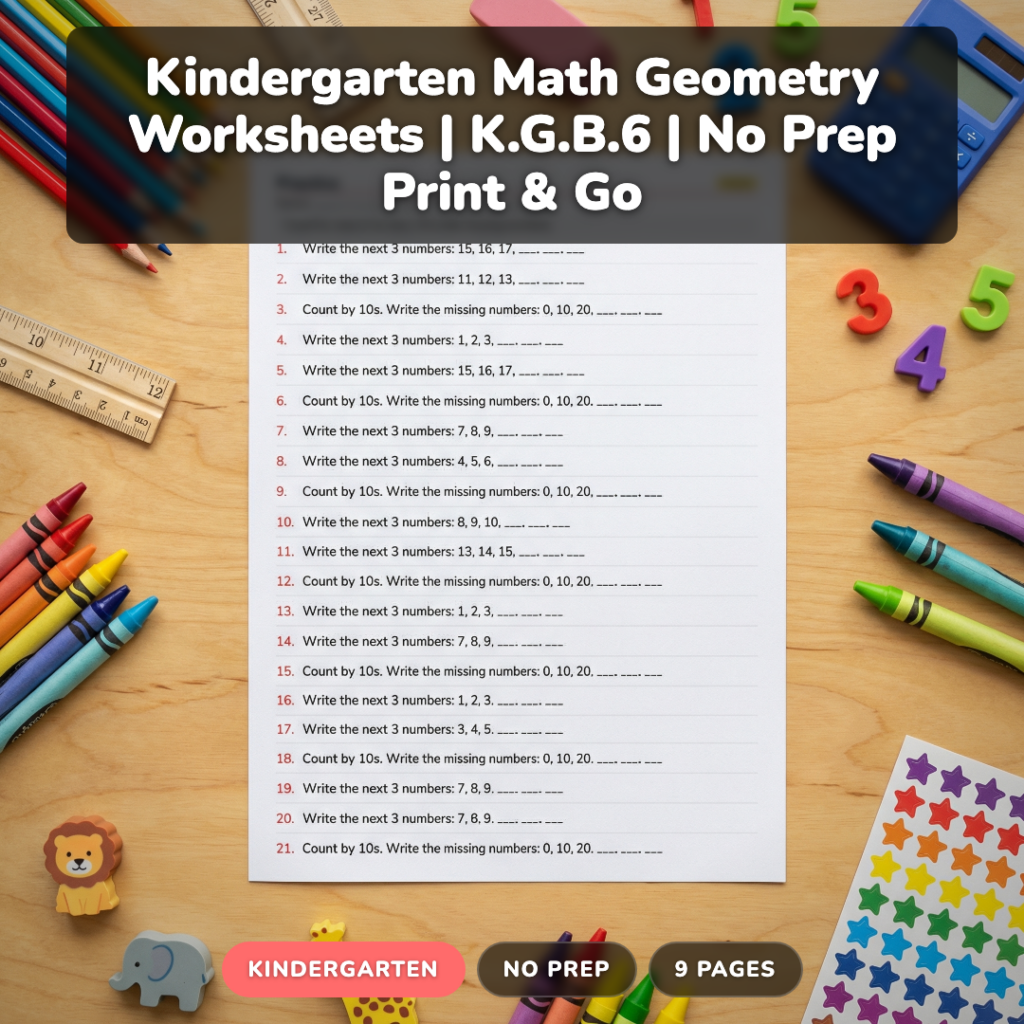
My Kindergarten Geometry Worksheets pack includes 79 carefully scaffolded problems across three difficulty levels. The Practice level (22 problems) focuses on basic two-shape compositions with visual supports. On-Level worksheets (30 problems) present grade-appropriate challenges that align perfectly with CCSS.Math.Content.K.G.B.6. The Challenge level (27 problems) extends learning with complex compositions and open-ended creation tasks.
What makes this resource different is the systematic progression and built-in differentiation. Each worksheet includes visual examples, clear directions that kindergarteners can follow independently, and answer keys showing multiple correct solutions. The problems move logically from concrete picture-based tasks to more abstract geometric compositions.
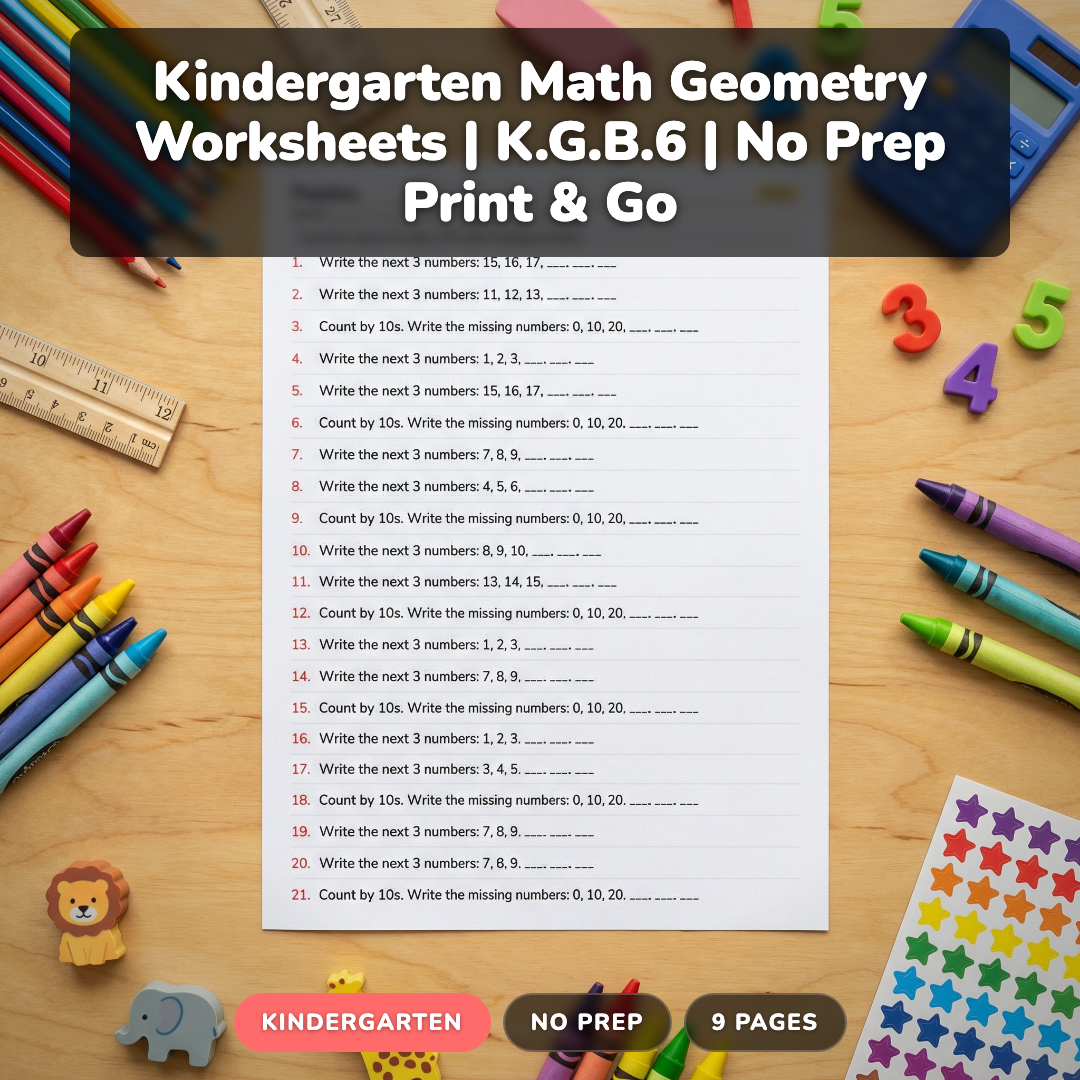
This no-prep resource saves hours of planning time while ensuring your students get the varied practice they need to master shape composition. All 9 pages are ready to print and use immediately.
Grab a Free Geometry Sample to Try
Want to see how these differentiated worksheets work in your classroom? I’ll send you a free sample pack with one worksheet from each difficulty level, plus my shape composition teaching tips checklist.
Frequently Asked Questions About Teaching Kindergarten Geometry
When should kindergarten students master shape composition?
Most kindergarteners develop shape composition skills in the second half of the school year, typically between January and April. Students need 4-6 weeks of consistent practice after mastering basic shape identification and attributes according to CCSS.Math.Content.K.G.B.6 expectations.
What manipulatives work best for teaching shape composition?
Pattern blocks are ideal because their proportional relationships create natural combinations. Tangrams work well for older kindergarteners, while large foam shapes help students with fine motor challenges. Digital tools provide unlimited experimentation opportunities without physical constraints.
How do I assess kindergarten geometry understanding?
Use performance-based assessments where students build specific shapes using manipulatives while explaining their thinking aloud. Look for ability to rotate pieces, try multiple approaches, and use geometric vocabulary. Portfolio collections showing progression over time work better than single-point testing.
What if students can identify shapes but struggle with composition?
This is common and indicates students need more time with concrete manipulation before moving to worksheets. Increase hands-on exploration time, use larger manipulatives, and provide templates with internal lines showing exactly where pieces fit. Some students need 2-3 additional weeks of concrete practice.
How does kindergarten geometry connect to later math learning?
Shape composition builds spatial reasoning skills essential for fraction understanding, area and perimeter concepts, and algebraic thinking. Students who master geometric visualization in kindergarten show stronger performance in middle school geometry and measurement according to longitudinal research studies.
Teaching kindergarten geometry successfully means giving students plenty of time to explore, experiment, and build understanding through hands-on experiences. Remember that every student develops spatial reasoning at their own pace — some need extra concrete practice while others are ready for creative challenges.
What’s your favorite strategy for helping kindergarteners see how shapes fit together? The free geometry sample above includes my complete teaching tips checklist to help you implement these strategies effectively in your own classroom.