If your kindergarteners struggle to compare objects and tell you which is taller, longer, or heavier, you’re not alone. Teaching measurement concepts to 5 and 6-year-olds requires concrete, hands-on experiences that build their understanding step by step. You’ll discover five research-backed strategies that make measurement concepts click for young learners.
Key Takeaway
Kindergarten measurement success comes from direct comparison activities using real objects before introducing any measurement tools or numbers.
Why Measurement Matters in Kindergarten
Measurement and data skills form the foundation for mathematical reasoning that students will use throughout their academic careers. In kindergarten, CCSS.Math.Content.K.MD.A.2 focuses on direct comparison of objects with measurable attributes like length, height, and weight. This standard appears in the second quarter of most kindergarten curricula, after students have developed basic counting and number recognition skills.
Research from the National Council of Teachers of Mathematics shows that students who master comparison concepts in kindergarten perform 23% better on standardized math assessments in later grades. The key is helping students understand that objects have measurable attributes and that we can compare these attributes using mathematical language.
Students need extensive practice with direct comparison before they’re ready for non-standard units of measurement in first grade. This developmental progression ensures they understand what measurement means before learning how to measure with tools.
Looking for a ready-to-go resource? I put together a differentiated measurement pack that covers everything below — but first, the teaching strategies that make it work.
Common Measurement Misconceptions in Kindergarten
Understanding where students typically struggle helps you address confusion before it becomes entrenched. Here are the most frequent misconceptions I’ve observed:
Common Misconception: Students think a wider object is automatically longer.
Why it happens: Young children focus on overall size rather than specific attributes.
Quick fix: Use objects with obvious length differences but similar widths, like a pencil and a ruler.
Common Misconception: Students believe heavier objects are always bigger.
Why it happens: They conflate weight with size based on their physical experience.
Quick fix: Compare a large foam block with a small metal toy to show size doesn’t determine weight.
Common Misconception: Students think objects must be identical except for the measured attribute.
Why it happens: They haven’t learned to focus on one attribute while ignoring others.
Quick fix: Practice comparing very different objects that share one measurable attribute, like a toy car and a book for length.
Common Misconception: Students assume taller always means longer.
Why it happens: They confuse vertical and horizontal measurements.
Quick fix: Use consistent language and demonstrate both orientations with the same object.
5 Research-Backed Strategies for Teaching Measurement
Strategy 1: Direct Side-by-Side Comparison
This foundational strategy teaches students to align objects at a common baseline to compare their attributes accurately. Students physically place objects next to each other to determine which has more or less of a specific attribute.
What you need:
- Pairs of similar objects with clear differences (crayons, blocks, books)
- Flat surface for alignment
- Masking tape for baseline markers
Steps:
- Place two objects on a table with a tape baseline
- Align both objects at the baseline
- Ask students to identify which attribute they’re comparing (length, height, width)
- Have students point to the object with more of that attribute
- Practice the language: ‘The red crayon is longer than the blue crayon’
Strategy 2: Body-Based Measurement Exploration
Using students’ own bodies as measurement tools makes abstract concepts concrete and personally meaningful. This kinesthetic approach helps students understand attributes through movement and physical comparison.
What you need:
- Open floor space
- Various classroom objects
- Chart paper for recording discoveries
Steps:
- Have students lie down next to classroom objects to compare length
- Ask them to stretch their arms wide next to desks, bookshelves, or bulletin boards
- Compare hand spans with book widths or paper lengths
- Record findings using comparative language on a class chart
- Discuss which body part worked best for each comparison
Strategy 3: Sorting by Measurable Attributes
This strategy builds classification skills while reinforcing measurement vocabulary. Students group objects based on shared measurable attributes, developing their ability to identify and compare specific characteristics.
What you need:
- Collection of mixed classroom objects (20-30 items)
- Three sorting circles or bins
- Labels: ‘Short,’ ‘Medium,’ ‘Long’ (or similar)
Steps:
- Present the collection and identify the attribute to sort by (length, height, or weight)
- Demonstrate sorting the first few objects while thinking aloud
- Have students work in pairs to sort remaining objects
- Discuss borderline cases where objects could fit multiple categories
- Resort the same objects using a different attribute
Strategy 4: Measurement Story Problems
Real-world contexts help students apply measurement concepts meaningfully. Story problems with visual supports bridge concrete experiences with mathematical reasoning and academic language development.
What you need:
- Picture books featuring size comparisons
- Simple story problem cards
- Actual objects mentioned in stories when possible
Steps:
- Read a story problem aloud while showing pictures
- Have students identify the two objects being compared
- Determine what attribute the story is asking about
- Use actual objects or clear pictures to make the comparison
- Practice answering in complete sentences using measurement vocabulary
Strategy 5: Interactive Measurement Games
Game-based learning increases engagement while providing repeated practice with comparison skills. Structured games create opportunities for peer learning and natural use of measurement vocabulary.
What you need:
- Sets of objects for comparison (blocks, manipulatives, classroom supplies)
- Simple game cards with comparison challenges
- Timer for turn-taking
Steps:
- Partners take turns drawing comparison challenge cards
- First player selects two objects and makes a comparison statement
- Second player verifies the comparison using direct alignment
- Players earn points for accurate comparisons and proper vocabulary use
- Rotate through different types of objects and attributes
How to Differentiate Measurement for All Learners
For Students Who Need Extra Support
Focus on very obvious differences between objects, using clear visual contrasts that eliminate ambiguity. Provide sentence frames like ‘The ___ is longer than the ___’ to support language development. Use consistent baseline markers and practice alignment repeatedly. Review vocabulary daily with picture supports, and allow extra processing time before expecting responses. Consider pairing these students with measurement buddies for peer support.
For On-Level Students
Present objects with moderate differences that require careful observation but aren’t ambiguous. Encourage complete sentence responses using grade-level measurement vocabulary. Introduce multiple attributes for the same objects (this block is longer but thinner). Practice with CCSS.Math.Content.K.MD.A.2 expectations through varied object pairs and consistent use of comparative language. Provide independent practice opportunities with self-checking materials.
For Students Ready for a Challenge
Use objects with subtle differences that require precise comparison techniques. Introduce measurement vocabulary beyond the standard (wider, narrower, thicker, thinner). Have them explain their reasoning and predict outcomes before comparing. Connect to real-world applications like cooking, building, or art projects. Encourage them to create their own comparison challenges for classmates and explore multiple attributes simultaneously.
A Ready-to-Use Measurement Resource for Your Classroom
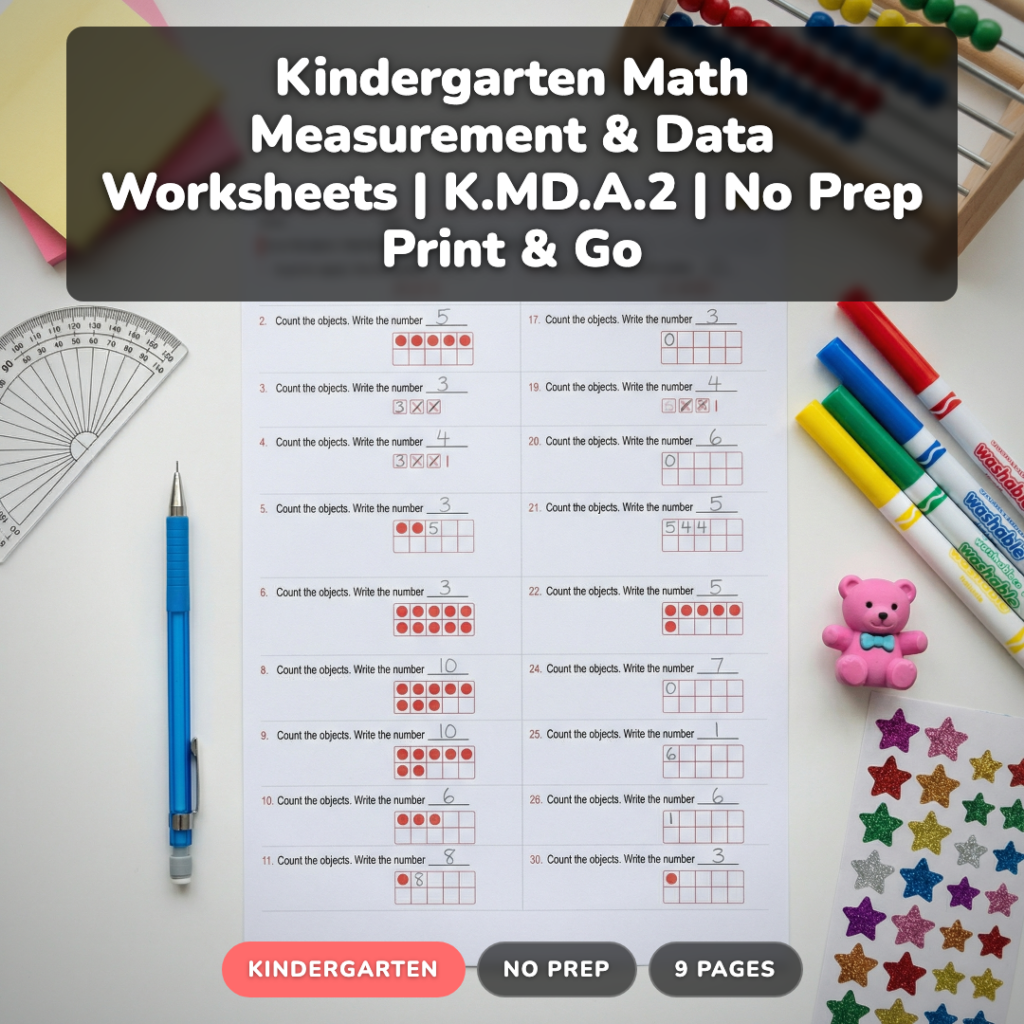
After years of creating measurement activities from scratch, I developed a comprehensive resource that saves hours of prep time while providing exactly the differentiated practice kindergarteners need. This measurement pack includes 79 problems across three difficulty levels, perfectly aligned with CCSS.Math.Content.K.MD.A.2.
The practice level focuses on obvious comparisons with clear visual differences, perfect for students building foundational skills. On-level worksheets present moderate challenges that match grade-level expectations. The challenge level pushes advanced learners with subtle differences and extended reasoning opportunities. Each level includes detailed answer keys and teaching notes.
What makes this resource different is its systematic progression from concrete to abstract thinking. Students start with picture-based comparisons, move to mixed attribute challenges, and finish with application problems. The visual design supports emerging readers while building mathematical vocabulary naturally.
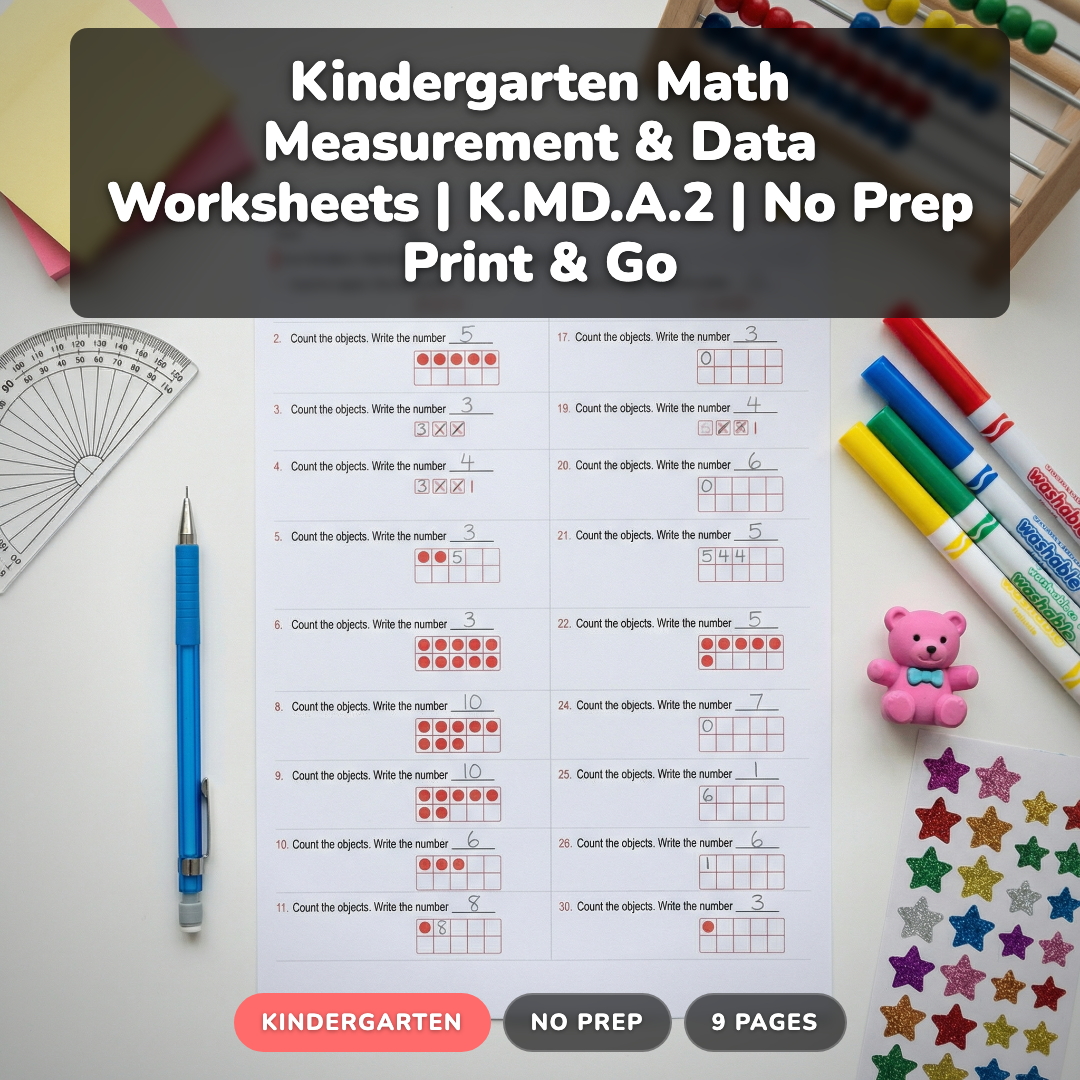
You can grab this time-saving resource that covers everything from basic comparisons to challenging applications. No more hunting for appropriate worksheets or creating materials from scratch.
Grab a Free Measurement Sample to Try
Want to see how these strategies work in practice? I’ll send you a free sample worksheet from each difficulty level, plus my measurement vocabulary word cards that students love. Perfect for trying these techniques with your class before diving into the full resource.
Frequently Asked Questions About Teaching Measurement
When should kindergarteners start learning measurement concepts?
Most kindergarteners are ready for direct comparison activities after mastering basic counting to 10 and developing fine motor skills for object manipulation, typically in October or November. Start with obvious differences before progressing to subtle comparisons.
What’s the difference between measurement and comparison in kindergarten?
Kindergarten focuses on direct comparison without measurement tools or units. Students compare objects side-by-side to determine which has more or less of an attribute, building foundational understanding before formal measurement in first grade.
How do I help students who confuse different measurable attributes?
Use explicit vocabulary instruction with visual supports, focusing on one attribute at a time. Practice with objects that vary in only one dimension, then gradually introduce objects with multiple attribute differences while maintaining clear language expectations.
Should kindergarteners use rulers or measuring tools?
No, CCSS.Math.Content.K.MD.A.2 specifically focuses on direct comparison without tools. Rulers and measuring devices are introduced in first grade after students understand what measurement means through concrete comparison experiences.
How often should I teach measurement concepts in kindergarten?
Integrate measurement activities 2-3 times per week for 10-15 minutes each session. Brief, frequent exposure with hands-on practice works better than longer, less frequent lessons for maintaining kindergarteners’ attention and building understanding.
Teaching measurement in kindergarten sets the foundation for all future mathematical learning. Focus on concrete experiences, use precise vocabulary, and provide plenty of hands-on practice with direct comparison. What’s your favorite way to help students master measurement concepts? Don’t forget to grab your free sample worksheets to get started with these strategies right away.