If your kindergarten students look confused when you ask them to compare the length of two objects, you’re not alone. Teaching measurement and data concepts to 5 and 6-year-olds requires hands-on exploration, concrete examples, and plenty of practice with real objects they can touch and manipulate.
This guide will walk you through research-backed strategies that make measurement concepts click for young learners, plus differentiation tips to meet every student where they are.
Key Takeaway
Kindergarten measurement skills develop through repeated hands-on experiences comparing and describing real objects using informal units and mathematical vocabulary.
Why Measurement & Data Matters in Kindergarten
Measurement and data skills form the foundation for all future math learning. According to the National Council of Teachers of Mathematics, early measurement experiences help students develop spatial reasoning, number sense, and logical thinking skills that transfer across mathematical domains.
In kindergarten, students work toward mastering CCSS.Math.Content.K.MD.A.1, which requires them to describe measurable attributes of objects like length, weight, and capacity. This standard typically appears in curriculum around February through May, after students have developed basic counting and comparison skills.
Research from the University of Chicago shows that students who receive explicit instruction in measurement vocabulary and comparison strategies score 23% higher on standardized assessments than those who learn through discovery alone. The key is providing structured opportunities to explore, compare, and describe objects using mathematical language.
Looking for a ready-to-go resource? I put together a differentiated measurement pack that covers everything below — but first, the teaching strategies that make it work.
Common Measurement Misconceptions in Kindergarten
Common Misconception: Students think bigger objects are always heavier.
Why it happens: They rely on visual size rather than actual weight or density.
Quick fix: Compare a large foam block to a small rock using a balance scale.
Common Misconception: Students confuse length and height.
Why it happens: The vocabulary is abstract and orientation-dependent.
Quick fix: Use consistent language and gestures — length goes side to side, height goes up and down.
Common Misconception: Students think capacity depends on container shape, not volume.
Why it happens: Tall, narrow containers look like they hold more than short, wide ones.
Quick fix: Pour water between different shaped containers to show equal amounts.
Common Misconception: Students focus on one attribute while ignoring others.
Why it happens: Young children struggle with multiple classification systems.
Quick fix: Explicitly name multiple attributes: “This block is long AND heavy AND smooth.”
5 Research-Backed Strategies for Teaching Measurement & Data
Strategy 1: Attribute Exploration Stations
Set up learning stations where students explore different measurable attributes through guided discovery. This approach builds foundational understanding before formal measurement begins.
What you need:
- Collection of classroom objects (blocks, books, toys, containers)
- Sorting mats or hula hoops
- Attribute cards with pictures and words
- Balance scale and measuring cups
Steps:
- Introduce one attribute per station (length, weight, capacity, height)
- Model how to sort objects by that attribute using comparison language
- Have students work in pairs to sort and describe their findings
- Rotate groups every 10-12 minutes with a reflection question
- Close with a whole-group discussion about discoveries
Strategy 2: Living Measurement Comparisons
Use students themselves as measurement tools to make abstract concepts concrete and personally meaningful. This kinesthetic approach works especially well for length and height.
What you need:
- Classroom objects of varying lengths
- Yarn or string cut to different lengths
- Chart paper for recording
- Measuring vocabulary cards
Steps:
- Have students lie down next to classroom objects (desk, bookshelf, rug)
- Compare: “Is the desk longer or shorter than Sarah?”
- Record findings using pictures and simple words
- Extend to arm spans, foot lengths, and hand widths
- Create a class measurement chart showing comparisons
Strategy 3: Capacity Investigation Center
Build understanding of capacity through water play and container comparisons. This sensory-rich activity makes volume concepts tangible for young learners.
What you need:
- Various containers (cups, bowls, bottles, jars)
- Rice, beans, or water for filling
- Funnels and scoops
- Towels for cleanup
- Recording sheet with container pictures
Steps:
- Start with two very different containers (tall/narrow vs. short/wide)
- Have students predict which holds more
- Fill one container, then pour into the other
- Discuss results using “holds more,” “holds less,” “holds the same”
- Repeat with different container pairs
- Record discoveries on a simple chart
Strategy 4: Weight Comparison Games
Use balance scales and hands-on materials to help students understand weight as a measurable attribute distinct from size.
What you need:
- Simple balance scale
- Collection of objects with surprising weights (foam blocks, rocks, feathers, coins)
- Weight comparison recording sheet
- “Heavier/Lighter” vocabulary cards
Steps:
- Introduce the balance scale and demonstrate how it works
- Have students predict which object is heavier before weighing
- Place objects on the scale and observe results
- Use consistent language: “The rock is heavier than the feather”
- Try surprising combinations that challenge assumptions about size and weight
- Record results with pictures and simple words
Strategy 5: Attribute Description Gallery Walk
Create opportunities for students to practice using measurement vocabulary while describing objects to their peers.
What you need:
- Mystery objects in bags or boxes
- Measurement vocabulary word wall
- Recording sheets with sentence starters
- Timer for rotations
Steps:
- Place mystery objects around the room in containers
- Students work in pairs to feel and describe objects without looking
- Provide sentence starters: “This object is _____ and _____”
- Rotate every 5 minutes to a new mystery object
- Share descriptions and reveal objects at the end
- Discuss which attributes were most helpful for identification
How to Differentiate Measurement & Data for All Learners
For Students Who Need Extra Support
Focus on one attribute at a time and use concrete, hands-on comparisons. Start with very obvious differences (a pencil vs. a yardstick for length) before moving to subtle distinctions. Provide picture cards showing measurement vocabulary and use consistent gestures for each attribute. Practice with the same materials multiple times before introducing new objects. Consider pairing these students with measurement buddies for peer support.
For On-Level Students
Students working at grade level should practice comparing multiple attributes of the same object and using mathematical vocabulary in complete sentences. They can handle 3-4 objects in comparison activities and begin using informal units like paperclips or blocks for measurement. Encourage them to make predictions before measuring and explain their thinking. These students benefit from recording their discoveries through pictures and simple words.
For Students Ready for a Challenge
Advanced students can explore measurement in real-world contexts and make connections between different attributes. Challenge them to find objects that are long but light, or short but heavy. Introduce simple measurement tools like rulers and measuring cups. Have them create their own measurement challenges for classmates or estimate measurements before confirming with tools. These students can also begin exploring the concept that different tools can measure the same attribute.
A Ready-to-Use Measurement & Data Resource for Your Classroom
After teaching measurement concepts for years, I know how time-consuming it can be to create differentiated practice materials that truly meet the CCSS.Math.Content.K.MD.A.1 standard. That’s why I developed a comprehensive measurement and data worksheet pack that takes the prep work off your plate.
This resource includes 79 carefully crafted problems across three differentiation levels: 22 practice problems for students who need extra support, 30 on-level problems for grade-appropriate practice, and 27 challenge problems for advanced learners. Each worksheet focuses on different measurable attributes with clear visual supports and age-appropriate vocabulary.
What makes this pack different is the intentional progression from concrete comparisons to more abstract thinking, plus detailed answer keys that save you grading time. The problems use familiar objects that kindergarteners recognize, making the math feel accessible and relevant.
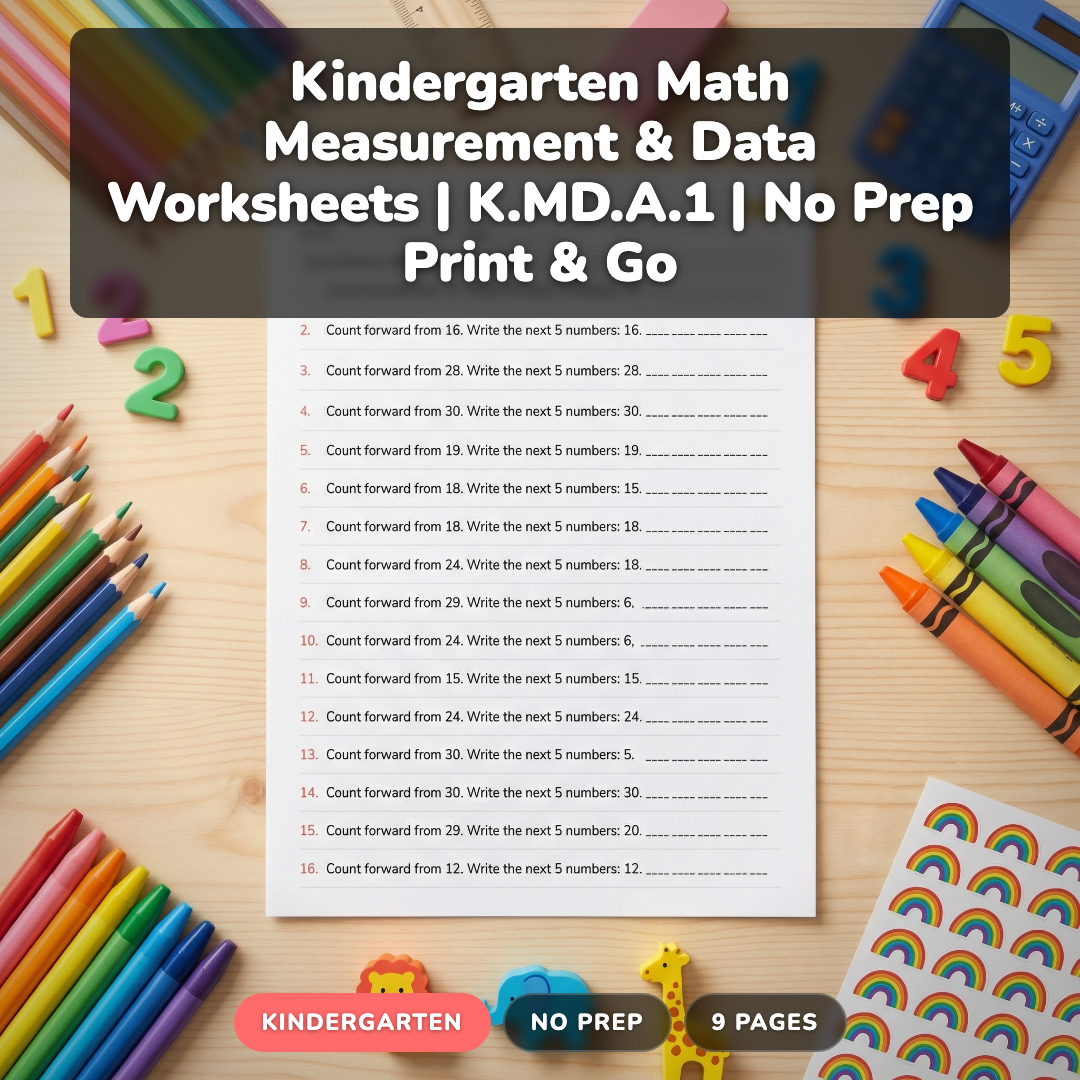
The entire pack is designed to print and go — no cutting, laminating, or complex prep required. Perfect for math centers, homework, or assessment preparation.
Grab a Free Measurement Sample to Try
Want to see how these differentiated worksheets work in your classroom? I’ll send you a free sample page from each level so you can try them with your students before committing to the full pack.
Frequently Asked Questions About Teaching Measurement & Data
When should kindergarten students start learning measurement concepts?
Most kindergarten curricula introduce measurement concepts in the second half of the year, typically February through May. Students need solid counting skills and basic comparison vocabulary before tackling CCSS.Math.Content.K.MD.A.1 effectively.
What’s the difference between measurement and data in kindergarten?
In kindergarten, measurement focuses on describing and comparing attributes like length and weight, while data involves collecting and organizing information. Both skills develop together through hands-on exploration and comparison activities.
Should kindergarten students use rulers and measuring tools?
Kindergarten students benefit more from informal measurement using non-standard units like paperclips or blocks. Formal tools like rulers can be introduced as enrichment, but the focus should remain on comparison and attribute identification.
How can I assess kindergarten measurement skills?
Use performance-based assessments where students physically compare objects and explain their thinking aloud. Observation checklists work better than written tests for this age group, focusing on vocabulary use and accurate comparisons.
What measurement vocabulary should kindergarten students know?
Essential vocabulary includes longer/shorter, taller/shorter, heavier/lighter, holds more/holds less, big/small, thick/thin, and wide/narrow. Students should use these terms in context when describing and comparing objects.
Teaching measurement and data concepts in kindergarten builds critical thinking skills that extend far beyond math class. When students learn to observe, compare, and describe the world around them using mathematical language, they develop foundational skills for scientific thinking and problem-solving.
What’s your favorite hands-on measurement activity for kindergarten? I’d love to hear what works best in your classroom! And don’t forget to grab that free measurement sample to try these strategies with your students.