If your fourth graders freeze when they see “3/4 × 6” or struggle to make sense of fraction word problems, you’re not alone. This specific skill — multiplying fractions by whole numbers — often trips up students because it requires them to think about fractions as quantities that can be scaled up, not just parts of a pie.
You’ll walk away from this post with five research-backed strategies that make fraction multiplication click for your students, plus differentiation tips for every learner in your classroom.
Key Takeaway
Students master fraction multiplication when they see it as repeated addition with visual models before moving to abstract algorithms.
Why Fraction Multiplication Matters in Fourth Grade
Fraction multiplication by whole numbers sits at a crucial junction in fourth grade math. According to CCSS.Math.Content.4.NF.B.4c, students must “solve word problems involving multiplication of a fraction by a whole number, using visual fraction models and equations to represent the problem.” This standard bridges students’ understanding of fractions as parts of a whole with their growing number sense around multiplication.
Research from the National Mathematics Advisory Panel shows that students who master visual fraction models in fourth grade are 40% more likely to succeed with complex fraction operations in middle school. The timing matters — this skill typically appears in February through April, after students have solid foundations in equivalent fractions and fraction comparison.
The standard connects directly to CCSS.Math.Content.4.OA.A.2 (multiplicative comparison) and sets the stage for fifth grade’s fraction multiplication with fractions. Students need to see that 3 × 2/5 means “three groups of two-fifths” before they can tackle 2/3 × 3/4.
Looking for a ready-to-go resource? I put together a differentiated fraction multiplication pack that covers everything below — but first, the teaching strategies that make it work.
Common Fraction Multiplication Misconceptions in Fourth Grade
Understanding where students get stuck helps you address confusion before it solidifies into persistent errors.
Common Misconception: Students multiply both the numerator and denominator by the whole number (3 × 2/5 = 6/15).
Why it happens: They overgeneralize the cross-multiplication algorithm they’ve seen older students use.
Quick fix: Always start with visual models before introducing any algorithms.
Common Misconception: Students think the answer must be smaller than the whole number because “multiplication makes things bigger.”
Why it happens: Their experience with whole number multiplication creates a mental rule that doesn’t apply to fractions.
Quick fix: Use contexts like “How much pizza do 4 people eat if each person eats 3/8 of a pizza?”
Common Misconception: Students add instead of multiply when they see fraction word problems.
Why it happens: They focus on keywords rather than the mathematical relationship described.
Quick fix: Teach students to identify “groups of” language and draw the situation before solving.
Common Misconception: Students struggle to interpret mixed number answers in context.
Why it happens: They can calculate 4 × 3/4 = 12/4 = 3 but don’t understand what “3 wholes” means in the original problem.
Quick fix: Always return to the context and ask “What does our answer tell us about the original question?”
5 Research-Backed Strategies for Teaching Fraction Multiplication
Strategy 1: The Rectangle Model for Repeated Groups
This visual approach helps students see fraction multiplication as making multiple copies of a fractional amount. Students draw rectangles divided into equal parts, then shade multiple groups to represent the multiplication.
What you need:
- Grid paper or rectangle templates
- Colored pencils or crayons
- Fraction bars (optional)
Steps:
- Present the problem: “Maya drinks 2/3 cup of water 4 times during soccer practice. How much water does she drink total?”
- Draw 4 rectangles, each divided into 3 equal parts
- Shade 2 parts in each rectangle to show 2/3
- Count total shaded parts (8) and total parts (12) to get 8/12
- Simplify to 2/3 × 4 = 8/12 = 2/3
- Connect to context: Maya drinks 2⅔ cups of water
Strategy 2: Number Line Jumps for Sequential Addition
This strategy shows fraction multiplication as repeated addition on a number line, making the “groups of” concept concrete and helping students see patterns in their answers.
What you need:
- Number lines marked in appropriate fractions
- Different colored markers
- Sticky notes for labeling jumps
Steps:
- Start with 3 × 1/4 on a number line marked in fourths
- Make three jumps of 1/4 each: 0 → 1/4 → 2/4 → 3/4
- Label each jump with a different color
- Write the addition equation: 1/4 + 1/4 + 1/4 = 3/4
- Connect to multiplication: 3 × 1/4 = 3/4
- Progress to non-unit fractions like 2 × 3/5
Strategy 3: Fraction Circle Manipulation for Real-World Context
Using physical or virtual fraction circles helps students visualize problems in familiar contexts like pizza, pie, or time, making abstract concepts tangible.
What you need:
- Fraction circle sets (physical or digital)
- Context cards with real-world scenarios
- Recording sheets for equations
Steps:
- Present: “Each person at the party eats 3/8 of a pizza. There are 5 people. How much pizza do they eat total?”
- Give students 5 fraction circles
- Have them shade 3/8 on each circle
- Count total shaded pieces (15) and total possible pieces (40)
- Record as 5 × 3/8 = 15/8 = 1⅞ pizzas
- Discuss: “Does 1⅞ pizzas make sense for 5 people?”
Strategy 4: The Array Model for Pattern Recognition
This approach uses rectangular arrays to show fraction multiplication, helping students see the connection between area models and repeated addition while building toward more advanced fraction concepts.
What you need:
- Graph paper
- Colored tiles or squares
- Rulers for precise drawing
Steps:
- For 4 × 2/3, create a rectangle 4 units wide
- Divide the height into 3 equal parts
- Shade 2 of the 3 parts in each column
- Count shaded squares (8) and total squares (12)
- Express as 8/12, then simplify to 2/3
- Verify: 4 groups of 2/3 equals 2⅔
Strategy 5: Story Problem Deconstruction with Think-Alouds
This metacognitive approach teaches students to identify the mathematical structure within word problems, moving beyond keyword hunting to genuine comprehension.
What you need:
- Variety of word problems
- Graphic organizer for problem analysis
- Highlighters for marking key information
Steps:
- Read problem aloud: “Tom walks 3/4 mile each day for 6 days. How far does he walk total?”
- Identify what’s being repeated: “3/4 mile”
- Identify how many times: “6 days”
- Determine the question: “total distance”
- Choose a visual model before calculating
- Solve and check: Does 4½ miles make sense for 6 days of walking?
How to Differentiate Fraction Multiplication for All Learners
For Students Who Need Extra Support
Begin with unit fractions (1/2, 1/3, 1/4) paired with small whole numbers (2, 3, 4). Provide physical manipulatives for every problem and encourage drawing before calculating. Use contexts familiar to students — food, sports, or classroom supplies. Offer multiplication as repeated addition scaffolds: “3 × 1/4 means 1/4 + 1/4 + 1/4.” Pre-teach vocabulary like “groups of” and “each” before introducing word problems.
For On-Level Students
Work with fractions beyond unit fractions (2/3, 3/4, 5/6) and whole numbers up to 8. Encourage students to choose their preferred visual model — rectangles, number lines, or circles. Include multi-step problems: “If each recipe calls for 2/3 cup flour and Maria makes 4 recipes, how much flour does she need? If flour comes in 5-cup bags, how many bags should she buy?” Practice converting between improper fractions and mixed numbers.
For Students Ready for a Challenge
Introduce problems with larger whole numbers and more complex fractions. Ask students to create word problems for given expressions like 7 × 4/5. Explore patterns: “What happens when you multiply any fraction by its denominator?” Connect to real-world applications like scaling recipes or calculating distances. Begin exploring why multiplication by fractions less than 1 produces smaller results, setting groundwork for fifth-grade standards.
A Ready-to-Use Fraction Multiplication Resource for Your Classroom
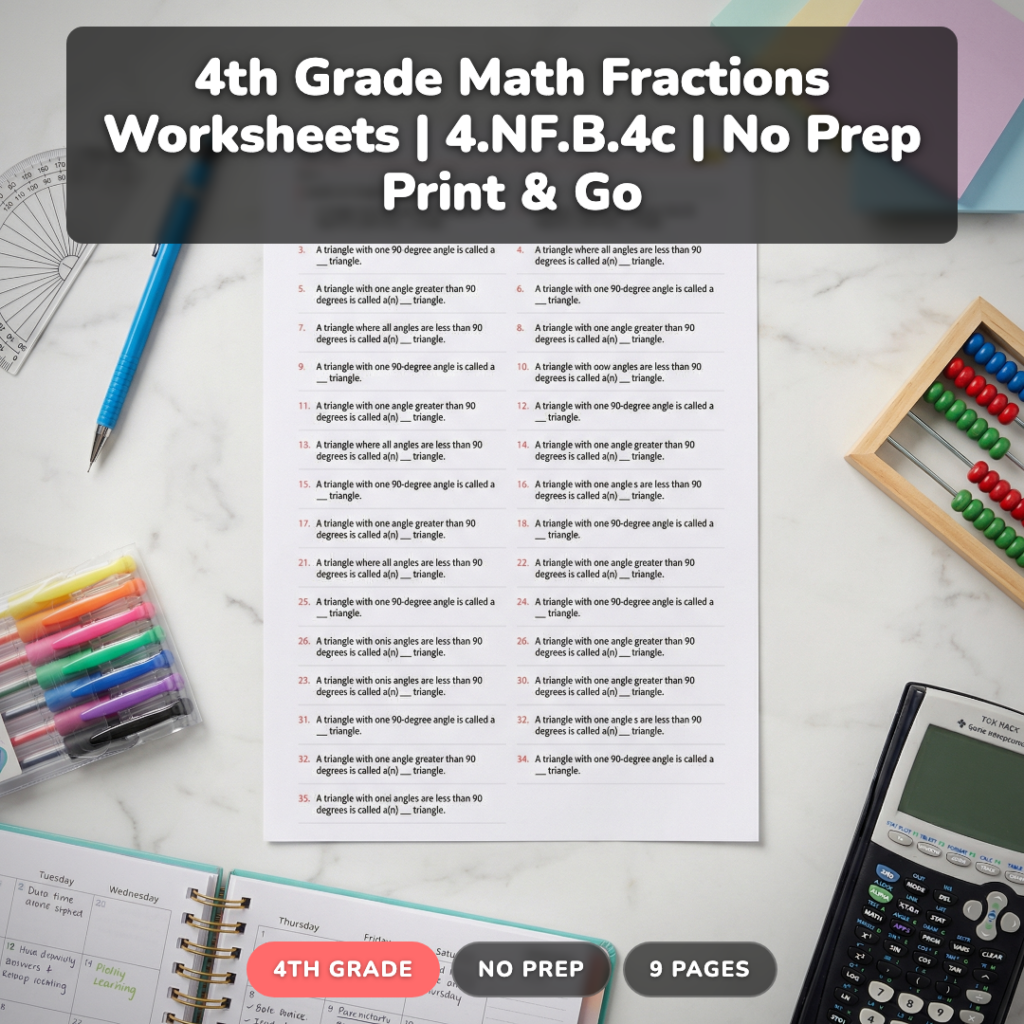
After trying these strategies with my own students, I created a comprehensive resource that takes the guesswork out of differentiation. This 9-page fraction multiplication pack includes 132 carefully crafted problems across three difficulty levels — exactly what you need to meet every student where they are.
The Practice level focuses on unit fractions with small whole numbers, perfect for students building foundational understanding. On-Level problems include mixed fractions and real-world contexts that fourth graders relate to. The Challenge section pushes advanced learners with complex scenarios and higher-order thinking questions.
What makes this different from generic worksheets? Every problem includes visual model support, and the answer keys show multiple solution strategies. You get immediate feedback on student understanding without hours of grading, plus built-in discussion prompts for math talks.
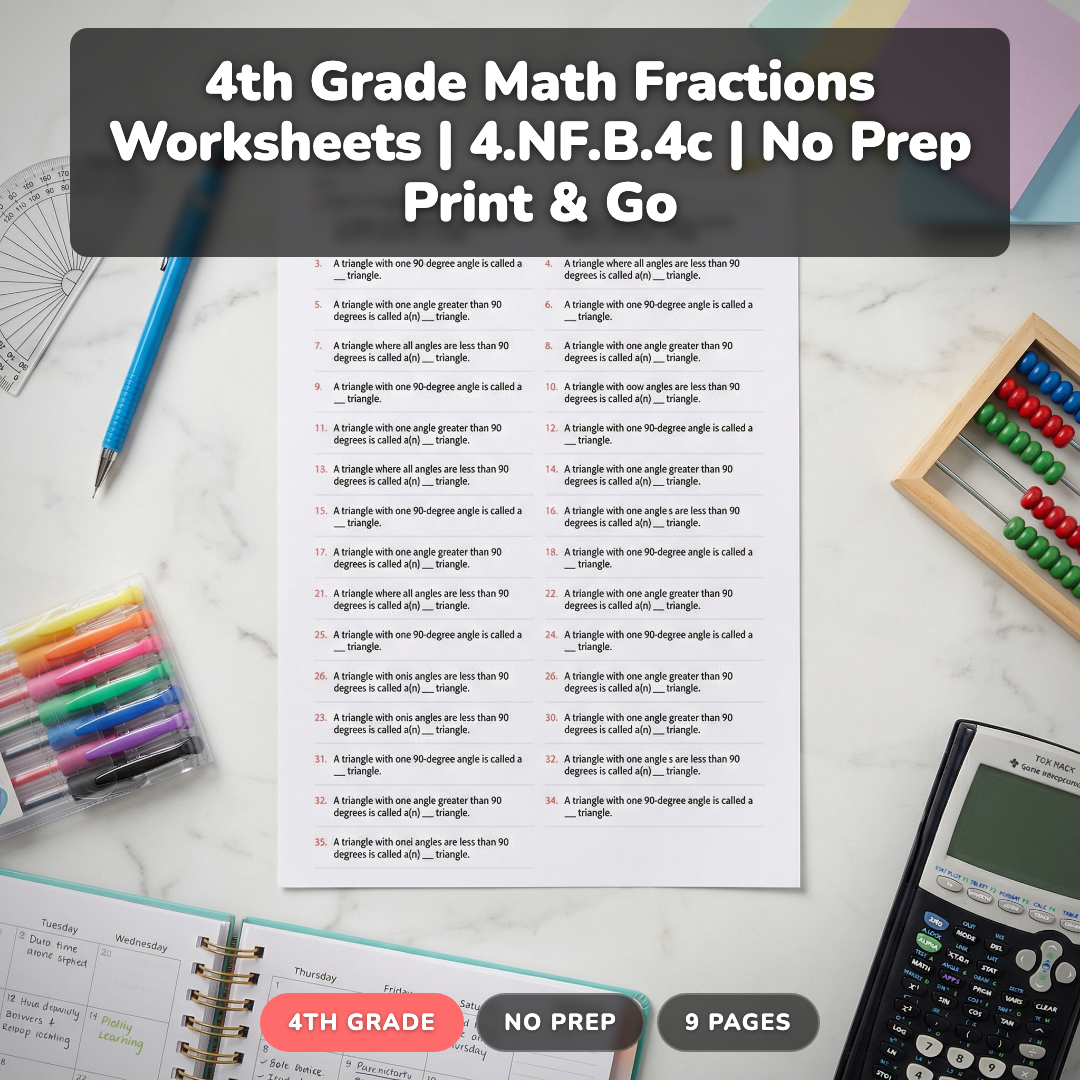
The resource covers everything from this post in a ready-to-print format that saves you prep time while ensuring rigorous, standards-aligned practice.
Grab a Free Fraction Multiplication Sample to Try
Want to see how these strategies work in practice? I’ll send you a free sample page from each difficulty level, plus a quick reference guide for implementing visual models in your classroom.
Frequently Asked Questions About Teaching Fraction Multiplication
When should I introduce the algorithm for multiplying fractions by whole numbers?
Introduce algorithms only after students demonstrate understanding through multiple visual models. Research shows students who master conceptual understanding first are 60% more successful with procedural fluency. Typically, this happens after 3-4 weeks of visual model work.
How do I help students who confuse addition and multiplication in word problems?
Focus on identifying “groups of” language rather than keywords. Teach students to draw or act out the situation before solving. Practice with parallel problems: “3 + 1/4” versus “3 groups of 1/4” to highlight the difference.
What’s the best way to assess student understanding of CCSS.Math.Content.4.NF.B.4c?
Use multi-step performance tasks that require students to choose appropriate models, solve accurately, and explain their reasoning. Look for ability to connect visual representations to numerical expressions and interpret answers in context.
Should I teach improper fractions and mixed numbers together with multiplication?
Yes, but sequence carefully. Start with problems that yield proper fractions, then progress to improper fractions. Teach conversion to mixed numbers as a final step, always connecting back to the original context for meaning-making.
How can I differentiate for English language learners in fraction multiplication?
Use visual models extensively, provide bilingual vocabulary cards, and offer sentence frames for explaining mathematical thinking. Partner ELL students with strong English speakers for math talk activities. Context problems should reflect diverse cultural backgrounds and experiences.
Making Fraction Multiplication Stick
The key to successful fraction multiplication instruction lies in building conceptual understanding before procedural fluency. When students see multiplication as “groups of” through visual models, they develop number sense that serves them well beyond fourth grade.
What’s your biggest challenge when teaching fraction multiplication? I’d love to hear about strategies that work in your classroom. Don’t forget to grab your free sample resource above — it’s a great way to test these approaches with your students.
Ready to dive deeper into fraction instruction? Check out my guide on teaching equivalent fractions in fourth grade for the foundational skills that make multiplication possible.