If your fourth graders freeze when they see 4/5 and can’t explain what it actually means, you’re not alone. The jump from “parts of a whole” to understanding fractions as multiples is where many students hit a wall. You need them to see that 4/5 isn’t just four shaded pieces — it’s four copies of 1/5.
This post breaks down five research-backed strategies that help students master CCSS.Math.Content.4.NF.B.4a and truly understand fractions as multiples of unit fractions.
Key Takeaway
Students understand fractions as multiples when they can build any fraction by counting unit fractions: 3/7 = 1/7 + 1/7 + 1/7.
Why This Fraction Concept Matters in Fourth Grade
Understanding fractions as multiples forms the foundation for every fraction operation students will learn. When students see 3/4 as “three copies of 1/4” rather than “three out of four pieces,” they’re ready for fraction addition, subtraction, and comparison.
Research from the National Council of Teachers of Mathematics shows that students who master unit fraction concepts in fourth grade perform 40% better on fraction assessments in fifth and sixth grade. The timing matters — this concept typically appears in October through December, after students have solid experience with equivalent fractions but before fraction operations.
CCSS.Math.Content.4.NF.B.4a specifically requires students to understand a fraction a/b as a multiple of 1/b. This means 5/8 equals five copies of 1/8, not just “five-eighths of a pizza.” Students need to move from visual representations to numerical understanding.
Looking for a ready-to-go resource? I put together a differentiated fraction multiples pack that covers everything below — but first, the teaching strategies that make it work.
Common Fraction Misconceptions in Fourth Grade
Before diving into strategies, let’s address the roadblocks that trip up students when learning fractions as multiples.
Common Misconception: Students think 3/5 means “3 and 5” as separate numbers.
Why it happens: They haven’t connected the fraction bar to division or the relationship between numerator and denominator.
Quick fix: Always read fractions as “three copies of one-fifth” before using “three-fifths.”
Common Misconception: Students believe 1/4 + 1/4 = 2/8 instead of 2/4.
Why it happens: They add numerators and denominators separately, missing that they’re adding the same unit.
Quick fix: Use physical manipulatives to show “one-fourth plus one-fourth equals two-fourths.”
Common Misconception: Students can’t explain why 4/6 and 2/3 are equivalent.
Why it happens: They memorize visual patterns without understanding the multiplicative relationship.
Quick fix: Show that 4/6 = 4 × (1/6) and 2/3 = 2 × (1/3), then demonstrate that 2 × (1/6) = 1/3.
Common Misconception: Students think larger denominators always mean larger fractions.
Why it happens: They apply whole number thinking where “bigger numbers mean more.”
Quick fix: Compare unit fractions first: 1/8 vs 1/4, showing that 1/8 is smaller because you need more pieces to make a whole.
5 Research-Backed Strategies for Teaching Fractions as Multiples
Strategy 1: Unit Fraction Building Blocks
Start with unit fractions as the fundamental building blocks. Students physically manipulate fraction pieces to build larger fractions by combining identical unit fractions.
What you need:
- Fraction circles or strips (physical or virtual)
- Recording sheets with fraction equations
- Timer for partner challenges
Steps:
- Give each student 8-10 copies of the same unit fraction (like 1/5 pieces)
- Ask them to build different fractions using only those pieces: “Show me 3/5 using your 1/5 pieces”
- Have students write the addition equation: 1/5 + 1/5 + 1/5 = 3/5
- Introduce multiplication notation: 3 × 1/5 = 3/5
- Repeat with different unit fractions, building complexity gradually
Strategy 2: Number Line Hopping
Use number lines to show fractions as repeated addition of unit fractions. Students “hop” along the number line in equal unit fraction steps.
What you need:
- Large floor number line or desk-sized number lines
- Fraction markers or sticky notes
- Colored pencils for recording
Steps:
- Mark unit fractions on the number line (0, 1/6, 2/6, 3/6, etc.)
- Students start at 0 and make equal “hops” of 1/6
- After each hop, they record the addition: 0 + 1/6 = 1/6, then 1/6 + 1/6 = 2/6
- Connect to multiplication: “Three hops of 1/6 equals 3 × 1/6 = 3/6”
- Challenge: “How many hops to reach 5/6? What equation shows this?”
Strategy 3: Fraction Recipe Cards
Students create “recipe cards” showing how to build target fractions using unit fraction “ingredients.” This connects to real-world cooking while reinforcing the multiplicative structure.
What you need:
- Index cards or recipe templates
- Fraction manipulatives for verification
- Chart paper for class recipe collection
Steps:
- Present a target fraction like 4/7
- Students write a “recipe”: “To make 4/7, take 4 copies of 1/7”
- They illustrate with drawings or manipulatives
- Write both addition and multiplication equations: 1/7 + 1/7 + 1/7 + 1/7 = 4/7 and 4 × 1/7 = 4/7
- Create a class cookbook of fraction recipes for reference
Strategy 4: Fraction Multiplication Stories
Students write and solve word problems that naturally lead to seeing fractions as multiples. This builds conceptual understanding through storytelling.
What you need:
- Story starter templates
- Fraction manipulatives for modeling
- Peer sharing protocol
Steps:
- Provide story starters: “Maria ate the same amount of pizza 3 times. Each time she ate 1/8 of the whole pizza…”
- Students complete the story and solve: “How much pizza did Maria eat in total?”
- They model with manipulatives: 3 groups of 1/8
- Write the equation: 3 × 1/8 = 3/8
- Students create their own stories for classmates to solve
Strategy 5: Equivalent Expression Matching
Students match different representations of the same fraction to deepen understanding of the multiplicative relationship. This strategy bridges concrete and abstract thinking.
What you need:
- Card sets with visual models, addition equations, and multiplication equations
- Recording sheets for matches
- Self-checking answer keys
Steps:
- Create card sets: visual model of 3/5, equation “1/5 + 1/5 + 1/5,” and equation “3 × 1/5”
- Students work in pairs to match equivalent representations
- They explain their reasoning: “These all show 3/5 because…”
- Challenge round: Include equivalent fractions like 6/10
- Students create their own matching sets for other pairs
How to Differentiate Fraction Multiples for All Learners
For Students Who Need Extra Support
Start with concrete manipulatives and familiar fractions. Use halves, thirds, and fourths exclusively until students master the concept. Provide sentence frames: “___ copies of 1/___ equals ___/___” and always connect to addition before introducing multiplication notation. Focus on denominators 2-6 and use visual models for every problem. Review prerequisite skills like identifying unit fractions and equal parts.
For On-Level Students
Students work with denominators up to 10 and begin connecting addition and multiplication representations fluently. They should explain their reasoning orally and in writing, using proper mathematical vocabulary. Introduce word problems that require building fractions from unit fractions. Students work independently with fraction circles, number lines, and recording sheets. Expect mastery of CCSS.Math.Content.4.NF.B.4a with denominators 2-8.
For Students Ready for a Challenge
Extend to improper fractions and mixed numbers: “How many 1/3s make 7/3?” Connect to division concepts and explore patterns with equivalent fractions. Students create their own word problems and teach strategies to classmates. Introduce fraction multiplication with whole numbers: 4 × 2/5. Challenge them to find multiple ways to express the same fraction using different unit fractions.
A Ready-to-Use Fraction Multiples Resource for Your Classroom
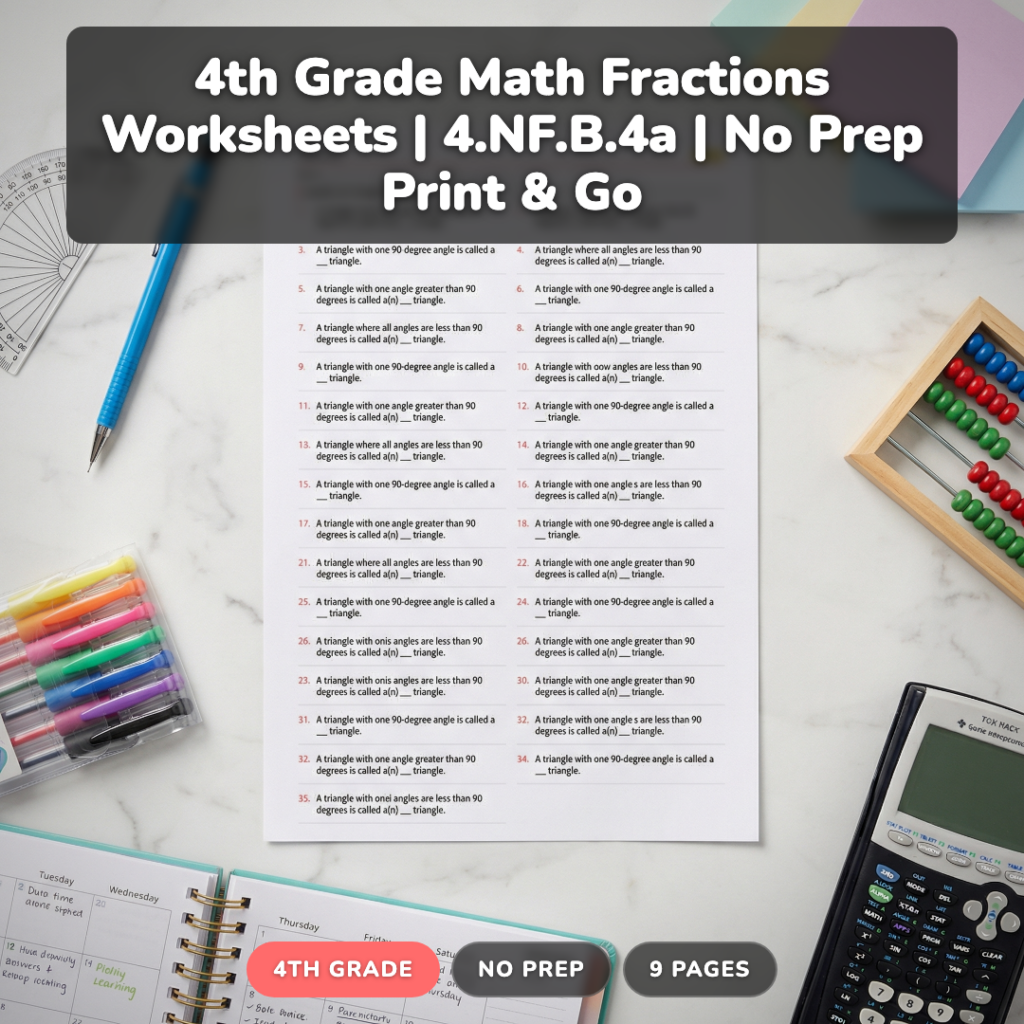
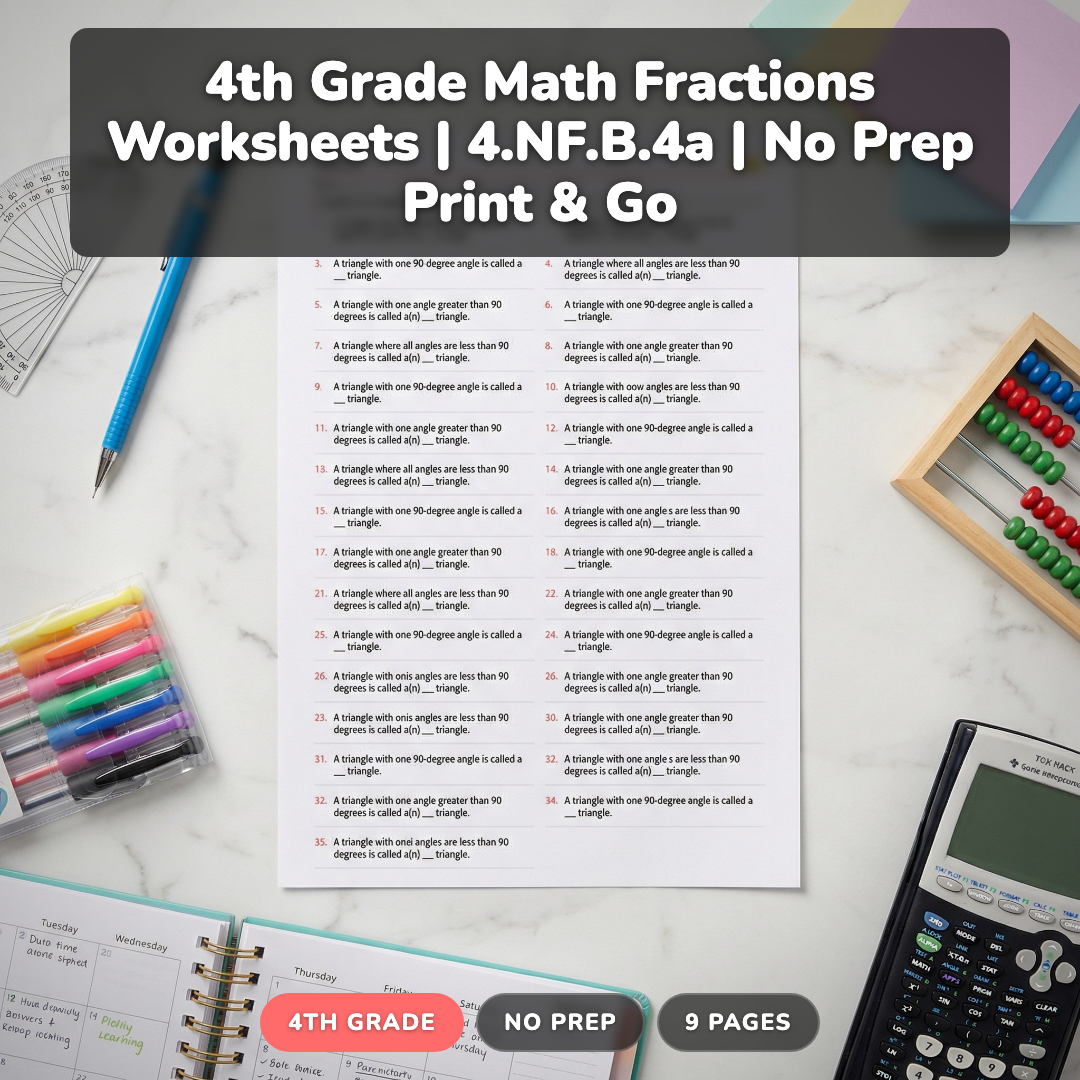
After years of teaching this concept, I created a comprehensive fraction multiples resource that saves you hours of prep time while giving students exactly the practice they need. This 9-page pack includes 132 carefully crafted problems across three differentiation levels.
The practice level focuses on building confidence with denominators 2-6, using clear visual supports and guided examples. On-level problems target grade-level expectations with denominators up to 10, including both addition and multiplication representations. Challenge problems push students to work with larger denominators, improper fractions, and real-world applications.
What sets this resource apart is the systematic progression from concrete to abstract thinking. Each level includes answer keys with step-by-step solutions, making it perfect for independent work, homework, or assessment preparation. The problems align directly with CCSS.Math.Content.4.NF.B.4a and include the mathematical vocabulary students need for state testing.
Teachers love that it’s truly no-prep — just print and go. Whether you need emergency sub plans, differentiated center work, or targeted intervention practice, this resource has you covered.
Grab a Free Fraction Sample to Try
Want to see the quality before you buy? I’ll send you a free sample that includes practice problems from each differentiation level, plus my favorite anchor chart for teaching fractions as multiples. Perfect for trying out these strategies with your students.
Frequently Asked Questions About Teaching Fractions as Multiples
When should I introduce fractions as multiples in fourth grade?
Introduce this concept after students understand equivalent fractions and can identify unit fractions confidently. Typically October-December works well, allowing 2-3 weeks for mastery before moving to fraction operations. Students need this foundation before learning to add and subtract fractions.
What’s the difference between 3/4 as “three-fourths” and “three copies of one-fourth”?
“Three-fourths” often leads to part-whole thinking, while “three copies of one-fourth” emphasizes the multiplicative structure. CCSS.Math.Content.4.NF.B.4a specifically requires understanding fractions as multiples of unit fractions, which builds foundation for operations and algebraic thinking.
How do I help students who confuse 3 × 1/4 with 3 × 4?
Use concrete manipulatives consistently. Show three physical pieces of 1/4, then write the equation. Emphasize that multiplication means “groups of” — three groups of 1/4. Connect to repeated addition first: 1/4 + 1/4 + 1/4 = 3/4, then show 3 × 1/4 = 3/4.
Should students memorize fraction multiplication facts at this level?
Focus on understanding rather than memorization. Students should fluently recognize that 5/8 means five copies of 1/8, but don’t require memorized facts like 7 × 1/9 = 7/9. Conceptual understanding supports long-term retention better than rote memorization for fourth graders.
How does this concept connect to fifth-grade fraction operations?
Understanding fractions as multiples is essential for adding and subtracting fractions. When students see 2/5 + 3/5 as “two-fifths plus three-fifths equals five-fifths,” they understand why denominators stay the same. This concept also supports fraction multiplication with whole numbers in fifth grade.
Teaching fractions as multiples transforms how students think about these essential numbers. When your fourth graders can confidently explain that 4/7 equals four copies of 1/7, they’re ready for every fraction challenge ahead.
What’s your biggest challenge when teaching fractions as multiples? Drop your email above for the free sample resource, and let’s help your students master this foundational concept.