If your fourth graders freeze when they see 4 × 1/3 or look completely lost when asked to find 5 × 2/7, you’re not alone. Multiplying fractions by whole numbers is where many students hit their first major fraction roadblock. The good news? With the right teaching strategies, this concept clicks beautifully and sets students up for success with all future fraction work.
Key Takeaway
Students master multiplying fractions by whole numbers when they understand it as repeated addition of unit fractions, not abstract multiplication rules.
Why This Skill Matters in Fourth Grade
Multiplying fractions by whole numbers bridges the gap between basic fraction understanding and more complex fraction operations. According to research from the National Council of Teachers of Mathematics, students who master CCSS.Math.Content.4.NF.B.4b show 40% better performance on fifth-grade fraction division problems.
This standard appears in most curricula around February or March, after students have worked with equivalent fractions and comparing fractions. The timing is crucial because it builds directly on students’ understanding that fractions represent parts of a whole, while preparing them for fraction multiplication in fifth grade.
The Common Core standard CCSS.Math.Content.4.NF.B.4b specifically requires students to “understand a multiple of a/b as a multiple of 1/b, and use this understanding to multiply a fraction by a whole number.” This means students need to see that 3 × 2/5 is really 3 groups of 2/5, which equals 6/5.
Looking for a ready-to-go resource? I put together a differentiated fraction multiplication pack that covers everything below — but first, the teaching strategies that make it work.
Common Fraction Multiplication Misconceptions in Fourth Grade
Understanding where students go wrong helps you address these issues before they become ingrained habits.
Common Misconception: Students multiply both the numerator and denominator by the whole number (3 × 2/5 = 6/15).
Why it happens: They apply whole number multiplication rules to fractions without understanding what fractions represent.
Quick fix: Use visual models to show that only the numerator changes when multiplying by a whole number.
Common Misconception: Students think 4 × 1/3 means “four thirds” instead of “four groups of one-third.”
Why it happens: They focus on the symbols rather than the meaning of multiplication as repeated addition.
Quick fix: Start every problem with “How many groups of…” language before introducing symbols.
Common Misconception: Students believe the answer should always be smaller than the whole number.
Why it happens: Their experience with whole number multiplication where factors are always smaller than products.
Quick fix: Use examples where the fraction is greater than one (like 3 × 4/3) to show answers can be larger.
Common Misconception: Students add instead of multiply when they see a whole number and fraction together.
Why it happens: Fraction addition is often taught right before multiplication, causing confusion.
Quick fix: Emphasize the language difference: “groups of” for multiplication versus “and” for addition.
4 Research-Backed Strategies for Teaching Fraction Multiplication
Strategy 1: Fraction Circles for Repeated Addition
This concrete strategy helps students visualize multiplication as repeated addition using manipulatives they can touch and move.
What you need:
- Fraction circle sets (one per student)
- Whiteboard for recording
- Chart paper for anchor chart
Steps:
- Start with 3 × 1/4. Have students take out three 1/4 pieces from their fraction circles.
- Ask: “How many fourths do we have altogether?” Students count: 1/4, 2/4, 3/4.
- Record on the board: 3 × 1/4 = 1/4 + 1/4 + 1/4 = 3/4.
- Try 4 × 2/5. Students take four groups of 2/5 pieces (8 pieces total).
- Count by unit fractions: “1/5, 2/5, 3/5, 4/5, 5/5, 6/5, 7/5, 8/5.”
- Create an anchor chart showing the pattern: multiply the whole number by the numerator.
Strategy 2: Number Line Jumps
Visual learners excel with this strategy that shows multiplication as repeated jumps on a number line.
What you need:
- Large number line (0 to 3, marked in fraction intervals)
- Colored markers or sticky notes
- Individual number line worksheets
Steps:
- Draw a number line marked in fifths (0, 1/5, 2/5, 3/5, 4/5, 1, 6/5, etc.).
- For 4 × 2/5, start at 0 and make four jumps of 2/5 each.
- Mark each landing spot with a different color: 2/5, 4/5, 6/5, 8/5.
- Count the total: “We landed on 8/5.”
- Have students try 3 × 3/4 on their own number lines.
- Connect to repeated addition: each jump represents adding another 2/5.
Strategy 3: Array Models with Rectangles
This strategy connects to students’ prior knowledge of multiplication arrays while building fraction understanding.
What you need:
- Grid paper or rectangle templates
- Colored pencils
- Fraction wall reference chart
Steps:
- Draw a rectangle divided into 5 equal parts for the problem 3 × 2/5.
- Show that 2/5 means 2 out of 5 parts are shaded in one rectangle.
- Draw three identical rectangles side by side.
- Shade 2/5 in each rectangle (2 parts out of 5 in each).
- Count total shaded parts: 6 parts. Count total parts: 15 parts.
- Simplify: 6/15 can be written as 2/5 + 2/5 + 2/5 = 6/5.
Strategy 4: Real-World Recipe Problems
Context makes abstract concepts concrete, and recipes provide natural fraction multiplication scenarios.
What you need:
- Simple recipe cards (trail mix, fruit salad, etc.)
- Measuring cups (optional, for demonstration)
- Problem-solving recording sheets
Steps:
- Present a recipe: “Trail mix uses 1/4 cup of nuts per serving.”
- Ask: “How many cups of nuts do we need for 6 servings?”
- Model the thinking: “6 servings means 6 groups of 1/4 cup.”
- Solve together: 6 × 1/4 = 6/4 = 1 2/4 = 1 1/2 cups.
- Have students create their own recipe problems using given fractions.
- Share and solve problems as a class, emphasizing the “groups of” language.
How to Differentiate Fraction Multiplication for All Learners
For Students Who Need Extra Support
Begin with unit fractions only (1/2, 1/3, 1/4) before introducing fractions with numerators greater than 1. Use concrete manipulatives for every problem, and provide fraction charts for reference. Focus on the repeated addition aspect: 4 × 1/3 = 1/3 + 1/3 + 1/3 + 1/3. Review prerequisite skills like identifying parts of a whole and counting by unit fractions. Provide sentence frames: “___ groups of ___ equals ___.”
For On-Level Students
Work with proper fractions where the numerator is less than the denominator. Practice converting improper fractions to mixed numbers when appropriate. Use a mix of concrete models and abstract problems. Students should explain their thinking using mathematical vocabulary and connect multiplication to repeated addition. Expect fluency with problems like 5 × 3/8 and 4 × 2/7.
For Students Ready for a Challenge
Include fractions greater than 1 (like 3 × 4/3) and mixed number results. Have students create word problems for given expressions. Connect to real-world applications like cooking, construction, and art projects. Introduce the relationship between fraction multiplication and division. Challenge students to find multiple ways to solve the same problem and compare efficiency of different methods.
A Ready-to-Use Fraction Multiplication Resource for Your Classroom
After teaching this concept for years, I’ve learned that students need lots of varied practice to truly master multiplying fractions by whole numbers. That’s why I created a comprehensive resource pack that saves you hours of prep time while giving your students exactly the practice they need.
This differentiated pack includes 132 problems across three levels: 37 practice problems for students who need extra support, 50 on-level problems for grade-level expectations, and 45 challenge problems for advanced learners. Each level uses different contexts and complexity while targeting the same core skill from CCSS.Math.Content.4.NF.B.4b.
What makes this resource different is the careful scaffolding within each level. Practice problems start with unit fractions and visual models, on-level problems include proper fractions with varied denominators, and challenge problems incorporate improper fractions and real-world contexts. Complete answer keys show multiple solution methods, so you can address different student approaches during discussions.
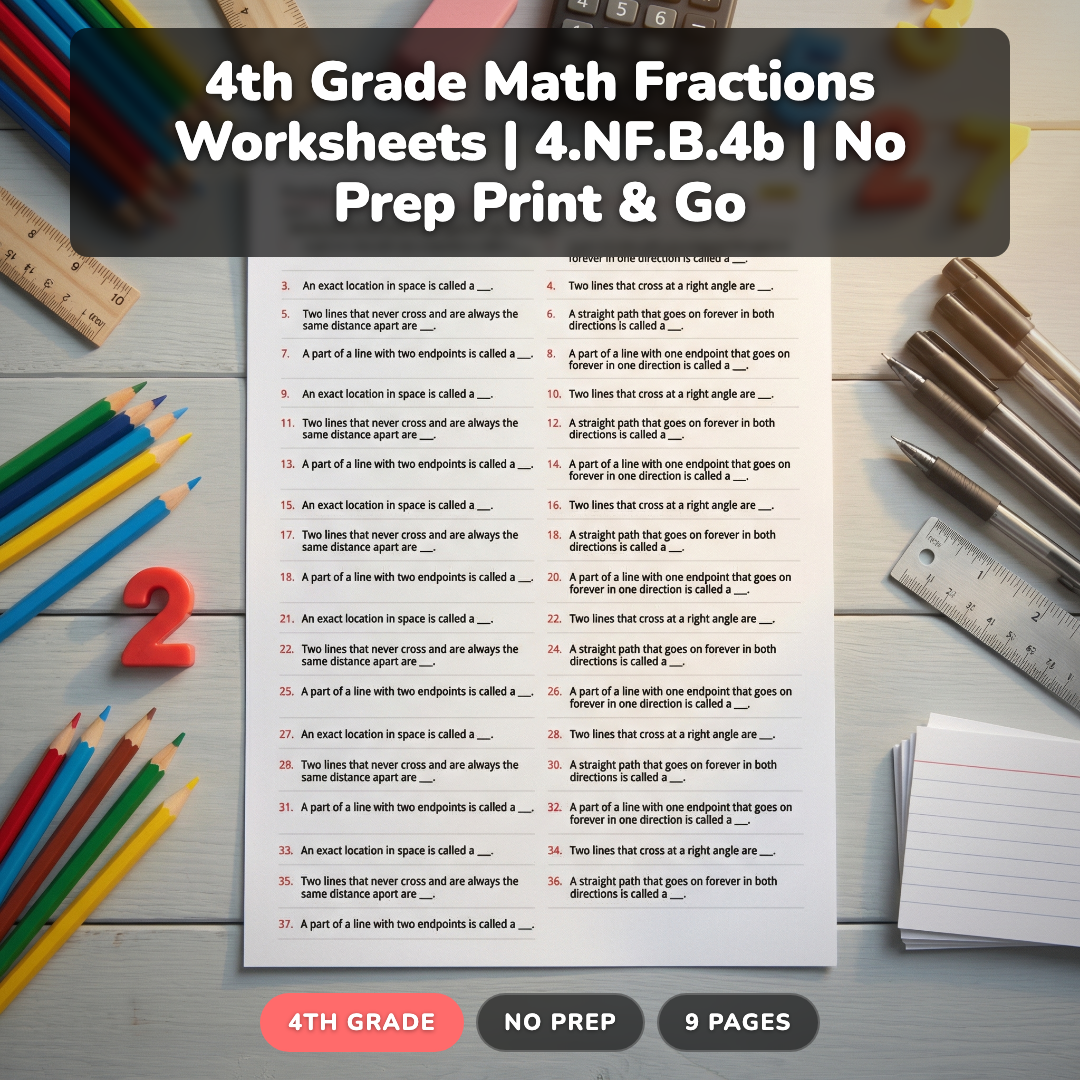
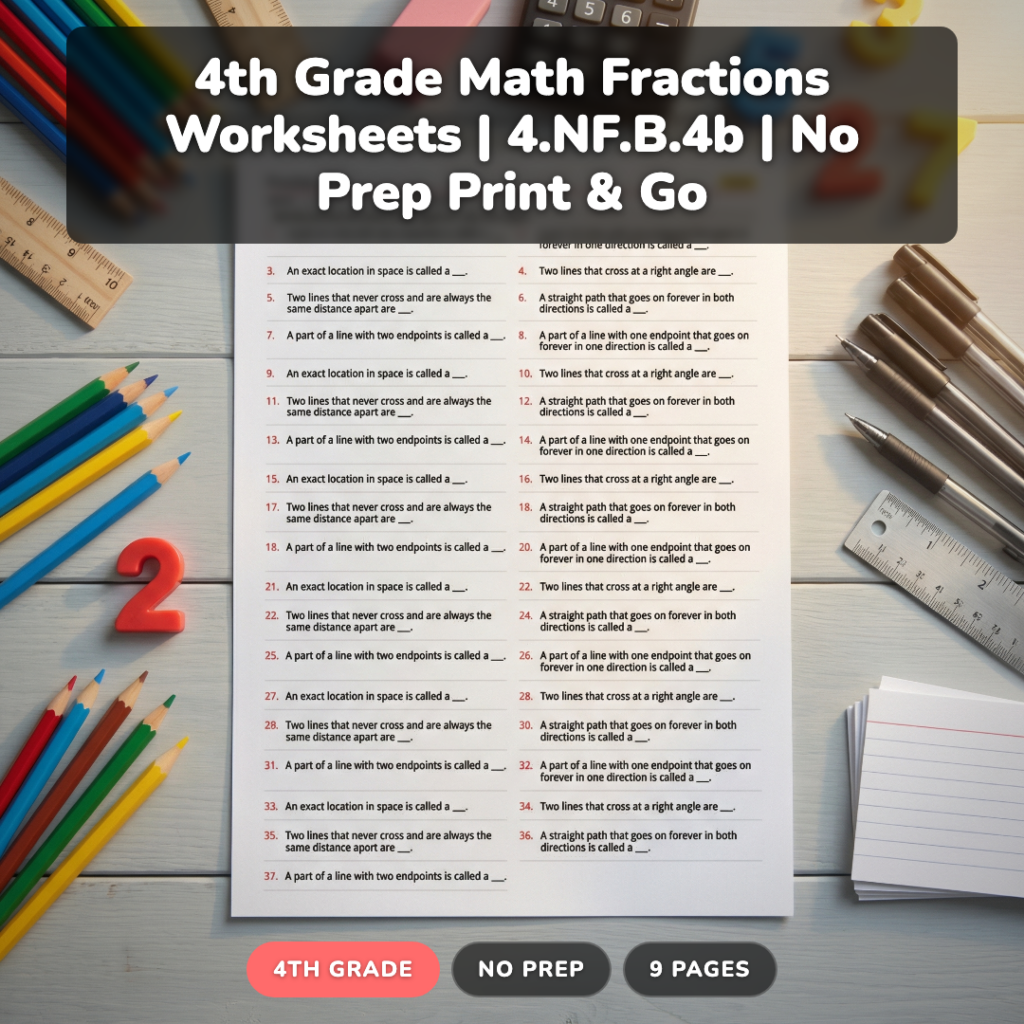
The pack includes 9 ready-to-print pages that you can use immediately — no prep required. Perfect for math centers, homework, assessment, or substitute teacher plans.
Grab a Free Fraction Multiplication Sample to Try
Want to see how this approach works in your classroom? I’ll send you a free sample page with 8 problems across all three difficulty levels, plus the answer key with multiple solution methods.
Frequently Asked Questions About Teaching Fraction Multiplication
When should I introduce multiplying fractions by whole numbers in fourth grade?
Most curricula introduce this concept in February or March, after students have mastered equivalent fractions and fraction comparison. Students need a solid foundation in understanding fractions as parts of a whole before tackling multiplication. The concept typically takes 2-3 weeks to develop fully.
Should students memorize the rule “multiply the numerator by the whole number”?
Students should understand why this rule works before memorizing it. Use concrete models and repeated addition for several weeks first. Once students can explain why 4 × 2/5 equals 8/5 using visual models, then introduce the shortcut rule as an efficient method.
How do I help students who confuse fraction multiplication with addition?
Emphasize different language for each operation. Use “groups of” for multiplication (3 groups of 2/5) and “and” for addition (2/5 and 1/5). Provide visual models that clearly show the difference: arrays for multiplication, combining parts for addition.
What’s the biggest mistake teachers make when teaching this standard?
Rushing to the abstract algorithm without building conceptual understanding first. Students who learn the rule without understanding often struggle with fraction division later. Spend adequate time with manipulatives and visual models before moving to symbolic representations.
How does this skill connect to fifth grade fraction multiplication?
Fourth grade multiplication by whole numbers is the foundation for fifth grade fraction × fraction problems. Students who understand 3 × 2/5 as repeated addition easily grasp that 2/3 × 2/5 means “two-thirds of 2/5.” The conceptual understanding transfers directly.
Teaching fraction multiplication doesn’t have to be frustrating for you or your students. When you start with concrete models, use consistent language, and provide plenty of differentiated practice, students develop both understanding and fluency. Remember to grab that free sample to try these strategies in your classroom — and let me know which approach works best for your fourth graders!