If your fourth graders look confused when you write 5/4 = 1/4 + 1/4 + 1/4 + 1/4 + 1/4 on the board, you’re not alone. Teaching students to understand fractions greater than one as sums of unit fractions is one of the trickiest concepts in fourth grade math. But when students finally grasp that 7/3 means “seven one-thirds put together,” everything else about fractions starts clicking into place.
Key Takeaway
Students master CCSS.Math.Content.4.NF.B.3 when they see fractions as collections of equal parts, not mysterious symbols.
Why Understanding Fractions as Sums Matters in Fourth Grade
The Common Core standard CCSS.Math.Content.4.NF.B.3 asks students to “understand a fraction a/b with a > 1 as a sum of fractions 1/b.” This foundational skill appears in October and November of most fourth grade curricula, right after students review equivalent fractions from third grade.
Research from the National Mathematics Advisory Panel shows that students who struggle with this concept often carry fraction misconceptions into middle school. When fourth graders understand that 11/8 means “eleven one-eighths added together,” they develop number sense that supports fraction addition, subtraction, and mixed number conversion later in the year.
This standard connects directly to CCSS.Math.Content.4.NF.B.4 (adding and subtracting fractions) and CCSS.Math.Content.4.NF.C.5 (expressing fractions with denominators of 10 as decimals). Students need this conceptual foundation before moving to computational procedures.
Looking for a ready-to-go resource? I put together a differentiated fractions as sums pack that covers everything below — but first, the teaching strategies that make it work.
Common Fraction Sum Misconceptions in Fourth Grade
Common Misconception: Students think 5/3 is “impossible” because you can’t have 5 out of 3 things.
Why it happens: They’re stuck thinking of fractions as parts of one whole, not as quantities that can exceed one whole.
Quick fix: Use multiple pizza circles to show 5/3 as one whole pizza plus 2/3 of another.
Common Misconception: Students write 7/4 = 1/4 + 1/4 + 1/4 + 1/4 + 1/4 + 1/4 + 1/4 but can’t explain why there are seven addends.
Why it happens: They’re following a pattern without understanding that the numerator tells how many unit fractions to add.
Quick fix: Have them count unit fraction pieces while building the sum with manipulatives.
Common Misconception: Students think 3/2 + 1/2 = 4/4 instead of 4/2.
Why it happens: They change denominators when adding, not understanding that unit fractions with the same denominator combine by counting.
Quick fix: Emphasize “three halves plus one half equals four halves” using consistent language.
Common Misconception: Students can’t connect 5/4 to the mixed number 1 1/4.
Why it happens: They see these as completely different representations rather than equivalent forms.
Quick fix: Show 5/4 as four quarters (one whole) plus one more quarter using fraction strips.
5 Research-Backed Strategies for Teaching Fractions as Sums
Strategy 1: Unit Fraction Building with Manipulatives
Students physically construct improper fractions by combining identical unit fraction pieces, making the “sum of unit fractions” concept concrete and visible.
What you need:
- Fraction circles or fraction strips
- Recording sheets
- Document camera for modeling
Steps:
- Give students six 1/5 pieces and ask them to show 6/5
- Have them arrange pieces in a line: 1/5 + 1/5 + 1/5 + 1/5 + 1/5 + 1/5
- Count together: “One fifth, two fifths, three fifths, four fifths, five fifths makes one whole, six fifths”
- Record the equation: 6/5 = 1/5 + 1/5 + 1/5 + 1/5 + 1/5 + 1/5
- Repeat with different fractions, having students predict how many unit pieces they’ll need
Strategy 2: The “Fraction Recipe” Method
Students think of fractions as recipes where the numerator tells “how many” and the denominator tells “what size piece,” making the connection to repeated addition natural.
What you need:
- Recipe card templates
- Colored pencils
- Chart paper for class recipes
Steps:
- Introduce 7/8 as “Recipe for seven-eighths: Take 7 pieces of size 1/8”
- Students write: “7/8 = 1/8 + 1/8 + 1/8 + 1/8 + 1/8 + 1/8 + 1/8”
- Draw the recipe: seven 1/8-sized rectangles
- Practice “reading recipes” aloud: “Nine fourths means nine pieces of size one-fourth”
- Have students create recipe cards for given fractions, then trade and solve each other’s recipes
Strategy 3: Number Line Hopping
Students use number lines to “hop” by unit fractions, visualizing how repeated addition of 1/b creates fractions greater than one.
What you need:
- Large floor number line (or tape on floor)
- Number line worksheets
- Colored markers or crayons
Steps:
- Start at 0 on a number line marked in thirds: 0, 1/3, 2/3, 1, 4/3, 5/3, 2
- To show 5/3, students take five hops of size 1/3
- Mark each landing spot and count: “1/3, 2/3, 3/3, 4/3, 5/3”
- Record the equation: 5/3 = 1/3 + 1/3 + 1/3 + 1/3 + 1/3
- Students predict where they’ll land before hopping, building estimation skills
Strategy 4: Fraction Story Problems
Students solve real-world contexts that naturally require adding unit fractions, connecting the mathematical concept to meaningful situations.
What you need:
- Story problem cards
- Drawing paper
- Fraction manipulatives for support
Steps:
- Present: “Maya ate 1/4 of a pizza for lunch each day this week. How much pizza did she eat in 5 days?”
- Students draw or model: 1/4 + 1/4 + 1/4 + 1/4 + 1/4
- Connect to fraction notation: 5/4
- Discuss: “Five fourths is more than one whole pizza”
- Create similar problems with different contexts: ribbon lengths, juice portions, chocolate bar pieces
Strategy 5: Decomposition and Composition Games
Students practice breaking apart and building fractions through engaging partner activities that reinforce the unit fraction sum concept.
What you need:
- Fraction cards (improper fractions and unit fractions)
- Timer
- Recording sheets
Steps:
- Partner A draws a card showing 8/5
- Partner B races to write the unit fraction sum: 1/5 + 1/5 + 1/5 + 1/5 + 1/5 + 1/5 + 1/5 + 1/5
- Partners check by counting unit fractions together
- Switch roles for the next round
- Add challenge: Partner B must also convert to a mixed number (1 3/5)
How to Differentiate Fractions as Sums for All Learners
For Students Who Need Extra Support
Begin with halves and thirds using concrete manipulatives. These students benefit from extended time with fraction circles and strips before moving to abstract notation. Provide number lines marked clearly with unit fractions, and use consistent language like “three halves” instead of switching between “three halves” and “three over two.” Focus on fractions between 1 and 2 before introducing larger numerators. Scaffold by having them build the physical model first, then write the equation.
For On-Level Students
These students work with denominators 2 through 8 and connect unit fraction sums to mixed numbers. They can handle the full range of CCSS.Math.Content.4.NF.B.3 expectations, including explaining why 11/4 equals 2 3/4. Provide opportunities to move between concrete models, number lines, and abstract notation. They should master both decomposing improper fractions into unit fraction sums and composing unit fraction sums into improper fractions.
For Students Ready for a Challenge
Advanced students explore patterns in unit fraction sums and make connections to multiplication. They might investigate why 7 × (1/3) = 7/3, laying groundwork for fifth grade fraction multiplication. Challenge them to find multiple ways to express the same fraction as a sum (like 6/4 = 1/4 + 1/4 + 1/4 + 1/4 + 1/4 + 1/4 or 6/4 = 2/4 + 4/4). These students can also work with larger denominators and create their own fraction story problems.
A Ready-to-Use Fractions as Sums Resource for Your Classroom
Teaching this concept effectively requires a lot of differentiated practice, which is why I created a comprehensive fractions as sums worksheet pack. This 9-page resource includes 132 problems across three difficulty levels, so every student in your class gets appropriate practice.
The Practice level (37 problems) focuses on denominators 2-4 with visual supports. On-Level worksheets (50 problems) cover the full standard with denominators 2-8, including mixed number connections. The Challenge level (45 problems) extends to larger denominators and multi-step problems.
What makes this resource different is the careful progression within each level. Problems start with unit fraction building, move to writing equations, then connect to mixed numbers. Answer keys show multiple solution methods, and each page includes a quick formative assessment question.
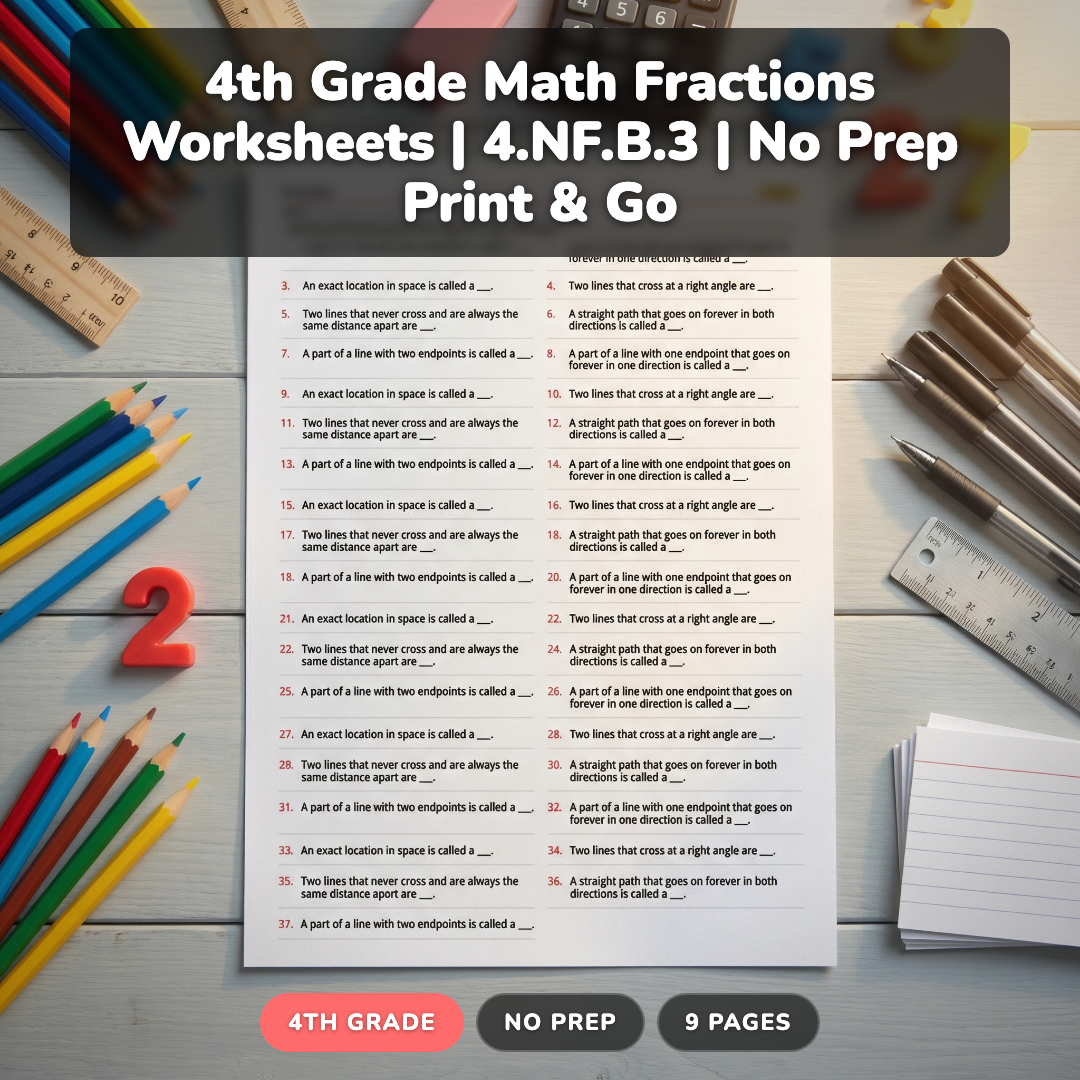
This no-prep resource saves hours of planning time and gives you confidence that you’re covering CCSS.Math.Content.4.NF.B.3 thoroughly. Students get the practice they need, and you get your evenings back.
Grab a Free Fractions as Sums Sample to Try
Want to see how this approach works with your students? I’ll send you a free sample worksheet with problems from each difficulty level, plus an answer key and teaching tips.
Frequently Asked Questions About Teaching Fractions as Sums
When should I introduce fractions greater than one in fourth grade?
Most curricula introduce this concept in October or November, after reviewing equivalent fractions from third grade. Students need solid understanding of unit fractions and fraction notation before tackling CCSS.Math.Content.4.NF.B.3. Wait until students can identify and create unit fractions confidently.
How long should I spend teaching this standard?
Plan 2-3 weeks of focused instruction, with 15-20 minutes daily. The concept requires time to develop conceptually before moving to computational fluency. Continue spiraling back to this concept when teaching fraction addition and mixed number conversion throughout the year.
What’s the biggest mistake teachers make with this standard?
Rushing to abstract notation without sufficient concrete experience. Students need extensive time with manipulatives and visual models before writing equations. The physical experience of combining unit fractions builds the number sense that supports later procedural work.
How do I help students who think fractions greater than one are impossible?
Use multiple wholes consistently. Show 5/4 using five quarter-circles arranged as one complete circle plus one additional quarter. Emphasize language: “five fourths means five pieces, each piece is one-fourth.” Avoid the phrase “parts of a whole” which reinforces the misconception.
Should I teach mixed numbers at the same time as improper fractions?
Yes, but introduce improper fractions first. Once students understand 7/3 as seven one-thirds, show how those seven pieces can be regrouped as two wholes plus one third. This connection helps students see mixed numbers and improper fractions as equivalent representations.
Understanding fractions as sums of unit fractions gives fourth graders the number sense foundation they need for all future fraction work. When students can confidently explain that 9/5 means “nine fifths put together,” they’re ready to add, subtract, and compare fractions with confidence.
What’s your favorite strategy for helping students visualize fractions greater than one? And don’t forget to grab that free sample worksheet above — it’s a great way to try these strategies with your class tomorrow.