If your 4th graders freeze up when they see 3/8 compared to 5/12, you’re not alone. Comparing fractions with different numerators and denominators is where many students hit their first major fraction roadblock. The good news? With the right strategies and plenty of practice, your students can master this essential skill and build confidence for more complex fraction work ahead.
Key Takeaway
Students succeed at comparing fractions when they understand multiple strategies — benchmark fractions, visual models, and equivalent fractions — rather than memorizing just one method.
Why Comparing Fractions Matters in 4th Grade
Comparing fractions is a cornerstone skill in CCSS.Math.Content.4.NF.A.2, which requires students to compare fractions with different numerators and denominators using multiple methods. This standard appears in the second quarter of most 4th grade curricula, building directly on 3rd grade’s work with equivalent fractions and fraction representations.
Research from the National Mathematics Advisory Panel shows that students who master fraction comparison in 4th grade are significantly more likely to succeed in algebra. The skill requires proportional reasoning — the same thinking students need for ratios, percentages, and algebraic concepts. When students can flexibly move between visual models, benchmark comparisons, and equivalent fractions, they develop the number sense that supports all future math learning.
The standard emphasizes three key approaches: creating common denominators, using benchmark fractions like 1/2, and employing visual fraction models. Students must also justify their reasoning and understand that fractions can only be compared when they refer to the same whole — a concept that trips up many learners.
Looking for a ready-to-go resource? I put together a differentiated fraction comparison pack with 132 problems across three levels — but first, the teaching strategies that make it work.
Common Fraction Comparison Misconceptions in 4th Grade
Understanding where students go wrong helps you address these misconceptions before they become ingrained habits.
Common Misconception: “The fraction with the bigger numbers is always larger.”
Why it happens: Students apply whole number thinking to fractions, comparing 3/4 and 2/5 by saying “3 and 4 are bigger than 2 and 5.”
Quick fix: Use visual models to show that 2/5 actually represents less than 3/4, despite having smaller numbers.
Common Misconception: “You can’t compare fractions unless they have the same denominator.”
Why it happens: Students overgeneralize the common denominator method they learned for adding fractions.
Quick fix: Introduce benchmark fractions and visual models as alternative comparison methods before teaching common denominators.
Common Misconception: “1/2 of a small pizza equals 1/2 of a large pizza.”
Why it happens: Students don’t understand that fractions must refer to the same whole to be compared meaningfully.
Quick fix: Use identical shapes or clearly state “same-size” when presenting comparison problems.
Common Misconception: “The fraction closer to 1 is always larger.”
Why it happens: Students misapply the benchmark strategy without considering the actual values.
Quick fix: Practice comparing fractions that are both less than 1/2 or both greater than 1/2 to build nuanced understanding.
5 Research-Backed Strategies for Teaching Fraction Comparison
Strategy 1: Benchmark Fraction Anchors
Students compare fractions to familiar benchmarks like 1/4, 1/2, and 3/4 to determine relative size without complex calculations. This strategy builds number sense and provides a quick estimation method.
What you need:
- Benchmark fraction anchor chart
- Fraction strips or circles
- Comparison recording sheet
Steps:
- Create an anchor chart showing 1/4, 1/2, and 3/4 with visual models
- Present two fractions like 2/7 and 4/5
- Have students identify which benchmark each fraction is closest to
- Compare the benchmarks to determine which original fraction is larger
- Verify using visual models or other methods
Strategy 2: Visual Fraction Models Race
Students use fraction strips, circles, or rectangles to physically represent and compare fractions. This concrete approach helps students see fraction relationships and builds conceptual understanding.
What you need:
- Fraction strips or circles for each student
- Comparison problems on cards
- Recording sheet with visual spaces
Steps:
- Give each student a set of fraction manipulatives
- Present a comparison problem like 3/8 vs 2/5
- Students build both fractions using their manipulatives
- They place the models side-by-side to compare sizes
- Record the comparison using >, <, or = symbols
- Discuss observations about why one fraction is larger
Strategy 3: Common Denominator Detective Work
Students find equivalent fractions with the same denominator to make direct comparisons. This algebraic thinking strategy prepares students for more advanced fraction operations.
What you need:
- Multiplication charts
- Factor lists for common denominators
- Step-by-step recording sheets
Steps:
- Present fractions like 3/4 and 5/6
- Find the least common multiple of the denominators (4 and 6 = 12)
- Convert both fractions: 3/4 = 9/12 and 5/6 = 10/12
- Compare the numerators: 9 < 10, so 3/4 < 5/6
- Verify using visual models or benchmark comparisons
Strategy 4: Cross-Multiplication Comparison
Students use cross-multiplication to compare fractions without finding common denominators. This efficient method works for any fraction pair and builds algebraic reasoning skills.
What you need:
- Cross-multiplication anchor chart
- Practice problems with space for calculations
- Colored pencils for organizing work
Steps:
- Write fractions like 2/3 and 3/5 with space between them
- Multiply the first numerator by the second denominator: 2 × 5 = 10
- Multiply the second numerator by the first denominator: 3 × 3 = 9
- Compare the products: 10 > 9, so 2/3 > 3/5
- Write the comparison symbol between the original fractions
Strategy 5: Number Line Fraction Placement
Students place fractions on number lines to visualize their relative positions. This strategy reinforces the linear nature of numbers and helps students see fraction relationships spatially.
What you need:
- Large number lines (0 to 1 or 0 to 2)
- Fraction cards
- Sticky notes or fraction markers
Steps:
- Draw a number line from 0 to 1 with benchmark marks at 1/4, 1/2, 3/4
- Give students fractions like 1/3 and 2/5 to place
- Students estimate where each fraction belongs on the line
- Compare positions to determine which fraction is larger
- Discuss the reasoning behind their placements
How to Differentiate Fraction Comparison for All Learners
For Students Who Need Extra Support
Start with unit fractions (1/2, 1/3, 1/4) where students only compare denominators — larger denominators mean smaller pieces. Use physical manipulatives like fraction bars or pizza models for every problem. Provide sentence frames: “___ is larger than ___ because…” Focus on benchmark comparisons with 1/2 before introducing other methods. Review equivalent fractions and simplifying before moving to comparison.
For On-Level Students
Students should master all five strategies and choose the most efficient method for each problem. They can compare fractions with denominators up to 12 and justify their reasoning using mathematical vocabulary. Practice includes mixed problems requiring different strategies, and students should explain why they chose each method. CCSS.Math.Content.4.NF.A.2 expectations include recording comparisons with symbols and using visual models to justify conclusions.
For Students Ready for a Challenge
Extend to comparing three or more fractions simultaneously. Introduce comparing fractions greater than 1 (improper fractions and mixed numbers). Challenge students to find fractions between two given fractions or to order fraction sets from least to greatest. Connect to real-world scenarios like recipe measurements or sports statistics. Have them create their own comparison problems and teach strategies to classmates.
A Ready-to-Use Fraction Comparison Resource for Your Classroom
After teaching fraction comparison for several years, I know how time-consuming it can be to create differentiated practice that truly meets every student’s needs. That’s why I developed this comprehensive fraction comparison resource that saves you hours of prep time while giving your students exactly the practice they need.
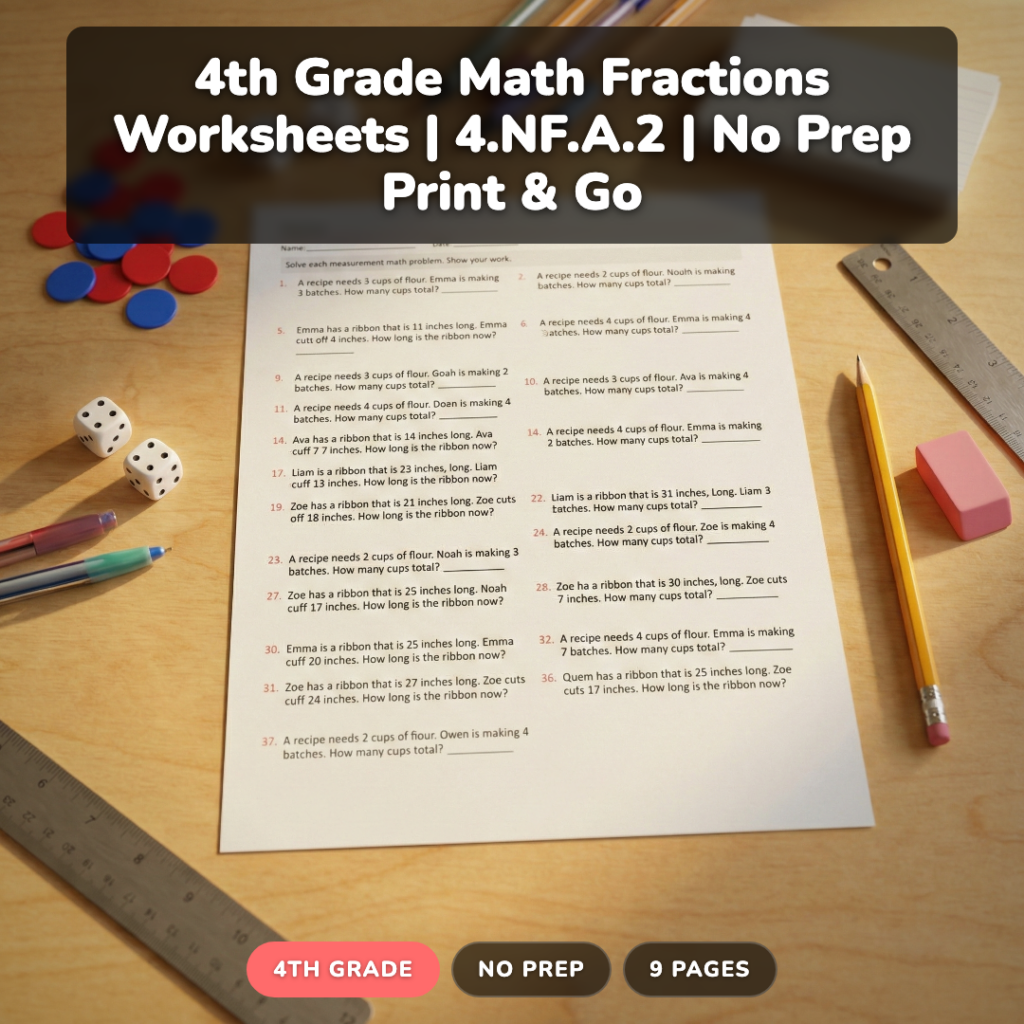
This resource includes 132 carefully crafted problems across three differentiation levels. The Practice level (37 problems) focuses on visual models and benchmark comparisons with simpler fractions. The On-Level section (50 problems) covers all required CCSS.Math.Content.4.NF.A.2 skills with mixed strategies. The Challenge level (45 problems) extends learning with complex comparisons and real-world applications.
What makes this different from other fraction worksheets? Each level includes answer keys with multiple solution methods shown, so you can see exactly how students might approach each problem. The problems progress systematically from concrete visual comparisons to abstract symbolic reasoning, ensuring students build solid conceptual understanding before moving to procedural fluency.
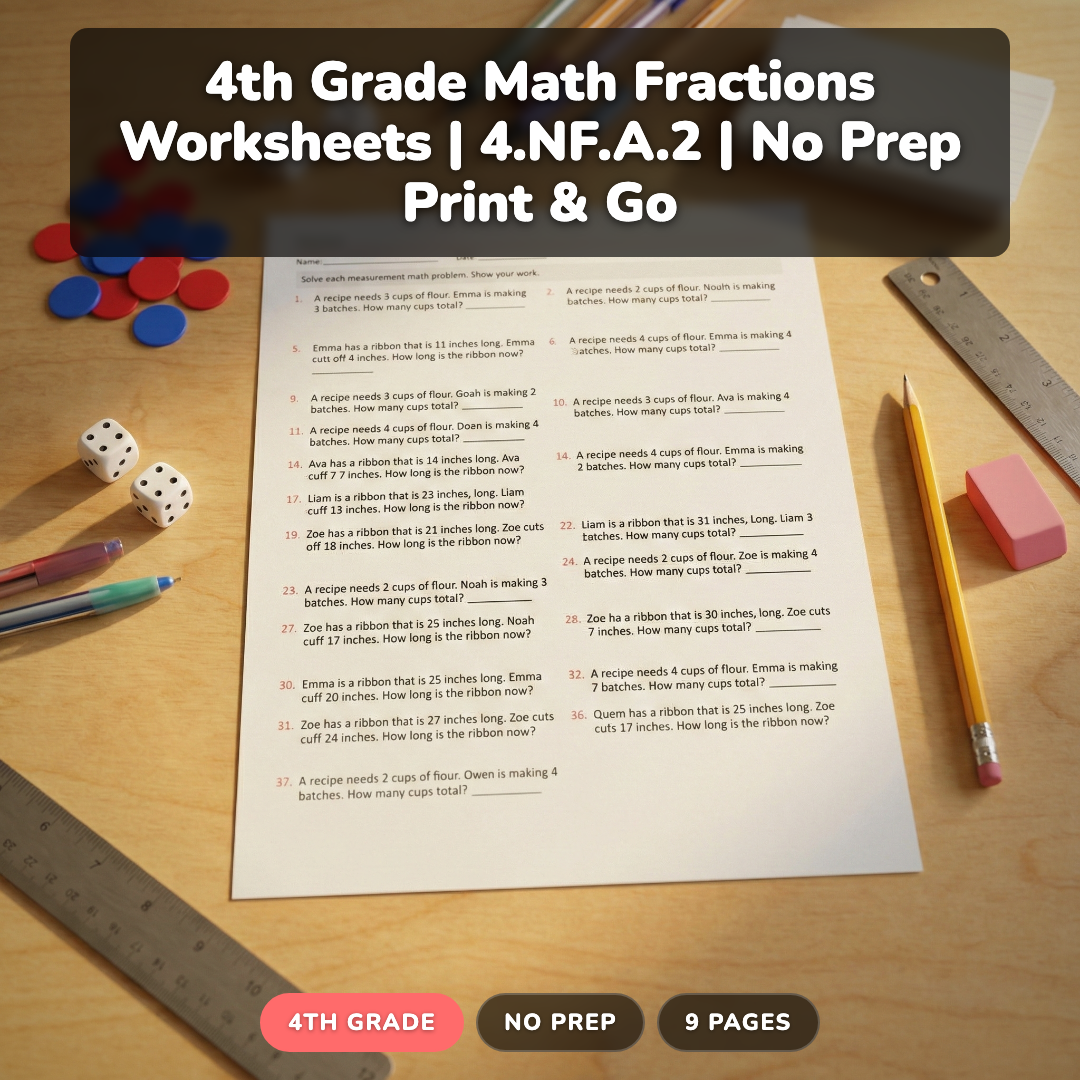
The 9-page resource is completely no-prep — just print and go. Perfect for math centers, homework, assessment, or substitute teacher plans.
Grab a Free Fraction Comparison Sample to Try
Want to see how these differentiated problems work in your classroom? I’ll send you a free sample with problems from each level, plus a quick reference guide for the five comparison strategies. Perfect for trying out the approach before diving into the full resource.
Frequently Asked Questions About Teaching Fraction Comparison
When should I introduce comparing fractions with different denominators in 4th grade?
Most curricula introduce this skill in the second quarter, after students have mastered equivalent fractions and fraction representations. Students need solid understanding of what fractions represent before comparing them meaningfully. Start with benchmark comparisons before moving to common denominators.
What’s the most effective strategy for struggling students?
Visual fraction models combined with benchmark comparisons work best for struggling learners. Start with comparing fractions to 1/2, then expand to 1/4 and 3/4. Physical manipulatives like fraction strips help students see relationships concretely before moving to abstract symbols.
How do I help students choose the best comparison strategy?
Teach all strategies first, then practice identifying when each works best. Benchmark comparisons work well when fractions are clearly above or below 1/2. Common denominators work for any fractions but take more time. Cross-multiplication is fastest for complex fractions but requires strong multiplication skills.
Should I teach cross-multiplication for fraction comparison in 4th grade?
Introduce cross-multiplication only after students understand why it works through visual models and common denominators. Many 4th graders aren’t developmentally ready for this abstract method. Focus on building conceptual understanding first, then introduce cross-multiplication as an efficient tool for students who are ready.
How can I connect fraction comparison to real-world situations?
Use cooking measurements (3/4 cup vs 2/3 cup), sports statistics (batting averages), and craft projects (fabric lengths). Pizza and chocolate bar models work well, but ensure all fractions refer to same-size wholes. Time comparisons (3/4 hour vs 2/3 hour) help students see practical applications.
Teaching fraction comparison doesn’t have to be a struggle for you or your students. With these five research-backed strategies and plenty of differentiated practice, your 4th graders will develop the confidence and skills they need for fraction success. What’s your go-to strategy for helping students compare fractions? Don’t forget to grab your free sample resource above — it’s a great way to get started with these approaches in your classroom.