If your fourth graders freeze when they see word problems about converting ounces to pounds or calculating elapsed time, you’re not alone. Measurement and data problems combine multiple skills — reading comprehension, number operations, and unit conversions — making them particularly challenging for students.
You’ll discover five research-backed strategies that help students tackle CCSS.Math.Content.4.MD.A.2 problems with confidence, plus practical differentiation tips for every learner in your classroom.
Key Takeaway
Fourth graders master measurement problems when they use visual models, practice real-world connections, and learn systematic approaches to unit conversion.
Why Measurement & Data Matters in Fourth Grade
The CCSS.Math.Content.4.MD.A.2 standard represents a significant leap in mathematical thinking. Students must now solve multi-step word problems involving distances, time intervals, liquid volumes, masses, and money — often requiring conversions between units and work with fractions or decimals.
Research from the National Council of Teachers of Mathematics shows that students who master measurement concepts in elementary grades demonstrate stronger problem-solving skills in middle school algebra. This standard typically appears in curriculum during the second quarter, building on third-grade measurement foundations while preparing students for fifth-grade volume concepts.
Fourth graders often struggle with this standard because it requires simultaneous processing of multiple mathematical concepts. They must decode word problems, identify relevant information, choose appropriate operations, convert between units, and represent solutions using diagrams or number lines.
Looking for a ready-to-go resource? I put together a differentiated measurement & data pack that covers everything below — but first, the teaching strategies that make it work.
Common Measurement & Data Misconceptions in Fourth Grade
Common Misconception: Students think larger units always have bigger numbers.
Why it happens: They confuse unit size with numerical value (3 feet seems smaller than 36 inches).
Quick fix: Use visual comparisons showing one foot next to twelve inches.
Common Misconception: Students add times incorrectly (2:45 + 30 minutes = 2:75).
Why it happens: They treat time like regular decimal numbers instead of base-60 system.
Quick fix: Practice with analog clocks and emphasize 60-minute hour conversions.
Common Misconception: Students struggle to identify which operation to use in multi-step problems.
Why it happens: They focus on keywords rather than understanding the problem structure.
Quick fix: Teach students to draw pictures and identify what they’re finding step-by-step.
Common Misconception: Students convert units in the wrong direction (multiply when they should divide).
Why it happens: They memorize conversion facts without understanding the relationship between units.
Quick fix: Use the “bigger to smaller means more pieces” rule with visual demonstrations.
5 Research-Backed Strategies for Teaching Measurement & Data
Strategy 1: Real-World Measurement Investigations
Students solve authentic measurement problems using actual objects and situations from their daily lives. This concrete approach helps them understand why measurement matters and builds number sense for unit relationships.
What you need:
- Measuring cups and containers
- Scales or balances
- Rulers and measuring tapes
- Stopwatches or timers
- Real objects to measure
Steps:
- Present a real scenario: “How much water fits in our classroom sink?”
- Have students estimate first, then measure using appropriate tools
- Record measurements and discuss which units make sense
- Create word problems based on their actual measurements
- Practice converting between units using their real data
Strategy 2: Visual Conversion Charts and Number Lines
Students create and use visual models to understand unit relationships and solve conversion problems systematically. Number lines help them see the mathematical relationships between different measurement units.
What you need:
- Large chart paper
- Colored markers
- Pre-made conversion reference sheets
- Number line templates
Steps:
- Create class conversion charts showing common relationships (12 inches = 1 foot)
- Model how to use number lines for time and distance problems
- Practice “jumping” on number lines to show unit conversions
- Have students create their own reference charts for different measurement types
- Use charts to solve increasingly complex word problems
Strategy 3: Step-by-Step Problem-Solving Protocol
Students learn a systematic approach to tackle multi-step measurement word problems, breaking complex scenarios into manageable pieces while identifying key information and required operations.
What you need:
- Problem-solving anchor chart
- Highlighters in different colors
- Graphic organizers
- Sample word problems
Steps:
- Read the problem twice, highlighting key information in different colors
- Identify what you know (given information) and what you need to find
- Determine if unit conversion is needed before or after calculations
- Choose appropriate operations and solve step-by-step
- Check if the answer makes sense in the real-world context
Strategy 4: Measurement & Data Games and Centers
Students practice measurement skills through engaging games that reinforce unit relationships, conversion strategies, and problem-solving techniques in a low-pressure environment.
What you need:
- Measurement conversion cards
- Dice or spinners
- Game boards
- Timer for time-based activities
- Play money for money problems
Steps:
- Set up rotation stations focusing on different measurement types
- Create “Conversion Race” games where students solve problems for points
- Design matching activities pairing equivalent measurements
- Include real-world scenario cards for problem-solving practice
- Have students create their own measurement challenges for classmates
Strategy 5: Technology-Enhanced Measurement Exploration
Students use digital tools and apps to explore measurement concepts, create visual representations, and solve complex problems that would be difficult to model with physical materials alone.
What you need:
- Tablets or computers
- Measurement apps or websites
- Digital graphing tools
- Online conversion calculators (for checking work)
Steps:
- Use virtual measuring tools to explore unit relationships
- Create digital number lines and bar models for word problems
- Compare measurements using graphing applications
- Solve virtual measurement challenges and simulations
- Document learning with digital portfolios showing problem-solving strategies
How to Differentiate Measurement & Data for All Learners
For Students Who Need Extra Support
Focus on concrete experiences with actual measuring tools before moving to word problems. Provide conversion charts and encourage students to draw pictures for every problem. Start with single-step problems using familiar units like feet and inches. Use manipulatives and real objects to make abstract concepts concrete. Break multi-step problems into separate, sequential questions.
For On-Level Students
Present grade-level CCSS.Math.Content.4.MD.A.2 problems involving two-step conversions and simple fractions. Encourage students to explain their thinking and justify their choice of operations. Practice with all measurement types specified in the standard: distance, time, liquid volume, mass, and money. Use number line diagrams to represent measurement quantities as required by the standard.
For Students Ready for a Challenge
Introduce problems involving decimal measurements and complex unit conversions. Have students create their own word problems for classmates to solve. Explore measurement in different contexts like cooking recipes or construction projects. Connect measurement concepts to other mathematical areas like geometry and data analysis. Challenge them to find multiple solution paths for the same problem.
A Ready-to-Use Measurement & Data Resource for Your Classroom
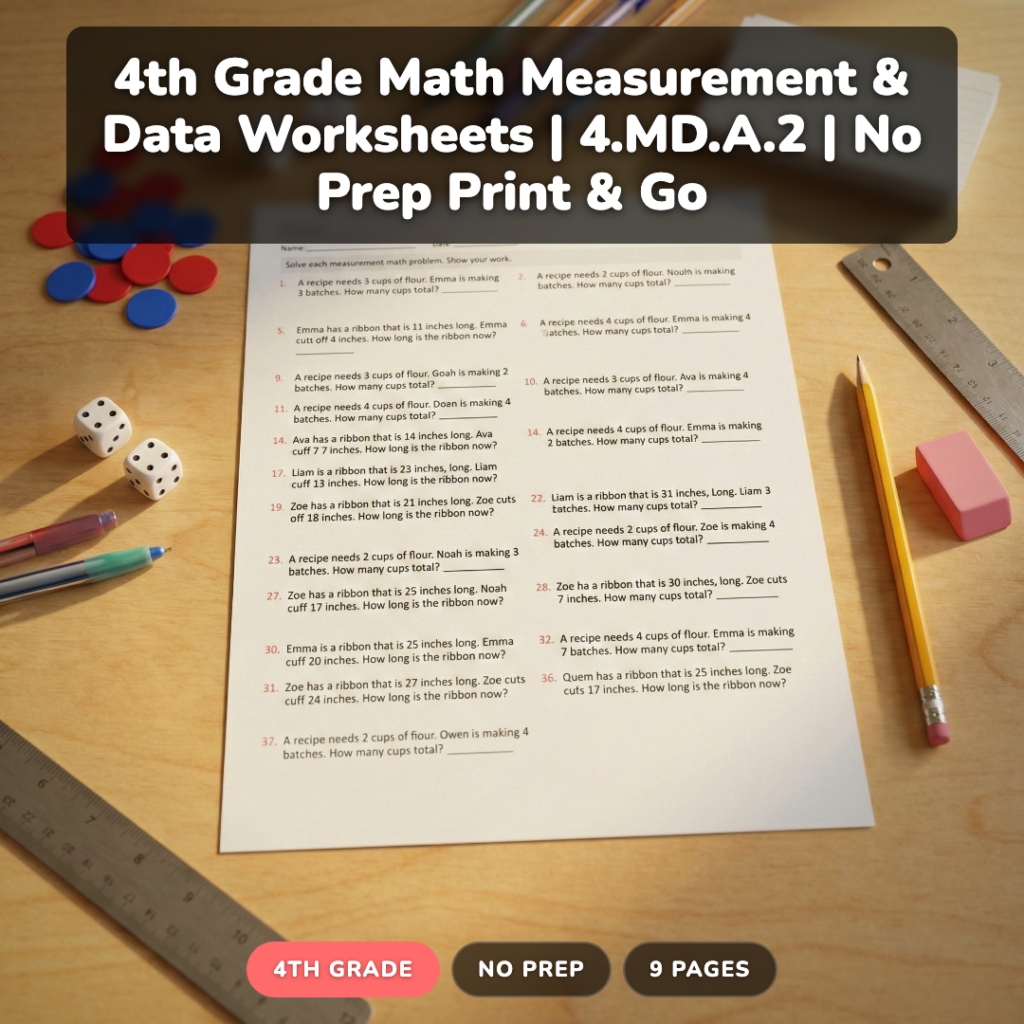
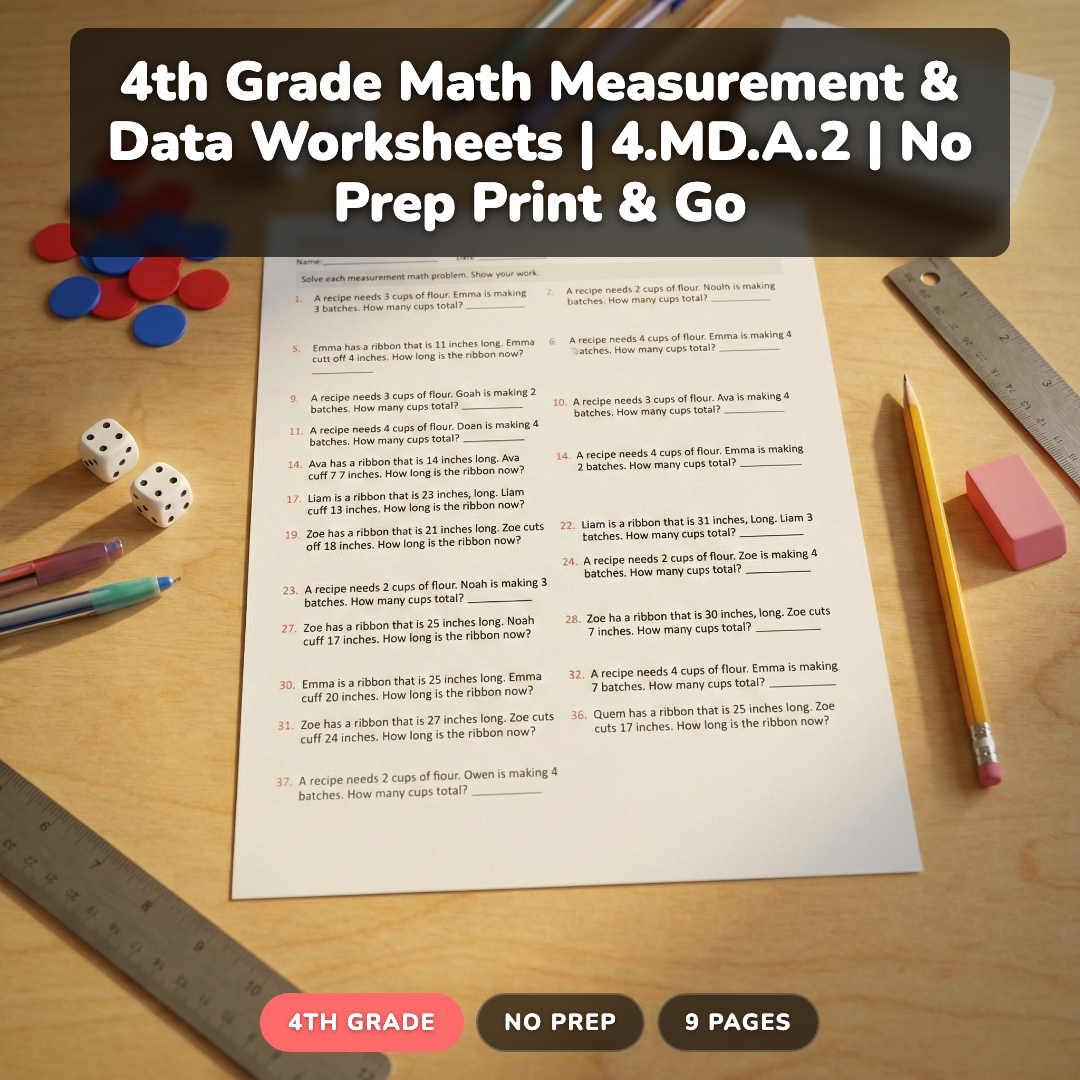
After years of creating measurement activities from scratch, I developed a comprehensive resource that saves you hours of prep time while providing exactly the practice your students need. This differentiated pack includes 132 carefully crafted problems across three difficulty levels.
The Practice level (37 problems) focuses on single-step conversions and basic word problems perfect for students building foundational skills. The On-Level section (50 problems) targets grade-level expectations with multi-step problems involving all measurement types from the standard. The Challenge level (45 problems) extends learning with complex scenarios involving decimals and real-world applications.
What makes this resource different is the systematic progression within each level and the inclusion of visual models and number line diagrams that align perfectly with CCSS.Math.Content.4.MD.A.2 requirements. Each section includes detailed answer keys with step-by-step solutions, making it easy to support students who get stuck.
The pack covers all measurement types — distance, time, liquid volume, mass, and money — with problems requiring unit conversions and the four operations. Students practice representing measurement quantities using number line diagrams exactly as the standard requires.
Grab a Free Measurement Sample to Try
Want to see how these strategies work in practice? I’ll send you a free sample with 10 differentiated measurement problems plus teaching tips for each level. Perfect for trying out these techniques with your students before diving into the full resource.
Frequently Asked Questions About Teaching Measurement & Data
When should I teach CCSS.Math.Content.4.MD.A.2 during the school year?
Most curricula introduce this standard in the second quarter after students have reviewed basic measurement concepts from third grade. This timing allows students to build on prior knowledge while having sufficient practice time before standardized testing in spring.
What’s the biggest challenge students face with measurement word problems?
Students struggle most with determining when and how to convert units. They often convert too early or in the wrong direction. Teaching the “bigger to smaller means more pieces” rule and providing visual conversion charts significantly improves success rates.
How do I help students who confuse different measurement types?
Create separate anchor charts for each measurement type (length, weight, capacity, time) with real-world examples and common units. Practice sorting measurement scenarios by type before solving, and use different colors to code each measurement category.
Should students memorize conversion facts or use reference charts?
Fourth graders should know basic conversions like 12 inches = 1 foot and 60 minutes = 1 hour from memory, but reference charts are appropriate for less common conversions. Focus on understanding relationships rather than pure memorization.
How can I make measurement problems more engaging for students?
Use real-world contexts that matter to students like planning parties, cooking recipes, or sports statistics. Let students measure actual objects in your classroom and create word problems based on their findings.
Teaching measurement and data successfully requires combining concrete experiences with systematic problem-solving strategies. When students understand unit relationships through hands-on exploration and learn to approach word problems step-by-step, they develop confidence with these challenging concepts.
What’s your favorite way to help students visualize unit conversions? Try the free sample problems above and see which strategies work best for your fourth graders.