If your first graders freeze when they see a box or question mark in a math equation, you’re not alone. Teaching unknown numbers (CCSS.Math.Content.1.OA.D.8) is one of the trickiest concepts in first grade because it requires students to think algebraically — a big leap from simple counting and basic facts.
This post will give you five research-backed strategies to help your students confidently solve equations like 8 + ? = 15 or ? – 6 = 4, plus differentiation tips for every learner in your classroom.
Key Takeaway
Students master unknown numbers when they understand the relationship between parts and wholes, not just memorize procedures.
Why Unknown Numbers Matter in First Grade
Standard CCSS.Math.Content.1.OA.D.8 asks students to determine the unknown whole number in addition or subtraction equations with three numbers. This isn’t just about finding missing addends — it’s laying the foundation for algebraic thinking that students will use through high school.
Research from the National Mathematics Advisory Panel shows that early algebraic reasoning strongly predicts later math success. When first graders learn to see equations as balanced relationships rather than just “do this operation,” they develop number sense that supports fraction work, multi-digit operations, and eventually solving for x.
This standard typically appears in the second half of first grade, after students have mastered basic addition and subtraction facts to 10. Students should be comfortable with part-whole relationships and understand that addition and subtraction are inverse operations before tackling unknown numbers systematically.
Looking for a ready-to-go resource? I put together a differentiated unknown numbers pack that covers everything below — but first, the teaching strategies that make it work.
Common Unknown Number Misconceptions in First Grade
Understanding where students struggle helps you address misconceptions before they become ingrained habits.
Common Misconception: Students think the unknown always goes at the end of the equation.
Why it happens: Most early addition problems follow the pattern “3 + 4 = ?” so students expect the box to be after the equals sign.
Quick fix: Show equations with unknowns in all three positions from the beginning: ? + 4 = 7, 3 + ? = 7, and 3 + 4 = ?
Common Misconception: Students add all three numbers together regardless of the operation.
Why it happens: They see numbers and automatically add without paying attention to the subtraction sign or equation structure.
Quick fix: Use different colors for addition and subtraction signs, and have students trace the operation before solving.
Common Misconception: Students think equations with subtraction are “harder” and avoid using addition to solve them.
Why it happens: They don’t understand that 12 – ? = 5 can be solved by thinking “5 + ? = 12.”
Quick fix: Explicitly teach the connection: “When I see subtraction with an unknown, I can think addition.”
Common Misconception: Students guess and check without using number relationships.
Why it happens: They haven’t internalized part-whole thinking or don’t see the equation as a balanced relationship.
Quick fix: Always start with concrete manipulatives to show the physical relationship before moving to abstract equations.
5 Research-Backed Strategies for Teaching Unknown Numbers
Strategy 1: Part-Whole Mats with Manipulatives
This concrete approach helps students visualize the relationship between known and unknown quantities using physical objects they can move and count.
What you need:
- Part-whole mats (circles divided into two sections)
- Two-color counters or small objects
- Equation cards with unknowns in different positions
Steps:
- Show the equation 5 + ? = 8 and place 8 counters in the “whole” circle
- Move 5 counters to one “part” section
- Count the remaining counters in the “whole” to find the unknown part
- Record the complete equation: 5 + 3 = 8
- Repeat with the unknown in different positions
Strategy 2: Number Line Jumps and Gaps
Visual number line work helps students see unknown numbers as distances or gaps they need to find, building spatial number sense alongside computational thinking.
What you need:
- Large floor number line (0-20)
- Smaller desk number lines for independent work
- Different colored markers or sticky notes
Steps:
- For 6 + ? = 11, start at 6 on the number line
- Jump forward to 11, counting each space
- Mark the distance jumped (5 spaces) as your unknown
- For ? + 4 = 9, start at 9 and jump backward 4 spaces to find the starting point
- Practice with subtraction: for 12 – ? = 7, start at 12 and find how many jumps back to reach 7
Strategy 3: Balance Scale Thinking
This strategy develops algebraic reasoning by helping students understand equations as balanced relationships where both sides must be equal.
What you need:
- Balance scale or balance scale app
- Uniform objects for weighing (blocks, coins, etc.)
- Equation recording sheets
Steps:
- Show 4 + ? = 7 using the balance: put 7 blocks on one side
- Put 4 blocks on the other side — it tips down
- Ask: “How many more blocks do we need to balance it?”
- Add blocks one at a time until balanced, counting as you go
- Record the complete equation and check by removing and re-adding
Strategy 4: Story Problem Contexts
Real-world contexts help students understand when and why they need to find unknown quantities, making abstract equations meaningful and memorable.
What you need:
- Picture cards or props for story contexts
- Chart paper for recording thinking
- Small objects to act out problems
Steps:
- Tell a story: “Maya had some stickers. Her friend gave her 4 more. Now she has 9 stickers. How many did she start with?”
- Act it out with objects, covering the unknown quantity
- Write the equation: ? + 4 = 9
- Solve using part-whole thinking or counting back
- Check the answer in the story context: “Does 5 + 4 = 9 make sense for Maya’s stickers?”
Strategy 5: Think-Addition for Subtraction
This strategy explicitly connects addition and subtraction as inverse operations, helping students use their stronger addition facts to solve subtraction unknowns.
What you need:
- Fact family triangles
- Equation strips showing related facts
- “Think-addition” strategy posters
Steps:
- Show the subtraction equation: 13 – ? = 8
- Say: “When I see subtraction with an unknown, I can think addition”
- Rewrite as: 8 + ? = 13
- Solve using known addition strategies
- Check: “Does 13 – 5 = 8? Yes!”
- Practice with fact families to reinforce the connection
How to Differentiate Unknown Numbers for All Learners
For Students Who Need Extra Support
Focus on concrete manipulatives and smaller numbers. Start with unknowns in the familiar final position (3 + ? = 7) before moving unknowns to other positions. Use consistent contexts and the same types of objects across multiple problems. Provide number lines or hundreds charts as visual supports. Break multi-step processes into smaller chunks with guided practice at each step.
For On-Level Students
Students working at grade level should practice unknowns in all three positions within equations using sums and differences to 20. They can handle a mix of addition and subtraction problems and should begin making connections between operations. Encourage multiple solution strategies and have students explain their thinking. Use story problems with familiar contexts and gradually introduce more abstract number work.
For Students Ready for a Challenge
Advanced students can work with larger numbers, multi-step problems, and equations with multiple unknowns (though this extends beyond the first-grade standard). Introduce early algebraic thinking: “What happens if we add 3 to both sides?” Challenge them to create their own story problems for given equations or find multiple equations that have the same unknown value. Connect to patterns and number relationships.
A Ready-to-Use Unknown Numbers Resource for Your Classroom
Teaching unknown numbers effectively requires lots of differentiated practice — more than most math programs provide. After years of creating my own materials, I developed a comprehensive resource that covers every strategy above with three distinct difficulty levels.
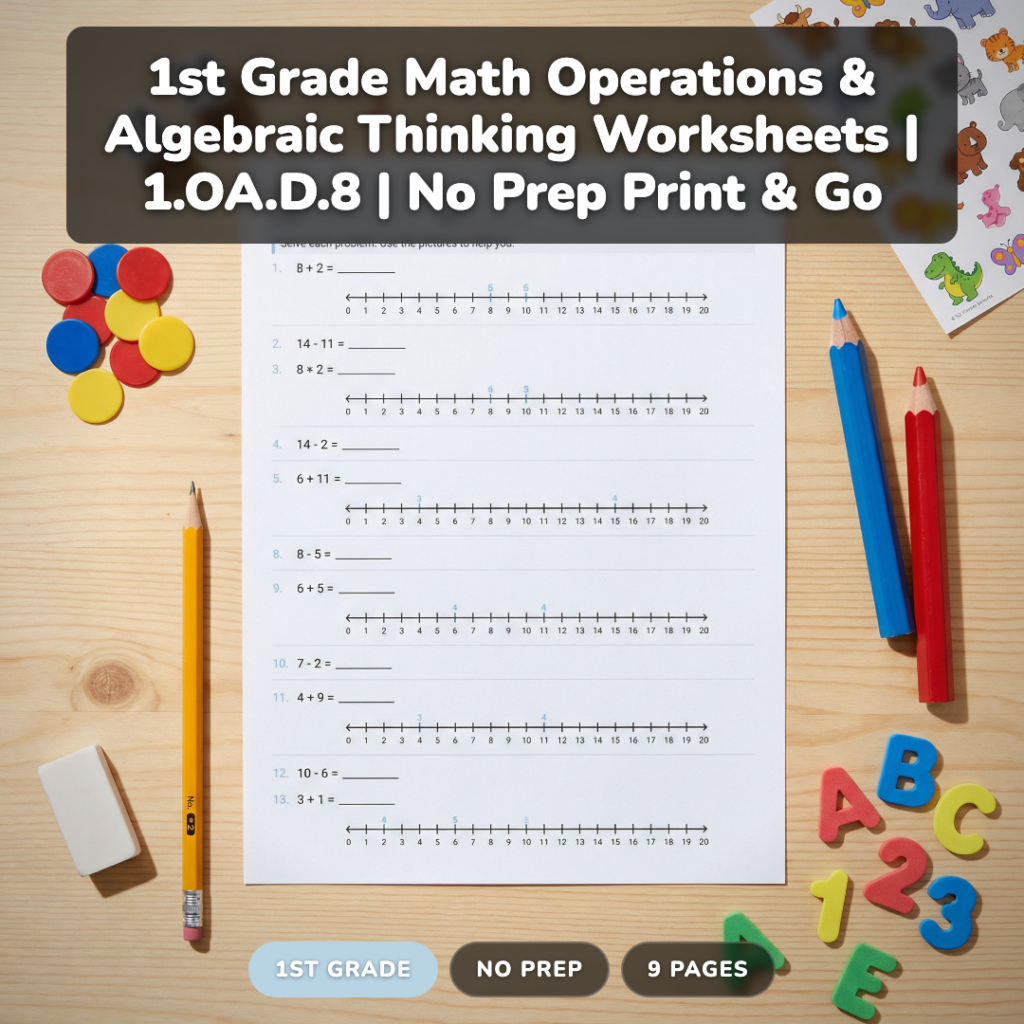
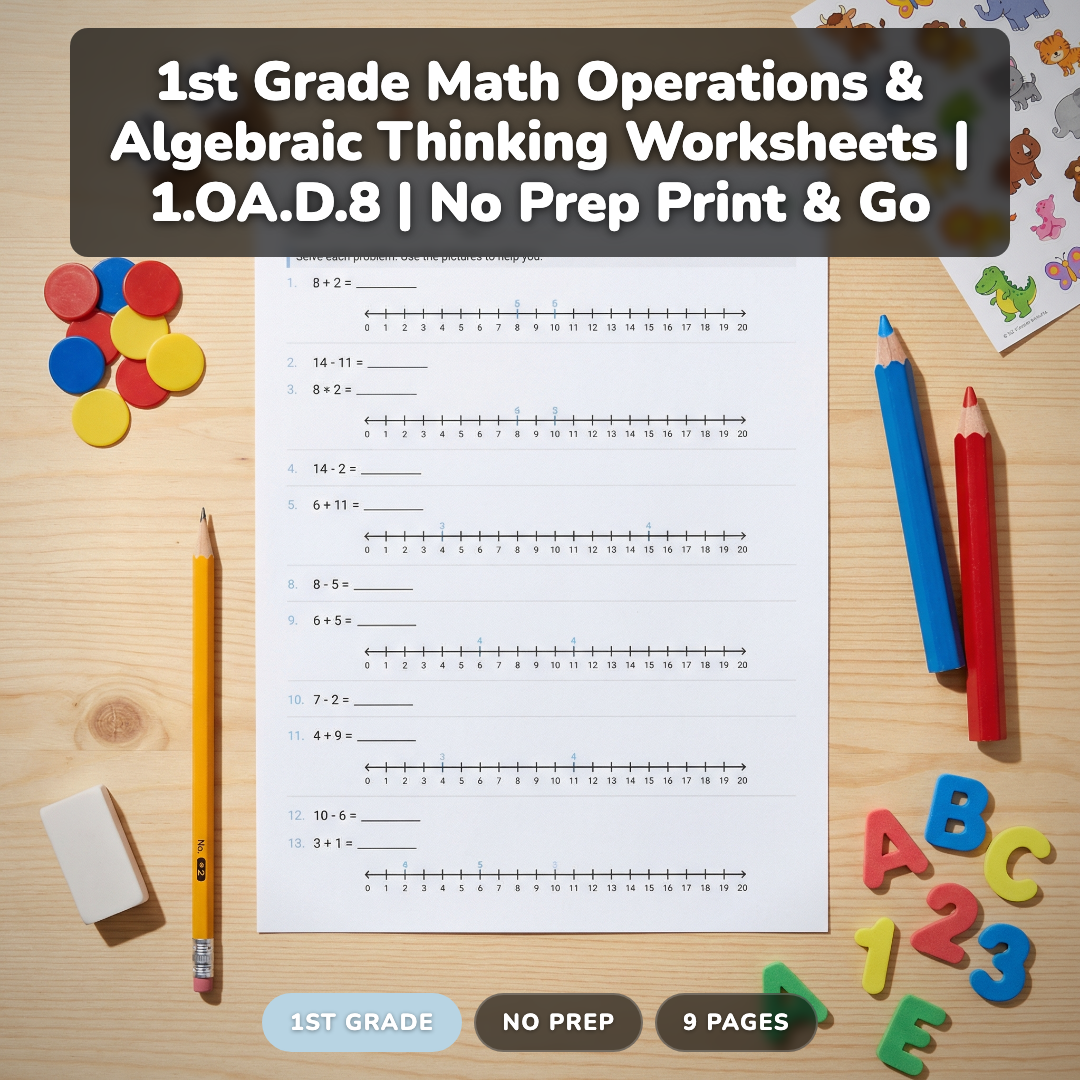
The 1st Grade Math Operations & Algebraic Thinking Worksheets include 106 carefully scaffolded problems across 9 pages. The Practice level focuses on unknowns in the final position with smaller numbers and visual supports. On-Level problems mix unknown positions and include story contexts. Challenge problems introduce multi-step thinking and larger numbers — all aligned to CCSS.Math.Content.1.OA.D.8.
What makes this different from generic worksheets? Each level builds systematically on the previous one, and every problem type connects to the concrete strategies above. You get immediate differentiation without creating three separate lessons.
The resource includes answer keys for quick checking and can be used for centers, homework, or assessment. It’s designed to save you hours of prep time while giving your students exactly the practice they need.
Grab a Free Unknown Numbers Sample to Try
Want to see how the differentiated approach works before diving in? I’ll send you a free sample page from each level — Practice, On-Level, and Challenge — so you can try it with your students first.
Frequently Asked Questions About Teaching Unknown Numbers
When should I introduce unknown numbers in first grade?
Introduce unknown numbers after students master basic addition and subtraction facts to 10, typically in January or February. Students need solid part-whole understanding and fluency with inverse operations before tackling systematic unknown number work aligned to CCSS.Math.Content.1.OA.D.8.
Should I teach different strategies for unknowns in different positions?
No — teach students that all unknown positions can be solved using part-whole thinking. Whether the unknown is first, middle, or last, students should identify the whole and the known part, then find the missing part. This builds algebraic reasoning better than position-specific tricks.
How do I help students who always want to add all the numbers together?
Use different colored manipulatives or equation parts to make the structure visible. Have students trace or highlight the operation sign before solving. Practice with balance scales so they can see physically that both sides must be equal, not just combined.
What’s the difference between missing addends and unknown numbers?
Missing addends typically refer to problems like 5 + ? = 8. Unknown numbers include this but also unknowns in other positions (? + 5 = 8, or 8 – ? = 5) and subtraction problems. The standard addresses all positions and both operations systematically.
How can I assess if students truly understand unknown numbers?
Give problems with unknowns in all three positions and both operations. Ask students to explain their thinking, not just find answers. Strong understanding shows when students can create their own story problems for equations and explain why their solutions make sense in context.
Building Algebraic Thinkers from First Grade
Teaching unknown numbers well in first grade sets up your students for success in every math class that follows. When students understand equations as balanced relationships and can flexibly find missing parts, they’re ready for the algebraic thinking that defines upper elementary and middle school math.
Start with concrete manipulatives, build understanding through multiple representations, and give students lots of practice with unknowns in different positions. The strategies above will help every student in your classroom develop the number sense and reasoning skills that make algebra accessible.
What’s your biggest challenge when teaching unknown numbers? Drop your email above for the free sample, and let me know what works best in your classroom!