If your first graders are still counting on their fingers for simple addition problems or get confused when you ask them to “count on” from a number, you’re not alone. Teaching operations and algebraic thinking to 6-year-olds requires concrete strategies that connect counting to addition and subtraction in ways they can actually understand.
This post will give you five research-backed strategies that help first graders master CCSS.Math.Content.1.OA.C.5 — relating counting to addition and subtraction — plus practical tips for differentiating instruction across all ability levels.
Key Takeaway
First graders learn operations best when they can physically see and manipulate the connection between counting forward (addition) and counting backward (subtraction).
Why Operations & Algebraic Thinking Matters in First Grade
Operations and algebraic thinking forms the foundation for all future math learning. In first grade, students transition from simply counting objects to understanding that addition means “counting on” and subtraction means “counting back.” This conceptual shift typically happens between October and February of the school year.
Standard CCSS.Math.Content.1.OA.C.5 specifically requires students to relate counting to addition and subtraction. Instead of counting all objects from one when solving 5+3, students should start at 5 and count on three more: “6, 7, 8.” Research from the National Council of Teachers of Mathematics shows that students who master counting strategies in first grade are 40% more likely to succeed in multi-digit operations by third grade.
This skill connects directly to other first-grade standards like CCSS.Math.Content.1.OA.A.1 (addition and subtraction word problems) and CCSS.Math.Content.1.OA.B.3 (applying properties of operations). Students need solid counting strategies before they can tackle fact families or missing addend problems.
Looking for a ready-to-go resource? I put together a differentiated operations and algebraic thinking pack that covers everything below — but first, the teaching strategies that make it work.
Common Operations & Algebraic Thinking Misconceptions in First Grade
Common Misconception: Students always start counting from 1, even in addition problems.
Why it happens: Counting from 1 is their most practiced skill, and they haven’t connected counting to addition yet.
Quick fix: Use a number line and physically point to the starting number before counting on.
Common Misconception: Students think subtraction always means “take away” physically removing objects.
Why it happens: Most early subtraction instruction focuses on removal rather than counting back.
Quick fix: Teach subtraction as “counting back” on a number line alongside take-away models.
Common Misconception: Students count the starting number when counting on (5+3 becomes “5, 6, 7, 8, 9”).
Why it happens: They haven’t learned that the starting number represents a quantity, not a counting position.
Quick fix: Use “closed fist” counting — hold up the starting number in a closed fist, then count on with fingers.
Common Misconception: Students think bigger numbers always come first in addition.
Why it happens: They haven’t learned the commutative property or that addition order doesn’t matter.
Quick fix: Show both 3+5 and 5+3 with manipulatives to prove they’re equal.
5 Research-Backed Strategies for Teaching Operations & Algebraic Thinking
Strategy 1: Number Line Counting On and Back
This visual strategy helps students see counting as movement along a number line, making the connection between counting and operations concrete and visible.
What you need:
- Floor number line (0-20) or desk number lines
- Small toys or game pieces for markers
- Addition and subtraction problems written on cards
Steps:
- Start with the first number in the problem and place your marker there
- For addition, count forward the second number of spaces, saying each number aloud
- For subtraction, count backward the second number of spaces
- Practice with problems where the first number is larger (easier) before smaller numbers
- Gradually transition from physical movement to pointing, then to mental visualization
Strategy 2: Ten Frame Counting Strategies
Ten frames provide a structured visual that helps students see number relationships and practice counting on efficiently, especially with numbers to 10.
What you need:
- Ten frames (printed or drawn)
- Two-color counters or small manipulatives
- Dry erase markers
Steps:
- Show the first addend using one color of counters in the ten frame
- Add the second addend using a different color, filling in additional spaces
- Count on from the first number, touching each new counter: “5… 6, 7, 8”
- For subtraction, start with the full amount and remove counters while counting back
- Practice identifying how many more spaces are needed to make 10
Strategy 3: Finger Counting with the “Start Number Fist”
This kinesthetic approach gives students a portable tool for counting on that they can use anywhere, while teaching them not to recount the starting number.
What you need:
- Just hands and fingers
- Simple addition problems (sums to 10)
- Visual cue cards showing the fist method
Steps:
- Make a fist to represent the first number (“This fist is 5”)
- Count on using fingers for the second number: “6, 7, 8” while raising three fingers
- The answer is the first number plus the fingers you raised
- Practice with different starting numbers, emphasizing that the fist “holds” that quantity
- Extend to subtraction by starting with fingers up and putting them down while counting back
Strategy 4: Story Problem Acting Out
Physical movement and storytelling help students connect abstract number operations to real-world situations they can understand and remember.
What you need:
- Simple props (toy animals, blocks, or student volunteers)
- Story problem scripts
- Space for movement
Steps:
- Read a simple story problem aloud (“3 birds were in a tree. 2 more birds flew over.”)
- Act out the story with props or student volunteers
- Identify the counting action: “We started with 3 and counted on 2 more”
- Count together while acting: “3… 4, 5. We have 5 birds now.”
- Write the number sentence to match the story: 3 + 2 = 5
Strategy 5: Counting Songs and Chants
Musical patterns help students memorize counting sequences and internalize the rhythm of counting on and back, making operations feel natural and automatic.
What you need:
- Simple melodies (Twinkle Twinkle, Row Row Row Your Boat)
- Written lyrics or visual cue cards
- Optional: simple instruments for keeping beat
Steps:
- Create counting songs that emphasize starting numbers: “Start at 5 and count some more, 6-7-8 now we have more!”
- Practice counting back songs: “Start at 8 and take away 3, 7-6-5 is what we see!”
- Use hand motions to show direction (forward for addition, backward for subtraction)
- Sing daily during transitions or math warm-ups
- Let students create their own counting songs with different starting numbers
How to Differentiate Operations & Algebraic Thinking for All Learners
For Students Who Need Extra Support
Start with concrete manipulatives and keep number ranges small (sums to 5, then 10). Use consistent language like “start at” and “count on” every time. Provide number lines with clear markings and practice counting sequences without operations first. Review one-to-one correspondence if students are still developing basic counting skills. Use visual supports like ten frames with some dots already filled in.
For On-Level Students
Practice CCSS.Math.Content.1.OA.C.5 with sums and differences to 20. Mix addition and subtraction problems within the same lesson. Encourage mental math strategies while still providing manipulatives when needed. Introduce the commutative property by showing that 4+3 equals 3+4. Use word problems that require students to choose between addition and subtraction.
For Students Ready for a Challenge
Extend to larger numbers (sums to 50) and introduce missing addend problems (“7 + ___ = 12”). Practice counting on and back by 2s, 5s, and 10s. Introduce simple algebraic thinking with balance scales or equation games. Create multi-step word problems that combine addition and subtraction. Connect to place value by counting on across tens (“28, 29, 30, 31”).
A Ready-to-Use Operations & Algebraic Thinking Resource for Your Classroom
After teaching first grade math for over a decade, I know how time-consuming it is to create differentiated practice that truly meets all your students’ needs. That’s why I created this comprehensive operations and algebraic thinking worksheet pack that covers everything we’ve discussed above.
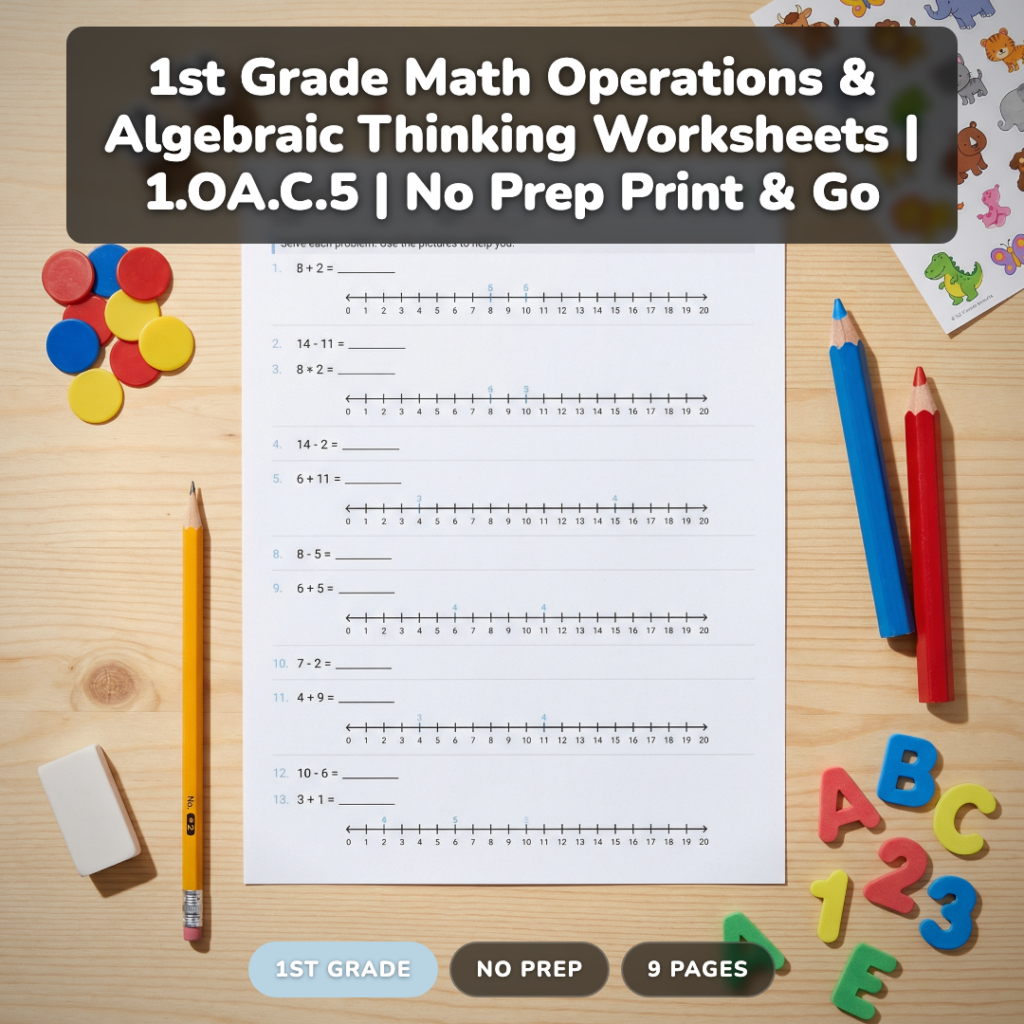
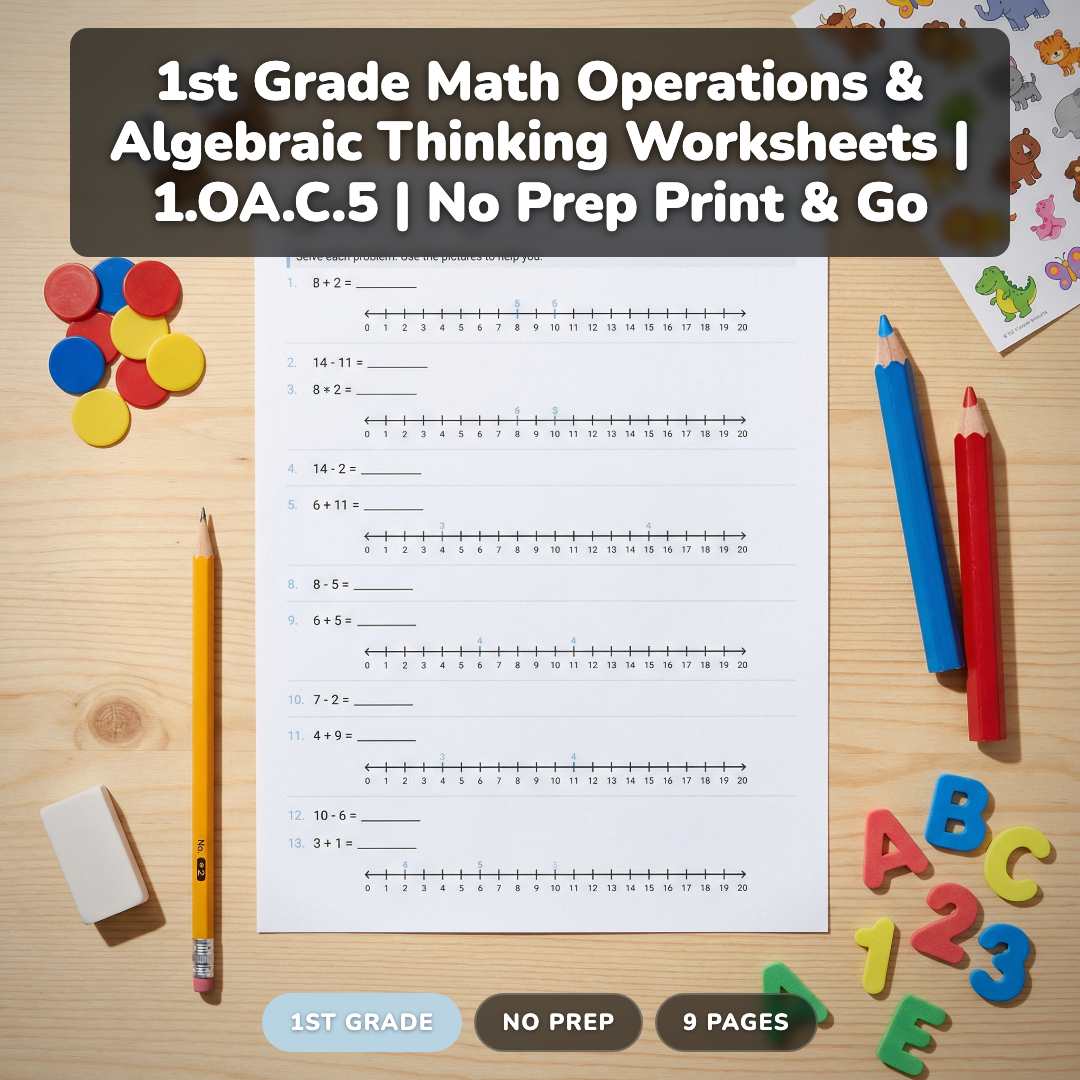
This 9-page resource includes 106 carefully designed problems across three difficulty levels. The Practice level (30 problems) focuses on basic counting on and back with numbers to 10. The On-Level section (40 problems) covers grade-level expectations with sums to 20 and mixed operations. The Challenge level (36 problems) extends learning with missing addends and larger numbers.
What makes this different from other worksheets is the intentional progression within each level. Problems start with visual supports and gradually increase independence. Each page includes clear directions and answer keys, so you can use them for independent work, homework, or assessment. The problems align perfectly with CCSS.Math.Content.1.OA.C.5 and connect to real-world situations your students understand.
The best part? It’s completely no-prep. Just print and go, knowing that every student in your class will have appropriately challenging practice that builds their understanding of operations and algebraic thinking.
Grab a Free Operations Practice Sheet to Try
Want to see how these differentiated problems work in your classroom? I’ll send you a free sample page that includes problems from all three levels, plus a quick reference guide for teaching counting on strategies.
Frequently Asked Questions About Teaching Operations & Algebraic Thinking
When should first graders master counting on for addition?
Most first graders develop counting on strategies between October and February. Students should reliably count on with sums to 10 by mid-year and extend to 20 by spring. Focus on accuracy before speed, and expect individual variation in timing.
What’s the difference between counting all and counting on?
Counting all means starting from 1 and counting every object (for 5+3, counting “1,2,3,4,5,6,7,8”). Counting on means starting with the first number and adding on (“5…6,7,8”). Counting on is more efficient and shows deeper number understanding.
Should I teach addition before subtraction?
Teach addition and subtraction together as related operations. Students understand that addition means counting forward and subtraction means counting backward. This connection helps them see inverse relationships and builds stronger number sense than teaching operations separately.
How do I help students who still count on their fingers?
Finger counting isn’t necessarily problematic if students count on efficiently. Use the “fist method” where the fist represents the starting number. Gradually encourage mental strategies, but don’t eliminate finger support until students have reliable alternatives.
What manipulatives work best for teaching operations?
Ten frames, number lines, and two-color counters are most effective. These tools help students visualize counting strategies and see number relationships clearly. Avoid manipulatives that encourage counting all rather than counting on.
Teaching operations and algebraic thinking successfully means helping your first graders see the connection between counting and mathematical operations. When students understand that addition is counting forward and subtraction is counting backward, they develop efficient strategies that serve them throughout elementary school.
What’s your favorite strategy for helping students move from counting all to counting on? Try the free sample above and let me know how these approaches work in your classroom!