If your third graders look confused when you mention grams, kilograms, and liters, you’re not alone. Teaching measurement and data to 8-year-olds requires hands-on experiences that make abstract units concrete. You’ll discover five research-backed strategies that transform measurement confusion into confident problem-solving skills.
Key Takeaway
Students master measurement when they physically interact with real objects before moving to abstract problems and word problems.
Why Measurement & Data Matters in 3rd Grade
Third grade marks a crucial transition in mathematical thinking. Students move from informal measurement experiences to formal standard units, setting the foundation for proportional reasoning in upper grades. The timing typically falls in late fall or early spring, after students have developed strong number sense with addition and subtraction.
The CCSS.Math.Content.3.MD.A.2 standard requires students to measure and estimate liquid volumes and masses using grams (g), kilograms (kg), and liters (l), then solve one-step word problems involving these measurements. Research from the National Council of Teachers of Mathematics shows that students who engage in hands-on measurement activities score 23% higher on standardized assessments compared to those receiving worksheet-only instruction.
This standard connects directly to real-world applications students encounter daily — from cooking measurements to understanding product labels. Students who master these concepts show improved spatial reasoning and develop stronger number sense overall.
Looking for a ready-to-go resource? I put together a differentiated measurement pack that covers everything below — but first, the teaching strategies that make it work.
Common Measurement Misconceptions in 3rd Grade
Understanding where students struggle helps you address confusion before it becomes entrenched. These misconceptions appear consistently across classrooms:
Common Misconception: Heavier objects always have more mass in grams than lighter objects, regardless of size.
Why it happens: Students confuse visual size with actual mass, assuming bigger automatically means heavier.
Quick fix: Compare a large foam block with a small metal object using a balance scale.
Common Misconception: A liter is always more than any amount measured in milliliters.
Why it happens: Students don’t understand the relationship between units — they see different unit names as completely separate measurements.
Quick fix: Use clear containers to show 1000 mL equals exactly 1 L through direct pouring.
Common Misconception: Grams and kilograms measure the same things, just with different numbers.
Why it happens: Students lack reference points for what 1 gram versus 1 kilogram actually feels like.
Quick fix: Create a classroom reference chart with familiar objects (paperclip = 1g, textbook = 1kg).
Common Misconception: Estimation means guessing randomly rather than using benchmarks.
Why it happens: Students haven’t developed internal reference points for standard units.
Quick fix: Practice daily estimation routines using the same reference objects until students internalize the measurements.
5 Research-Backed Strategies for Teaching Measurement & Data
Strategy 1: Benchmark Building with Real Objects
Students develop measurement sense by creating personal reference points for each unit. This strategy builds the foundation for accurate estimation and helps students visualize abstract measurements in concrete terms.
What you need:
- Digital scale (grams/kilograms)
- Measuring cups and graduated cylinders
- Collection of classroom objects (paperclips, textbooks, water bottles)
- Anchor chart paper
Steps:
- Measure and record the mass of 10 familiar classroom objects, from paperclips (1g) to textbooks (1kg)
- Create a class anchor chart showing object photos with their actual measurements
- Have students hold each benchmark object while saying its measurement aloud
- Practice daily estimation games using these benchmarks as reference points
- Gradually introduce new objects for students to estimate using their benchmark knowledge
Strategy 2: Measurement Station Rotations
Students rotate through hands-on stations that target different aspects of measurement, providing multiple practice opportunities while maintaining engagement through variety and movement.
What you need:
- 4-5 measurement stations with different tools
- Station instruction cards
- Recording sheets for each station
- Timer for rotations
Steps:
- Set up Station 1 (Mass): Students weigh objects and sort into gram/kilogram categories
- Create Station 2 (Volume): Students measure liquids and compare capacities
- Design Station 3 (Estimation): Students estimate then measure to check accuracy
- Build Station 4 (Word Problems): Students solve problems using manipulatives and drawings
- Add Station 5 (Real-World): Students read product labels and compare measurements
- Rotate groups every 12-15 minutes with 2-minute transition time
Strategy 3: Measurement Problem-Solving with Visual Models
Students use drawings and visual representations to solve word problems involving measurement, making abstract concepts concrete and supporting different learning styles.
What you need:
- Word problems involving measurement
- Drawing paper and colored pencils
- Measurement tools for verification
- Problem-solving strategy poster
Steps:
- Read the problem aloud and identify what’s being measured (mass or volume)
- Draw the objects mentioned in the problem with labels showing their measurements
- Circle the question being asked and underline key measurement information
- Choose the appropriate operation (add, subtract, multiply, divide) based on the problem context
- Solve using the visual model, then verify with actual measurement tools when possible
- Write the answer with correct units and check if it makes sense
Strategy 4: Measurement Scavenger Hunts
Students apply measurement skills in authentic contexts by finding and measuring objects throughout the classroom and school, reinforcing learning through real-world application and physical activity.
What you need:
- Clipboards and recording sheets
- Portable measurement tools
- List of measurement challenges
- Digital cameras (optional)
Steps:
- Create challenge cards: ‘Find something that weighs about 100 grams’ or ‘Find a container that holds about 1 liter’
- Send student pairs on hunts with measurement tools and recording sheets
- Have students measure their discoveries and record actual vs. estimated measurements
- Gather to share findings and discuss which objects were closest to target measurements
- Create a class collection of measured objects for future reference
Strategy 5: Cooking Connections and Recipe Math
Students apply measurement skills through cooking activities that naturally incorporate volume measurements and provide immediate, tangible results that reinforce learning through taste and smell.
What you need:
- Simple no-bake recipes (trail mix, smoothies)
- Measuring cups and spoons
- Ingredients in various quantities
- Recipe cards with measurement conversions
Steps:
- Choose recipes requiring liter and milliliter measurements (smoothies work perfectly)
- Have students read recipes and identify all measurement vocabulary
- Practice measuring ingredients while discussing unit relationships (500 mL + 500 mL = 1 L)
- Solve problems like ‘If we double the recipe, how many liters of juice do we need?’
- Create new recipe variations by adjusting measurements proportionally
- Document the process with photos and measurement recordings
How to Differentiate Measurement & Data for All Learners
For Students Who Need Extra Support
Start with concrete manipulatives before moving to abstract numbers. Use benchmark objects consistently — the same paperclip for 1 gram, the same water bottle for 1 liter. Provide measurement reference cards students can keep at their desks. Focus on one unit at a time rather than mixing grams and kilograms in the same lesson. Use real objects students can hold and manipulate rather than pictures or worksheets. Break word problems into smaller steps with visual supports for each part.
For On-Level Students
Students at grade level should work with the full range of CCSS.Math.Content.3.MD.A.2 expectations, measuring and estimating using all three units (g, kg, L) within the same activities. They can handle word problems that require choosing the appropriate operation and should practice both estimation and exact measurement. Encourage students to explain their thinking and justify their measurement choices. Provide opportunities to work with mixed units and compare measurements across different contexts.
For Students Ready for a Challenge
Advanced students can explore unit conversions within the metric system, comparing milliliters to liters and grams to kilograms. Challenge them to create measurement problems for classmates, design experiments that require precise measurements, and make connections to real-world applications like nutrition labels and recipe scaling. Introduce concepts of precision and accuracy, discussing when estimates are appropriate versus when exact measurements are necessary.
A Ready-to-Use Measurement & Data Resource for Your Classroom
Planning differentiated measurement activities takes significant prep time, especially when you’re creating problems at three different levels. That’s why I created a comprehensive measurement and data worksheet pack that saves you hours of preparation while ensuring every student gets appropriate practice.
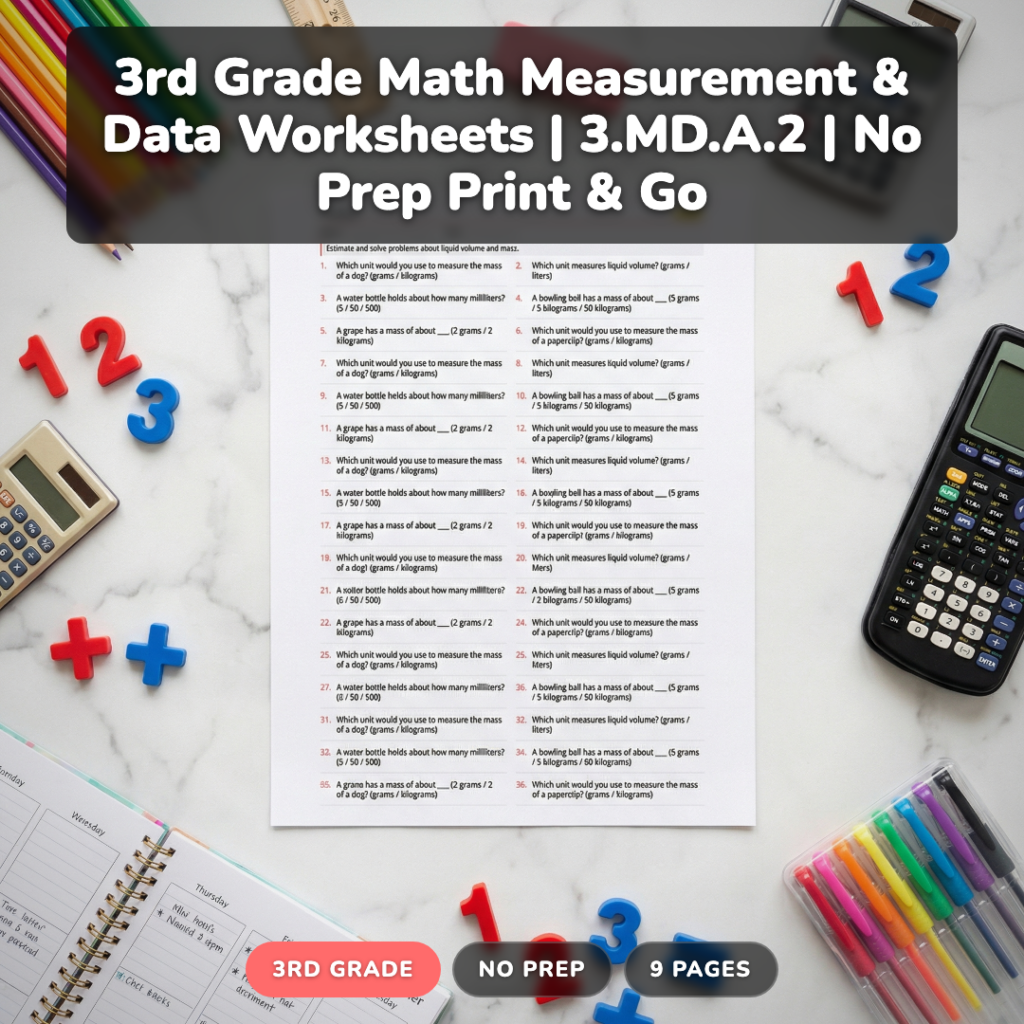
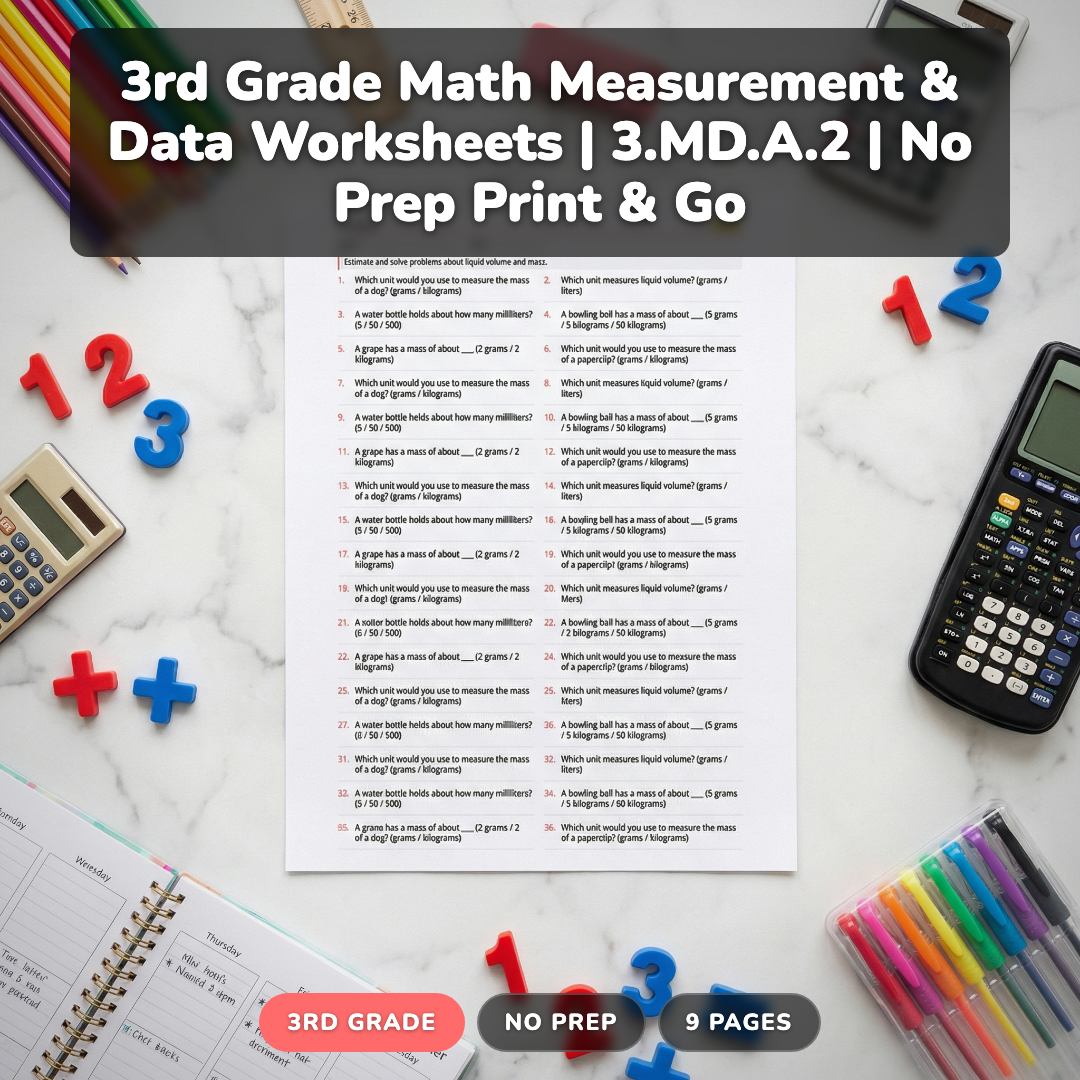
This resource includes 132 carefully crafted problems across three differentiation levels. The Practice level (37 problems) focuses on basic measurement and simple word problems with visual supports. On-Level worksheets (50 problems) cover the full CCSS.Math.Content.3.MD.A.2 standard with mixed units and multi-step thinking. Challenge problems (45 problems) extend learning with real-world applications and beginning unit conversions.
What makes this different from generic worksheets? Every problem includes visual models, answer keys show multiple solution strategies, and the progression builds systematically from concrete to abstract thinking. You get 9 pages of ready-to-print activities that require zero prep time.
Skip the late-night planning and grab this complete measurement resource that covers everything your students need to master this challenging standard.
Grab a Free Measurement Practice Sheet to Try
Want to see the quality before you buy? I’ll send you a free sample worksheet that includes problems at all three levels, plus an answer key with teaching tips. Perfect for trying out these strategies with your students.
Frequently Asked Questions About Teaching Measurement & Data
When should I teach CCSS.Math.Content.3.MD.A.2 during the school year?
Most teachers introduce measurement and data in late fall (November-December) or early spring (February-March), after students have solid addition and subtraction skills. The timing allows for hands-on activities when weather permits outdoor measurement explorations.
What’s the difference between mass and weight when teaching 3rd graders?
For 3rd grade purposes, use ‘mass’ and ‘weight’ interchangeably. The scientific distinction is too abstract for this age. Focus on measuring how heavy objects are using grams and kilograms rather than explaining gravitational force differences.
How do I help students remember when to use grams versus kilograms?
Create consistent benchmark references: paperclips and coins for grams, textbooks and students for kilograms. Practice daily estimation using these benchmarks until students automatically associate light objects with grams and heavy objects with kilograms.
Should 3rd graders learn metric conversions like 1000g = 1kg?
The standard doesn’t require conversions, but introducing the relationship helps with number sense. Use concrete examples: ‘It takes 1000 paperclips to equal the weight of this textbook’ rather than abstract conversion formulas.
What manipulatives work best for teaching liquid volume measurement?
Clear graduated cylinders, measuring cups with metric markings, and various sized containers work best. Avoid tools with both metric and customary units displayed together, as this creates confusion for beginning learners.
Teaching measurement and data successfully requires balancing hands-on exploration with systematic skill building. When students can physically experience the weight of a kilogram or see a liter of water, abstract numbers become meaningful. Remember to grab your free sample worksheet to try these strategies with your students right away.
What’s your biggest challenge when teaching measurement to third graders? I’d love to hear how these strategies work in your classroom!