If your third graders freeze when you ask them to divide a circle into equal parts, you’re not alone. Teaching geometry concepts like partitioning shapes and understanding unit fractions can feel overwhelming — especially when students struggle to see that a half of a rectangle looks different from a half of a circle.
You need concrete strategies that help students visualize equal areas, connect fractions to shapes, and build spatial reasoning skills. This post breaks down exactly how to teach CCSS.Math.Content.3.G.A.2 with activities that work in any classroom.
Key Takeaway
Third graders learn geometry best through hands-on manipulation, visual models, and explicit connections between equal parts and unit fractions.
Why Geometry Matters in Third Grade
Third grade geometry marks a crucial shift from simply identifying shapes to understanding their properties and relationships. Students must master CCSS.Math.Content.3.G.A.2 — partitioning shapes into equal areas and expressing each part as a unit fraction — before they can tackle more complex fraction concepts in fourth grade.
Research from the National Council of Teachers of Mathematics shows that students who struggle with spatial reasoning in elementary school often have difficulty with advanced math concepts later. The van Hiele theory of geometric thinking emphasizes that students must progress through concrete manipulation before reaching abstract understanding.
This standard typically appears in the spring semester, after students have solid number sense with fractions like 1/2, 1/3, and 1/4. It connects directly to fraction work in CCSS.Math.Content.3.NF.A.1 and prepares students for area and perimeter concepts in fourth grade.
Looking for a ready-to-go resource? I put together a differentiated geometry pack that covers everything below — but first, the teaching strategies that make it work.
Common Geometry Misconceptions in Third Grade
Understanding where students typically struggle helps you address misconceptions before they become entrenched. Here are the four most common geometry misconceptions I see in third grade classrooms:
Common Misconception: Students think all equal parts must look identical in shape.
Why it happens: They focus on visual similarity rather than equal area.
Quick fix: Use pattern blocks to show different-shaped pieces with the same area.
Common Misconception: Students believe a shape divided into more parts means smaller fractions are bigger.
Why it happens: They confuse the number of parts with the size of each part.
Quick fix: Compare 1/2 and 1/4 of the same circle side by side.
Common Misconception: Students think fractions only work with circles and rectangles.
Why it happens: Most textbook examples use these familiar shapes.
Quick fix: Practice with triangles, hexagons, and irregular shapes regularly.
Common Misconception: Students assume equal partitions must follow symmetrical lines.
Why it happens: They rely on visual patterns rather than area measurement.
Quick fix: Show creative partitions using grid paper to verify equal areas.
5 Research-Backed Strategies for Teaching Third Grade Geometry
Strategy 1: Paper Folding for Equal Parts
Paper folding gives students immediate tactile feedback about equal areas. When they fold a shape in half, they can physically see and feel that both parts match exactly. This concrete experience builds the foundation for abstract fraction understanding.
What you need:
- Construction paper circles, rectangles, and squares (6 inches)
- Different colored paper for each shape
- Fraction vocabulary cards (halves, thirds, fourths)
Steps:
- Give each student a paper circle. Model folding it exactly in half.
- Have students trace the fold line and shade one half a different color.
- Repeat with rectangles, showing multiple ways to make halves (horizontal, vertical, diagonal).
- Progress to thirds using strips of paper, then fourths with squares.
- Connect each fold to fraction language: “This is one-half of the whole circle.”
Strategy 2: Pattern Block Fraction Exploration
Pattern blocks provide a hands-on way to explore equal areas with different shapes. Students can physically manipulate pieces to discover that six triangles equal one hexagon, making each triangle one-sixth of the whole.
What you need:
- Pattern blocks (hexagons, trapezoids, rhombuses, triangles)
- Pattern block recording sheets
- Fraction recording chart
Steps:
- Start with yellow hexagons as the “whole.” Have students find how many green triangles fit inside.
- Record the discovery: 6 triangles = 1 hexagon, so each triangle = 1/6.
- Explore red trapezoids: 2 trapezoids = 1 hexagon, so each trapezoid = 1/2.
- Try blue rhombuses: 3 rhombuses = 1 hexagon, so each rhombus = 1/3.
- Challenge students to create their own fraction combinations and record them.
Strategy 3: Grid Paper Area Verification
Grid paper transforms abstract area concepts into countable squares. Students can verify that partitions are truly equal by counting unit squares in each section, building a concrete understanding of equal areas.
What you need:
- 1-inch grid paper
- Colored pencils or crayons
- Rulers
- Shape templates (rectangles, squares, triangles)
Steps:
- Draw a 4×6 rectangle on grid paper. Count total squares (24).
- Show students how to partition it into halves: 12 squares each section.
- Try different half partitions (2×12, 4×3, 3×4) and verify equal areas.
- Progress to thirds and fourths, always counting to verify equal areas.
- Introduce irregular shapes and challenge students to find creative equal partitions.
Strategy 4: Fraction Circle Comparison Games
Comparison activities help students internalize fraction relationships. When they physically compare 1/2 to 1/4 pieces, they develop number sense about fraction size that supports later computation work.
What you need:
- Fraction circle sets (halves, thirds, fourths, sixths, eighths)
- “Fraction War” cards
- Recording sheets for comparisons
Steps:
- Each student gets a complete fraction circle set. Start with halves and fourths only.
- Call out comparisons: “Show me which is bigger: 1/2 or 1/4?”
- Students hold up pieces to compare visually, then explain their reasoning.
- Play “Fraction War”: students draw cards and compare fraction pieces.
- Record discoveries on a comparison chart (1/2 > 1/4 > 1/8).
Strategy 5: Real-World Partitioning Projects
Connecting geometry to real situations helps students see the relevance of equal partitioning. Pizza slices, garden plots, and classroom supplies provide authentic contexts for applying fraction concepts.
What you need:
- Paper plates (for pizza models)
- Garden plot templates
- Classroom supply scenarios
- Digital camera or tablets for documentation
Steps:
- Present a scenario: “We need to share this pizza equally among 4 friends.”
- Students partition the paper plate pizza and label each piece as 1/4.
- Extend to garden plots: “Divide this garden into 3 equal sections for different vegetables.”
- Challenge: “8 students need equal amounts of construction paper. How do we divide 2 sheets?”
- Students photograph their solutions and explain their partitioning strategies.
How to Differentiate Third Grade Geometry for All Learners
For Students Who Need Extra Support
Start with concrete manipulatives and limit choices to prevent cognitive overload. Use pre-folded shapes with clear fold lines, begin with halves only, and provide fraction vocabulary cards with visual supports. Focus on one shape type per lesson and use consistent language like “equal parts” and “same size.” Pair struggling students with math buddies for peer support during hands-on activities.
For On-Level Students
Third graders working at grade level should partition circles, rectangles, and squares into halves, thirds, and fourths. They can compare unit fractions using concrete models, explain their reasoning with mathematical vocabulary, and connect partitioned shapes to written fractions. Expect them to identify equal and unequal partitions and justify their thinking using area concepts.
For Students Ready for a Challenge
Advanced students can explore sixths and eighths, work with irregular shapes and creative partitions, and investigate equivalent fractions using different models. Challenge them to find multiple ways to partition the same shape, create their own fraction comparison problems, and connect geometry work to real-world measurement situations like cooking and construction.
A Ready-to-Use Geometry Resource for Your Classroom
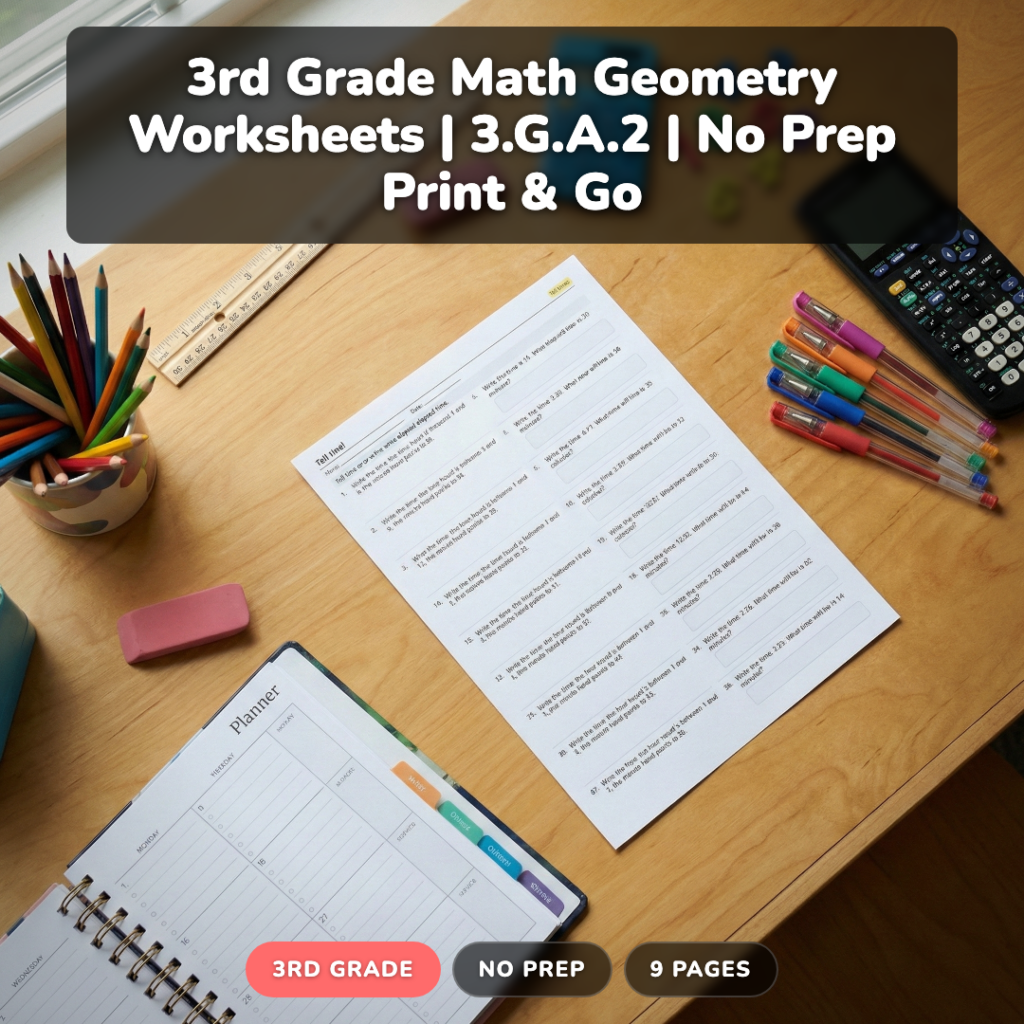
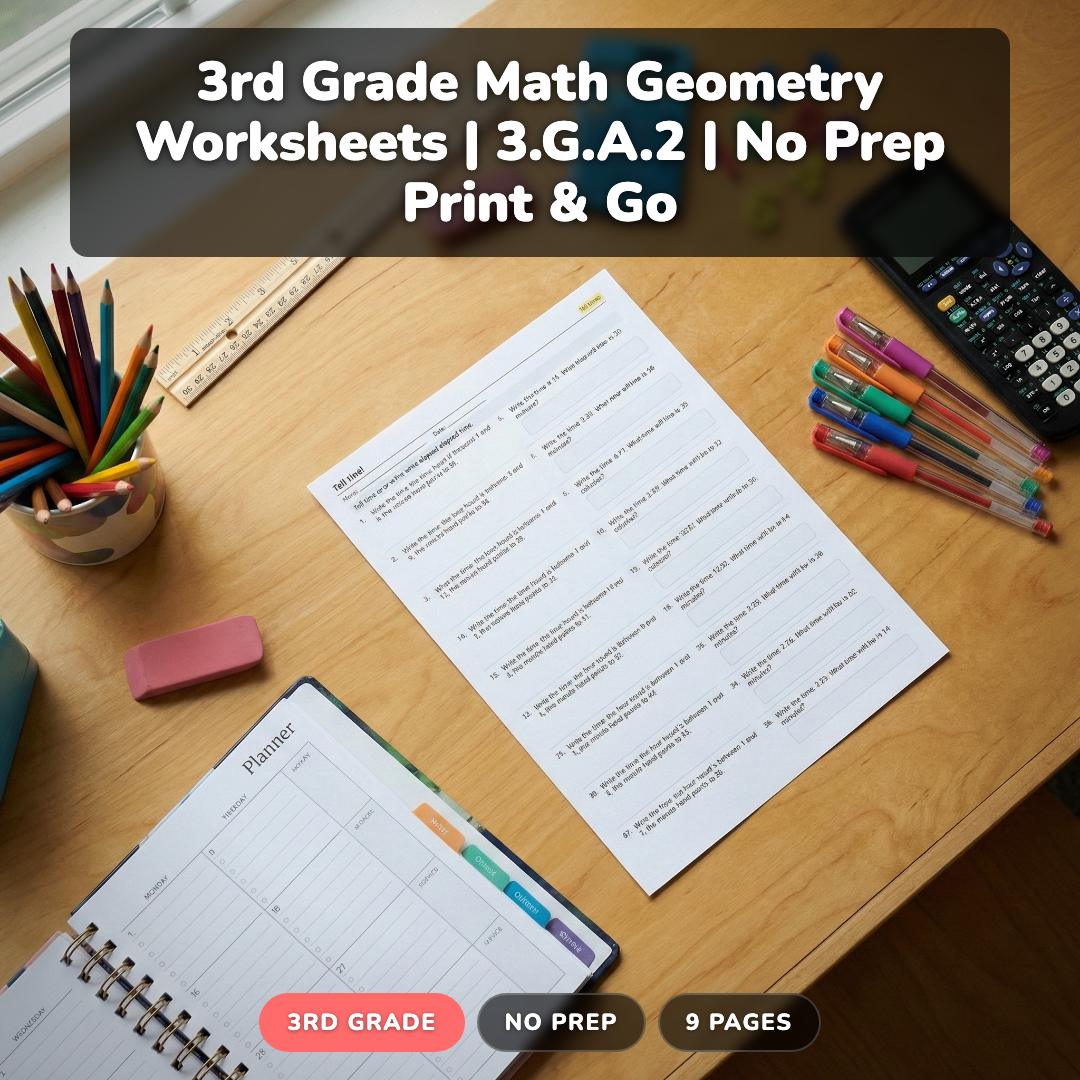
After using these strategies with hundreds of third graders, I created a comprehensive geometry pack that takes the guesswork out of planning. This 9-page resource includes 132 differentiated problems across three levels — perfect for meeting every student where they are.
The practice level focuses on basic partitioning with clear visual supports. On-level problems challenge students to work with multiple shapes and fraction comparisons. The challenge level pushes advanced learners with irregular shapes and complex partitioning scenarios. Each level includes detailed answer keys and teaching notes.
What makes this different from other geometry worksheets? Every problem connects directly to CCSS.Math.Content.3.G.A.2, includes multiple solution strategies, and provides scaffolding for struggling learners. You get immediate differentiation without the prep work.
This geometry pack saves hours of planning time while ensuring every student gets appropriate practice with equal area partitioning and unit fractions.
Grab a Free Geometry Sample to Try
Want to see how differentiated geometry practice works in your classroom? I’ll send you a free sample worksheet with problems from each level, plus my favorite hands-on activity for teaching equal parts.
Frequently Asked Questions About Teaching Third Grade Geometry
What’s the difference between equal parts and equal pieces?
Equal parts refer to sections of a shape that have the same area, even if they look different. Equal pieces typically look identical in both shape and size. For CCSS.Math.Content.3.G.A.2, focus on equal areas rather than identical appearance.
Should third graders work with improper fractions in geometry?
No, third grade geometry focuses exclusively on unit fractions (1/2, 1/3, 1/4, etc.). Students partition wholes into equal parts and identify each part as a unit fraction. Improper fractions appear in fourth grade standards.
How do I help students who can’t visualize equal areas?
Use concrete manipulatives like pattern blocks, folded paper, and grid paper. Let students physically handle pieces to compare areas. Start with halves using folding, then progress to thirds and fourths with guided practice and visual verification.
What shapes should third graders partition besides circles and rectangles?
Include squares, triangles, hexagons, and simple irregular shapes. This builds flexibility in geometric thinking and prevents students from believing fractions only work with familiar shapes. Use pattern blocks for easy access to various polygons.
How does third grade geometry connect to fraction computation?
Partitioning shapes builds conceptual understanding of what fractions represent — equal parts of a whole. This visual foundation supports fraction comparison, addition, and subtraction in fourth grade. Students need this concrete base before abstract computation.
Building Strong Geometry Foundations
Teaching third grade geometry successfully means moving from concrete to abstract understanding through hands-on exploration. When students can physically manipulate shapes, fold paper, and count grid squares, they develop the spatial reasoning skills that support all future math learning.
Remember to start with familiar shapes, use consistent mathematical language, and always connect partitions back to unit fractions. Your students will build confidence with equal areas when they can see, touch, and verify their work.
What’s your favorite hands-on strategy for teaching equal parts? Try the free sample above and see which activities work best for your students.