If your third graders freeze when they see 1/4 or think fractions are “too hard,” you’re not alone. Teaching fractions in third grade requires a careful balance of concrete experiences and abstract understanding. The good news? With the right strategies, your students will develop a solid foundation for fraction concepts that will serve them through middle school and beyond.
Key Takeaway
Third grade fraction success comes from helping students see fractions as parts of wholes through hands-on experiences before moving to symbolic representation.
Why Third Grade Fractions Matter
Third grade marks students’ first formal introduction to fractions, making this year crucial for building number sense beyond whole numbers. According to the Common Core State Standards, CCSS.Math.Content.3.NF.A.1 requires students to understand that a fraction 1/b represents one part when a whole is divided into b equal parts, and a fraction a/b represents a parts of size 1/b.
Research from the National Mathematics Advisory Panel shows that students who struggle with fractions in elementary school often continue to struggle with algebra in high school. This makes third grade fraction instruction a critical foundation year. Students typically encounter fractions in the second quarter, after mastering place value and basic multiplication facts.
The standard builds directly on students’ understanding of equal parts from second grade geometry and prepares them for fraction equivalence and comparison in fourth grade. Students need approximately 4-6 weeks of consistent practice to develop fraction sense at this level.
Looking for a ready-to-go resource? I put together a differentiated 3rd grade fractions pack that covers everything below — but first, the teaching strategies that make it work.
Common Fraction Misconceptions in 3rd Grade
Understanding where students get confused helps you address these misconceptions before they become ingrained habits.
Common Misconception: Students think the larger the denominator, the larger the fraction (believing 1/8 > 1/4).
Why it happens: They apply whole number thinking where 8 > 4.
Quick fix: Use pizza or chocolate bar models to show more pieces means smaller pieces.
Common Misconception: Students count all parts instead of shaded parts (saying 3/4 shows “4 parts”).
Why it happens: They focus on total parts rather than the relationship between parts and whole.
Quick fix: Always ask “How many parts are shaded?” and “How many parts in the whole?”
Common Misconception: Students think fractions only work with circles and rectangles.
Why it happens: Most textbook examples use these shapes exclusively.
Quick fix: Show fractions using groups of objects, number lines, and irregular shapes.
Common Misconception: Students believe all parts must be the same shape to be equal.
Why it happens: They confuse “equal” with “identical.”
Quick fix: Use pattern blocks to show different shapes can have equal areas.
5 Research-Backed Strategies for Teaching Fractions
Strategy 1: Fraction Circles with Food Models
Start with real-world objects students can manipulate and eat. This concrete approach helps students understand that fractions represent actual quantities, not abstract symbols.
What you need:
- Paper plates
- Pizza cutouts or tortillas
- Chocolate bars (or brown paper rectangles)
- Fraction circle manipulatives
Steps:
- Give each student a paper plate “pizza.” Have them fold it in half, then unfold and trace the crease.
- Ask: “How many equal parts do we have?” (2) “If I eat one part, what fraction did I eat?” (1/2)
- Repeat with fourths and eighths, always connecting the fold lines to equal parts.
- Move to chocolate bar models, breaking apart rectangular pieces to show unit fractions.
- Use fraction circles to reinforce the concept with different colors for each part.
Strategy 2: Number Line Fraction Walks
Physical movement helps students internalize fraction concepts while building number sense on a linear model rather than just area models.
What you need:
- Masking tape for floor number line
- Large index cards with fractions
- Fraction strips or rulers
Steps:
- Create a number line from 0 to 2 on your classroom floor using tape, marking whole numbers clearly.
- Start with halves: have students stand at 0, then take “half steps” to reach 1/2, then 1, then 1 1/2.
- Add fourths by having students take smaller steps, counting 1/4, 2/4, 3/4, 4/4.
- Give students fraction cards and have them find their position on the line.
- Play “Fraction Simon Says”: “Simon says step to 3/4” or “Simon says find someone standing at 1/2.”
Strategy 3: Pattern Block Fraction Exploration
Pattern blocks provide a hands-on way to explore equivalent fractions and different representations of the same fractional amount using various shapes.
What you need:
- Pattern blocks (hexagons, triangles, rhombuses, trapezoids)
- Pattern block fraction mats
- Recording sheets
Steps:
- Establish the yellow hexagon as “one whole.” Ask students to find how many green triangles fit inside (6).
- Show that one green triangle = 1/6 of the hexagon. Have students build this relationship multiple times.
- Introduce red trapezoids (1/2) and blue rhombuses (1/3) using the same process.
- Challenge students to make the same fraction using different block combinations.
- Record discoveries on fraction recording sheets, drawing the blocks and writing the fractions.
Strategy 4: Fraction Stories and Context Problems
Connecting fractions to real-world situations helps students understand when and why we use fractions, making the math meaningful and memorable.
What you need:
- Story problem cards
- Manipulatives for acting out problems
- Drawing paper
- Crayons or colored pencils
Steps:
- Start with sharing stories: “Four friends want to share a pizza equally. How much does each friend get?”
- Have students act out the problem with real objects or drawings.
- Introduce measurement contexts: “The recipe calls for 1/2 cup of flour. Show me 1/2 on this measuring cup.”
- Use time contexts: “It’s 1/4 past the hour. What does that mean on our clock?”
- Have students create their own fraction story problems to share with classmates.
Strategy 5: Fraction Art and Creative Representations
Artistic activities engage different learning styles while reinforcing fraction concepts through creative expression and visual representation.
What you need:
- Construction paper in various colors
- Scissors and glue
- Fraction templates
- Crayons or markers
Steps:
- Create fraction quilts by cutting squares into equal parts and coloring specified fractions.
- Make fraction flowers with petals representing different unit fractions (1/4, 1/6, 1/8).
- Design fraction flags where students must color specific fractions of rectangles or triangles.
- Build fraction collages using magazine cutouts to show fractions of different objects.
- Display completed artwork with fraction labels for ongoing classroom reference.
How to Differentiate Fractions for All Learners
For Students Who Need Extra Support
Begin with concrete manipulatives exclusively before introducing any written fractions. Use larger denominators sparingly — focus on halves, fourths, and eighths. Provide fraction strips and circles for every activity. Review the concept of “equal parts” frequently using different shapes and objects. Connect to familiar experiences like sharing food or dividing toys. Use consistent language and visual cues across all activities.
For On-Level Students
Work with unit fractions through eighths systematically, following CCSS.Math.Content.3.NF.A.1 expectations. Practice identifying and creating fractions using multiple representations: area models, number lines, and sets of objects. Solve simple fraction word problems with visual support. Begin exploring the relationship between numerator and denominator through hands-on activities. Complete independent practice with immediate feedback.
For Students Ready for a Challenge
Explore fractions with larger denominators like tenths and twelfths. Investigate equivalent fractions using pattern blocks and fraction strips. Create their own fraction story problems for classmates to solve. Connect fractions to measurement tools like rulers and measuring cups. Begin informal work with mixed numbers using concrete models. Explore fractions in art, music, and other subject areas.
A Ready-to-Use Fraction Resource for Your Classroom
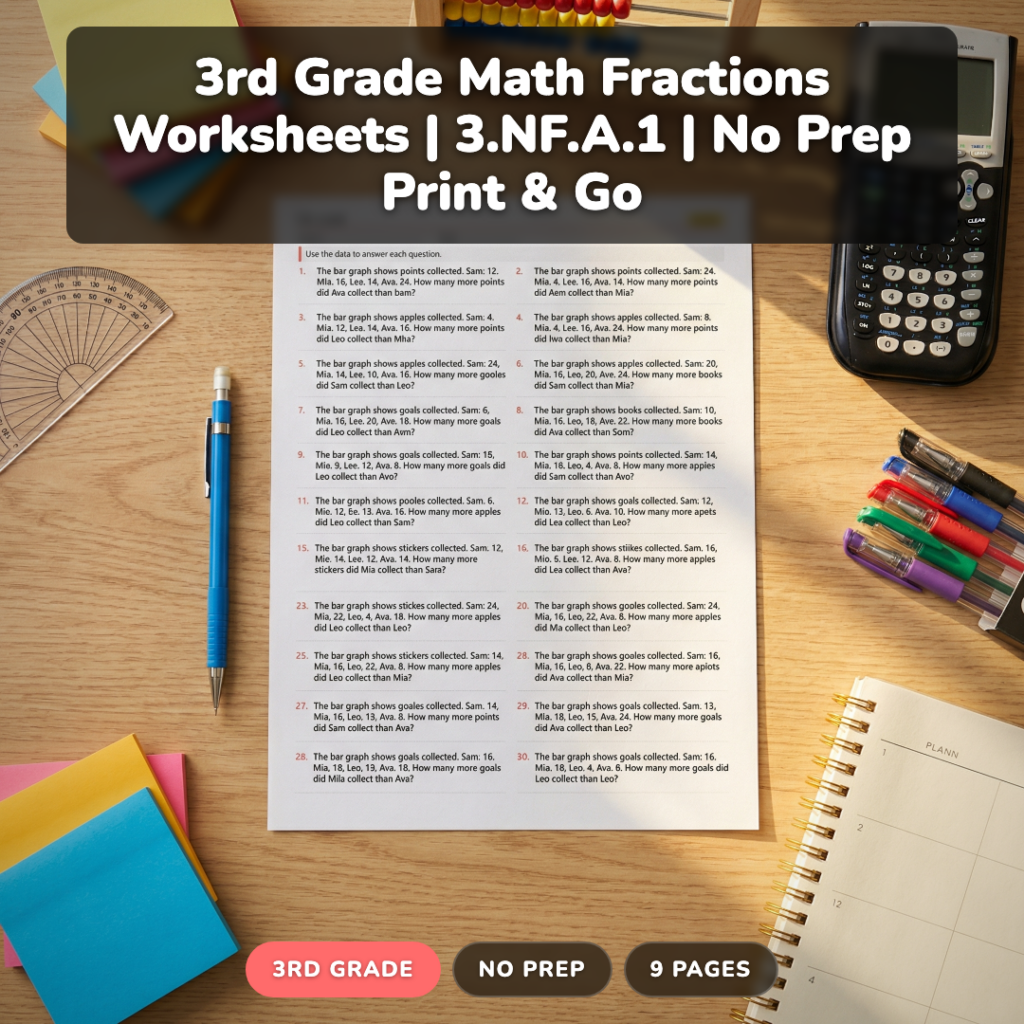
After years of teaching third grade fractions, I created a comprehensive resource that addresses all the strategies above while saving you hours of prep time. This differentiated fraction pack includes 132 carefully crafted problems across three levels: Practice (37 problems), On-Level (50 problems), and Challenge (45 problems).
What makes this resource different is the systematic progression from concrete to abstract thinking. The Practice level focuses heavily on visual models and unit fractions, the On-Level worksheets align perfectly with CCSS.Math.Content.3.NF.A.1 expectations, and the Challenge level extends learning without overwhelming students. Each level includes detailed answer keys and teaching notes.
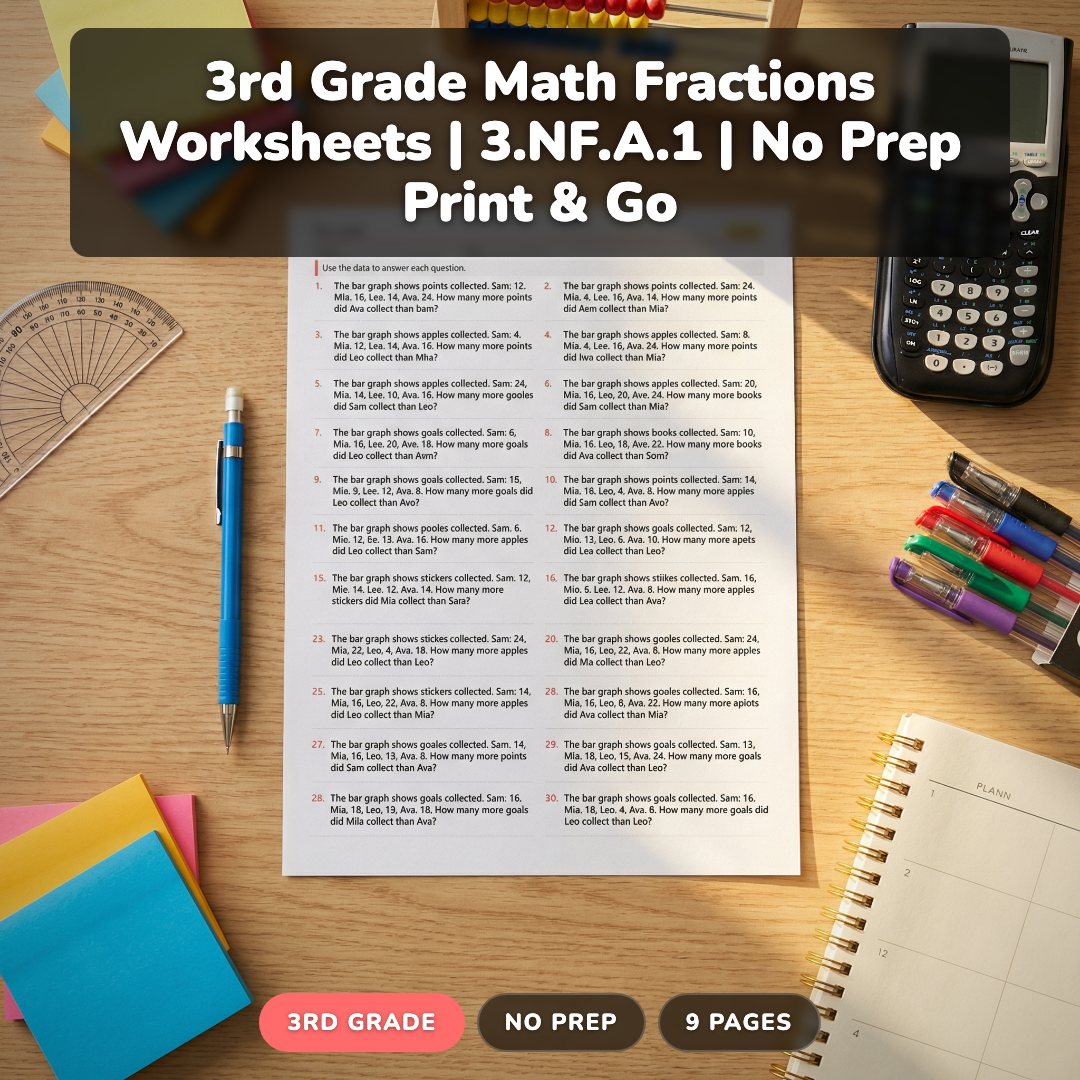
The 9-page pack covers everything from basic fraction identification to complex problem-solving scenarios, with clear visual models throughout. Students work with circles, rectangles, number lines, and real-world contexts across all three levels.
Grab a Free Fraction Sample to Try
Want to see the quality and differentiation before you buy? I’ll send you a free sample worksheet from each level — Practice, On-Level, and Challenge — plus my fraction teaching tips checklist. Perfect for trying these strategies with your students right away.
Frequently Asked Questions About Teaching 3rd Grade Fractions
When should I introduce fractions in third grade?
Most curricula introduce fractions in the second quarter, after students master place value through 1,000 and basic multiplication facts. Students need strong understanding of equal parts and sharing concepts before formal fraction instruction begins.
What manipulatives work best for teaching fractions?
Fraction circles, pattern blocks, fraction strips, and real objects like pizza or chocolate work exceptionally well. The key is using multiple representations so students see fractions as quantities, not just symbols or pictures.
How do I help students who think 1/8 is bigger than 1/4?
Use concrete models consistently. Have students physically break a chocolate bar into 4 pieces, then 8 pieces. Let them see and hold that 8 pieces means smaller individual pieces. Avoid rushing to symbolic work.
Should third graders learn equivalent fractions?
Basic equivalent fractions like 1/2 = 2/4 can be explored informally using manipulatives, but formal equivalent fraction work is a fourth-grade standard. Focus on building strong unit fraction understanding first.
How much time should I spend on fractions in third grade?
Plan for 4-6 weeks of consistent fraction instruction, with ongoing review throughout the year. Students need multiple exposures across different contexts to develop solid fraction sense and number understanding.
Teaching fractions successfully in third grade comes down to providing concrete experiences before abstract thinking. When students can physically see, touch, and manipulate fractional parts, they develop the number sense needed for future fraction work.
What’s your biggest challenge when teaching fractions? Try one of these strategies this week and see how your students respond. Don’t forget to grab your free fraction sample above — it’s a great way to test these approaches with your class.