If your third graders freeze when they see fractions on a number line, you’re not alone. This foundational skill trips up even mathematically confident students because it requires them to think about fractions as actual numbers with specific locations, not just parts of shapes. You’ll discover five research-backed strategies that make fraction number lines click for every learner in your classroom.
Key Takeaway
Students master fraction number lines when they physically partition intervals and connect each equal part to its fractional name through hands-on exploration before abstract practice.
Why Fraction Number Lines Matter in Third Grade
Fraction number lines represent a critical shift in mathematical thinking for third graders. Up until now, students have primarily encountered fractions as parts of shapes or sets. CCSS.Math.Content.3.NF.A.2a introduces fractions as actual numbers with specific locations on a number line, laying the groundwork for all future fraction work including addition, subtraction, and comparison.
Research from the National Mathematics Advisory Panel shows that students who master fraction number lines in elementary school demonstrate significantly stronger algebra readiness in middle school. This happens because number lines develop number sense — the intuitive understanding that 1/4 comes before 1/2, which comes before 3/4, and that these aren’t just symbols but represent actual quantities.
The standard requires students to partition the interval from 0 to 1 into equal parts, recognize that each part represents 1/b, and locate unit fractions precisely. This typically happens in late fall or early winter, after students have explored fractions with manipulatives and visual models.
Looking for a ready-to-go resource? I put together a differentiated fraction number line pack that covers everything below — but first, the teaching strategies that make it work.
Common Fraction Number Line Misconceptions in 3rd Grade
Common Misconception: Students think 1/4 goes at the first mark on any number line.
Why it happens: They count tick marks instead of understanding equal intervals.
Quick fix: Always start by identifying the whole (0 to 1) before placing any fractions.
Common Misconception: Students believe larger denominators mean larger fractions.
Why it happens: They apply whole number thinking where 8 is bigger than 3.
Quick fix: Use the pizza analogy — cutting a pizza into 8 pieces gives smaller slices than cutting it into 3 pieces.
Common Misconception: Students place fractions at random points without considering equal spacing.
Why it happens: They haven’t internalized that fractions represent precise locations.
Quick fix: Have students fold paper strips to create physical equal parts before drawing number lines.
Common Misconception: Students think the number line only shows fractions less than 1.
Why it happens: Initial instruction focuses on unit fractions between 0 and 1.
Quick fix: Extend number lines beyond 1 to show that fractions continue as real numbers.
5 Research-Backed Strategies for Teaching Fraction Number Lines
Strategy 1: Paper Strip Folding for Physical Partitioning
Students create their own number lines by folding paper strips, making the abstract concept of equal intervals concrete and tactile.
What you need:
- Paper strips (8.5″ x 2″ works well)
- Rulers
- Pencils
- Fraction cards (1/2, 1/3, 1/4, etc.)
Steps:
- Give each student a paper strip and have them mark 0 at the left end and 1 at the right end
- Students fold the strip in half, creating two equal parts, then mark 1/2
- For thirds, students fold into three equal parts (demonstrate the accordion fold)
- Students label each fold line with its corresponding unit fraction
- Have students compare their folded strips to verify equal spacing
- Transfer the markings to a drawn number line
Strategy 2: Human Number Line Movement
Students become fractions and position themselves on a floor number line, creating kinesthetic understanding of fraction locations and relationships.
What you need:
- Masking tape for floor number line
- Fraction cards to hold
- Yarn or rope (optional, for measuring equal intervals)
Steps:
- Create a large number line on the floor using masking tape, marking 0 and 1
- Give students fraction cards (1/2, 1/3, 1/4, 2/3, 3/4)
- Call out “1/2” and have that student find their position
- Add more fractions one at a time, with class discussion about placement
- Have students physically measure intervals to verify equal spacing
- Challenge students to arrange themselves in order without talking
Strategy 3: Fraction Number Line Race Game
Partner teams compete to correctly place fractions on number lines, combining practice with engagement while building fluency.
What you need:
- Laminated number line templates
- Dry erase markers
- Fraction cards
- Timer
- Answer keys
Steps:
- Partners receive a blank number line (0 to 1 marked) and a set of fraction cards
- Set timer for 3 minutes
- Teams draw one fraction card at a time and place it correctly on their number line
- Partners must agree on placement before drawing the next card
- Check answers together as a class, discussing any disagreements
- Award points for correct placement and good mathematical reasoning
Strategy 4: Benchmark Fraction Anchor Chart Building
Students create a visual reference showing key benchmark fractions (1/4, 1/2, 3/4) with multiple representations to support number line understanding.
What you need:
- Large chart paper
- Colored markers
- Fraction manipulatives (fraction bars, circles)
- Sticky notes
Steps:
- Draw a large number line from 0 to 1 on chart paper
- Have students identify where 1/2 belongs and mark it clearly
- Add 1/4 and 3/4, discussing their relationship to 1/2
- Below each fraction, attach visual models (fraction bars, circles)
- Students add real-world examples on sticky notes (1/4 = quarter of an hour)
- Display prominently and reference during all fraction number line work
Strategy 5: Fraction Story Problem Number Lines
Students solve real-world problems that require placing fractions on number lines, connecting abstract math to meaningful contexts.
What you need:
- Story problem cards
- Individual number line worksheets
- Colored pencils
- Manipulatives for modeling
Steps:
- Present a story: “Maya walked 1/4 of the way to school before stopping to tie her shoe”
- Students identify what represents the whole (distance to school = 0 to 1)
- Students partition their number line appropriately (fourths)
- Students locate and mark 1/4 on their number line
- Extend: “She then walked another 1/4. Where is she now?”
- Students discuss and justify their reasoning with partners
How to Differentiate Fraction Number Lines for All Learners
For Students Who Need Extra Support
Start with concrete manipulatives before moving to number lines. Use fraction bars or strips that students can physically place on number lines to see the connection between the manipulative and the abstract representation. Pre-mark some interval lines so students focus on fraction placement rather than partitioning. Limit initial practice to unit fractions with denominators of 2, 3, and 4. Provide number lines with different scales so students can see that 1/2 always falls at the midpoint regardless of the line’s length.
For On-Level Students
Students working at grade level should master CCSS.Math.Content.3.NF.A.2a by independently partitioning number lines into equal parts and accurately placing unit fractions. They should recognize that 1/3 is smaller than 1/2 and be able to explain why using the number line. Provide practice with denominators through 8, and include problems where students must create their own number lines rather than fill in pre-made ones. Students should connect fraction number lines to other fraction representations they’ve learned.
For Students Ready for a Challenge
Advanced students can work with fractions greater than 1, placing mixed numbers like 1 1/4 on number lines that extend beyond 1. Challenge them to compare fractions using number lines (“Which is greater: 2/3 or 3/4?”) and explain their reasoning. Introduce equivalent fractions on the same number line, showing that 1/2 and 2/4 occupy the same location. Have them create word problems that require fraction number line solutions and solve multi-step problems involving fraction addition on number lines.
A Ready-to-Use Fraction Number Line Resource for Your Classroom
After years of teaching fraction number lines, I’ve learned that students need lots of varied practice at just the right level. That’s why I created this comprehensive fraction number line worksheet pack that takes the guesswork out of differentiation.
The resource includes 132 problems across three difficulty levels: 37 practice problems for students who need extra support, 50 on-level problems that align perfectly with CCSS.Math.Content.3.NF.A.2a, and 45 challenge problems for advanced learners. Each level includes answer keys and covers different aspects of the standard — from basic partitioning to placing unit fractions to comparing fraction locations.
What makes this different from other fraction worksheets is the careful progression within each level. Students start with pre-marked number lines and gradually work toward creating their own partitions. The practice level uses larger denominators and provides visual scaffolds, while the challenge level introduces fractions greater than 1 and comparison problems.
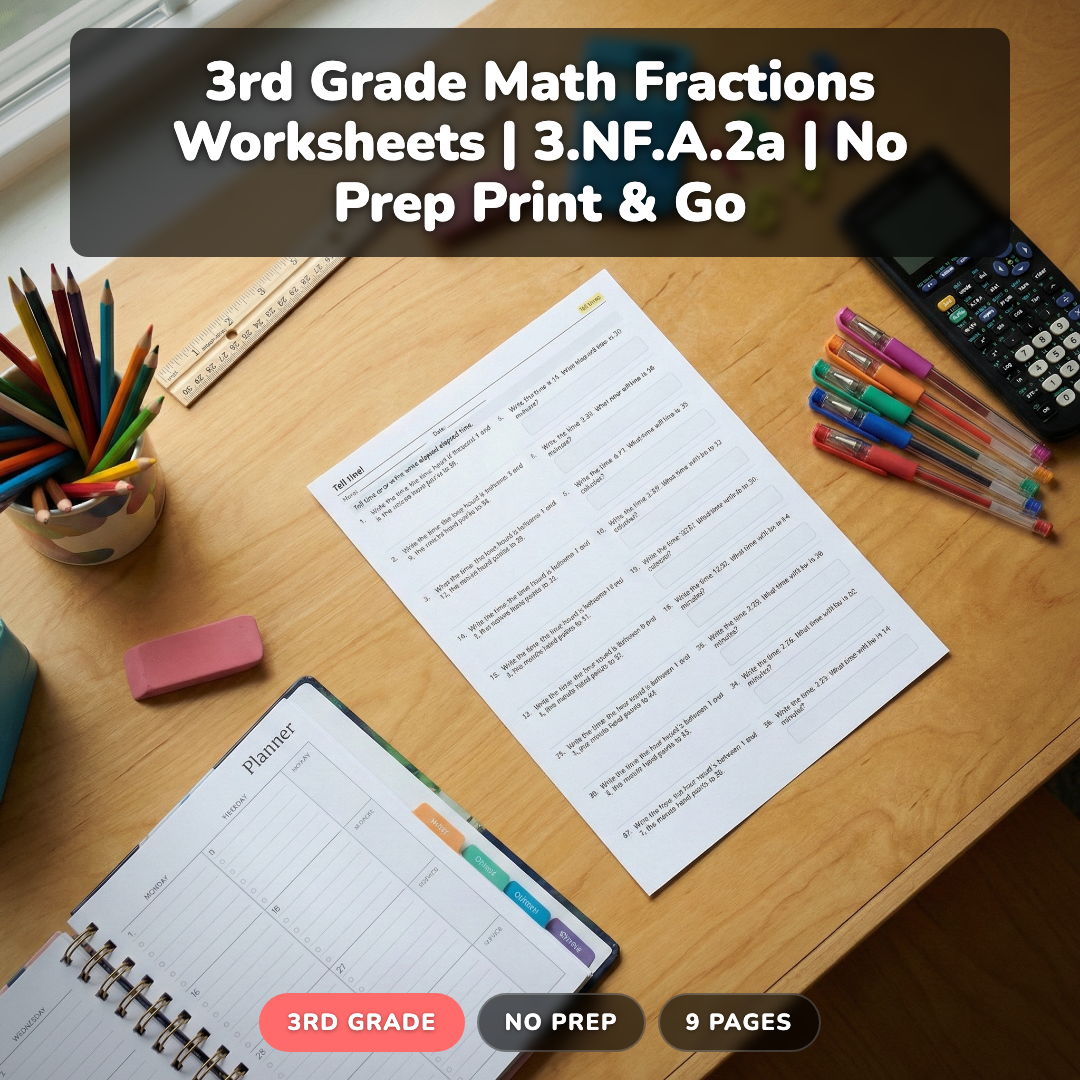
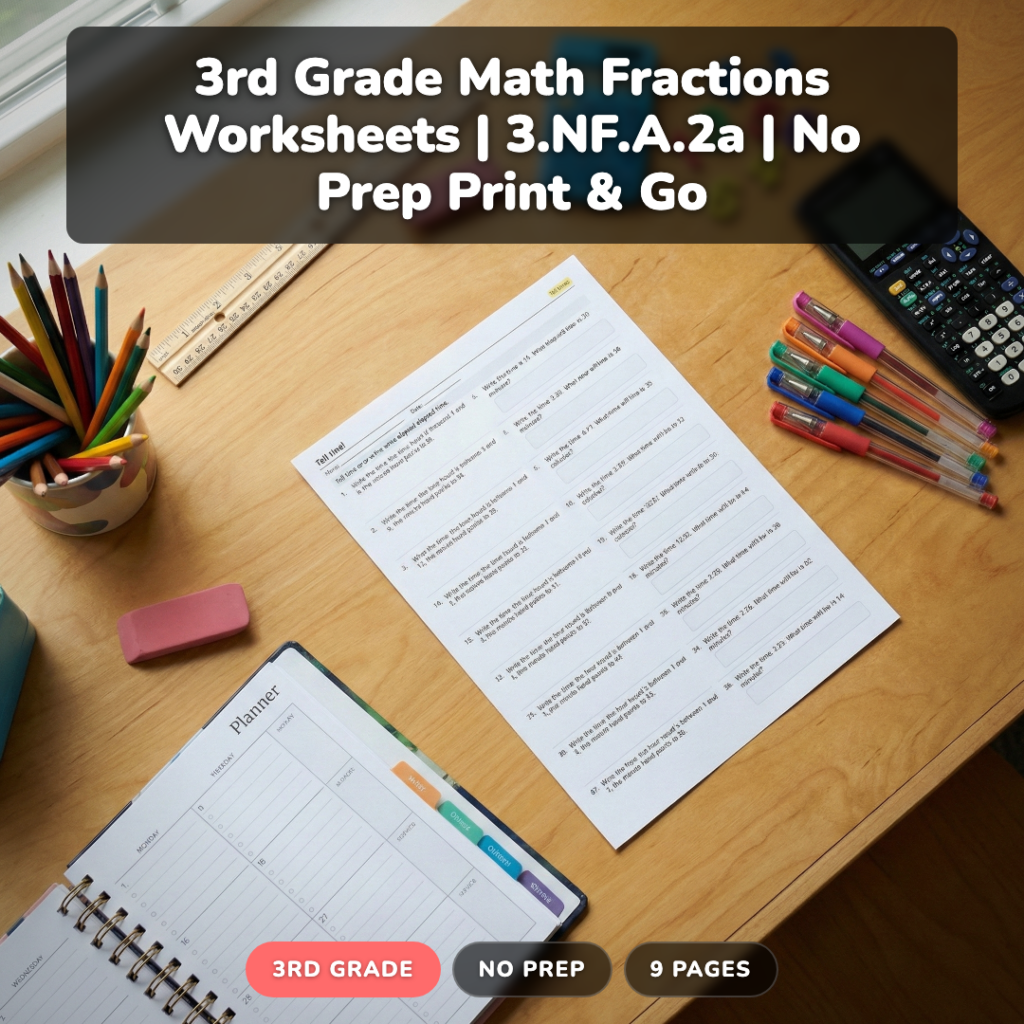
You can grab the complete differentiated fraction number line pack here — it’s saved me hours of prep time and given my students exactly the practice they need at their level.
Grab a Free Fraction Number Line Sample to Try
Want to see how the differentiated approach works? I’ll send you a free sample that includes one worksheet from each level plus the answer keys. Perfect for trying out the strategies above with your class.
Frequently Asked Questions About Teaching Fraction Number Lines
When should I introduce fraction number lines in 3rd grade?
Introduce fraction number lines after students have explored fractions with manipulatives and visual models, typically in late fall or early winter. Students need a solid foundation understanding fractions as parts of wholes before they can grasp fractions as numbers with specific locations.
What’s the biggest mistake teachers make with fraction number lines?
The biggest mistake is jumping to abstract number lines too quickly without enough concrete experience. Students need to physically partition intervals using folding, measuring, and manipulatives before they can accurately draw and use number lines independently.
How do I help students who place fractions randomly on number lines?
Focus on the partitioning step first. Have students fold paper strips or use fraction bars to create equal parts, then transfer those physical divisions to drawn number lines. Emphasize that each part must be exactly the same size.
Should 3rd graders work with fractions greater than 1 on number lines?
While CCSS.Math.Content.3.NF.A.2a focuses on unit fractions between 0 and 1, advanced students benefit from seeing number lines extended beyond 1. This helps them understand that fractions are real numbers that continue infinitely, not just parts of shapes.
How can I assess if students truly understand fraction number lines?
Ask students to create their own number line from scratch, partition it appropriately, and place given fractions. Then have them explain their reasoning. True understanding shows when students can justify why 1/4 comes before 1/2 and partition intervals accurately.
Teaching fraction number lines successfully comes down to making the abstract concrete through hands-on exploration before moving to independent practice. When students can physically feel equal intervals and connect them to fraction names, number line placement becomes logical rather than guesswork.
What’s your biggest challenge when teaching fraction number lines? Drop your email above to get that free sample, and let me know what strategies work best in your classroom!