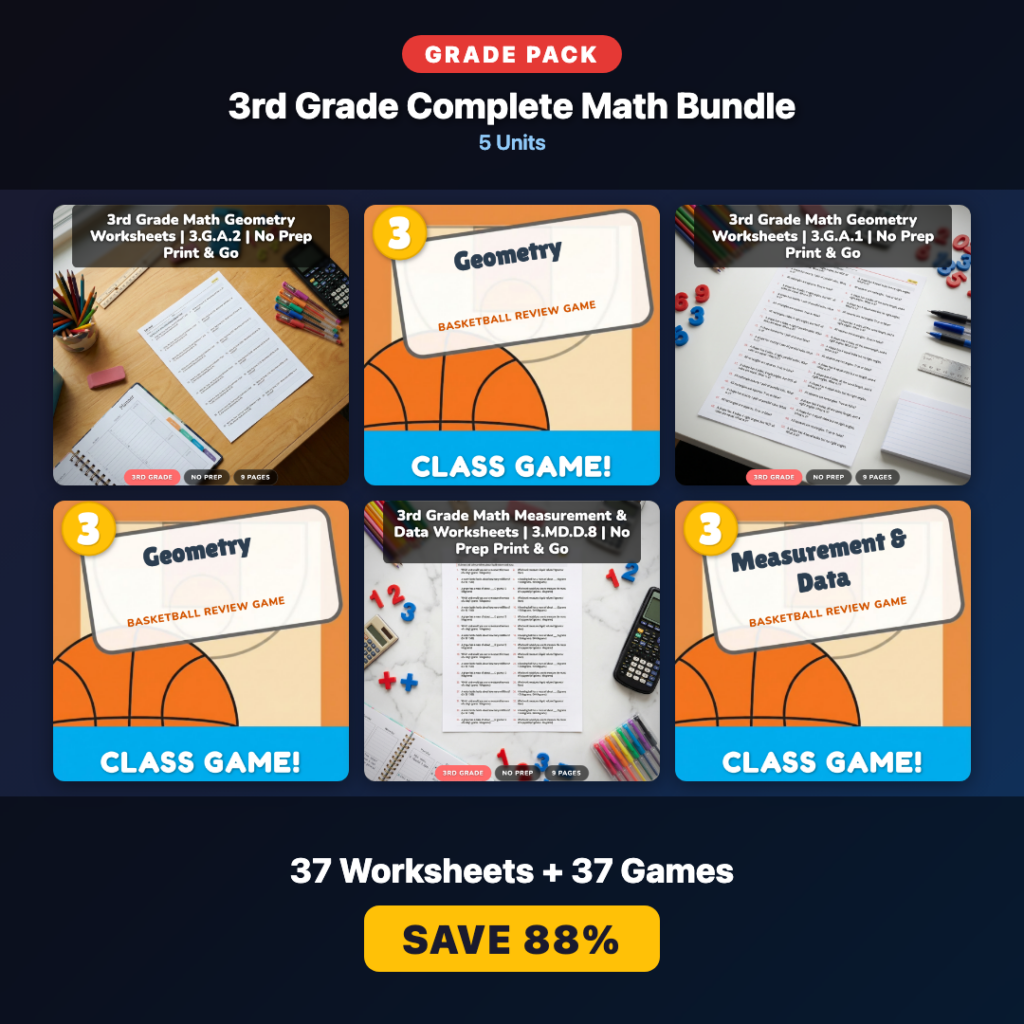
Planning an entire year of 3rd grade math instruction across five different domains feels overwhelming. You need differentiated worksheets for 37 different standards, engaging review activities, and resources that actually work with your diverse learners. The scope of covering everything from basic multiplication to fraction concepts to geometry can leave you scrambling for quality materials week after week.
This comprehensive guide walks you through every 3rd grade math domain with specific teaching strategies, common student challenges, and ready-to-use classroom activities. You’ll discover how to structure your year-long math instruction and find the complete resource collection that covers every single standard your students need to master.
Key Takeaway
Third grade math builds the foundation for multiplication, fractions, and geometric thinking through five core domains covering 37 Common Core standards.
3rd Grade Math: What Students Need to Master This Year
Third grade represents a pivotal year in mathematical development where students transition from concrete counting strategies to abstract mathematical reasoning. This is the year students master multiplication facts, understand fractions as numbers, and begin working with area and perimeter concepts that will support algebraic thinking in later grades.
The Common Core framework organizes 3rd grade math into five essential domains: Operations & Algebraic Thinking (9 standards) focuses on multiplication and division mastery, Number & Operations in Base Ten (3 standards) extends place value to 1,000, Number & Operations — Fractions (9 standards) introduces fractions as numbers on a number line, Measurement & Data (14 standards) covers time, mass, volume, area, and data analysis, and Geometry (2 standards) explores shapes and their attributes.
Students enter 3rd grade with addition and subtraction fluency within 20 and leave with multiplication and division fact fluency, fraction understanding, and measurement skills. This progression sets the stage for multi-digit operations, equivalent fractions, and geometric reasoning in 4th grade. Developmentally, 8 and 9-year-olds are ready for this abstract thinking while still benefiting from concrete manipulatives and visual representations.
Need ready-to-go resources for every standard below? I put together a complete 3rd grade math bundle with worksheets and review games for each one — but first, here’s your domain-by-domain guide.
Operations & Algebraic Thinking: Building Multiplication & Division Fluency
Operations & Algebraic Thinking forms the mathematical backbone of 3rd grade, where students develop fluency with multiplication and division facts through 100. This domain covers nine standards including interpreting products and quotients (CCSS.Math.Content.3.OA.A.1), using multiplication and division to solve word problems (CCSS.Math.Content.3.OA.A.3), and achieving fluency with facts through 10 × 10 (CCSS.Math.Content.3.OA.C.7).
Operations & Algebraic Thinking: From Skip Counting to Fact Fluency
Students build multiplication understanding through equal groups, arrays, and area models before memorizing facts. The progression moves from concrete manipulatives to abstract number relationships.
Start with concrete multiplication experiences using counters, cubes, or classroom objects arranged in equal groups. Students need to see that 3 × 4 means “3 groups of 4” before they can understand the commutative property. Array activities with dot paper or square tiles help students visualize multiplication as rows and columns, building the foundation for area concepts later in the year.
Division instruction should connect directly to multiplication through fact families and the relationship between the operations. When students understand that 24 ÷ 6 asks “how many groups of 6 make 24?” they can use their multiplication knowledge to find the answer. Word problems become more accessible when students can identify whether they’re looking for the total, the number of groups, or the size of each group.
Common struggles in this domain include confusing multiplication and addition, difficulty with zero and one as factors, and challenges with two-step word problems. Interactive basketball review games help students practice fact fluency while worksheets provide structured problem-solving practice with various problem types and visual supports.
For detailed strategies and free resources for each standard, see our posts on teaching area measurement concepts and foundational area strategies.
Number & Operations in Base Ten: Extending Place Value Understanding
Number & Operations in Base Ten extends students’ place value understanding to 1,000 while building fluency with addition and subtraction algorithms. The three standards in this domain focus on using place value understanding for rounding (CCSS.Math.Content.3.NBT.A.1), fluently adding and subtracting within 1,000 (CCSS.Math.Content.3.NBT.A.2), and multiplying one-digit numbers by multiples of 10 (CCSS.Math.Content.3.NBT.A.3).
Number & Operations in Base Ten: Making Hundreds Concrete
Students need hands-on experience with base ten blocks and place value charts to understand that 10 tens make 1 hundred. This concrete foundation supports abstract algorithms.
Place value instruction requires extensive work with base ten manipulatives, place value charts, and number lines to 1,000. Students need to understand that 456 represents 4 hundreds, 5 tens, and 6 ones before they can successfully round numbers or use algorithms. Rounding becomes logical when students can visualize numbers on a number line and determine which hundred or ten they’re closest to.
Addition and subtraction algorithms build on place value understanding through regrouping activities. Students should experience “trading” 10 ones for 1 ten with manipulatives before using the standard algorithm on paper. The connection between concrete regrouping and abstract borrowing helps students understand why the algorithm works, not just how to follow the steps.
Multiplication by multiples of 10 connects to skip counting patterns and place value concepts. When students understand that 6 × 30 means “6 groups of 3 tens,” they can use their basic facts and place value knowledge to find 18 tens or 180. This foundation prepares students for multi-digit multiplication in 4th grade.
Number & Operations — Fractions: Understanding Fractions as Numbers
Number & Operations — Fractions introduces students to fractions as numbers on the number line, moving beyond the “parts of a whole” concept from earlier grades. This domain includes nine standards covering unit fractions (CCSS.Math.Content.3.NF.A.1), fractions on number lines (CCSS.Math.Content.3.NF.A.2), equivalent fractions (CCSS.Math.Content.3.NF.A.3), and comparing fractions (CCSS.Math.Content.3.NF.A.3.D).
Number & Operations — Fractions: From Parts to Numbers
Students must understand fractions as numbers that exist between whole numbers, not just pieces of pizza. Number line work is essential for this conceptual shift.
Fraction instruction begins with unit fractions (1/2, 1/3, 1/4) as the building blocks for all other fractions. Students need extensive experience partitioning shapes, sets, and number lines into equal parts before they can understand that 3/4 means “3 copies of the unit fraction 1/4.” This unit fraction foundation makes equivalent fractions and fraction comparison logical rather than procedural.
Number line work is crucial for developing fraction number sense. When students can place 1/2, 2/4, and 3/6 on the same number line location, they understand equivalent fractions conceptually. Fraction strips, circular fraction models, and rectangular area models all support this understanding, but the number line helps students see fractions as numbers rather than just parts of objects.
Comparing fractions becomes systematic when students understand that fractions with the same denominator compare by numerator (more parts of the same size), while fractions with the same numerator compare by denominator (same number of parts, but different sizes). This reasoning prepares students for more complex fraction operations in later grades.
Common fraction misconceptions include thinking larger denominators mean larger fractions, confusing equivalent fractions with equal whole numbers, and difficulty placing fractions on number lines. Hands-on activities with fraction manipulatives and systematic practice with basketball review games help students build accurate fraction concepts.
Measurement & Data: Connecting Math to Real-World Applications
Measurement & Data encompasses 14 standards that connect mathematical concepts to real-world applications through time, mass, volume, area, perimeter, and data analysis. Key standards include solving problems involving time intervals (CCSS.Math.Content.3.MD.A.1), measuring and estimating masses and volumes (CCSS.Math.Content.3.MD.A.2), understanding area concepts (CCSS.Math.Content.3.MD.C.5), and finding areas of rectangles (CCSS.Math.Content.3.MD.C.7).
Measurement & Data: Making Abstract Concepts Concrete
Students learn measurement through hands-on experiences with actual tools and real objects. Area and perimeter make sense when students measure classroom spaces and objects.
Time instruction focuses on elapsed time problems that require students to use number lines, clocks, and time intervals. Students need practice with both analog and digital time formats while solving problems like “The movie starts at 2:15 PM and lasts 1 hour and 45 minutes. What time does it end?” These real-world contexts make time calculation meaningful and help students develop time number sense.
Mass and volume measurement introduces metric units through hands-on experiences with scales, measuring cups, and estimation activities. Students need to develop benchmarks for grams, kilograms, liters, and milliliters through actual measurement rather than memorizing conversion charts. Estimation skills develop when students handle objects and liquids regularly.
Area concepts build directly on multiplication understanding as students discover that rectangles with dimensions 4 by 6 have an area of 24 square units. The connection between arrays, multiplication, and area helps students understand why length × width calculates area. Perimeter instruction should contrast with area — students need to understand that area measures the space inside while perimeter measures the distance around.
Data analysis involves creating and interpreting scaled picture graphs and bar graphs where symbols represent more than one object. Students learn to ask and answer questions about data while developing skills in organizing, representing, and analyzing information. These skills connect to real classroom data like favorite subjects, pet ownership, or lunch choices.
For detailed strategies and free resources for measurement standards, see our posts on teaching perimeter concepts, area addition strategies, area and distributive property connections, and foundational area measurement strategies.
Geometry: Exploring Shapes and Their Properties
Geometry in 3rd grade focuses on two essential standards that build spatial reasoning and shape analysis skills. Students learn to understand and categorize shapes by their attributes (CCSS.Math.Content.3.G.A.1) and partition shapes into equal areas to understand fractions (CCSS.Math.Content.3.G.A.2). This domain connects directly to fraction concepts and measurement understanding.
Geometry: Building Spatial Reasoning Through Attributes
Students analyze shapes by their defining attributes rather than appearance. A triangle is defined by having 3 sides and 3 angles, not by its orientation or size.
Shape classification moves beyond simple identification to attribute analysis. Students learn that quadrilaterals include squares, rectangles, rhombuses, and trapezoids because they all have four sides and four angles. This categorical thinking prepares students for more complex geometric reasoning in later grades. Attribute activities help students understand that a square is a special rectangle, and a rectangle is a special parallelogram.
Partitioning shapes into equal areas connects geometry to fraction understanding. When students divide rectangles into fourths or circles into eighths, they see the relationship between geometric division and fraction concepts. These activities reinforce that equal parts must have equal areas, not just equal counts, building important fraction foundations.
Spatial reasoning develops through hands-on activities with pattern blocks, tangrams, and geoboards. Students need opportunities to compose and decompose shapes, create designs, and describe geometric relationships. These experiences build the spatial visualization skills necessary for more advanced geometry concepts.
Common geometry challenges include confusing shape names with attributes, difficulty seeing shapes in different orientations, and misconceptions about equal parts in fraction contexts. Hands-on manipulative work and systematic practice with interactive games help students develop accurate geometric concepts and vocabulary.
For detailed strategies and free resources for geometry standards, see our posts on partitioning shapes for fraction understanding and shape attribute analysis strategies.
What’s in the 3rd Grade Complete Math Bundle?
37 Differentiated Worksheet Sets
Each worksheet set includes a full-color PDF version, black and white printer-friendly option, complete answer keys, and Google Slides format for digital learning. Every set provides three difficulty levels to support struggling learners, on-level students, and advanced mathematicians. The 37 sets cover every single Common Core standard with multiple problem types, visual supports, and real-world contexts. With over 999+ total pages, you’ll have enough practice materials for the entire school year plus test prep and review sessions.
37 Interactive Basketball Review Games
Each basketball review game includes HTML5 format that works on Smartboards, Chromebooks, and iPads without downloads or plugins. Every game offers three difficulty levels with 2-team competition features that turn review into exciting classroom tournaments. The 37 games contain over 2,220 total questions covering every standard with immediate feedback and score tracking. Try the free demo game to see how these interactive reviews engage your students while reinforcing key concepts.
Bundle Savings
Individual worksheet and game sets would cost $222.00 if purchased separately, but the complete bundle is just $27.00 — an 88% savings that breaks down to only $0.73 per standard. The school license option at $40.50 allows sharing across your entire building while still providing massive savings compared to individual purchases. This investment covers your entire year of 3rd grade math instruction with professional-quality resources.
5 Ways to Use This Bundle All Year Long
1. Daily Practice & Warm-Ups
Use worksheet sections as 5-10 minute warm-up activities that review previously taught concepts while introducing new skills. The differentiated levels allow you to assign appropriate practice for each student’s needs without creating multiple lesson plans.
2. Test Prep & Review
Basketball review games turn test preparation into interactive team competitions. Students practice standards in a game format that reduces test anxiety while reinforcing key concepts through immediate feedback and repeated practice opportunities.
3. Math Centers & Stations
Set up Chromebook or iPad stations with basketball games while other students work on worksheet practice. The self-paced digital format allows independent learning while you work with small groups or provide individual support.
4. Sub Plans
Leave a basketball game and corresponding worksheet for easy substitute teacher coverage. The clear instructions and self-contained activities require minimal preparation while maintaining productive learning time during your absence.
5. Differentiated Small Groups
Use the three difficulty levels to target instruction for struggling students, on-level learners, and advanced mathematicians. The consistent format across all materials allows flexible grouping based on current needs rather than fixed ability levels.
Supporting Every Learner in 3rd Grade Math
For Struggling Students
Start with Level 1 difficulty in both worksheets and games, which provides additional visual supports, smaller numbers, and guided practice steps. Use manipulatives alongside worksheet problems and allow extra time for basketball game completion. The immediate feedback in games helps struggling students self-correct without teacher intervention.
For On-Level Students
Level 2 materials provide grade-level appropriate challenge with standard algorithms and problem-solving strategies. These students can work independently on worksheets while participating in competitive basketball games that reinforce learning through repetition and peer interaction.
For Advanced Students
Level 3 offers extension problems, multi-step challenges, and cross-domain connections that push mathematical thinking beyond basic standards. Advanced students can mentor struggling peers during game play while tackling more complex worksheet problems independently.
Get the Complete 3rd Grade Math Bundle
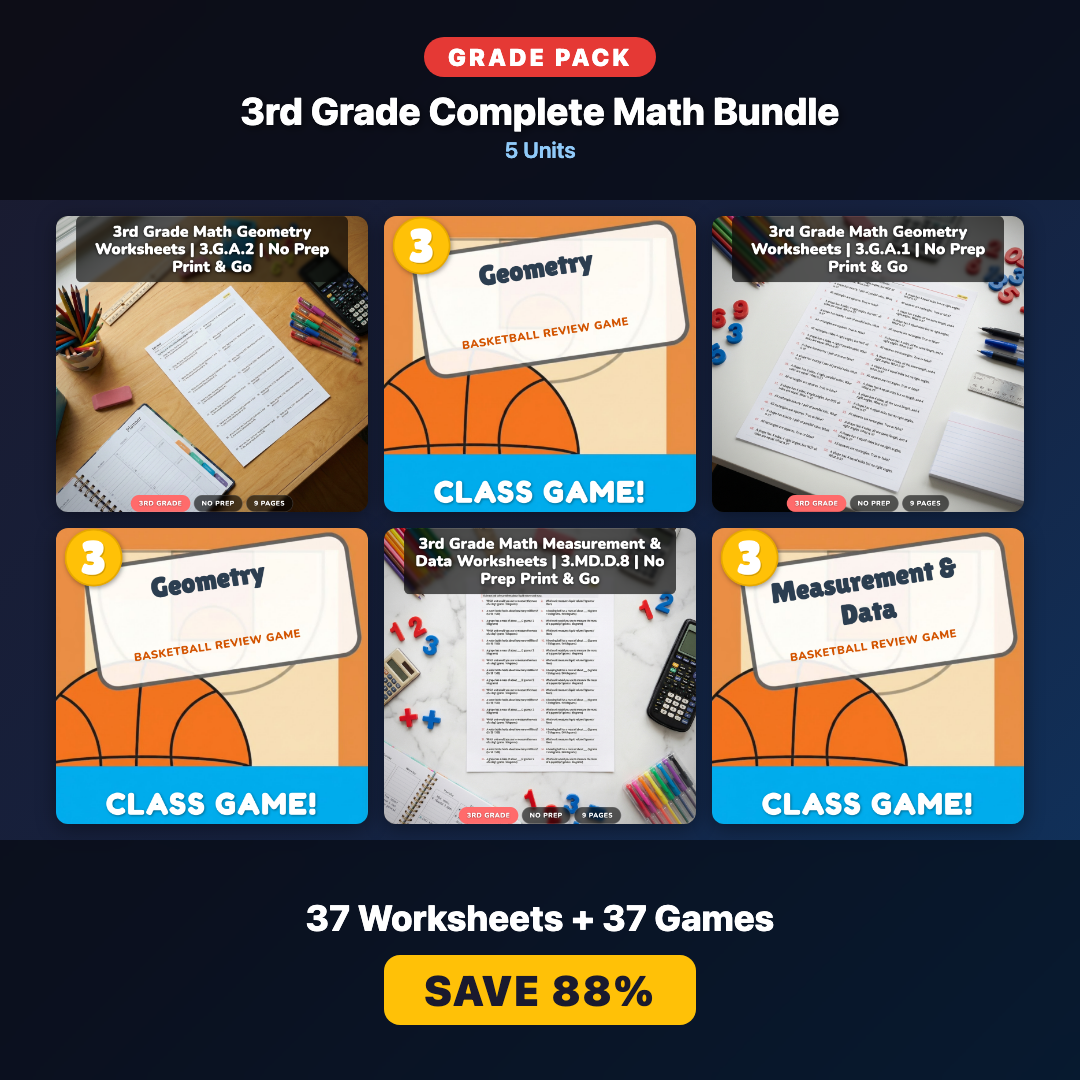
This comprehensive bundle provides everything you need for a full year of 3rd grade math instruction: 37 differentiated worksheet sets, 37 interactive basketball review games, and complete coverage of all Common Core standards. Save 88% compared to individual purchases while getting professional-quality resources that engage students and support diverse learning needs.
Get the Complete Bundle on TpT
Want to try before you buy? Play the free demo game to experience the interactive review format your students will love.
Try a Free Sample First
Not ready for the full bundle? Drop your email and I’ll send you a free 3rd grade math worksheet pack with sample problems from each domain plus access to additional demo games.
Frequently Asked Questions About 3rd Grade Math Resources
What specific standards does this bundle cover?
The bundle covers all 37 Common Core standards across five domains: Operations & Algebraic Thinking (9 standards), Number & Operations in Base Ten (3 standards), Number & Operations — Fractions (9 standards), Measurement & Data (14 standards), and Geometry (2 standards). Each standard gets its own dedicated worksheet set and review game.
How do the basketball review games work?
Students answer math questions to score baskets in a 2-team competition format. Correct answers advance the ball toward the basket, while incorrect answers provide immediate feedback and second chances. Games work on any device with internet access and include three difficulty levels for differentiation.
Can I use these resources on Chromebooks and iPads?
Yes! The basketball games are HTML5 format that works on any device with internet access — no downloads or plugins required. Worksheets come in both PDF and Google Slides format for easy digital distribution and completion on any device.
Is there a school license option available?
Yes, the school license is $40.50 and allows sharing across your entire building. This includes permission for all teachers in your school to use the materials with their students, making it an excellent value for math departments or grade-level teams.
Do the worksheets include complete answer keys?
Every worksheet set includes detailed answer keys with step-by-step solutions where appropriate. This allows for quick grading and helps you identify common student errors or misconceptions that need additional instruction.
How are the three difficulty levels different?
Level 1 provides additional visual supports, smaller numbers, and guided practice steps for struggling students. Level 2 offers grade-level appropriate problems with standard algorithms. Level 3 includes extension problems, multi-step challenges, and cross-domain connections for advanced learners.
Planning a complete year of 3rd grade math instruction doesn’t have to overwhelm you. With 37 differentiated worksheet sets and 37 interactive review games covering every Common Core standard, you can focus on teaching while having confidence that your resources support every learner in your classroom.
What’s your biggest challenge when planning math instruction for diverse learners? The combination of hands-on activities, visual supports, and interactive technology in this bundle addresses the most common classroom needs while saving you countless hours of preparation time.
Remember to try the free demo game and grab your sample worksheet pack above. Looking for resources for other grade levels? Check out our complete math bundles for 2nd and 4th grade as well.