If your kindergarten students freeze when they hear “word problem” or randomly pick numbers without thinking through the story, you’re not alone. Teaching operations and algebraic thinking at this age requires breaking down abstract concepts into concrete, hands-on experiences that make sense to five and six-year-olds.
You’ll discover five research-backed strategies that help kindergarteners solve addition and subtraction word problems with confidence, plus differentiation tips for every learner in your classroom.
Key Takeaway
Kindergarteners need to act out word problems with real objects before they can visualize or solve them abstractly.
Why Operations & Algebraic Thinking Matters in Kindergarten
Operations and algebraic thinking forms the foundation for all future math learning. At the kindergarten level, CCSS.Math.Content.K.OA.A.2 requires students to solve addition and subtraction word problems within 10 using objects or drawings to represent the problem.
Research from the National Research Council shows that students who master concrete problem-solving strategies in kindergarten demonstrate significantly stronger algebraic reasoning skills in later grades. The timing matters too — this standard typically appears in the second half of the kindergarten year, after students have developed number sense and counting skills through 10.
According to the Common Core progression documents, kindergarteners should spend 65% of their math time on number and operations concepts. Word problems aren’t just about computation — they develop critical thinking, reading comprehension, and mathematical reasoning that transfers across all subject areas.
Looking for a ready-to-go resource? I put together a differentiated word problem pack that covers everything below — but first, the teaching strategies that make it work.
Common Word Problem Misconceptions in Kindergarten
Common Misconception: Students think all word problems require addition.
Why it happens: Many early math experiences focus on “putting together” or “adding more,” so students default to addition for every story problem.
Quick fix: Use action words like “gave away,” “ate,” or “left” and act out subtraction scenarios daily.
Common Misconception: Students grab any numbers they see without understanding the story.
Why it happens: They haven’t learned to visualize the problem or connect the story to the mathematical operation.
Quick fix: Cover the numbers and ask “What’s happening in this story?” before revealing any digits.
Common Misconception: Students think they need to count everything from 1 each time.
Why it happens: They haven’t developed counting-on strategies or number flexibility.
Quick fix: Model starting with the larger number and counting on, using a number line or ten frame.
Common Misconception: Students believe drawings must be perfect to be correct.
Why it happens: They focus on artistic ability rather than mathematical representation.
Quick fix: Show simple circles, tally marks, or dots as valid mathematical drawings.
5 Research-Backed Strategies for Teaching Word Problems
Strategy 1: Act It Out with Real Objects
The most powerful strategy for kindergarten word problems involves physical manipulation of concrete objects. Students need to touch, move, and count real items before they can visualize problems mentally.
What you need:
- Counting bears, cubes, or other manipulatives
- Small containers or plates for sorting
- Simple word problem cards with 1-2 sentences
Steps:
- Read the problem aloud twice while students listen
- Ask “What’s happening in this story?” before showing any numbers
- Have students use manipulatives to act out each part of the story
- Count together to find the answer
- Connect the concrete action to the abstract number sentence
Strategy 2: Story Problem Theater
Turn word problems into mini-dramas where students become the characters and act out the mathematical situations. This kinesthetic approach helps students understand the action and operation needed.
What you need:
- Simple props (toy food, stuffed animals, books)
- Story problem scripts with clear action words
- Space for students to move around
Steps:
- Choose 2-3 students to be “actors” in the word problem
- Read the problem and assign roles (“Maya has 4 apples…”)
- Have actors demonstrate the action while classmates watch
- Pause at the question and ask the audience to predict
- Complete the action and count together for the answer
Strategy 3: Picture Drawing with Number Bonds
Teach students to draw simple representations of word problems using circles, dots, or basic shapes, then connect their drawings to number bond diagrams that show part-whole relationships.
What you need:
- Whiteboards and markers for each student
- Number bond templates (circles connected with lines)
- Word problems with clear visual elements
Steps:
- Read the problem and identify what to draw
- Model drawing simple shapes (not detailed pictures)
- Show how to cross out objects for subtraction problems
- Transfer the drawing to a number bond diagram
- Write the number sentence that matches
Strategy 4: Number Line Jumping
Use a large floor number line or individual number line strips to help students visualize addition as moving forward and subtraction as moving backward. This builds spatial number sense alongside problem-solving skills.
What you need:
- Floor number line (0-10) with tape or chalk
- Individual number line strips for each student
- Small game pieces or counters for markers
Steps:
- Start at the first number mentioned in the problem
- For addition, jump forward the second number of spaces
- For subtraction, jump backward the second number of spaces
- Land on the answer and verify by counting
- Record the number sentence that matches the jumps
Strategy 5: Ten Frame Problem Solving
Ten frames provide a structured visual that helps kindergarteners see number relationships and develop efficient counting strategies for word problems within 10.
What you need:
- Ten frame mats (2×5 grids)
- Two-color counters or beans
- Word problems that work well with ten frame visualization
Steps:
- Place the starting number of counters on the ten frame
- For addition problems, add more counters in a different color
- For subtraction problems, remove the specified number of counters
- Count the final result using the ten frame structure
- Discuss patterns (“I see 5 and 2 more makes 7”)
How to Differentiate Operations & Algebraic Thinking for All Learners
For Students Who Need Extra Support
Start with problems using numbers 1-5 and focus on addition before introducing subtraction. Provide concrete manipulatives for every problem and use consistent language (“How many altogether?” for addition, “How many are left?” for subtraction). Review counting skills and one-to-one correspondence if students struggle with basic number concepts. Use problems with familiar contexts like toys, food, or classroom objects.
For On-Level Students
Work with the full range of numbers 1-10 as specified in CCSS.Math.Content.K.OA.A.2. Mix addition and subtraction problems within the same lesson. Encourage multiple solution strategies (counting all, counting on, using fingers, drawing pictures). Introduce simple word problems with unknown addends (“Sam had some stickers. His mom gave him 3 more. Now he has 7 stickers. How many did he start with?”).
For Students Ready for a Challenge
Introduce two-step problems (“Maya had 8 crayons. She gave 2 to her friend and bought 1 more. How many does she have now?”). Encourage students to create their own word problems for classmates to solve. Explore problems with three addends within 10. Connect to early algebraic thinking by using symbols or boxes for unknown numbers in number sentences.
A Ready-to-Use Word Problem Resource for Your Classroom
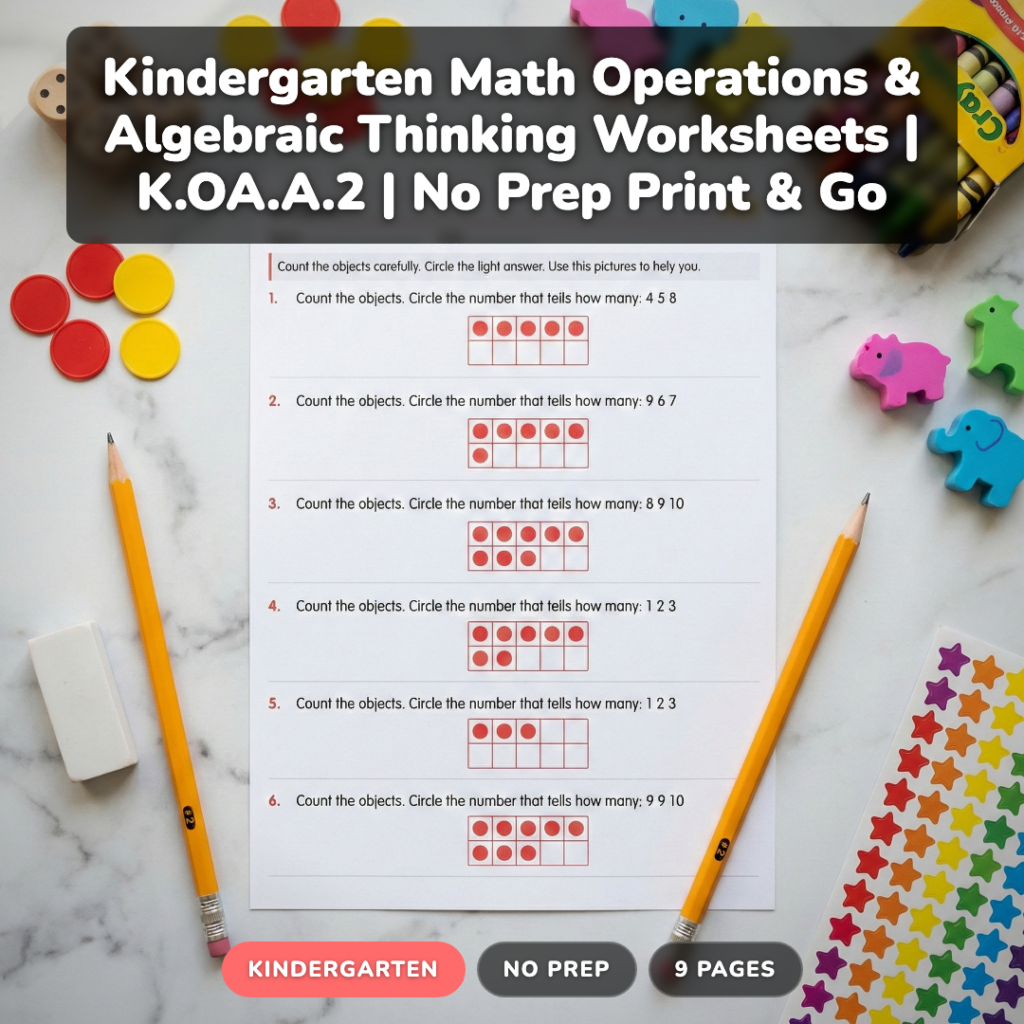
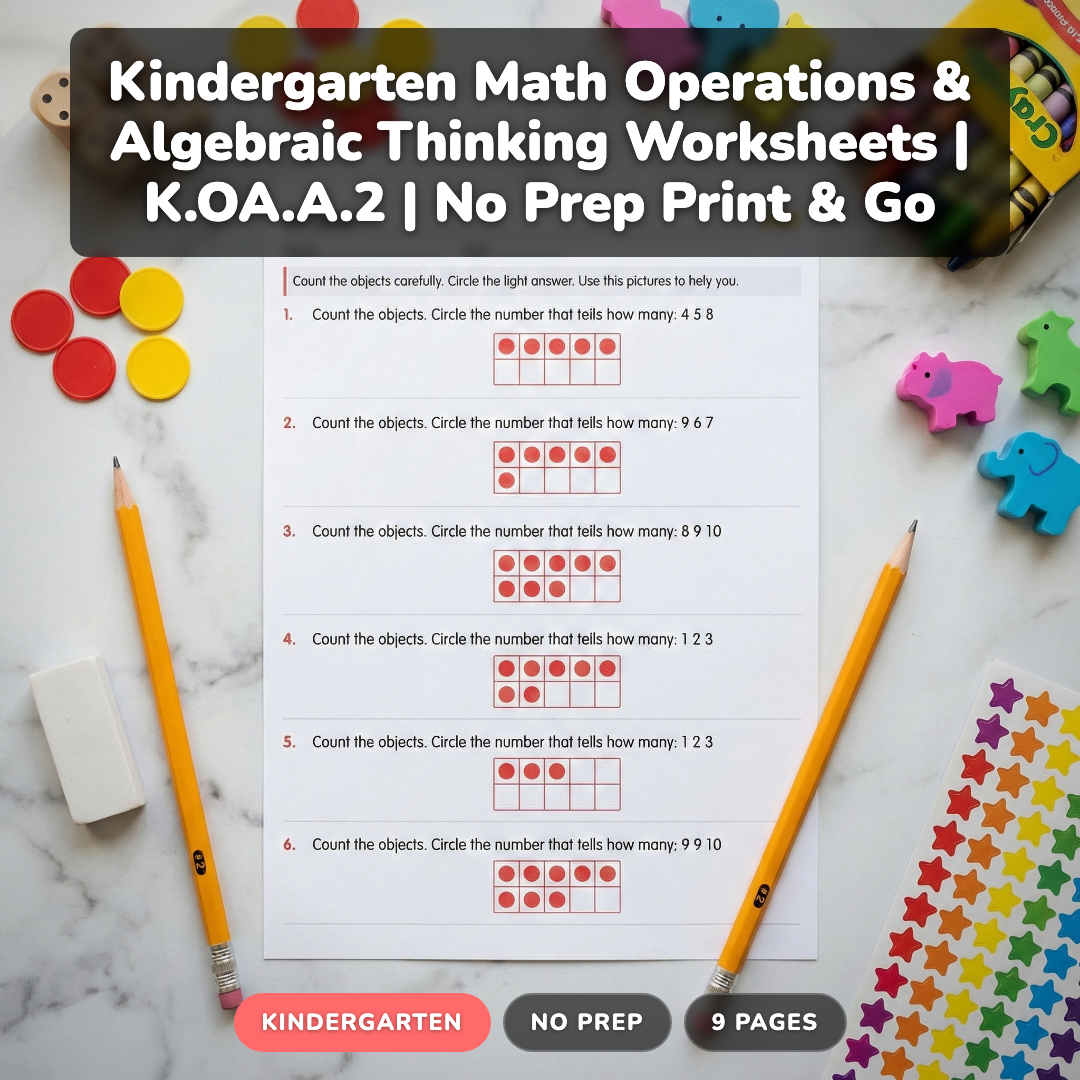
After years of creating word problems from scratch and watching students struggle with poorly designed practice, I developed a comprehensive resource that addresses every challenge mentioned above. This differentiated word problem pack includes 79 carefully crafted problems across three difficulty levels.
The Practice level (22 problems) focuses on numbers 1-5 with clear action words and familiar contexts. On Level problems (30 problems) use the full 1-10 range with mixed operations. Challenge problems (27 problems) include unknown addends and multi-step scenarios. Each page includes visual supports and follows a consistent format that reduces cognitive load.
What makes this different from other resources? Every problem has been classroom-tested with real kindergarteners. The progression builds systematically from concrete to abstract thinking, and the answer keys include multiple solution strategies teachers can model.
You can grab this time-saving resource and start using it tomorrow in your classroom.
Grab a Free Word Problem Sample to Try
Want to see how these strategies work in practice? I’ll send you a free sample page from the resource above, plus a quick reference guide for the five teaching strategies. Perfect for trying out these techniques with your students before committing to the full resource.
Frequently Asked Questions About Teaching Operations & Algebraic Thinking
When should I introduce word problems in kindergarten?
Start word problems after students can count to 10 and understand basic addition/subtraction concepts, typically in January or February. Begin with simple action problems using numbers 1-5 before progressing to the full CCSS.Math.Content.K.OA.A.2 expectations of working within 10.
How do I help students who can’t read the word problems yet?
Read all word problems aloud and use picture supports whenever possible. Focus on listening comprehension and mathematical reasoning rather than reading skills. Partner struggling readers with stronger readers, or provide audio recordings of problems for independent work.
What’s the difference between computation practice and word problems?
Computation focuses on number facts and procedures (3+2=5), while word problems develop mathematical reasoning and real-world application. Word problems require students to determine which operation to use, not just calculate an answer. Both are important for kindergarten math development.
How many word problems should kindergarteners solve per day?
Start with 1-2 word problems per day, focusing on quality discussion and multiple solution strategies rather than quantity. As students develop confidence, you can increase to 3-4 problems, but always prioritize understanding over speed or volume.
Should kindergarteners write number sentences for word problems?
Yes, but only after they understand the problem through concrete manipulation or drawing. Start by having students say the number sentence aloud, then gradually introduce writing 4+3=7. The focus should be on connecting the story to the mathematical representation.
Teaching operations and algebraic thinking in kindergarten sets the foundation for all future math success. When you provide concrete experiences, encourage multiple solution strategies, and differentiate for all learners, you’re building confident problem-solvers who see math as meaningful and accessible.
What’s your biggest challenge when teaching word problems to kindergarteners? Try one of these strategies this week and see how your students respond. Don’t forget to grab your free sample resource above — it’s a great way to test these techniques in your own classroom.