If your kindergarten students look confused when you say “fifteen has ten ones and five more ones,” you’re not alone. Teaching teen numbers — those tricky numbers from 11 to 19 — challenges even experienced kindergarten teachers. The concept that 15 equals 10 + 5 seems simple to us, but for five and six-year-olds, it’s a major cognitive leap.
This post shares five research-backed strategies that help kindergarten students truly understand how teen numbers work, plus differentiation tips for every learner in your classroom.
Key Takeaway
Teen numbers are the foundation for place value understanding — master these in kindergarten, and students excel in first grade and beyond.
Why Teen Numbers Matter in Kindergarten
Teen numbers bridge the gap between single-digit counting and true place value understanding. When students master CCSS.Math.Content.K.NBT.A.1 — composing and decomposing numbers 11-19 into ten ones and additional ones — they’re building the foundation for all future math learning.
Research from the National Council of Teachers of Mathematics shows that students who understand teen number structure in kindergarten perform 23% better on place value assessments in second grade. This skill directly connects to addition and subtraction strategies, mental math, and number sense development.
Teen numbers appear in your math curriculum around February or March, after students have solid counting skills to 20 and understand the concept of “ten.” The timing is crucial — students need enough counting experience but shouldn’t wait so long that bad habits form.
Looking for a ready-to-go resource? I put together a differentiated teen numbers pack that covers everything below — but first, the teaching strategies that make it work.
Common Teen Number Misconceptions in Kindergarten
Understanding what trips students up helps you address confusion before it becomes entrenched. Here are the four misconceptions I see most often:
Common Misconception: Students think “fourteen” means “four-teen” (four tens).
Why it happens: English number names don’t match the mathematical structure — “fourteen” sounds like it should be 40.
Quick fix: Always pair spoken numbers with visual ten-frames showing one full ten plus extras.
Common Misconception: Students count teen numbers as separate objects instead of seeing the ten-structure.
Why it happens: They haven’t internalized that ten can be treated as one unit.
Quick fix: Use bundling activities where ten loose objects become one “stick of ten.”
Common Misconception: Students write teen numbers backwards (71 for 17).
Why it happens: They hear “seven-teen” and write the 7 first.
Quick fix: Teach the pattern: teen numbers always start with 1, then add the ones digit.
Common Misconception: Students think 10 + 3 and 13 are different amounts.
Why it happens: They see these as separate math facts rather than equivalent representations.
Quick fix: Use hands-on materials to show both representations simultaneously.
5 Research-Backed Strategies for Teaching Teen Numbers
Strategy 1: Ten-Frame Foundation Building
Ten-frames provide the visual structure students need to see teen numbers as “ten plus some more.” This concrete representation makes the abstract concept tangible and builds automatic recognition of ten-patterns.
What you need:
- Large ten-frames (laminated or drawn on whiteboards)
- Two-color counters or beans
- Teen number cards (11-19)
- Recording sheets
Steps:
- Show a teen number card (start with 11-15)
- Have students fill one complete ten-frame with red counters
- Add yellow counters to a second ten-frame for the remaining ones
- Count together: “Ten ones and three more ones makes thirteen”
- Write the equation: 10 + 3 = 13
- Repeat with different teen numbers, emphasizing the pattern
Strategy 2: Bundling Sticks Activity
Physical bundling helps students understand that ten individual objects can become one group of ten. This kinesthetic approach reinforces the concept that teen numbers contain exactly one ten plus additional ones.
What you need:
- Craft sticks or straws (at least 20 per student)
- Rubber bands
- Teen number cards
- Recording mats with spaces for “tens” and “ones”
Steps:
- Give each student 19 loose sticks
- Show a teen number card (example: 14)
- Students count out that many sticks
- Guide them to bundle exactly 10 sticks with a rubber band
- Place the bundle in the “tens” column, loose sticks in “ones”
- Record: “1 ten and 4 ones = 14”
- Unbundle and rebundle with different teen numbers
Strategy 3: Teen Number Chant and Movement
Combining movement with mathematical language helps students internalize teen number patterns. This multisensory approach works especially well for kinesthetic learners and builds automatic recall of number structures.
What you need:
- Open floor space
- Teen number cards
- Optional: drum or clapping rhythm
Steps:
- Students stand and hold up ten fingers
- Chant: “Ten ones, ten ones, that’s what I see!”
- Show a teen number card (example: 16)
- Students keep ten fingers up, then show six more with their toes or by hopping six times
- Chant together: “Ten ones and six more ones makes sixteen!”
- Write the equation in the air: “10 + 6 = 16”
- Repeat with different teen numbers, building rhythm and automaticity
Strategy 4: Domino Decomposition Game
Using dominoes helps students see teen numbers as combinations of ten plus additional dots. This game format makes practice engaging while reinforcing the mathematical concept through repeated exposure.
What you need:
- Dominoes with ten dots on one side
- Teen number recording sheet
- Pencils
- Timer (optional)
Steps:
- Students work in pairs with a set of dominoes
- Partner A draws a domino and counts total dots
- If it’s a teen number, they identify the “ten side” and “extra dots side”
- Partner B records the equation (example: 10 + 7 = 17)
- Partners switch roles and continue
- Challenge: Find three different dominoes that make the same teen number
Strategy 5: Teen Number Story Problems
Embedding teen numbers in real-world contexts helps students understand why this skill matters. Story problems also connect CCSS.Math.Content.K.NBT.A.1 to other kindergarten math standards like addition and problem-solving.
What you need:
- Picture books with groups of objects
- Drawing paper
- Crayons or markers
- Teen number story prompt cards
Steps:
- Read a story problem: “Maya has 10 stickers in one pack and 5 more loose stickers. How many does she have altogether?”
- Students draw 10 stickers in a group (or box) and 5 individual stickers
- Count together and write the equation: 10 + 5 = 15
- Create new story problems using classroom objects (crayons, books, blocks)
- Students draw their own teen number stories
- Share solutions and discuss different ways to show the same number
How to Differentiate Teen Numbers for All Learners
For Students Who Need Extra Support
Start with numbers 11-15 and use concrete manipulatives for every activity. Pre-fill ten-frames with the ten portion so students focus on adding the extra ones. Provide number lines and hundreds charts as visual references. Use consistent language: always say “ten ones and [number] more ones” before saying the teen number name. Break lessons into shorter segments with frequent movement breaks.
For On-Level Students
Work with all teen numbers 11-19 and gradually move from concrete to abstract representations. Students should be able to use ten-frames, draw pictures, and write equations independently. Expect them to explain their thinking using mathematical language. Provide practice with both composition (making teen numbers from ten plus ones) and decomposition (breaking teen numbers apart).
For Students Ready for a Challenge
Extend beyond 19 to explore what happens with 20, 21, 22. Introduce the concept that 20 = 10 + 10 (two tens). Challenge students to find multiple ways to make the same teen number using different manipulatives. Have them create their own teen number games or teach the concept to younger students. Connect to early addition strategies like “make ten” thinking.
A Ready-to-Use Teen Numbers Resource for Your Classroom
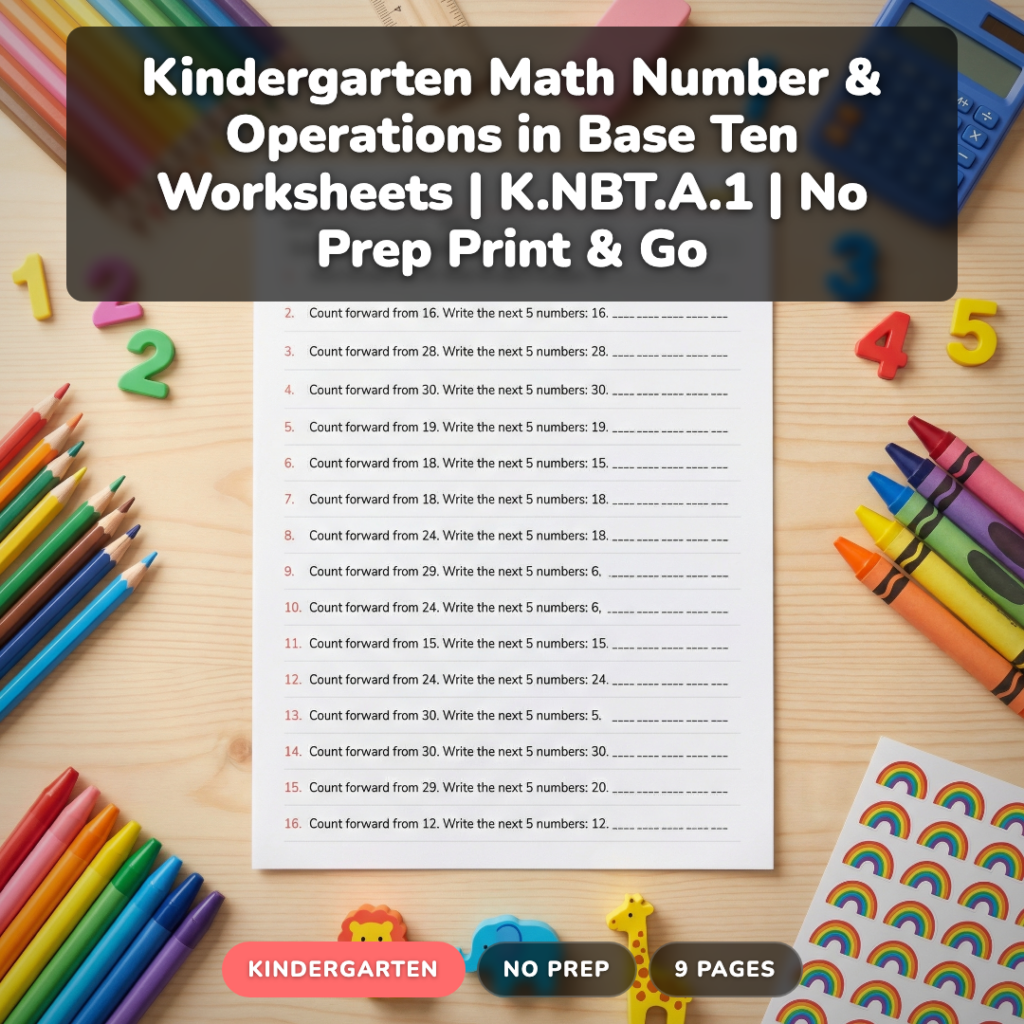
After teaching teen numbers for years, I created a comprehensive worksheet pack that saves you hours of prep time while providing exactly the practice your students need. This 9-page resource includes 79 differentiated problems across three levels: Practice (22 problems), On-Level (30 problems), and Challenge (27 problems).
What makes this resource different is the careful progression from concrete representations to abstract thinking. Practice level uses pre-drawn ten-frames and visual supports. On-Level requires students to draw their own representations and write equations. Challenge level includes word problems and multiple solution paths.
Each worksheet includes clear directions, answer keys, and can be used for independent work, math centers, or homework. The problems align perfectly with CCSS.Math.Content.K.NBT.A.1 and prepare students for first-grade place value concepts.
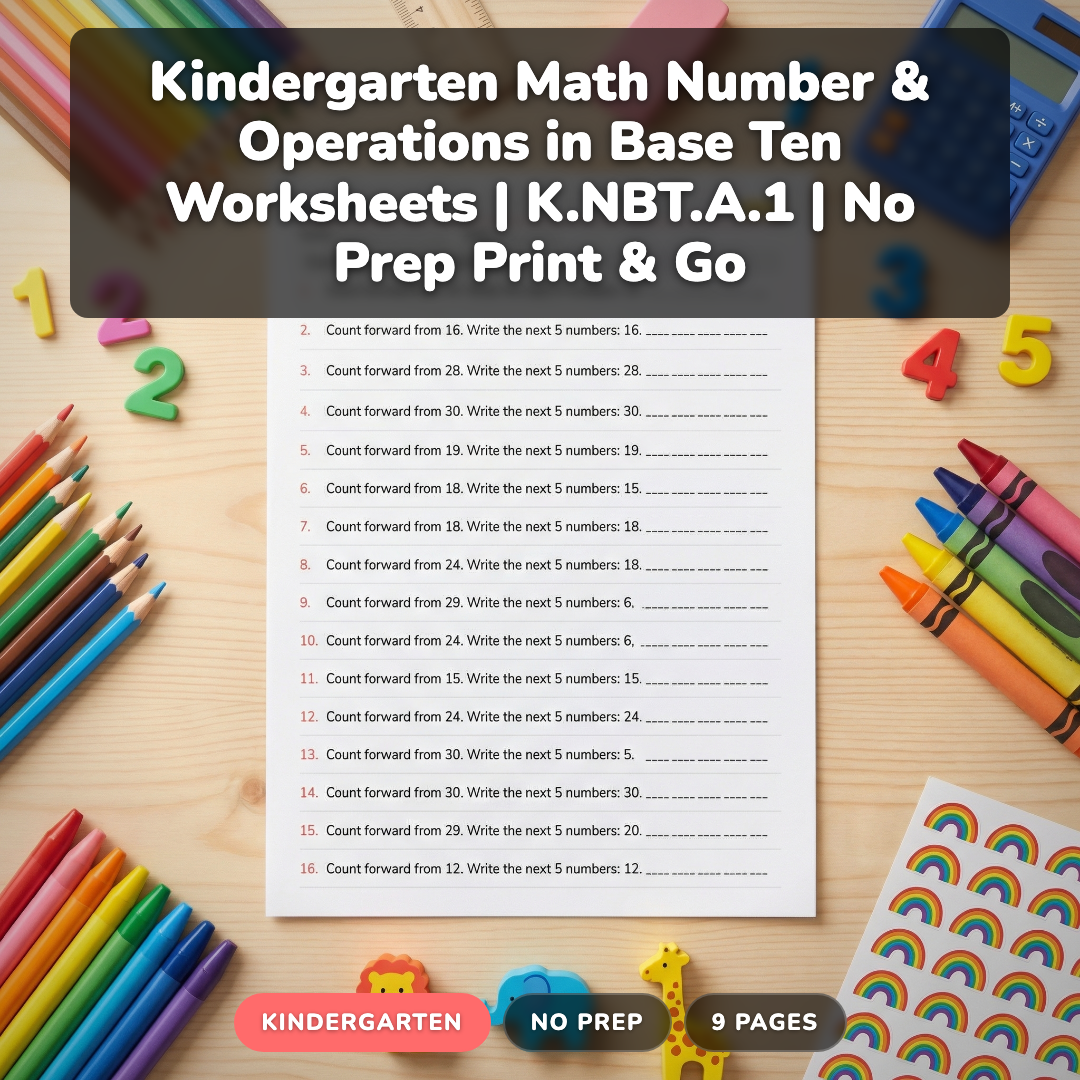
You can grab this complete teen numbers pack to use with your students right away.
Grab a Free Teen Number Practice Sheet to Try
Want to see how this approach works with your students? I’ll send you a free sample worksheet that includes all three differentiation levels plus teaching tips for implementation.
Frequently Asked Questions About Teaching Teen Numbers
When should I introduce teen numbers in kindergarten?
Introduce teen numbers after students can count to 20 fluently and understand the concept of ten as a group. This typically happens in February or March, depending on your students’ readiness and your curriculum pacing guide.
What’s the difference between teen numbers and place value?
Teen numbers are the foundation for place value understanding. Students learn that numbers 11-19 contain exactly one ten plus additional ones. True place value (understanding tens and ones positions) develops more fully in first grade.
Should I teach teen number names or focus on the ten-structure first?
Teach both simultaneously. Students need to connect the spoken name “fifteen” with the mathematical structure (10 + 5). Use visual representations every time you say a teen number name to reinforce this connection.
How do I help students who keep writing teen numbers backwards?
Use the consistent pattern that all teen numbers start with 1. Practice writing teen numbers while saying “one-ten and [number] ones” to emphasize the tens digit comes first. Provide lots of practice with number formation.
What manipulatives work best for teaching teen numbers?
Ten-frames are most effective because they clearly show the ten-structure. Base-ten blocks, bundling sticks, and two-color counters also work well. Choose manipulatives that clearly separate the ten from the additional ones.
Teaching teen numbers successfully sets your kindergarten students up for place value success in first grade and beyond. The key is helping them see the hidden ten-structure in these tricky numbers through hands-on experiences and visual representations.
What’s your favorite strategy for helping students understand teen numbers? Try the free practice sheet above and let me know how it goes with your class!