If your kindergarteners struggle to sort objects into categories or can’t quite count how many are in each group, you’re not alone. This foundational skill — sorting, counting, and comparing categories — sets the stage for everything from graphing to data analysis in later grades.
In this post, you’ll discover five research-backed strategies that make CCSS.Math.Content.K.MD.B.3 click for young learners, plus differentiation tips for every student in your classroom.
Key Takeaway
Kindergarten data skills develop best through hands-on sorting with real objects before moving to worksheets or abstract representations.
Why Measurement & Data Matters in Kindergarten
Sorting and counting categories isn’t just busy work — it’s the foundation of mathematical thinking. When kindergarteners classify objects and count within categories, they’re developing number sense, logical reasoning, and early data analysis skills that directly support first-grade graphing and measurement standards.
The CCSS.Math.Content.K.MD.B.3 standard appears in most kindergarten curricula during the second half of the year, typically after students have solid counting skills to 20. Research from the National Council of Teachers of Mathematics shows that students who master classification and counting in kindergarten perform significantly better on data interpretation tasks in elementary grades.
This skill connects directly to K.CC.B.4 (counting objects) and K.CC.B.5 (counting to answer “how many?”), making it a natural bridge between number concepts and early data work. Students need approximately 15-20 exposures to sorting activities before they can independently classify objects by multiple attributes.
Looking for a ready-to-go resource? I put together a differentiated sorting and counting pack that covers everything below — but first, the teaching strategies that make it work.
Common Sorting and Counting Misconceptions in Kindergarten
Understanding where students get stuck helps you address these challenges before they become ingrained habits.
Common Misconception: Students sort by the most obvious visual feature without considering the given category.
Why it happens: Five-year-olds naturally focus on what stands out most (biggest, brightest color) rather than the specific attribute you’ve named.
Quick fix: Always state the sorting rule clearly and have students repeat it back before they begin sorting.
Common Misconception: Students recount the same objects multiple times when determining totals.
Why it happens: They haven’t developed one-to-one correspondence or lose track of what they’ve already counted.
Quick fix: Teach them to move objects to a “counted” pile or touch each item as they count it.
Common Misconception: Students think “more” always means the category that takes up more physical space.
Why it happens: They confuse quantity with size or area, especially when comparing big and small objects.
Quick fix: Use objects of similar size when first teaching counting comparisons.
Common Misconception: Students create their own categories instead of using the given ones.
Why it happens: They see patterns or attributes that seem more logical to them than the categories you’ve provided.
Quick fix: Start with very clear, distinct categories (red vs. blue) before moving to more subtle distinctions.
5 Research-Backed Strategies for Teaching Sorting and Counting
Strategy 1: The Sort-and-Scoop Method
This concrete approach uses physical manipulation to make abstract categories visible and countable. Students physically move objects into distinct containers or areas, making the sorting decision tangible.
What you need:
- Small containers or paper plates (one per category)
- Mixed collection of objects (buttons, blocks, counting bears)
- Category labels with pictures and words
Steps:
- Place labeled containers in front of students
- Demonstrate sorting 3-4 objects, thinking aloud about your decisions
- Have students sort remaining objects one at a time
- Count objects in each container together, moving items as you count
- Compare totals: “Which group has more? How do you know?”
Strategy 2: Human Sorting Graphs
Turn your students into data points by having them physically position themselves in categories. This kinesthetic approach makes abstract sorting concepts concrete and memorable.
What you need:
- Masking tape to create floor categories
- Category signs (with pictures for non-readers)
- Chart paper to record results
Steps:
- Create category spaces on the floor with tape
- Ask a sorting question (“Do you have laces or velcro on your shoes?”)
- Students move to their category space
- Count students in each category aloud together
- Record numbers on chart paper and discuss which has more/fewer
Strategy 3: Picture Sort and Tally
Bridge concrete and abstract thinking by sorting picture cards and using tally marks to count. This develops both classification skills and early data recording.
What you need:
- Picture cards (animals, shapes, food items)
- Sorting mats with category headers
- Crayons for making tally marks
Steps:
- Give each student 8-12 picture cards and a sorting mat
- Students sort cards into categories on their mat
- For each category, students make one tally mark per picture
- Count tally marks to find totals for each category
- Circle the category with the most items
Strategy 4: Mystery Box Classification
Build excitement around sorting by having students reach into a mystery container and classify objects by touch before revealing them visually.
What you need:
- Opaque container or bag
- Objects with distinct textures (smooth blocks, rough sandpaper pieces, soft fabric squares)
- Category labels (smooth, rough, soft)
Steps:
- Student reaches into container without looking
- They feel one object and predict which category it belongs to
- Remove object to check prediction
- Place object in correct category pile
- Continue until all objects are sorted and counted
Strategy 5: Snack Sort and Graph
Combine math learning with snack time by sorting and counting edible items. The real-world connection makes the activity meaningful and memorable.
What you need:
- Mixed snacks (goldfish crackers, pretzels, cereal pieces)
- Small paper plates for categories
- Simple graphing paper or pre-made graph template
Steps:
- Give each student a small handful of mixed snacks
- Students sort snacks onto separate plates by type
- Count items in each category
- Color one square on graph paper for each snack item
- Compare columns: “Which snack did you have the most of?”
- Eat the snacks as a reward for good mathematical thinking!
How to Differentiate Sorting and Counting for All Learners
For Students Who Need Extra Support
Start with concrete, hands-on sorting using real objects before moving to pictures or worksheets. Use only 2 categories initially, with 6-8 total objects to sort. Provide clear visual cues like different colored containers for each category. Practice one-to-one correspondence by having students touch each object as they count. Review prerequisite skills like counting to 10 and recognizing basic attributes (color, size, shape) before introducing sorting tasks.
For On-Level Students
Use 2-3 categories with 10-15 objects total, progressing to picture sorts and simple recording sheets. Students should master CCSS.Math.Content.K.MD.B.3 by sorting familiar objects, counting accurately within each category, and comparing totals using “more,” “fewer,” and “same.” Introduce basic graphing by having students color squares to represent their counts.
For Students Ready for a Challenge
Introduce sorting by multiple attributes simultaneously (red circles vs. blue circles vs. red squares). Have students create their own sorting categories or re-sort the same collection in different ways. Connect to real-world data by sorting classroom supplies, playground equipment, or lunch choices. Challenge them to predict outcomes before sorting or to explain their sorting rules to classmates.
A Ready-to-Use Sorting and Counting Resource for Your Classroom
If you want to save prep time while ensuring your students get differentiated practice with sorting and counting, I’ve created a comprehensive resource that takes the guesswork out of planning.
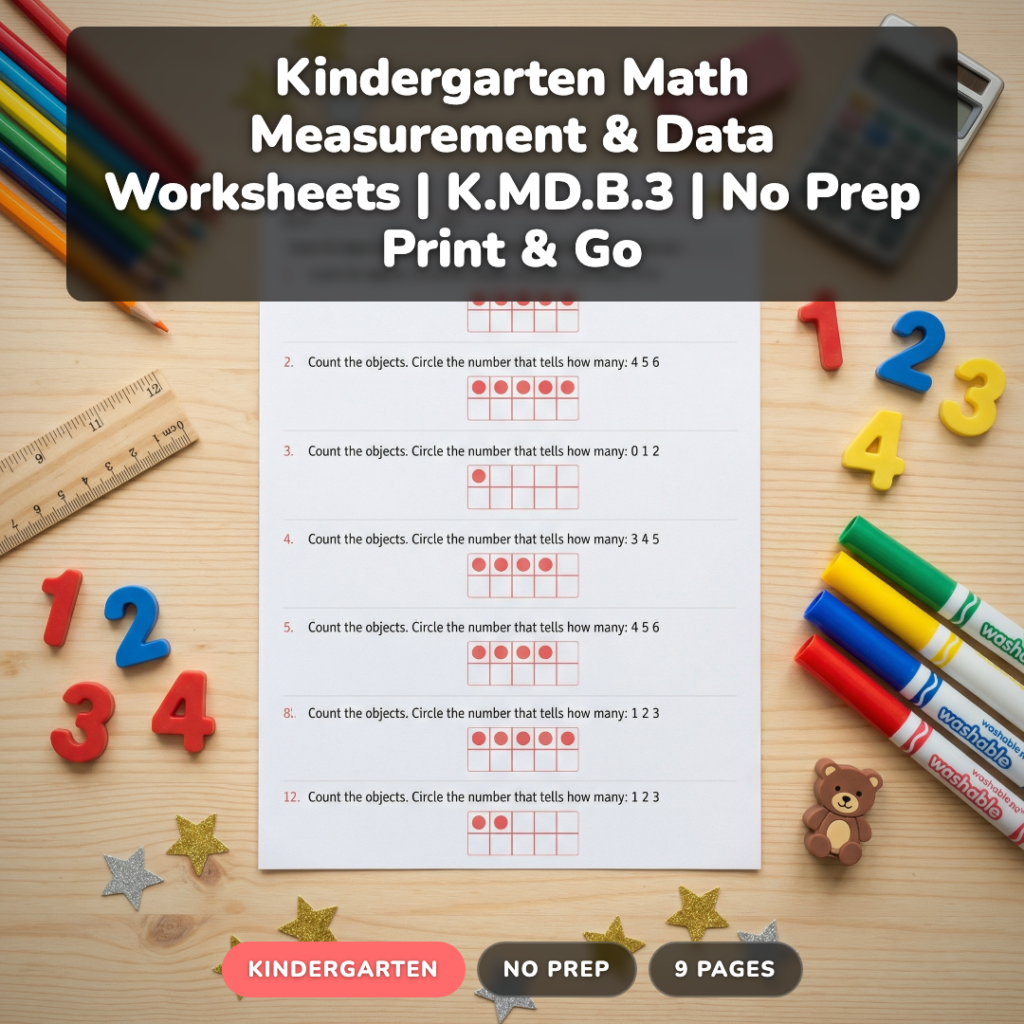
This Kindergarten Math Measurement & Data Worksheets pack includes 79 problems across three difficulty levels. The Practice level (22 problems) focuses on basic sorting with clear visual cues. On Level worksheets (30 problems) align perfectly with grade-level expectations for CCSS.Math.Content.K.MD.B.3. Challenge pages (27 problems) extend learning with multi-step sorting and comparison tasks.
What makes this different from other sorting worksheets? Each level uses age-appropriate graphics, clear instructions that kindergarteners can follow independently, and answer keys that save you grading time. The problems progress logically from concrete sorting to more abstract classification tasks.
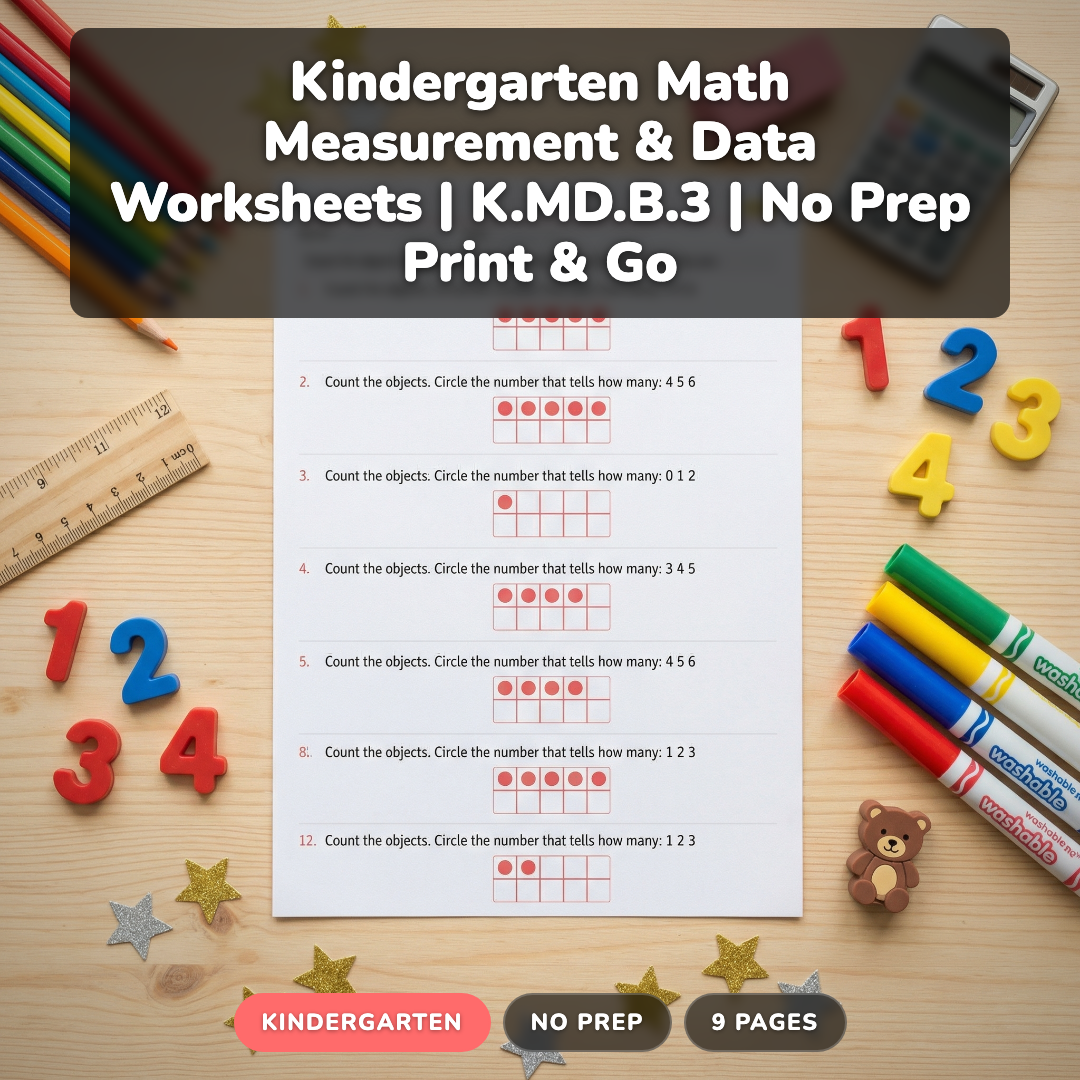
Nine pages of differentiated practice means you can meet every student where they are while targeting the same essential standard.
Grab a Free Sorting Sample to Try
Want to see how these differentiated sorting activities work in your classroom? I’ll send you a free sample page from each level — Practice, On Level, and Challenge — so you can try them out with your students.
Frequently Asked Questions About Teaching Sorting and Counting
When should kindergarten students master sorting and counting by categories?
Most kindergarten students master basic sorting and counting by categories in the spring semester, typically March through May. Students need solid counting skills to 20 and understanding of basic attributes before tackling CCSS.Math.Content.K.MD.B.3 successfully.
How many objects should kindergarten students sort at once?
Start with 6-8 objects total across 2 categories for beginning sorters. Gradually increase to 15-20 objects across 3 categories as students develop confidence. Too many objects overwhelm young learners and lead to counting errors.
What’s the difference between sorting and classifying in kindergarten math?
Sorting is the physical act of grouping objects, while classifying involves understanding the rule or attribute used for grouping. Kindergarteners typically sort first, then develop classification thinking through guided questioning about their sorting decisions.
Should kindergarten students use tally marks when counting categories?
Introduce tally marks only after students can accurately count objects to 10. Many kindergarteners find tally marks confusing initially. Start with moving objects or making dots, then progress to tally marks in late kindergarten or first grade.
How do I assess kindergarten sorting and counting skills?
Use performance-based assessment with real objects. Give students 10-12 mixed items and ask them to sort into given categories, count each group, and tell which has more. Document their process, not just their final answer.
Teaching sorting and counting builds the foundation for all future data analysis skills. Start with hands-on activities, provide plenty of practice, and celebrate when students can explain their thinking about categories and quantities.
What’s your favorite way to make sorting engaging for kindergarteners? And don’t forget to grab that free sample above — it’s a great way to see these strategies in action!