If your kindergarteners call every four-sided shape a “square” or insist that a tilted triangle is “broken,” you’re not alone. Teaching shape recognition seems simple until you realize how many misconceptions young learners bring to geometry. The good news? With the right strategies, you can help your students master CCSS.Math.Content.K.G.A.2 and correctly identify shapes regardless of size or orientation.
Key Takeaway
Students learn shapes best through hands-on exploration that focuses on attributes (sides, corners) rather than visual appearance alone.
Why Shape Recognition Matters in Kindergarten
Shape identification forms the foundation of geometric thinking that students will build on through elementary school. According to research by Clements and Sarama, students who master basic shape recognition in kindergarten show stronger spatial reasoning skills in later grades. The CCSS.Math.Content.K.G.A.2 standard specifically requires students to “correctly name shapes regardless of their orientations or overall size” — a skill that challenges many five and six-year-olds.
This standard typically appears in the second half of the kindergarten year, after students have had experience with basic counting and number recognition. Shape work connects to measurement concepts (comparing sizes), algebraic thinking (sorting and classifying), and even early fraction understanding (parts of shapes).
Looking for a ready-to-go resource? I put together a differentiated kindergarten geometry pack that covers everything below — but first, the teaching strategies that make it work.
Common Shape Misconceptions in Kindergarten
Common Misconception: Students think rotated shapes are different shapes (a tilted square becomes a “diamond”).
Why it happens: Young children rely heavily on visual orientation and haven’t developed mental rotation skills yet.
Quick fix: Practice rotating physical shapes while counting sides and corners together.
Common Misconception: All four-sided shapes are “squares” or all triangles must point up.
Why it happens: Students memorize one visual example rather than learning defining attributes.
Quick fix: Show multiple examples of each shape in different orientations from day one.
Common Misconception: Bigger shapes are “different” from smaller versions of the same shape.
Why it happens: Size is more visually obvious than geometric properties to young learners.
Quick fix: Use shape families — show parent, baby, and grandparent versions of each shape.
Common Misconception: Shapes must be “perfect” — a slightly irregular triangle isn’t a triangle.
Why it happens: Students expect textbook-perfect examples and haven’t seen real-world variations.
Quick fix: Include hand-drawn and slightly imperfect shapes in your examples regularly.
5 Research-Backed Strategies for Teaching Shape Recognition
Strategy 1: Shape Detective with Attribute Focus
Turn your students into shape detectives who solve mysteries using geometric clues. This strategy teaches students to identify shapes by their defining attributes rather than overall appearance, directly addressing the CCSS.Math.Content.K.G.A.2 requirement for orientation independence.
What you need:
- Variety of shapes in different sizes and orientations
- Magnifying glasses (real or toy)
- “Detective notebook” for recording findings
- Shape attribute cards (“3 sides,” “4 corners,” etc.)
Steps:
- Give each student a mystery shape hidden in an envelope
- Students feel the shape and predict what it might be
- Reveal the shape and count sides/corners together using magnifying glasses
- Match the shape to attribute cards (“This has 3 sides and 3 corners — it’s a triangle!”)
- Rotate the shape and recount to prove it’s still the same shape
- Record findings in detective notebooks with drawings and numbers
Strategy 2: Shape Building with Play Dough
Hands-on construction helps students internalize the defining characteristics of each shape. When students build shapes themselves, they focus on the number of sides and corners rather than visual appearance.
What you need:
- Play dough or modeling clay
- Toothpicks or craft sticks
- Shape reference cards
- Plastic knives for cutting
Steps:
- Students roll play dough into “snakes” (long cylinders)
- For triangles: cut three equal pieces, arrange in triangle, connect corners
- Count sides and corners while building
- Challenge: build the same shape in a different orientation
- Create shape families — big triangle, medium triangle, tiny triangle
- Display finished shapes and have classmates identify them
Strategy 3: Shape Sorting Scavenger Hunt
Real-world application helps students recognize that shapes exist everywhere, not just in math workbooks. This activity reinforces that size and orientation don’t change a shape’s identity.
What you need:
- Clipboards with recording sheets
- Pencils
- Classroom objects of various shapes
- Digital camera (optional)
Steps:
- Create teams of 2-3 students with recording sheets
- Assign each team one shape to find around the classroom
- Students hunt for objects matching their assigned shape
- Record findings with drawings or photos
- Teams share discoveries: “We found rectangles in books, windows, and doors”
- Discuss how the same shape appears in different sizes and positions
Strategy 4: Musical Shape Chairs
Movement and music help kinesthetic learners while reinforcing quick shape recognition. This game builds automaticity in shape identification across different orientations.
What you need:
- Large shape cards taped to the floor
- Music player
- Shape calling cards
- Space for movement
Steps:
- Tape large shape cards around the room in various orientations
- Students dance/move around the room while music plays
- When music stops, call out a shape name
- Students must quickly find and stand on that shape
- Discuss: “How did you know this tilted square was still a square?”
- Rotate or flip shapes between rounds to reinforce orientation independence
Strategy 5: Shape Story Creation
Storytelling engages multiple learning modalities while helping students remember shape characteristics through narrative connections. This strategy particularly helps students who struggle with abstract concepts.
What you need:
- Various shape cutouts
- Craft materials (googly eyes, markers)
- Story recording sheets
- Examples of shape characters
Steps:
- Students choose shapes and turn them into characters with faces and names
- Create a simple story featuring their shape characters
- Include the shape’s attributes in the story (“Triangle Tom has three pointy corners”)
- Share stories with the class, emphasizing shape characteristics
- Bind stories into a class book for repeated reading
- Act out stories using body movements to form shapes
How to Differentiate Shape Learning for All Learners
For Students Who Need Extra Support
Begin with just two shapes (circle and square) and master these completely before adding others. Use large, tactile shapes that students can trace with their fingers. Provide consistent language: “This is a circle. A circle is round. It has no corners.” Create shape books with one shape per page, showing multiple examples. Use the same shapes daily in different contexts until recognition becomes automatic.
For On-Level Students
Work with all basic shapes (circle, square, triangle, rectangle) simultaneously. Include shapes in different orientations from the beginning. Practice both naming shapes and describing their attributes. Use sorting activities that require students to explain their thinking. Incorporate shapes into daily routines like snack time (“Your crackers are rectangles”) and story time (“What shapes do you see on this page?”).
For Students Ready for a Challenge
Introduce additional shapes like hexagons, pentagons, and ovals. Challenge students to create complex pictures using only specific shapes. Have them teach younger students about shapes. Explore 3D shapes and their relationships to 2D shapes. Create shape patterns and ask students to extend them. Connect shapes to early fraction concepts (“How many triangles make a hexagon?”).
A Ready-to-Use Kindergarten Geometry Resource for Your Classroom
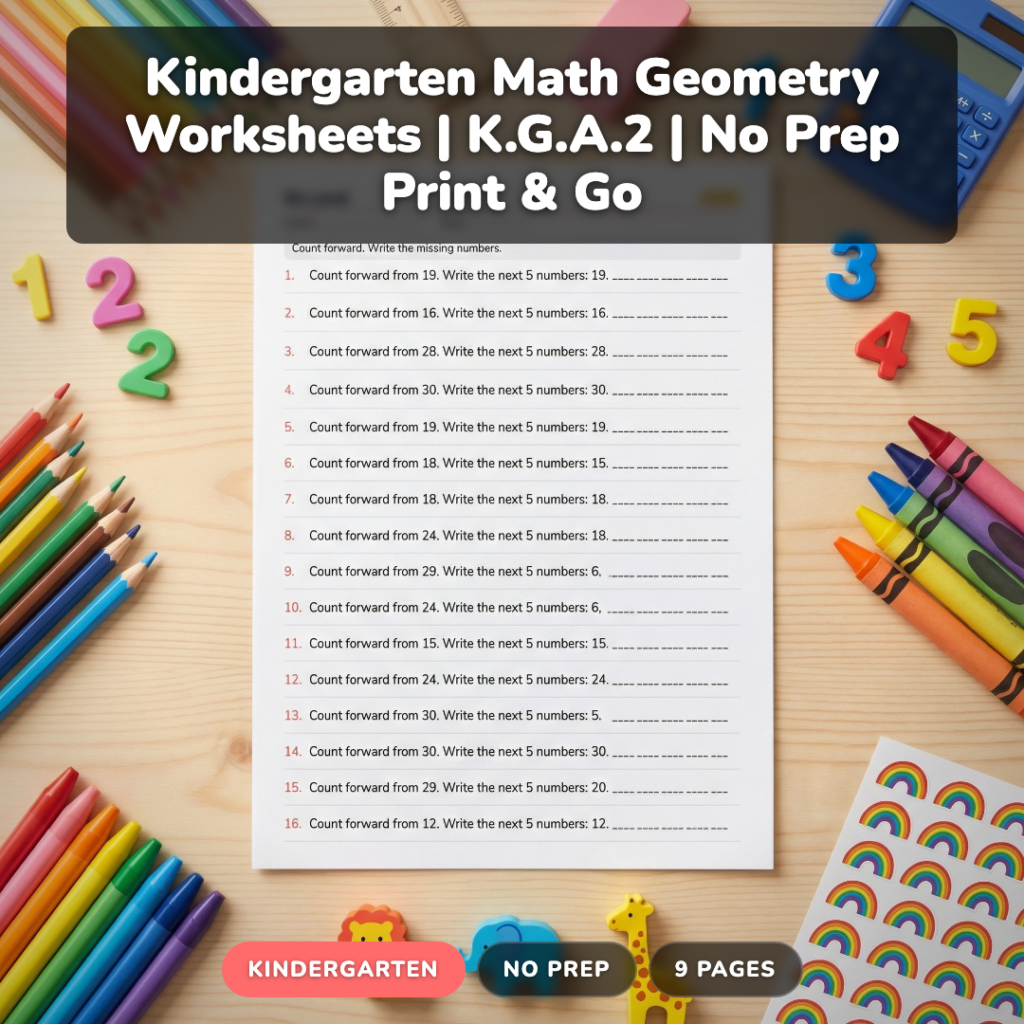
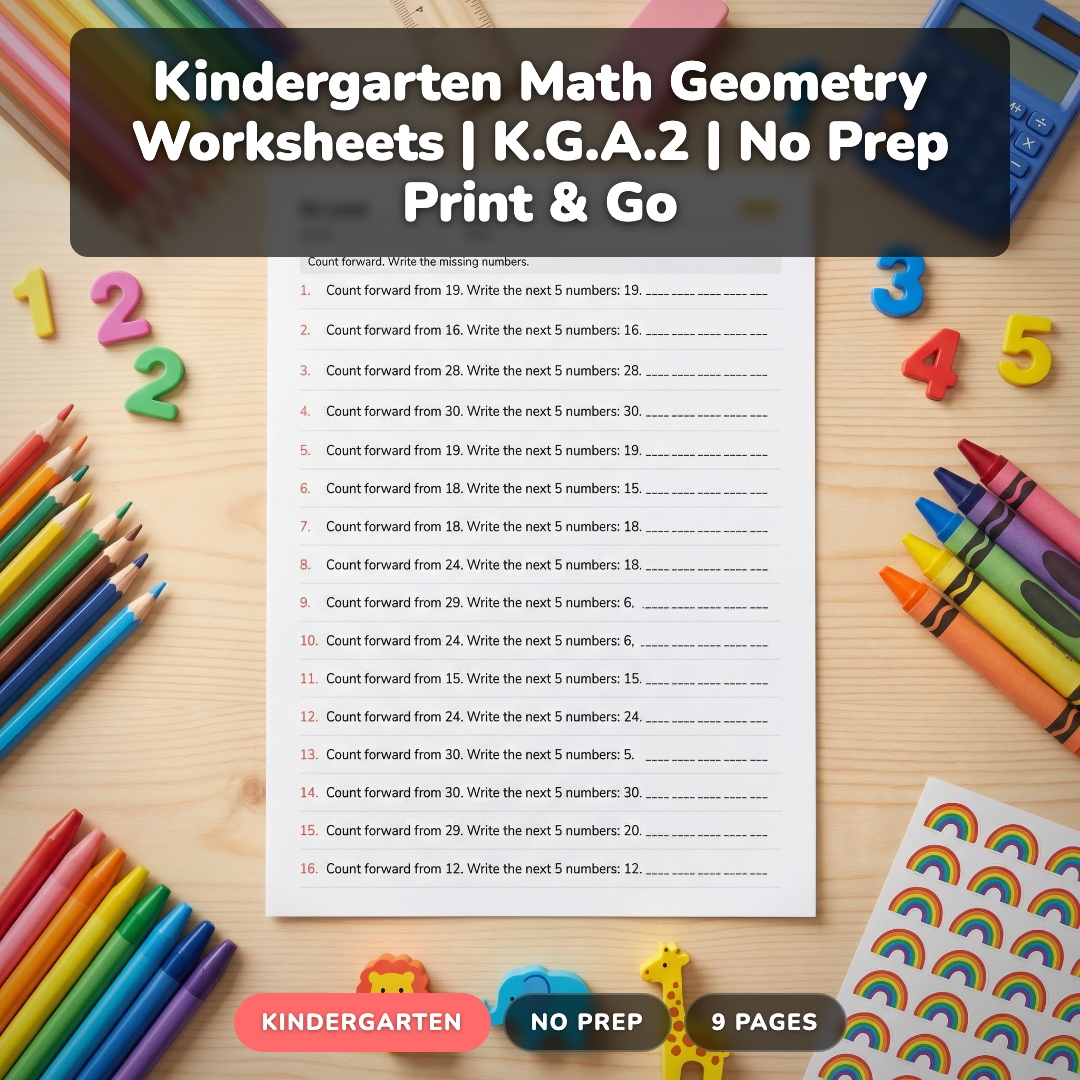
Teaching shapes effectively requires consistent practice with varied examples — exactly what busy teachers often struggle to create from scratch. This differentiated geometry pack takes the prep work off your plate while ensuring every student gets appropriate practice with shape recognition.
The resource includes 79 carefully designed problems across three difficulty levels. The Practice level focuses on basic shape identification with clear, unrotated examples. On-Level worksheets include shapes in various orientations and sizes, directly addressing the CCSS.Math.Content.K.G.A.2 standard. Challenge pages feature complex sorting tasks and real-world shape applications.
What makes this different from generic shape worksheets? Each level builds systematically on the previous one, and answer keys help you quickly assess student understanding. The problems move from simple identification to attribute-based sorting — exactly the progression research shows works best for kindergarten learners.
With 9 pages of differentiated practice, you’ll have enough material for weeks of shape work without any prep time.
Grab a Free Shape Practice Page to Try
Want to see how differentiated shape practice works in your classroom? I’ll send you a sample page from each level — practice, on-level, and challenge — so you can try the approach with your students before committing to the full resource.
Frequently Asked Questions About Teaching Shapes in Kindergarten
When should kindergarteners master basic shape recognition?
Most kindergarteners can identify circles, squares, triangles, and rectangles by mid-year (January-February). The CCSS.Math.Content.K.G.A.2 standard expects mastery by end of kindergarten, including recognition regardless of orientation or size.
How many shapes should I teach at once?
Start with 2-3 shapes maximum, ensuring solid recognition before adding more. Introduce circle and square first, add triangle, then rectangle. Students need 15-20 exposures to each shape in varied contexts before achieving automaticity.
What’s the difference between squares and rectangles for kindergarteners?
Teach that squares are special rectangles with four equal sides. Use precise language: “All squares are rectangles, but not all rectangles are squares.” Focus on the four-corner, four-side commonality before introducing the equal-sides distinction.
How do I help students recognize rotated shapes?
Use physical manipulation — have students hold and turn shapes while counting sides and corners. Practice the “shape spin” — rotate shapes slowly while chanting “Same shape, different position.” Provide many examples of each shape in different orientations from day one.
Should I teach 3D shapes in kindergarten?
Focus primarily on 2D shapes per Common Core standards, but you can introduce 3D shapes informally. Use real objects (balls, boxes) and connect them to 2D shapes (“This ball is round like a circle”). Formal 3D geometry instruction typically begins in first grade.
Shape recognition builds the foundation for all future geometry learning. When you focus on attributes rather than appearance, use hands-on exploration, and provide differentiated practice, you’re setting your kindergarteners up for mathematical success. Remember to grab that free sample page to see how systematic shape practice can work in your classroom.
What’s your biggest challenge when teaching shapes? Drop a comment below — I’d love to hear how these strategies work for your students!