How to Teach Number Decomposition in Kindergarten: 5 Strategies That Work (+ Free Worksheets)
If your kindergarteners freeze when they see 5 = 2 + ?, you’re not alone. Number decomposition — breaking numbers into smaller parts — is one of the most challenging concepts for young learners. But when you teach it right, you’re building the foundation for addition, subtraction, and algebraic thinking that will serve them through elementary school and beyond.
Key Takeaway
Number decomposition success in kindergarten comes from concrete manipulation before abstract symbols — students need to physically break apart and combine objects before they can understand equations on paper.
Why Number Decomposition Matters in Kindergarten
Number decomposition is the cornerstone of mathematical thinking in kindergarten. When students understand that 7 can be broken into 3 + 4, 5 + 2, or 6 + 1, they’re developing number sense that will make addition and subtraction facts automatic later. This skill directly addresses CCSS.Math.Content.K.OA.A.3, which requires students to decompose numbers less than or equal to 10 into pairs in more than one way.
Research from the National Council of Teachers of Mathematics shows that students who master decomposition strategies in kindergarten score 23% higher on first-grade math assessments. The skill typically emerges in late fall or early winter, after students have solid counting skills and understand that numbers represent quantities.
You’ll want to introduce decomposition after students can count to 10 reliably, recognize numerals, and understand one-to-one correspondence. Most kindergarteners are ready for this concept between October and December, depending on their prior math experiences.
Looking for a ready-to-go resource? I put together a differentiated number decomposition pack that covers everything below — but first, the teaching strategies that make it work.
Common Number Decomposition Misconceptions in Kindergarten
Understanding where students struggle helps you address problems before they become entrenched. Here are the four most common misconceptions I see in kindergarten classrooms:
Common Misconception: Students think there’s only one way to break apart a number.
Why it happens: They memorize one combination (like 5 = 3 + 2) without understanding the flexible nature of decomposition.
Quick fix: Use manipulatives to show multiple ways to make the same number in one lesson.
Common Misconception: Students count all objects instead of recognizing parts.
Why it happens: They haven’t developed part-whole thinking and default to counting strategies.
Quick fix: Cover one part and ask ‘How many are hiding?’ to build part-whole visualization.
Common Misconception: Students think the equals sign means ‘the answer comes next.’
Why it happens: Traditional worksheets show problems like 3 + 2 = __ instead of various formats.
Quick fix: Present equations in multiple formats: 5 = 3 + 2, __ = 4 + 1, 2 + 3 = 5.
Common Misconception: Students can’t connect concrete objects to abstract symbols.
Why it happens: They skip the representational stage and jump from manipulatives to equations too quickly.
Quick fix: Use drawings and ten frames as a bridge between objects and numbers.
5 Research-Backed Strategies for Teaching Number Decomposition
Strategy 1: Two-Color Counter Exploration
This foundational strategy uses physical manipulation to help students discover multiple ways to decompose numbers. Students shake two-color counters in a cup and record the combinations they create, building understanding that numbers can be broken apart in various ways.
What you need:
- Two-color counters (red/yellow or red/white)
- Small cups (one per student)
- Recording sheets with number lines or ten frames
- Crayons matching counter colors
Steps:
- Give each student 5 two-color counters and a cup
- Have students shake the counters and spill them out
- Count red counters and yellow counters separately
- Record the combination using drawings or numbers (3 red + 2 yellow = 5)
- Repeat 4-5 times to find different combinations
- Share discoveries: ‘Who found a different way to make 5?’
Strategy 2: Ten Frame Number Stories
Ten frames provide a visual structure that helps students see number relationships clearly. This strategy combines storytelling with visual representation to make decomposition meaningful and memorable for young learners.
What you need:
- Large ten frames (poster-size for demonstration)
- Individual ten frames for students
- Colored manipulatives (bears, cubes, or chips)
- Simple story prompts
Steps:
- Tell a number story: ‘6 birds were in a tree. Some flew to another branch.’
- Place 6 manipulatives in the ten frame
- Move some objects to show the story action
- Count objects in each section: ‘4 birds here, 2 birds there’
- Record the decomposition: 6 = 4 + 2
- Retell the story with different numbers of birds moving
Strategy 3: Number Bond Circles
Number bonds provide a visual model that shows the relationship between a whole number and its parts. This graphic organizer helps students understand that decomposition is about finding the parts that make up a whole.
What you need:
- Large circle cutouts (whole numbers)
- Smaller circle cutouts (parts)
- Dry erase boards and markers
- Magnetic numbers for demonstration
Steps:
- Draw a large circle at the top and write the target number (like 7)
- Draw two smaller circles below, connected with lines
- Use manipulatives to find one way to make 7 (like 5 + 2)
- Write the parts in the smaller circles
- Erase the parts and find a different combination
- Challenge: ‘Can you find three different ways to make 7?’
Strategy 4: Decomposition Dice Games
Games make practice engaging while building fluency with number combinations. This partner activity encourages students to think flexibly about numbers while having fun with friendly competition.
What you need:
- Dot dice or number dice (1-6)
- Recording sheets with equations
- Small manipulatives for verification
- Timer (optional)
Steps:
- Partner A rolls the die and announces the number
- Partner B creates a decomposition using manipulatives
- Both partners record the equation (6 = 4 + 2)
- Partner B rolls next, Partner A decomposes
- Continue for 10 rounds, trying to find new combinations each time
- Compare recordings to see who found the most different ways
Strategy 5: Real-World Decomposition Scenarios
Connecting math to everyday situations helps students understand why decomposition matters. This strategy uses familiar contexts to make abstract number concepts concrete and meaningful.
What you need:
- Small toys or classroom objects (pencils, crayons, books)
- Containers or boxes for sorting
- Chart paper for recording discoveries
- Digital camera for documenting work (optional)
Steps:
- Present a real scenario: ‘We have 8 crayons to share between two tables’
- Give students 8 objects to manipulate
- Have them physically divide objects into two groups
- Record each division: ‘5 crayons here, 3 crayons there = 8 total’
- Try different divisions and compare fairness or practicality
- Connect to equation format: 8 = 5 + 3, 8 = 4 + 4, etc.
How to Differentiate Number Decomposition for All Learners
For Students Who Need Extra Support
Students struggling with decomposition often need more time with concrete manipulation and smaller numbers. Start with numbers 3-5 and use consistent materials like counting bears or unifix cubes. Provide ten frames with some dots already filled in, so students only need to add 2-3 more objects. Focus on one decomposition at a time rather than finding multiple ways. Use finger patterns and number lines to reinforce counting strategies. Review prerequisite skills like one-to-one correspondence and number recognition if needed.
For On-Level Students
Grade-level expectations for CCSS.Math.Content.K.OA.A.3 include decomposing numbers 6-10 into pairs and recording with drawings or equations. Students should find 2-3 different ways to break apart each number and begin connecting concrete objects to abstract symbols. They can work independently with familiar manipulatives and complete simple recording sheets. Encourage them to explain their thinking using math vocabulary like ‘parts,’ ‘whole,’ and ‘equals.’
For Students Ready for a Challenge
Advanced students can explore systematic decomposition (finding all possible combinations for a number), work with numbers beyond 10, or investigate patterns in number combinations. Challenge them to decompose numbers into three parts (7 = 2 + 3 + 2) or explore the relationship between addition and subtraction. They can create their own number stories, teach decomposition strategies to classmates, or use digital tools to record and share their mathematical thinking.
A Ready-to-Use Number Decomposition Resource for Your Classroom
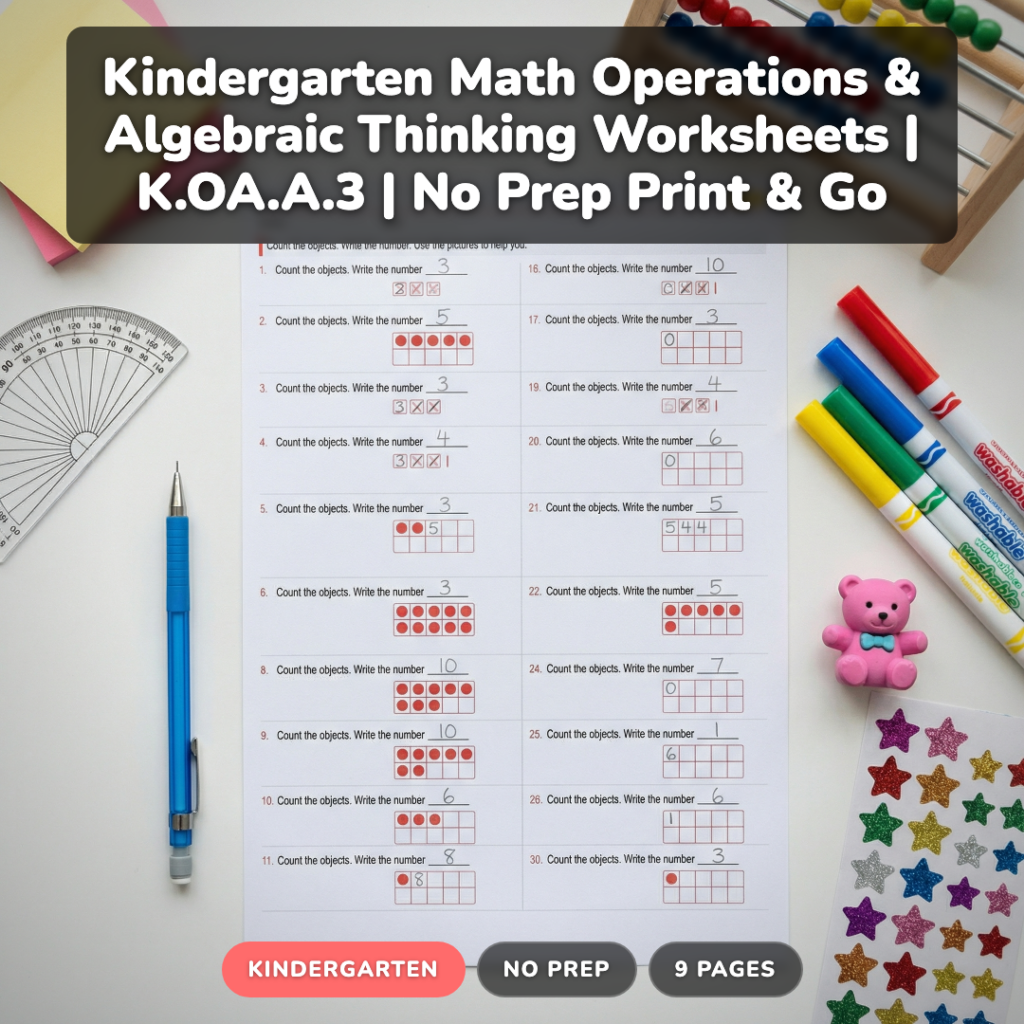
After years of creating decomposition activities from scratch, I put together a comprehensive worksheet pack that saves you hours of prep time. This resource includes 79 carefully designed problems across three differentiation levels, so every student in your class can practice at their appropriate level.
The practice level focuses on numbers 3-6 with visual supports and guided examples. On-level worksheets target numbers 5-8 with a mix of concrete and abstract representations. Challenge pages explore numbers 6-10 with multiple decomposition requirements and extension problems. Each level includes answer keys and teaching notes to help you implement the activities effectively.
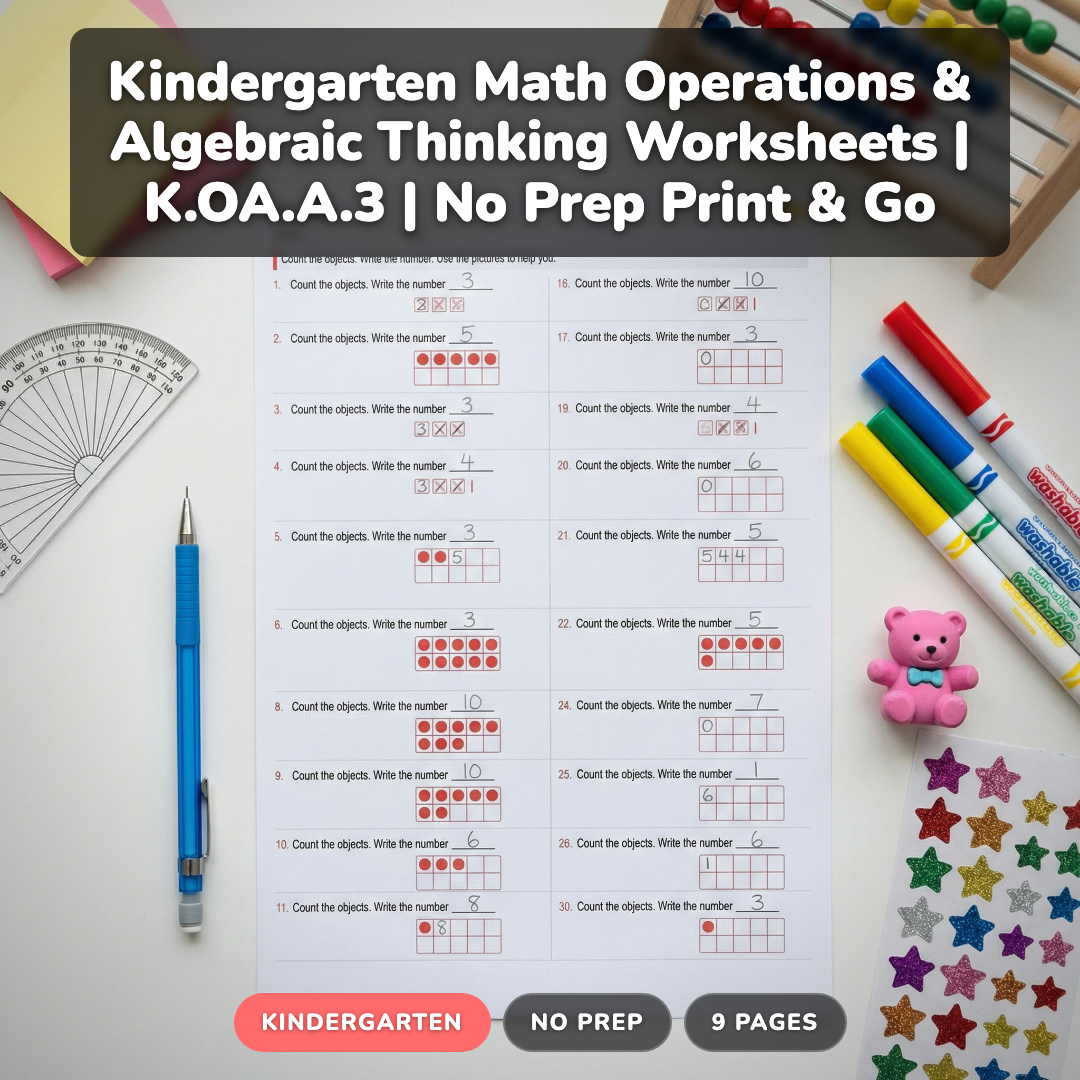
What sets this resource apart is the careful progression from concrete to abstract thinking. Students start with picture-based problems, move to ten frame representations, and finish with equation writing — exactly the sequence research shows works best for kindergarten learners.
Grab a Free Number Decomposition Sample to Try
Want to see how these worksheets work in your classroom before committing? I’ll send you a free sample pack with one worksheet from each level, plus my favorite decomposition warm-up activity. Perfect for testing the waters or using as emergency sub plans.
Frequently Asked Questions About Teaching Number Decomposition
When should kindergarten students master number decomposition?
Most kindergarteners develop decomposition skills between December and March, after establishing solid counting and number recognition. Students should comfortably decompose numbers 5-10 by the end of kindergarten, as required by CCSS.Math.Content.K.OA.A.3. Focus on understanding over speed — fluency develops with practice and time.
What’s the difference between decomposition and addition facts?
Decomposition focuses on breaking apart numbers (7 = 4 + 3), while addition facts involve combining numbers (4 + 3 = 7). Decomposition builds number sense and part-whole understanding that makes addition facts meaningful rather than memorized. Both skills support each other and should be taught together using manipulatives and visual models.
How do I help students who can’t visualize number parts?
Use consistent manipulatives like two-color counters or ten frames to make parts visible. Start with very small numbers (3-4) and always have students physically separate objects before recording. Cover and reveal activities help build mental imagery — hide part of a group and ask students to predict how many are hidden.
Should kindergarteners write equations for decomposition?
Yes, but only after extensive work with concrete objects and drawings. Start with picture equations (drawing 5 circles as 3 + 2), then progress to number sentences. Many kindergarteners can write simple equations like 5 = 3 + 2 by spring, but understanding the concept matters more than perfect notation.
How is decomposition related to subtraction?
Decomposition builds the foundation for subtraction by teaching part-whole relationships. When students understand that 8 = 5 + 3, they can more easily solve 8 – 5 = ? because they recognize 3 as the missing part. This connection typically emerges in first grade but begins with kindergarten decomposition work.
Building Strong Number Sense Through Decomposition
Teaching number decomposition effectively in kindergarten sets the stage for mathematical success throughout elementary school. When students understand that numbers are flexible and can be broken apart in multiple ways, they develop the number sense that makes advanced math concepts accessible.
Remember to grab your free decomposition sample above — it’s a great way to try these strategies with your students this week.
What’s your favorite way to teach number decomposition? I’d love to hear what works in your classroom!