If your kindergarten students freeze when they see 3 + 2 or start counting on their fingers for 4 – 1, you’re not alone. Teaching operations and algebraic thinking to five and six-year-olds requires concrete, hands-on approaches that build number sense before abstract thinking. You’ll discover five research-backed strategies that make addition and subtraction within 5 click for your students, plus differentiation tips for every learner in your classroom.
Key Takeaway
Kindergarten math operations success comes from moving systematically through concrete manipulatives, visual representations, and abstract number work — never skipping the foundation-building steps.
Why Operations & Algebraic Thinking Matters in Kindergarten
Operations and algebraic thinking forms the foundation for all future math learning. At the kindergarten level, CCSS.Math.Content.K.OA.A.5 requires students to fluently add and subtract within 5, which means they can solve these problems accurately and efficiently without counting strategies.
This standard typically appears in the second half of the kindergarten year, after students have developed solid number recognition and counting skills. Research from the National Mathematics Advisory Panel shows that early fluency with basic facts within 10 directly predicts success in later mathematics, making this foundational work critical.
The timing matters: most kindergarten teachers introduce this concept between January and March, allowing the first semester to build number sense through counting, number recognition, and one-to-one correspondence. Students need approximately 60-80 practice opportunities across multiple contexts to achieve fluency with facts within 5.
Looking for a ready-to-go resource? I put together a differentiated operations pack that covers everything below — but first, the teaching strategies that make it work.
Common Operations Misconceptions in Kindergarten
Understanding where students typically struggle helps you address problems before they become ingrained habits. Here are the four most common misconceptions kindergarten students develop with operations within 5:
Common Misconception: Students think subtraction always means “take away” physically.
Why it happens: Early instruction focuses only on removal scenarios rather than comparison or missing addend situations.
Quick fix: Introduce subtraction as “how many more” and “what’s missing” alongside take-away problems.
Common Misconception: Students believe addition always makes numbers bigger.
Why it happens: They haven’t encountered adding zero or worked with missing addend problems like __ + 3 = 3.
Quick fix: Use ten frames to show 3 + 0 = 3 visually, emphasizing that adding zero keeps the number the same.
Common Misconception: Students count from one instead of counting on.
Why it happens: Counting from one feels safer and more concrete than the abstract strategy of starting from the larger number.
Quick fix: Model counting on with a number line, showing how 4 + 1 starts at 4, then moves one space forward.
Common Misconception: Students think the equal sign means “the answer comes next.”
Why it happens: Traditional worksheet formats always show problems as 2 + 3 = __, never as __ = 2 + 3 or 5 = 2 + 3.
Quick fix: Present equations in multiple formats from day one, including 5 = 4 + 1 and 3 + __ = 5.
5 Research-Backed Strategies for Teaching Math Operations
Strategy 1: Ten Frame Foundation Building
Ten frames provide the visual structure kindergarten students need to see number relationships and develop addition and subtraction strategies. This concrete-to-abstract progression builds number sense while supporting CCSS.Math.Content.K.OA.A.5 fluency goals.
What you need:
- Laminated ten frames (one per student)
- Two-color counters or small manipulatives
- Dry erase markers
- Large ten frame for modeling
Steps:
- Start with numbers 1-5 using only the top row of the ten frame
- Model 3 + 1 by placing 3 counters, then adding 1 more
- Have students verbalize: “I see 3, I add 1 more, now I have 4”
- Practice subtraction by removing counters: “I had 4, I took away 1, now I have 3”
- Progress to missing addend problems: “I want 5 total, I have 2, how many more do I need?”
Strategy 2: Number Bond Decomposition
Number bonds help kindergarten students understand that numbers can be broken apart and put back together in multiple ways. This algebraic thinking foundation makes addition and subtraction facts within 5 automatic rather than procedural.
What you need:
- Number bond mats (circles connected with lines)
- Small manipulatives in two colors
- Number bond anchor chart
- Recording sheets
Steps:
- Introduce the concept with 4 manipulatives: “How many ways can we break apart 4?”
- Show 4 as 3 + 1, 2 + 2, 1 + 3, and 0 + 4 using the number bond visual
- Have students create each combination with manipulatives on their mats
- Record all combinations on chart paper: “4 is 3 and 1, 4 is 2 and 2…”
- Practice daily with different target numbers 2-5
- Connect to addition facts: “If 4 is 3 and 1, then 3 + 1 = 4”
Strategy 3: Story Problem Acting
Kindergarten students understand math operations best when they can connect them to real situations. Acting out story problems develops problem-solving skills while making abstract operations concrete and meaningful.
What you need:
- Small toys or classroom objects
- Simple story problem cards
- Recording sheets with pictures
- Props for acting (optional)
Steps:
- Start with join problems: “Maya had 2 stickers. Her friend gave her 1 more. How many does she have now?”
- Have students act out the story using toys or themselves
- Connect the action to the math: “We started with 2, added 1, and got 3. So 2 + 1 = 3”
- Progress to take-away stories: “There were 4 birds in a tree. 2 flew away. How many are left?”
- Introduce compare problems: “Sam has 3 apples. Lisa has 5 apples. How many more does Lisa have?”
Strategy 4: Finger Pattern Fluency
Systematic finger pattern work builds automatic recall of addition and subtraction facts within 5. This strategy develops subitizing skills while providing a always-available tool for computation.
What you need:
- Finger pattern cards
- Mirrors (optional)
- Timer for fluency practice
- Recording chart
Steps:
- Teach standard finger patterns for 1-5 (thumb first, then pointer, etc.)
- Practice “finger flashes” — show 3 fingers, students say “3” immediately
- Model addition: show 2 fingers, add 1 more, students say “2 plus 1 equals 3”
- Practice subtraction: show 4 fingers, put down 1, students say “4 minus 1 equals 3”
- Build speed with daily 2-minute finger pattern drills
Strategy 5: Math Talk Number Strings
Number strings are short sequences of related problems that help students see patterns and develop mental math strategies. This approach builds algebraic thinking by highlighting number relationships within 5.
What you need:
- Whiteboard or chart paper
- Colored markers
- Student recording sheets
- Number line (optional)
Steps:
- Start with a simple problem: 2 + 1
- Solve together and record the equation
- Present the next problem: 2 + 2 (building on the first)
- Ask: “How is this problem like the first one? How is it different?”
- Continue the string: 2 + 3, then 3 + 2
- Discuss patterns: “What do you notice about these problems?”
How to Differentiate Math Operations for All Learners
For Students Who Need Extra Support
Students working below grade level benefit from extended concrete manipulation time and smaller number ranges. Start with addition and subtraction within 3, using real objects like toys, snacks, or classroom supplies. Provide number lines and ten frames as permanent supports, and break multi-step problems into single operations. These students need 15-20 additional practice opportunities with manipulatives before moving to abstract work.
For On-Level Students
Grade-level students should work systematically through all fact combinations within 5, moving from concrete to pictorial to abstract representations over 4-6 weeks. They can handle simple word problems with familiar contexts and should begin recognizing patterns in number relationships. Expect these students to achieve fluency with facts within 5 by late spring, meeting the CCSS.Math.Content.K.OA.A.5 standard.
For Students Ready for a Challenge
Advanced kindergarten students can extend their work to addition and subtraction within 10, explore multiple strategies for the same problem, and create their own word problems. Introduce missing addend problems in multiple formats (__ + 2 = 5, 3 + __ = 4) and simple algebraic thinking with balance scales. These students benefit from explaining their thinking to peers and exploring number patterns beyond the grade-level standard.
A Ready-to-Use Math Operations Resource for Your Classroom
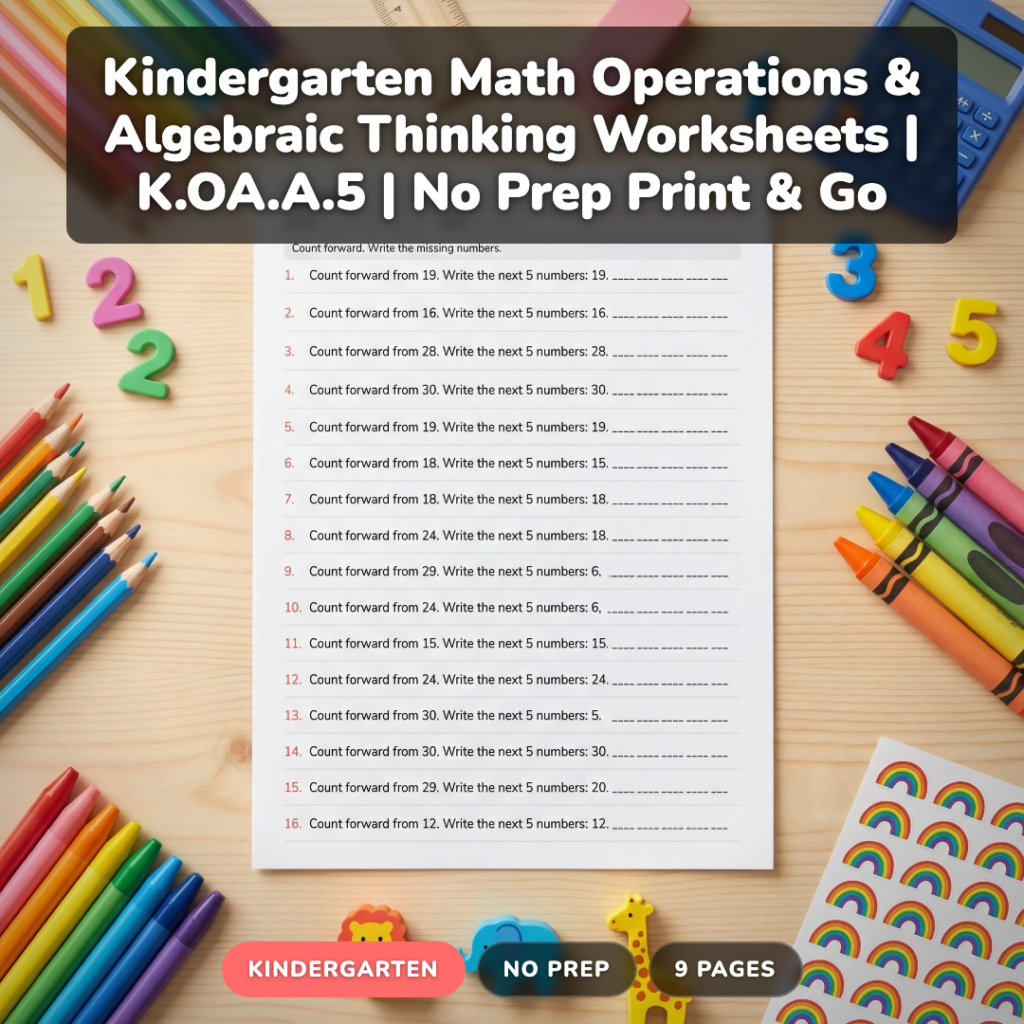
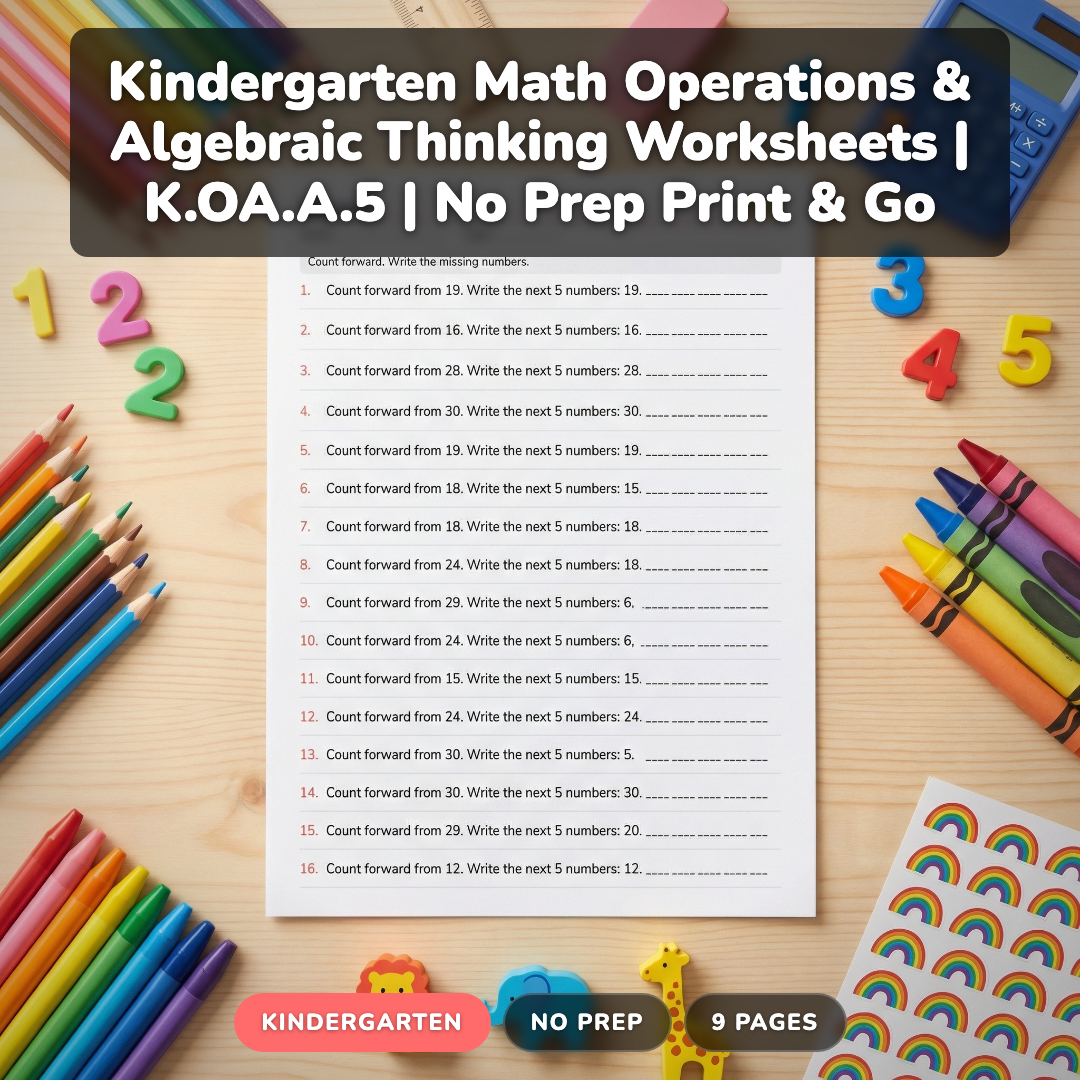
Teaching operations and algebraic thinking requires systematic practice across multiple difficulty levels, which means hours of worksheet creation and differentiation work. The Kindergarten Math Operations & Algebraic Thinking Worksheets eliminates that prep time with 79 carefully scaffolded problems across three differentiation levels.
The resource includes 22 practice problems for students who need extra support, 30 on-level problems that directly address the grade-level standard, and 27 challenge problems for advanced learners. Each level uses developmentally appropriate contexts and visual supports, moving students systematically from concrete thinking to abstract fluency with addition and subtraction within 5.
What makes this resource different is the intentional progression within each level — problems start with ten frame support, move to number line work, and finish with abstract equations. Answer keys are included for all levels, making it perfect for math centers, homework, or quick assessments.
Nine pages of differentiated practice that covers every student in your classroom, from struggling learners to advanced mathematicians.
Grab a Free Operations Practice Sheet to Try
Want to see how differentiated operations practice works in your classroom? I’ll send you a free sample worksheet with problems at all three levels, plus a quick implementation guide.
Frequently Asked Questions About Teaching Math Operations
When should kindergarten students master addition and subtraction within 5?
Most students achieve fluency with facts within 5 by late spring of kindergarten year. CCSS.Math.Content.K.OA.A.5 expects fluent computation, meaning accurate and efficient recall without counting strategies. Allow 60-80 practice opportunities across multiple contexts for mastery.
What does “fluently” mean for kindergarten math operations?
Fluency means students can solve addition and subtraction problems within 5 accurately and efficiently, typically within 2-3 seconds. They should not need to count on fingers or use manipulatives for these basic facts, demonstrating automatic recall through various strategies.
Should kindergarten students memorize math facts or understand strategies?
Both are important. Students need conceptual understanding through manipulatives and visual models first, then develop automatic recall through practice. Understanding why 3 + 2 = 5 makes memorization meaningful rather than rote. Strategy instruction should precede fluency expectations.
How do I help students who still count on their fingers for simple addition?
Finger counting indicates students haven’t developed number relationships yet. Use ten frames and number bonds to build visual number sense, practice subitizing with dot patterns, and provide more concrete manipulation time before expecting abstract computation strategies.
What’s the difference between operations and algebraic thinking in kindergarten?
Operations focus on addition and subtraction computation, while algebraic thinking involves understanding number relationships, patterns, and equality. Kindergarten algebraic thinking includes decomposing numbers (5 is 4 and 1) and understanding that both sides of an equation represent the same amount.
Teaching operations and algebraic thinking in kindergarten sets the foundation for all future mathematics learning. These five strategies — ten frames, number bonds, story problems, finger patterns, and number strings — give your students multiple pathways to understanding while building the fluency that CCSS.Math.Content.K.OA.A.5 requires.
What’s your favorite strategy for helping kindergarten students master addition and subtraction within 5? Try the free sample worksheet above and let me know how these approaches work in your classroom.