If your kindergarteners struggle to tell the difference between a square and a rectangle, or call every three-sided shape a “triangle” regardless of size, you’re not alone. Teaching geometry to 5 and 6-year-olds requires moving beyond simple shape identification to help them analyze and compare geometric properties.
Key Takeaway
Kindergarten geometry success comes from hands-on exploration that builds vocabulary for describing shape attributes like sides, corners, and relative size.
Why Geometry Matters in Kindergarten
Geometry forms the foundation for spatial reasoning skills that students will use throughout their mathematical journey. The CCSS.Math.Content.K.G.B.4 standard asks kindergarteners to analyze and compare two- and three-dimensional shapes using informal language to describe similarities, differences, and attributes like number of sides and vertices.
Research from the National Council of Teachers of Mathematics shows that students who develop strong spatial reasoning in early grades perform better in algebra and higher-level mathematics. Kindergarten is when children transition from simply recognizing shapes to understanding that shapes have measurable properties.
This standard typically appears in the second half of the kindergarten year, after students have mastered basic shape identification. Students should be comfortable naming common shapes before diving into attribute analysis and comparison.
Looking for a ready-to-go resource? I put together a differentiated kindergarten geometry pack that covers everything below — but first, the teaching strategies that make it work.
Common Geometry Misconceptions in Kindergarten
Common Misconception: Students think a rotated square is a diamond or different shape.
Why it happens: They rely on visual orientation rather than geometric properties.
Quick fix: Rotate shapes while counting sides and corners together.
Common Misconception: Students believe rectangles and squares are completely different shapes.
Why it happens: They focus on overall appearance rather than shared properties.
Quick fix: Emphasize that squares are special rectangles with equal sides.
Common Misconception: Students think bigger shapes have more sides or corners.
Why it happens: They confuse size with geometric properties.
Quick fix: Compare large and small versions of the same shape side-by-side.
Common Misconception: Students call all triangles “triangles” regardless of type.
Why it happens: They haven’t learned to notice differences in triangle attributes.
Quick fix: Sort triangles by size while emphasizing the constant “three sides, three corners.”
5 Research-Backed Strategies for Teaching Kindergarten Geometry
Strategy 1: Shape Attribute Hunt with Real Objects
Students explore classroom objects to find shapes and describe their properties using mathematical vocabulary. This concrete approach helps children connect abstract geometric concepts to their physical world.
What you need:
- Collection of classroom objects (books, blocks, crayons, paper)
- Shape attribute chart
- Magnifying glasses (optional but engaging)
Steps:
- Give each student 3-4 classroom objects
- Model examining one object: “This book has 4 sides, 4 corners, and opposite sides are the same length”
- Students examine their objects and describe what they notice
- Record findings on the attribute chart using student language
- Compare objects with similar shapes but different sizes
Strategy 2: Shape Building with Manipulatives
Students construct shapes using various manipulatives to understand how geometric properties remain constant regardless of size or material. This hands-on approach reinforces the CCSS.Math.Content.K.G.B.4 focus on analyzing shapes in different sizes and orientations.
What you need:
- Pattern blocks
- Geoboards and rubber bands
- Play dough and toothpicks
- Shape challenge cards
Steps:
- Demonstrate building a triangle with pattern blocks while counting sides and vertices
- Students build the same shape using different materials (geoboard, play dough)
- Compare all versions: “What’s the same? What’s different?”
- Challenge students to build shapes with specific attributes (“Make a shape with 4 equal sides”)
- Display and discuss different solutions to the same challenge
Strategy 3: Shape Detective Sorting Game
Students become “shape detectives” who sort and classify shapes based on multiple attributes simultaneously. This develops analytical thinking and mathematical reasoning skills essential for geometry understanding.
What you need:
- Mixed collection of 2D and 3D shapes in various sizes
- Sorting hoops or boxes
- Detective badges (optional)
- Attribute sorting cards
Steps:
- Present a mystery sorting rule (“I sorted these shapes by something special”)
- Students examine the sorted groups and guess the rule
- Reveal the rule and have students check their thinking
- Students create their own sorting rules for partners to solve
- Introduce multiple-attribute sorting (“shapes with 4 sides AND 4 corners”)
Strategy 4: Shape Transformation Theater
Students use their bodies and movement to demonstrate how shapes maintain their properties even when rotated, flipped, or resized. This kinesthetic approach helps children understand orientation independence.
What you need:
- Large floor shapes (tape or laminated cutouts)
- Shape costume pieces (optional)
- Music for movement
- Rotation and flip direction cards
Steps:
- Students stand on or around a large floor triangle
- Call out transformations: “Rotate your triangle to the right!”
- Students move while chanting shape properties: “Still 3 sides, still 3 corners!”
- Compare the “before” and “after” triangle positions
- Students take turns being the “shape caller” for different transformations
Strategy 5: Attribute Comparison Charts
Students create visual charts comparing shape attributes to develop analytical thinking and mathematical vocabulary. This strategy builds the comparison skills central to the kindergarten geometry standard.
What you need:
- Large chart paper
- Shape cutouts in various sizes
- Markers or crayons
- Attribute word cards (sides, corners, curved, straight)
Steps:
- Create a two-column chart with “Same” and “Different” headers
- Place two shapes at the top (e.g., large square and small square)
- Students identify similarities and differences
- Record findings using pictures and words
- Repeat with increasingly complex shape pairs
How to Differentiate Geometry for All Learners
For Students Who Need Extra Support
Begin with concrete shape identification using real objects before moving to abstract analysis. Provide shape templates for tracing and focus on one attribute at a time (count sides, then count corners separately). Use consistent vocabulary and repeat key terms frequently. Offer visual supports like attribute cards with pictures and words.
For On-Level Students
Students at grade level can handle comparing two shapes simultaneously and describing multiple attributes. They should practice using mathematical vocabulary independently and work with shapes in various orientations. Provide opportunities for both guided and independent exploration of shape properties.
For Students Ready for a Challenge
Advanced learners can explore complex shape relationships, such as how squares relate to rectangles or how triangles can be combined to form other shapes. Introduce early fraction concepts by dividing shapes into equal parts. Challenge them to create their own shape definitions and sorting rules.
A Ready-to-Use Geometry Resource for Your Classroom
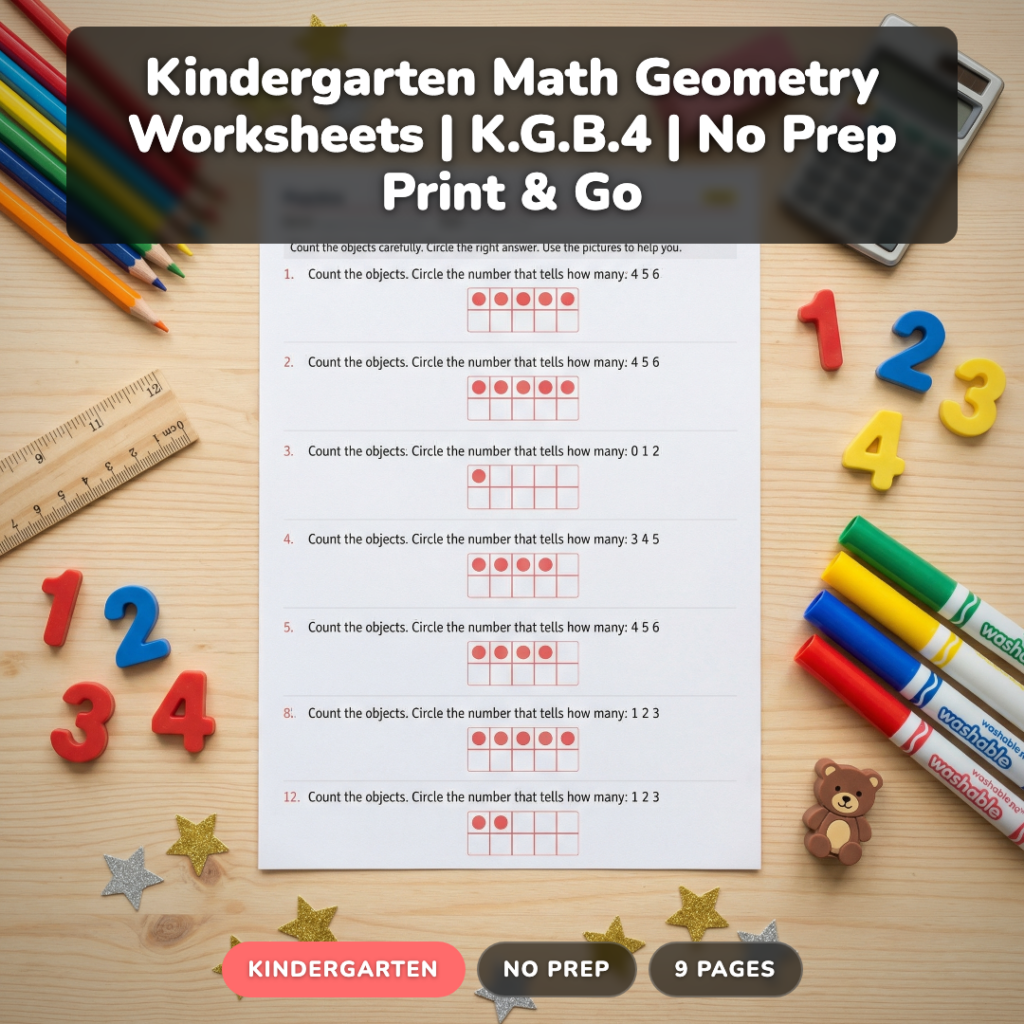
Teaching kindergarten geometry effectively requires differentiated materials that meet students where they are. After years of creating geometry lessons, I developed a comprehensive worksheet pack that addresses the CCSS.Math.Content.K.G.B.4 standard with three distinct difficulty levels.
This 9-page resource includes 79 problems total: 22 practice problems for students building foundational skills, 30 on-level problems for grade-appropriate challenges, and 27 advanced problems for students ready to extend their learning. Each level focuses on shape analysis and comparison while building mathematical vocabulary.
What makes this resource different is the careful scaffolding between levels. Practice pages emphasize shape identification and basic counting, on-level pages add comparison tasks, and challenge pages introduce complex attribute analysis. Answer keys are included for quick assessment.
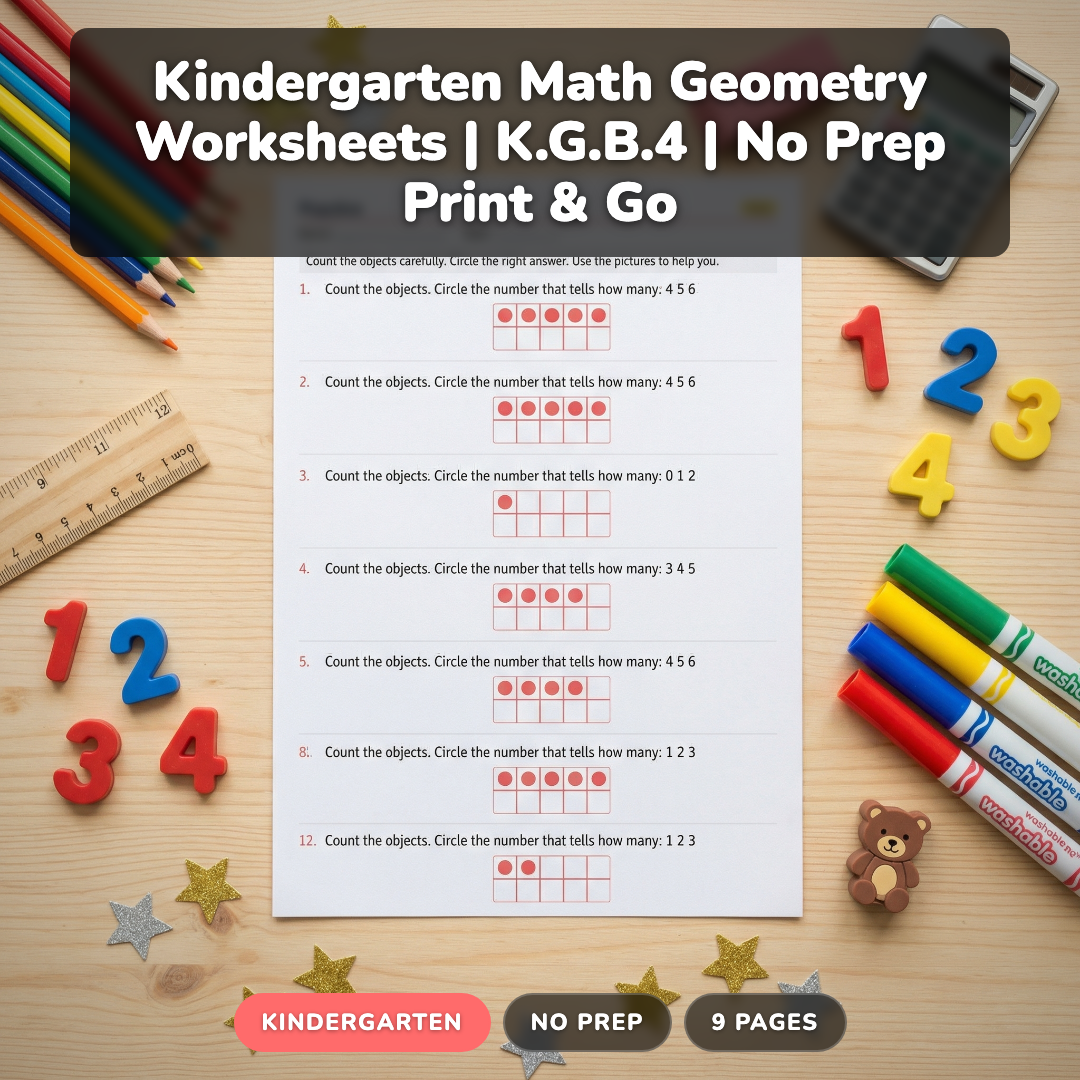
The no-prep format means you can print and use immediately, whether for whole-class instruction, small group work, or individual practice. Each page includes clear directions and visual supports to help students work independently.
Grab a Free Geometry Sample to Try
Want to see how this differentiated approach works in your classroom? I’ll send you a free sample page from each difficulty level, plus a bonus shape attribute chart you can use with any geometry lesson.
Frequently Asked Questions About Teaching Kindergarten Geometry
When should kindergarteners learn geometry vocabulary like “vertices” and “attributes”?
Introduce formal vocabulary gradually after students understand the concepts through exploration. Start with “corners” and “sides,” then add “vertices” and “edges” as students become comfortable. Most kindergarteners can use basic geometry vocabulary by mid-year with consistent practice and visual supports.
How do I help students understand that orientation doesn’t change a shape?
Use physical manipulation frequently. Have students rotate shapes while counting sides and corners, demonstrating that these properties stay constant. Practice with floor shapes where students can walk around and view from different angles. The key is repeated exposure with hands-on exploration.
What’s the difference between 2D and 3D shape instruction in kindergarten?
Focus primarily on 2D shapes in kindergarten, as CCSS.Math.Content.K.G.B.4 emphasizes flat shape analysis. Introduce 3D shapes for enrichment, but don’t expect mastery. Students should identify basic 3D shapes like cubes and spheres but detailed analysis comes in later grades.
How can I assess kindergarten geometry understanding effectively?
Use performance-based assessments where students manipulate actual shapes while explaining their thinking. Ask them to sort shapes and describe their reasoning. Observe whether they can identify shape properties consistently across different sizes and orientations. Written assessments should include visual supports and simple vocabulary.
What manipulatives work best for kindergarten geometry instruction?
Pattern blocks, attribute blocks, and geoboards provide excellent hands-on exploration opportunities. Real-world objects like books, boxes, and classroom supplies help connect geometry to daily life. Avoid overly complex manipulatives that distract from the mathematical concepts. Simple, sturdy materials work best for 5 and 6-year-olds.
Teaching kindergarten geometry successfully means balancing hands-on exploration with vocabulary development. When students can analyze and compare shapes using mathematical language, they’re building the spatial reasoning skills that will serve them throughout their education. Remember to celebrate small victories — recognizing that a rotated square is still a square represents significant mathematical growth for a 5-year-old.
What’s your favorite strategy for helping kindergarteners understand shape properties? The free geometry sample is waiting for you above — it’s a great way to try these differentiated approaches in your own classroom.