If your kindergarten students can recite numbers to 20 but still grab a handful when you ask for “3 blocks,” you’re dealing with a classic counting and cardinality challenge. They’ve memorized the counting sequence but haven’t connected those number words to actual quantities.
This disconnect between rote counting and understanding quantity is one of the most common hurdles in early math. The good news? With the right strategies, you can help every student build this crucial foundation for all future math learning.
Key Takeaway
Students master counting and cardinality when they understand that each number represents a specific quantity that’s exactly one more than the previous number.
Why Counting & Cardinality Matters in Kindergarten
Counting and cardinality forms the foundation of all mathematical thinking. When students understand CCSS.Math.Content.K.CC.B.4c — that each successive number name refers to a quantity that is one larger — they’re building number sense that will support addition, subtraction, and place value concepts throughout elementary school.
Research from the National Council of Teachers of Mathematics shows that students who develop strong cardinality understanding in kindergarten perform significantly better on standardized math assessments through third grade. This skill typically develops between ages 4-6, making kindergarten the optimal window for intensive instruction.
The timing matters too. Most kindergarten curricula introduce counting and cardinality in the first quarter, building from counting to 10 in September to counting to 20 by December. Students need to master one-to-one correspondence before tackling cardinality, and both skills before moving to comparing quantities.
Looking for a ready-to-go resource? I put together a differentiated counting & cardinality pack that covers everything below — but first, the teaching strategies that make it work.
Common Counting & Cardinality Misconceptions in Kindergarten
Understanding why students struggle helps you target your instruction more effectively. Here are the four misconceptions I see most often:
Common Misconception: Students think counting faster means they’re better at math.
Why it happens: They’ve been praised for memorizing the counting sequence without understanding what the numbers represent.
Quick fix: Slow down counting and emphasize touching each object once.
Common Misconception: When asked “How many?” students recount from 1 instead of giving the last number counted.
Why it happens: They don’t understand that the final number in a count represents the total quantity.
Quick fix: Practice the “magic last number” — emphasize that the last number you say tells you how many total.
Common Misconception: Students skip objects or count the same object twice when counting collections.
Why it happens: They haven’t developed one-to-one correspondence between number words and objects.
Quick fix: Use the “touch and move” method — physically move each object as you count it.
Common Misconception: Students think bigger objects represent bigger numbers.
Why it happens: They confuse physical size with numerical quantity.
Quick fix: Count collections of different-sized objects together, emphasizing that size doesn’t change the count.
5 Research-Backed Strategies for Teaching Counting & Cardinality
Strategy 1: The Touch-and-Count Method with Movement
This foundational strategy builds one-to-one correspondence by requiring students to physically interact with each object as they count. The movement creates a kinesthetic connection between number words and quantities.
What you need:
- Small manipulatives (counting bears, blocks, or beans)
- Paper plates or counting mats
- Pointing finger puppet (optional but engaging)
Steps:
- Give each student 5-10 objects and a plate
- Model touching each object while saying the number word
- Have students move each object to their plate as they count
- Ask “How many total?” and celebrate when they give the last number counted
- Gradually increase the quantity as students show mastery
Strategy 2: Number Line Body Movement
This strategy helps students understand that each number is exactly one more than the previous number, directly addressing CCSS.Math.Content.K.CC.B.4c. The physical movement reinforces the concept that numbers grow in a predictable sequence.
What you need:
- Floor number line (tape numbers 1-10 on the floor)
- Counting objects to hold
- Music for movement (optional)
Steps:
- Start students at position 0 with no objects
- As they step to 1, they pick up one object and say “1”
- At position 2, they pick up one more object and say “2 is one more than 1”
- Continue to 5, emphasizing “[number] is one more than [previous number]”
- Count total objects at the end to reinforce cardinality
Strategy 3: The “Magic Last Number” Game
This game specifically targets the cardinality principle — understanding that the last number counted represents the total quantity. Many students can count accurately but don’t grasp this crucial concept.
What you need:
- Various small objects (buttons, shells, crackers)
- Small containers or bags
- “Magic wand” (ruler or pencil)
Steps:
- Count a small collection together, touching each object
- Wave the “magic wand” and ask “What’s the magic number that tells us how many?”
- Celebrate when students identify the last number counted
- Practice with different quantities, always emphasizing the “magic last number”
- Let students be the “magician” and ask classmates for the magic number
Strategy 4: Subitizing with Dot Patterns
Subitizing — instantly recognizing small quantities without counting — builds number sense and helps students see numbers as distinct quantities rather than just words in a sequence.
What you need:
- Dot cards (1-5 dots in various patterns)
- Timer
- Small manipulatives to match quantities
Steps:
- Flash a dot card for 2 seconds
- Students say how many dots they saw without counting
- Reveal the card and count together to verify
- Have students build the same quantity with manipulatives
- Progress from organized patterns (dice dots) to random arrangements
Strategy 5: Counting Collections with Real Objects
Using authentic objects from students’ lives makes counting meaningful and helps them see math in their world. This strategy builds both counting skills and mathematical reasoning.
What you need:
- Collections of real objects (rocks, leaves, pasta, buttons)
- Recording sheets
- Magnifying glasses (optional)
Steps:
- Give each student or pair a collection of 8-12 similar objects
- Students organize objects in a way that makes sense to them
- They count their collection using touch-and-move method
- Students record the total and explain their counting strategy
- Share different organizational methods as a class
How to Differentiate Counting & Cardinality for All Learners
For Students Who Need Extra Support
These students benefit from smaller quantities, more structured activities, and additional practice with one-to-one correspondence. Start with 1-5 objects arranged in a line, use larger manipulatives that are easier to handle, and provide verbal prompts like “touch and say.” Review prerequisite skills like recognizing “more” and “less” with concrete objects. Consider using a hundreds chart to show the counting sequence visually, and allow extra time for processing between counting and answering “how many?”
For On-Level Students
Grade-level expectations for kindergarten include counting to 20, understanding cardinality for quantities up to 10, and recognizing that each number is one larger than the previous. These students should practice with quantities of 5-10 objects, work with both organized and scattered arrangements, and begin connecting counting to simple addition concepts. They can handle mixed collections and start comparing quantities using mathematical language.
For Students Ready for a Challenge
Advanced students can work with quantities up to 20, explore skip counting by 2s and 5s, and make connections to place value concepts. Challenge them with counting backwards, starting counts from numbers other than 1, and solving simple story problems involving counting. These students can also explore different ways to organize the same quantity and explain their mathematical thinking to peers.
A Ready-to-Use Counting & Cardinality Resource for Your Classroom
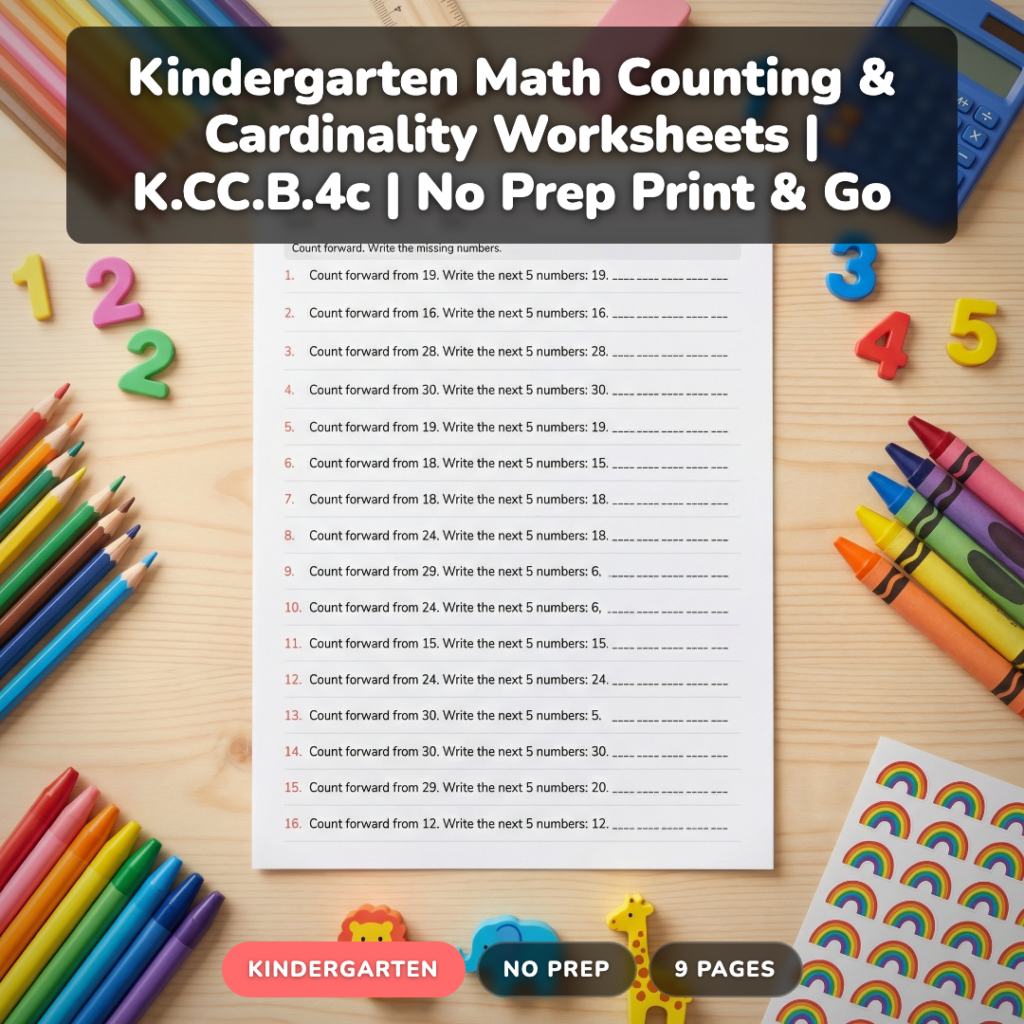
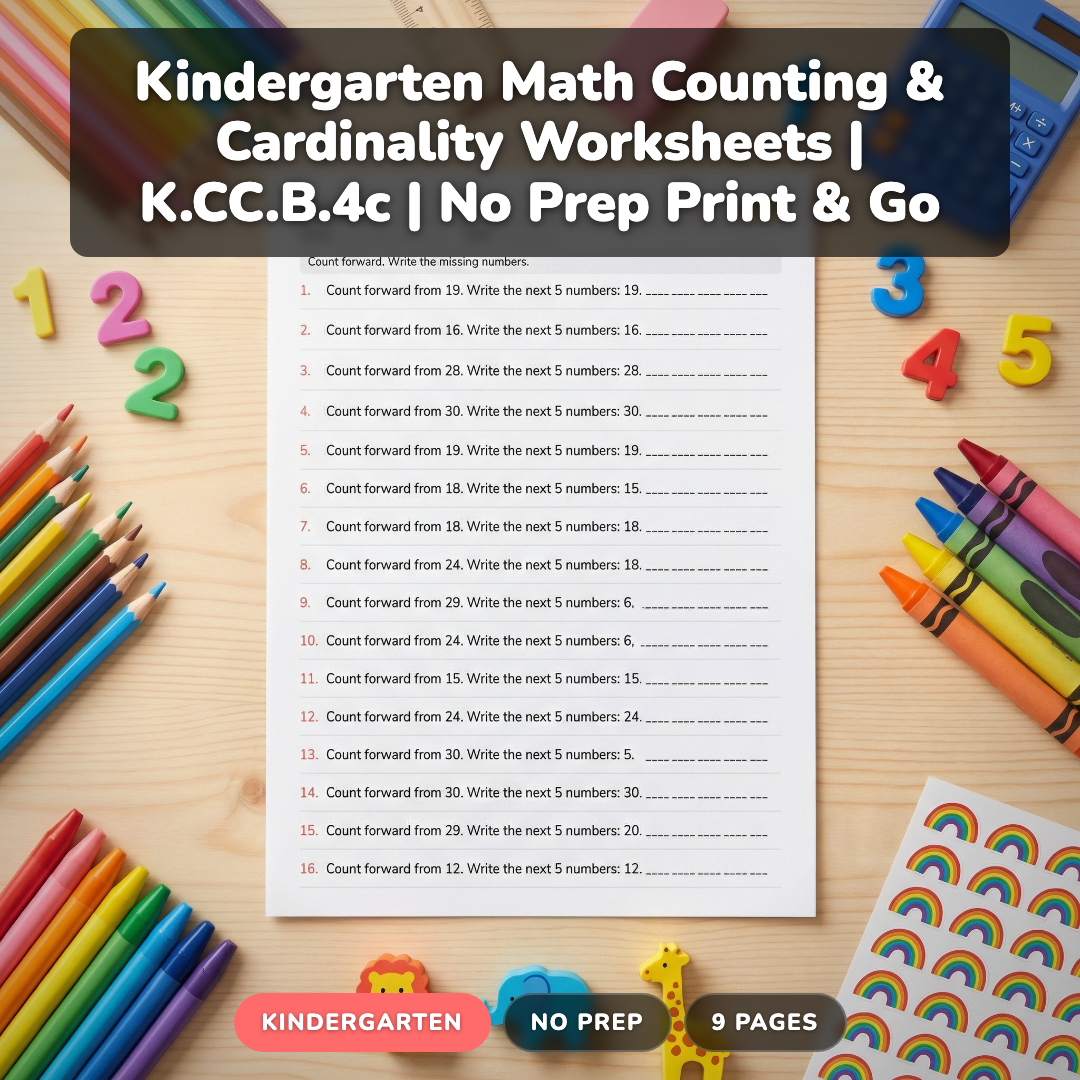
If you’re looking for differentiated practice that covers all these concepts, I’ve created a comprehensive counting and cardinality worksheet pack that saves you hours of prep time. This 9-page resource includes 79 problems across three difficulty levels, perfectly aligned with kindergarten standards.
The pack includes 22 practice problems for students building foundational skills, 30 on-level problems for grade-appropriate practice, and 27 challenge problems for advanced learners. Each level uses engaging visuals and varied problem types to keep students motivated while building essential number sense skills.
What makes this resource different is the careful progression — problems start with organized objects and gradually move to scattered arrangements, building both counting skills and mathematical reasoning. Answer keys are included for quick assessment, and the no-prep format means you can use it immediately.
Grab a Free Counting Sample to Try
Want to see how these strategies work in practice? I’ll send you a free sample worksheet that includes problems from each difficulty level, plus a quick reference guide for implementing the touch-and-count method in your classroom.
Frequently Asked Questions About Teaching Counting & Cardinality
When should kindergarten students master cardinality?
Most students develop cardinality understanding between October and January of kindergarten year. Students should master cardinality with quantities 1-10 by mid-year to support addition and subtraction concepts introduced in second semester.
What’s the difference between rote counting and cardinality?
Rote counting is reciting number words in sequence (“1, 2, 3, 4, 5”). Cardinality means understanding that the last number counted represents the total quantity — when you count 5 objects, there are 5 total items.
How do I know if a student understands one-to-one correspondence?
Students with one-to-one correspondence touch each object exactly once while counting, don’t skip objects or count the same object twice, and can accurately count scattered objects, not just those in a line.
Should I correct students who count too fast?
Yes, gently slow them down. Fast counting often indicates they’re reciting memorized sequences without connecting to quantities. Encourage deliberate touching and moving of objects to build true understanding rather than rote memorization.
What manipulatives work best for counting practice?
Small, uniform objects like counting bears, blocks, or beans work well. Avoid objects that are too small (choking hazard) or too large (hard to organize). Natural objects like shells or rocks add engagement and real-world connections.
Teaching counting and cardinality successfully means helping students see numbers as representations of real quantities, not just words in a sequence. When you use concrete manipulatives, emphasize the “magic last number,” and provide plenty of hands-on practice, you’re building the number sense foundation that will support all future math learning.
What’s your favorite strategy for helping students understand that numbers represent quantities? Try the free sample above and see how your students respond to differentiated counting practice.