If your kindergarteners can count to ten but freeze when you ask them to write the number 7, or if they confidently say “one, two, three, four, five” while pointing to three objects, you’re not alone. The bridge between counting, understanding quantity, and writing numerals is where many young learners stumble. You’ll discover five research-backed strategies that help students master both the “how many” and the “write it down” parts of early number sense.
Key Takeaway
Successful counting and cardinality instruction connects three representations: concrete objects, verbal counting, and written numerals through hands-on practice and systematic progression.
Why Counting & Cardinality Matters in Kindergarten
Counting and cardinality forms the foundation for all future math learning. CCSS.Math.Content.K.CC.A.3 requires students to write numbers 0-20 and represent quantities with written numerals, including zero for empty sets. This standard typically appears in the first quarter of kindergarten, building on students’ informal counting experiences.
Research from the National Council of Teachers of Mathematics shows that students who master cardinality—understanding that the last number counted represents the total quantity—demonstrate stronger number sense throughout elementary school. The key insight: counting isn’t just saying number words in order. It’s understanding that each number represents a specific quantity and can be recorded with a symbol.
Effective instruction connects three critical representations: concrete objects (5 blocks), verbal counting (“one, two, three, four, five”), and written numerals (5). Students need extensive practice moving between these representations before the connections become automatic.
Looking for a ready-to-go resource? I put together a differentiated counting & cardinality pack that covers everything below — but first, the teaching strategies that make it work.
Common Counting & Cardinality Misconceptions in Kindergarten
Common Misconception: Students count objects correctly but can’t tell you “how many” total.
Why it happens: They view counting as a recitation activity rather than a way to determine quantity.
Quick fix: Always end counting with “So how many do we have altogether?” and emphasize the last number counted.
Common Misconception: Students write numbers backwards or upside down (6 looks like 9, 3 faces the wrong way).
Why it happens: Letter and number formation requires fine motor control and spatial awareness still developing in 5-year-olds.
Quick fix: Use directional language (“Start at the top, curve down and around”) and provide numbered dots for tracing.
Common Misconception: Students skip numbers when counting or don’t understand that zero means “none.”
Why it happens: The counting sequence is memorized without connecting to quantity, and zero is abstract.
Quick fix: Use physical objects for every counting experience and explicitly teach zero with empty containers.
Common Misconception: Students count the same object twice or skip objects when counting collections.
Why it happens: They lack systematic counting strategies and one-to-one correspondence.
Quick fix: Teach the “touch and move” strategy—physically moving each object as they count it.
5 Research-Backed Strategies for Teaching Counting & Cardinality
Strategy 1: Number Formation Songs with Hand Motions
Transform number writing from a fine motor struggle into a memorable, multi-sensory experience. Students learn the directional movements for forming each numeral through songs that include hand motions, making the abstract concrete and engaging.
What you need:
- Large chart paper or whiteboard
- Thick markers or finger paints
- Number formation rhymes or songs
- Sand trays or finger-writing surfaces
Steps:
- Introduce one number at a time with its formation song (“Start at the top and go straight down, that’s the way to make a one”)
- Practice the hand motion in the air while singing
- Trace the number in sand, on textured surfaces, or with finger paints
- Connect to counting by having students make the number after counting that many objects
- Practice daily for 2-3 minutes during morning routine
Strategy 2: Count, Touch, and Move Collections
Develop one-to-one correspondence and cardinality through systematic object counting that prevents double-counting and builds understanding that the last number represents the total quantity.
What you need:
- Various counting objects (blocks, bears, buttons)
- Small bowls or counting mats
- Number cards 0-20
- “Counting cups” for moving counted objects
Steps:
- Give students a collection of 5-10 objects scattered on their workspace
- Model the “touch and move” technique: touch each object while saying the number, then move it to a separate area
- After counting all objects, ask “How many do we have altogether?” and emphasize the last number counted
- Have students find the matching numeral card and place it next to their collection
- Repeat with different quantities, gradually increasing the number range
Strategy 3: Zero the Hero Introduction
Make the abstract concept of zero concrete and meaningful by treating it as a special number that represents “none” or “empty,” helping students understand that zero is a quantity (nothing) that can be written and counted.
What you need:
- Clear containers of various sizes
- Small objects for filling containers
- “Zero the Hero” character or puppet
- Number line including zero
Steps:
- Introduce “Zero the Hero” as the number that means “nothing” or “empty”
- Show containers with different amounts, including completely empty ones
- Count objects in each container, emphasizing that empty containers have “zero” objects
- Practice writing zero while saying “Zero means none, nothing here at all”
- Create “zero situations” throughout the day (“How many elephants are in our classroom?”)
Strategy 4: Number Line Body Movement
Transform abstract number sequences into physical experiences that help students internalize number order, understand quantity relationships, and practice numeral recognition through whole-body learning.
What you need:
- Floor number line (tape or chalk) 0-20
- Large number cards
- Counting objects for each number
- Music for movement activities
Steps:
- Create a large floor number line with numerals clearly marked
- Have students walk the number line while counting aloud
- Call out numbers and have students jump to that position
- Place the corresponding number of objects at each numeral position
- Practice “one more” and “one less” by taking steps forward and backward
Strategy 5: Daily Number of the Day Routine
Build comprehensive number sense through focused daily practice that connects counting, numeral writing, quantity representation, and number relationships in a predictable, engaging routine.
What you need:
- Daily calendar or number chart
- Counting objects (different each day)
- Whiteboard for number writing practice
- “Number of the Day” recording sheet
Steps:
- Choose one number each day (follow calendar date or systematic progression)
- Count out that many objects as a class
- Practice writing the numeral with proper formation
- Find the number on a hundreds chart or number line
- Identify “one more” and “one less” than the daily number
- Create different representations (drawings, tally marks, ten frames)
How to Differentiate Counting & Cardinality for All Learners
For Students Who Need Extra Support
Focus on numbers 1-10 with extensive concrete manipulation. Provide larger objects for easier handling and use hand-over-hand guidance for number formation. Break counting into smaller chunks (1-5, then 6-10) and use visual supports like number charts with pictures. Emphasize one-to-one correspondence with physical touch-and-move strategies before introducing numeral writing. Review prerequisite skills like object sorting and pattern recognition.
For On-Level Students
Work systematically through numbers 0-20 as outlined in CCSS.Math.Content.K.CC.A.3. Balance concrete counting experiences with numeral writing practice. Use varied counting objects and contexts to build flexible thinking. Incorporate both structured practice and playful counting games. Focus on connecting all three representations: objects, counting words, and written numerals through daily practice routines.
For Students Ready for a Challenge
Extend beyond 20 to explore numbers through 50 or 100. Introduce concepts like skip counting by 2s, 5s, and 10s. Explore different number representations including tally marks, ten frames, and base-ten blocks. Create counting challenges with larger collections and practice estimation skills. Connect to real-world applications like counting classroom supplies or measuring ingredients for cooking activities.
A Ready-to-Use Counting & Cardinality Resource for Your Classroom
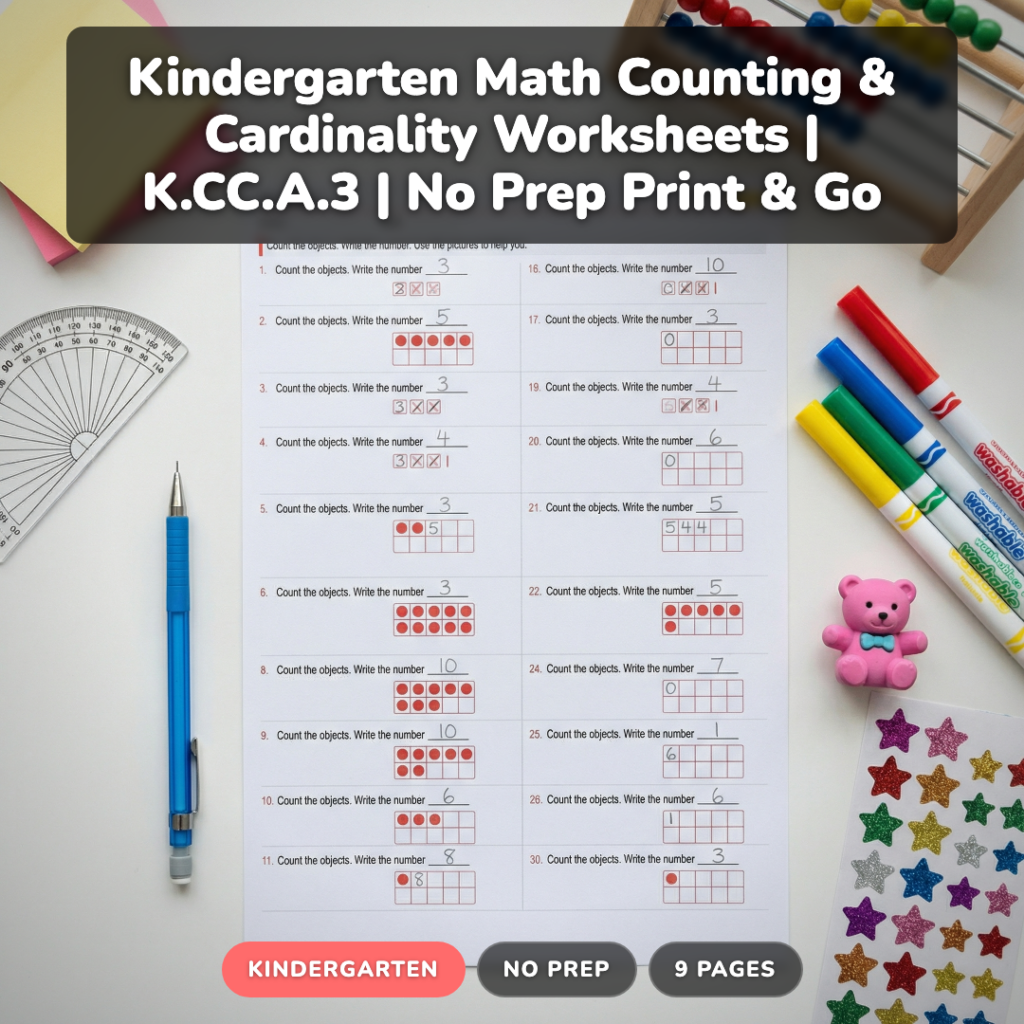
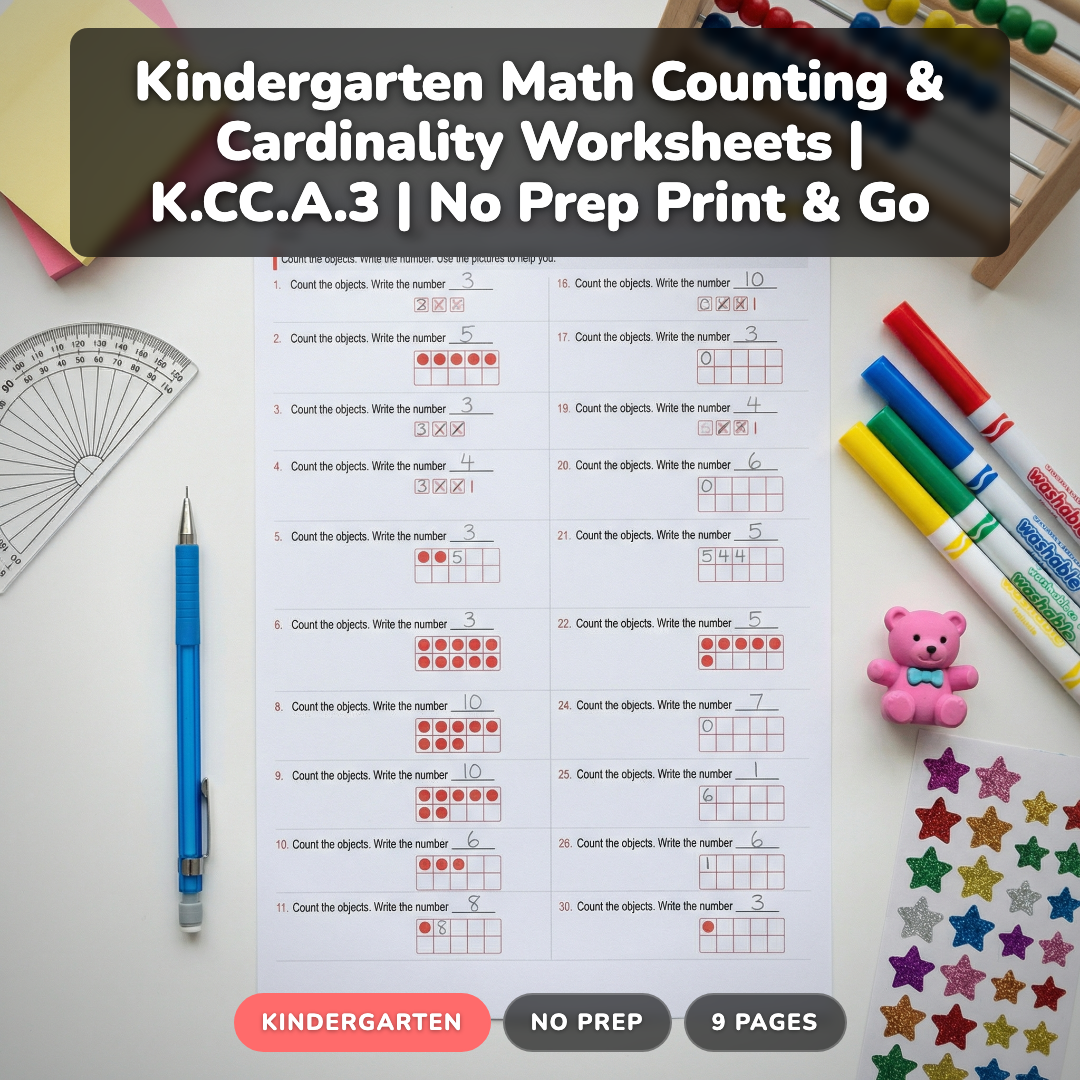
After years of creating counting activities from scratch, I designed a comprehensive resource that saves hours of prep time while providing the systematic practice kindergarteners need. This Kindergarten Math Counting & Cardinality Worksheets pack includes 79 carefully crafted problems across 9 pages, differentiated into three distinct levels.
The practice level (22 problems) focuses on numbers 1-10 with larger images and extra visual support. On-level worksheets (30 problems) cover the full 0-20 range with varied counting contexts. Challenge pages (27 problems) extend learning with teen numbers and more complex counting scenarios. Each level includes answer keys and can be used for independent practice, homework, or assessment.
What makes this resource different is the intentional progression—students don’t just practice random counting. They move systematically from concrete counting to numeral writing, with built-in review and spiral practice that matches how children actually learn number concepts.
You can grab this time-saving resource and start using it tomorrow morning. No prep required—just print and go.
Grab a Free Counting Practice Sheet to Try
Want to see the quality and format before you buy? I’ll send you a free sample worksheet that includes practice, on-level, and challenge problems so you can try it with your students first.
Frequently Asked Questions About Teaching Counting & Cardinality
When should kindergarten students master counting and writing numbers 0-20?
Most kindergarteners master numbers 1-10 by mid-year and numbers 11-20 by spring, according to CCSS.Math.Content.K.CC.A.3 expectations. However, focus on understanding quantity and one-to-one correspondence before emphasizing speed or perfect numeral formation.
What should I do if students can count but can’t write numerals correctly?
Separate counting practice from writing practice initially. Use multi-sensory approaches like sand trays, finger paints, and formation songs. Many kindergarteners need extra time to develop fine motor skills required for numeral formation, so provide larger writing spaces and shorter practice sessions.
How do I teach the concept of zero to kindergarten students?
Make zero concrete by using empty containers and “nothing” situations. Introduce zero as “the number that means none” and practice counting empty sets. Use visual representations like empty ten frames and connect to real experiences like “zero cookies left” after snack time.
Should kindergarten students memorize number facts or focus on counting strategies?
Focus on counting strategies and number sense first. Students need to understand what numbers represent before memorizing facts. Counting strategies provide the foundation for later fact fluency and help students develop flexible thinking about numbers and quantities.
How can I assess if students truly understand cardinality versus just memorizing counting?
Ask “How many altogether?” after students count collections. Give them a number and ask them to show you that many objects. Mix up counting sequences or start from different numbers to check for genuine understanding versus rote memorization.
Teaching counting and cardinality successfully comes down to connecting concrete experiences with abstract symbols through systematic, engaging practice. Remember that kindergarteners learn best when they can touch, move, and manipulate objects while building their understanding of number relationships.
What’s your biggest challenge when teaching counting and cardinality? I’d love to hear about your classroom experiences! Don’t forget to grab that free sample worksheet above to try these strategies with your students tomorrow.