If your kindergarteners can sing the counting song but freeze when asked to start counting from 7, you’re not alone. Many young learners memorize the number sequence without truly understanding how counting works or how to pick up counting from any given number.
This foundational skill — counting forward from a given number — is crucial for developing number sense and sets the stage for addition, subtraction, and place value understanding later. You’ll discover five research-backed strategies that make this abstract concept concrete for kindergarten minds.
Key Takeaway
Kindergarteners need explicit practice starting counts from numbers other than 1, using visual anchors and kinesthetic activities to internalize the counting sequence.
Why Counting Forward from Any Number Matters in Kindergarten
The Common Core standard CCSS.Math.Content.K.CC.A.2 requires students to count forward beginning from a given number within the known sequence, rather than always starting at 1. This skill typically emerges in the second half of kindergarten, after students have mastered rote counting to at least 20.
Research from the National Research Council shows that children who can flexibly start counting from any number demonstrate stronger number sense and perform better on early addition tasks. This skill directly supports mental math strategies like “counting on” for addition problems.
Most kindergarten curricula introduce this concept between January and March, building on students’ ability to count objects and recognize written numerals. The skill connects to future standards involving skip counting, addition within 10, and understanding place value in first grade.
Looking for a ready-to-go resource? I put together a differentiated counting & cardinality pack that covers everything below — but first, the teaching strategies that make it work.
Common Counting Misconceptions in Kindergarten
Understanding why students struggle helps you address the root causes rather than just practicing the same ineffective approaches.
Common Misconception: Students always start counting from 1, even when given a different starting number.
Why it happens: They’ve memorized the counting sequence as one long “song” that must begin at the beginning.
Quick fix: Use a number line and physically point to the starting number while saying “We start HERE.”
Common Misconception: Students count the starting number twice (“Start at 5: 5, 6, 7” becomes “5, 5, 6, 7”).
Why it happens: They confuse the starting position with the first count.
Quick fix: Use different voices — whisper the starting number, then count normally from the next number.
Common Misconception: Students can count forward from 1-10 but struggle with numbers beyond 10.
Why it happens: The teen numbers have irregular naming patterns that disrupt their mental sequence.
Quick fix: Practice the 11-20 sequence separately with visual supports before combining with counting-on activities.
Common Misconception: Students think they need objects to count, even for abstract number sequences.
Why it happens: Early counting instruction focuses heavily on counting concrete objects.
Quick fix: Explicitly teach that numbers exist independently of objects through number line activities.
5 Research-Backed Strategies for Teaching Counting Forward
Strategy 1: Number Line Jumping with Movement
Transform abstract number sequences into physical movement using a floor number line. Students literally step through the counting sequence, making the progression concrete and memorable.
What you need:
- Masking tape floor number line (0-20)
- Bean bags or small markers
- Index cards with starting numbers
Steps:
- Have student stand on the starting number (e.g., 8)
- Say “We start at 8. What comes next?” and have them step forward
- Continue for 3-5 numbers, emphasizing the forward motion
- Repeat with different starting points, gradually increasing the range
- Add challenges like “Count forward 4 numbers from 6”
Strategy 2: Counting Chain Visual Anchor
Create a visual reference that shows how numbers connect in sequence, helping students see that counting can begin anywhere in the chain.
What you need:
- Paper chain with numbers written on each link (1-20)
- Clothespins or clips
- Dry erase marker
Steps:
- Display the number chain where all students can see it
- Clip a clothespin at the starting number
- Point to each subsequent number while counting aloud
- Have students practice with you, then independently
- Use different colored clips for different starting points
Strategy 3: Partner Counting Games
Engage students through interactive games that require starting counts from various numbers, building fluency through repeated practice in a social context.
What you need:
- Dice or number cards
- Counting bears or other manipulatives
- Timer (optional)
Steps:
- Partner A rolls a die or draws a number card (starting number)
- Partner B must count forward 5 numbers from that starting point
- Partners check each other using a number line reference
- Switch roles and repeat with a new starting number
- Add variations like counting backward or counting by 2s
Strategy 4: Hundred Chart Hide and Seek
Use a hundreds chart (or 1-20 chart for beginners) to help students visualize number patterns and practice starting counts from any position.
What you need:
- Laminated hundreds chart or 1-20 chart
- Sticky notes or removable dots
- Dry erase markers
Steps:
- Cover several consecutive numbers with sticky notes
- Point to the number before the covered sequence
- Have students count forward to “discover” the hidden numbers
- Remove sticky notes to check their predictions
- Repeat with different starting points and lengths
Strategy 5: Musical Counting Sequences
Combine counting practice with rhythm and music to help students internalize number sequences through multiple sensory channels.
What you need:
- Simple percussion instruments (shakers, drums)
- Number cards
- Audio device for background rhythm (optional)
Steps:
- Draw a number card to establish the starting point
- Begin a steady rhythm with instruments
- Chant the counting sequence in rhythm, starting from the drawn number
- Have students join in, maintaining the beat
- Stop at a predetermined endpoint and draw a new starting number
How to Differentiate Counting & Cardinality for All Learners
For Students Who Need Extra Support
Focus on smaller number ranges (1-10) and provide concrete manipulatives for every counting activity. Use consistent visual anchors like a desktop number line, and practice the same starting numbers multiple times before introducing variety. Break the skill into micro-steps: first master counting 1-10 from 1, then from 2, then from 3, gradually building confidence. Pair struggling students with counting buddies and use multisensory approaches that combine visual, auditory, and kinesthetic elements.
For On-Level Students
Work within the standard kindergarten expectation of counting forward from any given number within the 1-20 sequence. Provide regular practice with varied starting points and incorporate the skill into daily routines like calendar time and transition activities. Use CCSS.Math.Content.K.CC.A.2 aligned activities that gradually increase in complexity, moving from teacher-supported to independent practice. Connect counting forward to real-world contexts like counting steps or playground equipment.
For Students Ready for a Challenge
Extend the counting range to 30 or beyond, and introduce skip counting patterns (counting by 2s, 5s, or 10s from various starting points). Challenge advanced students with backward counting or counting across decades (like 28, 29, 30, 31). Incorporate problem-solving elements: “If we start counting at 7 and count 6 more numbers, what number will we end on?” Connect to early addition concepts by showing how counting forward relates to adding.
A Ready-to-Use Counting & Cardinality Resource for Your Classroom
After implementing these strategies, you’ll want structured practice materials that reinforce the concepts without requiring extensive prep time. This is where having a comprehensive, differentiated worksheet pack becomes invaluable for both guided practice and independent work.
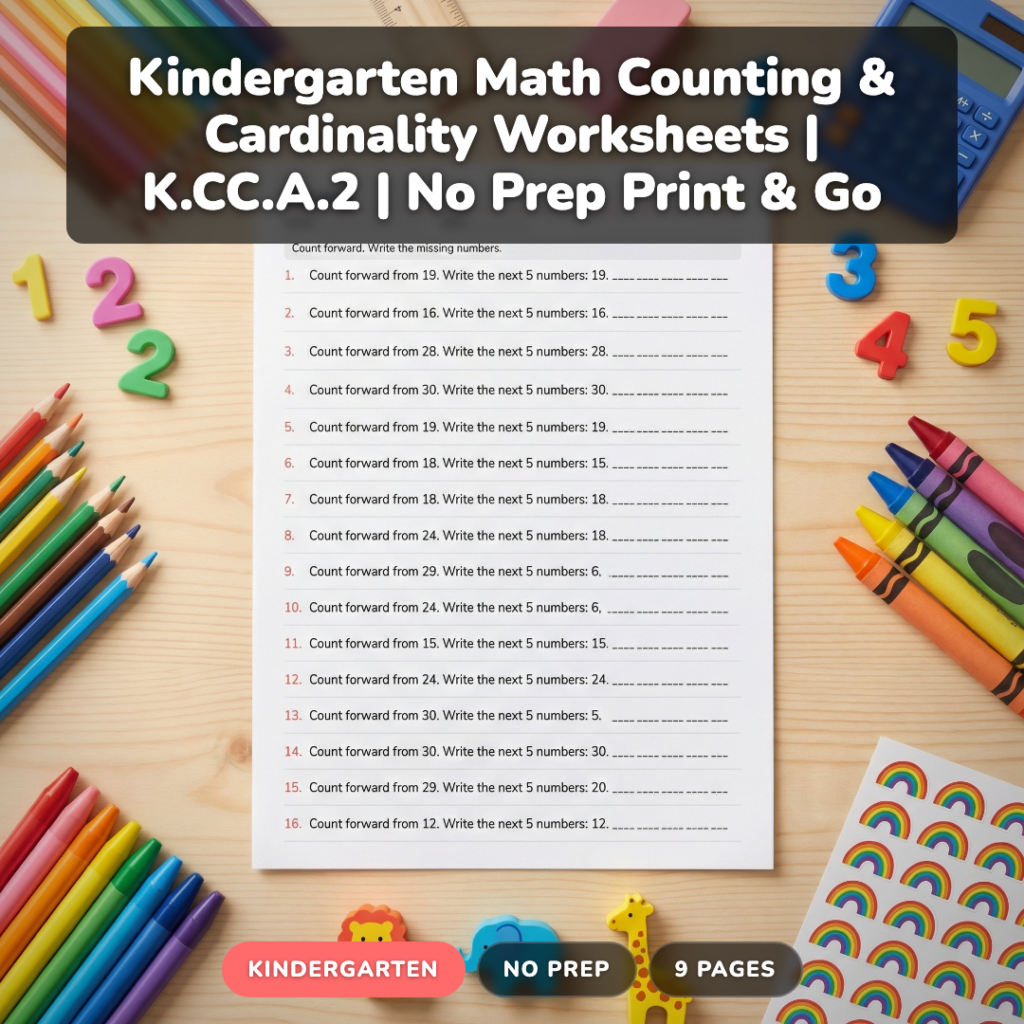
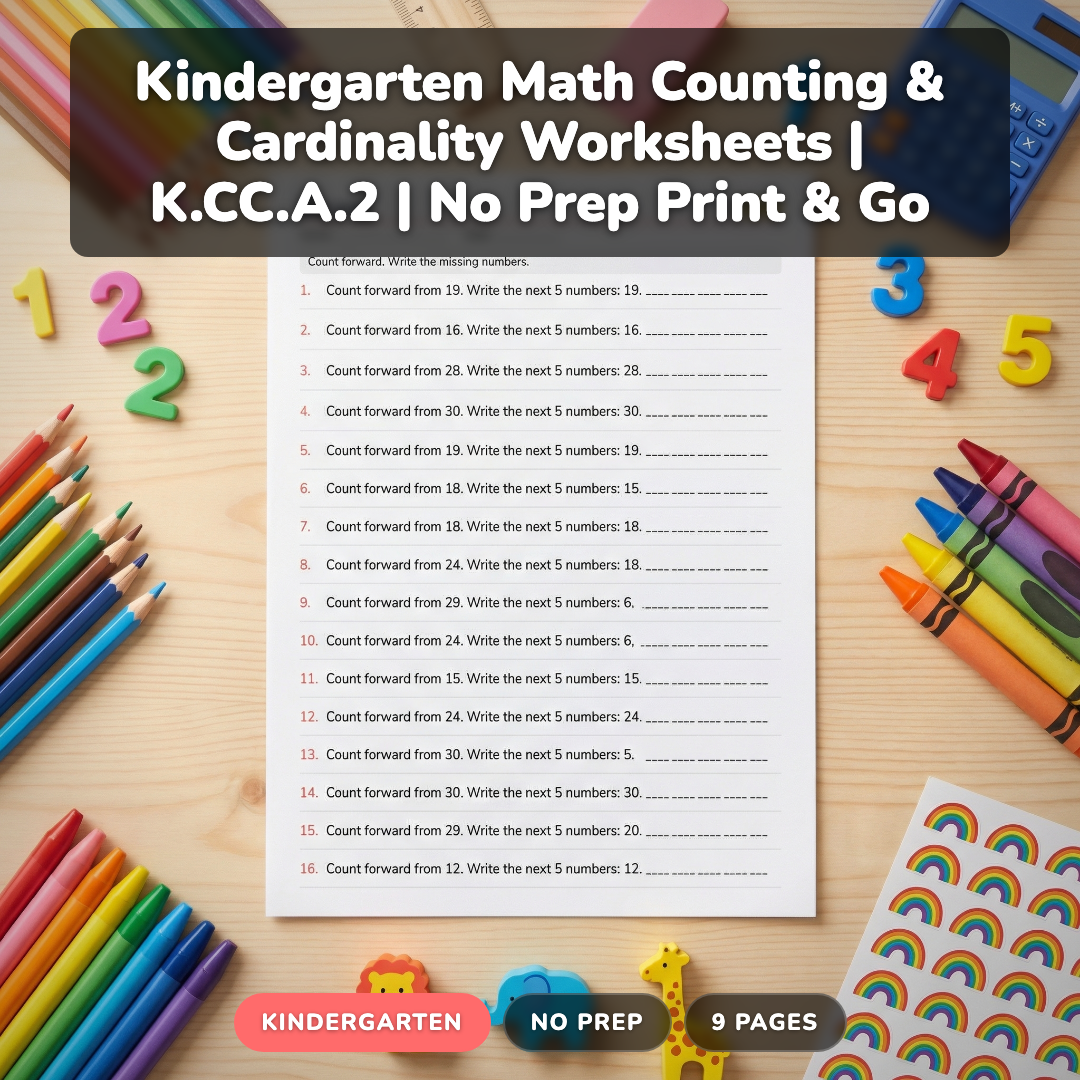
The Kindergarten Math Counting & Cardinality Worksheets pack includes 79 problems across three difficulty levels, specifically designed to support CCSS.Math.Content.K.CC.A.2. The practice level focuses on counting forward 3-4 numbers from single-digit starting points, while the challenge level extends to counting forward from teen numbers and longer sequences.
What sets this resource apart is the careful progression from concrete to abstract thinking. Each level includes visual supports like number lines and ten frames, with answer keys that save you grading time. The 9-page pack provides enough variety for weeks of practice without overwhelming young learners.
Grab a Free Counting Practice Sheet to Try
Want to see how differentiated counting practice works in your classroom? I’ll send you a sample worksheet with all three difficulty levels so you can try it with your students before committing to the full pack.
Frequently Asked Questions About Teaching Counting Forward
When should kindergarteners master counting forward from any number?
Most kindergarteners develop this skill between January and March, after mastering rote counting to 20. Students need solid number recognition and basic counting skills before tackling counting from given starting points. The timeline varies based on individual development and prior experience.
What’s the difference between rote counting and counting forward from a given number?
Rote counting involves memorizing the number sequence from 1, like reciting a song. Counting forward from a given number requires understanding that the sequence can begin anywhere and demonstrates flexible number sense rather than just memorization.
How do I help students who can count to 20 but struggle starting from 8?
Use visual anchors like number lines and practice “finding your place” in the sequence. Start with numbers close to 1 (like 2 or 3) before moving to mid-sequence numbers. Emphasize that counting is like reading — you can start anywhere in the story.
Should I teach counting backward at the same time as counting forward?
Focus on counting forward first, as it’s more intuitive and aligns with how students learn the number sequence. Introduce counting backward only after students are fluent with counting forward from various starting points, typically in late kindergarten or first grade.
How does counting forward from given numbers connect to addition?
This skill directly supports the “counting on” addition strategy, where students start with the larger addend and count forward. For example, 5 + 3 becomes “start at 5, count forward 3: 6, 7, 8.” It’s a crucial bridge to mental math strategies.
Teaching counting forward from any given number builds the number sense foundation your kindergarteners need for future math success. The key is making the abstract concept concrete through movement, visuals, and plenty of practice with varied starting points.
What’s your favorite way to help students master counting sequences? Try the free sample worksheet and see which strategies work best with your class — every group of kindergarteners brings their own unique learning needs to this fundamental skill.