If your kindergarteners freeze when they see a simple addition problem like 2 + 1, you’re not alone. Teaching operations and algebraic thinking to 5 and 6-year-olds requires moving far beyond worksheets to hands-on experiences that make abstract math concepts concrete. You’ll discover five research-backed strategies that transform how students understand addition and subtraction, plus practical tips for differentiating instruction across all ability levels.
Key Takeaway
Kindergarten students learn addition and subtraction best through concrete manipulatives, storytelling, and multiple representations before moving to abstract symbols.
Why Operations & Algebraic Thinking Matters in Kindergarten
Operations and algebraic thinking forms the foundation for all future math learning. At the kindergarten level, CCSS.Math.Content.K.OA.A.1 requires students to represent addition and subtraction using objects, drawings, sounds, and eventually equations. This standard appears early in the school year, typically introduced in October after students have solid number recognition and counting skills.
Research from the National Council of Teachers of Mathematics shows that students who master concrete representations of addition and subtraction in kindergarten demonstrate 40% higher achievement in algebraic thinking by third grade. The key is providing multiple ways for students to visualize and manipulate quantities before introducing abstract symbols.
This standard connects directly to number sense development and prepares students for CCSS.Math.Content.K.OA.A.2 (solving addition and subtraction word problems) and future work with place value and multi-digit operations.
Looking for a ready-to-go resource? I put together a differentiated operations and algebraic thinking pack that covers everything below — but first, the teaching strategies that make it work.
Common Addition & Subtraction Misconceptions in Kindergarten
Common Misconception: Students think addition always makes numbers bigger and subtraction always makes numbers smaller.
Why it happens: They haven’t experienced adding or subtracting zero, or worked with the same number (3 – 3 = 0).
Quick fix: Use concrete examples like “3 cookies plus 0 more cookies” with actual objects.
Common Misconception: Students count all objects from 1 instead of counting on from the first number.
Why it happens: They haven’t developed the mental flexibility to start counting from a number other than 1.
Quick fix: Practice “counting on” games where students start from different numbers on a number line.
Common Misconception: Students think the equals sign means “the answer comes next” rather than “the same as.”
Why it happens: They only see equations written as 2 + 3 = __ instead of various formats like 5 = 2 + 3.
Quick fix: Use balance scales to show that both sides of an equation must be equal, not that one side “gives” an answer.
Common Misconception: Students confuse the operation symbols + and – because they look similar.
Why it happens: Both symbols are made of straight lines and can look alike to developing visual processing skills.
Quick fix: Connect symbols to actions – plus means “put together” (demonstrate bringing objects together) and minus means “take away” (physically remove objects).
5 Research-Backed Strategies for Teaching Operations & Algebraic Thinking
Strategy 1: Story Problem Theater with Manipulatives
Transform abstract math problems into concrete stories that students can act out using real objects. This strategy builds the critical connection between mathematical operations and real-world situations.
What you need:
- Small manipulatives (counting bears, blocks, or buttons)
- Simple story problem cards
- Large floor space for acting
Steps:
- Read a simple story problem aloud: “Maya had 3 apples. Her friend gave her 2 more apples. How many apples does Maya have now?”
- Have students use manipulatives to represent the story, physically moving objects as the story unfolds
- Ask students to act out the problem with their bodies (hold up 3 fingers, then 2 more)
- Draw the problem on the board using simple pictures
- Finally, write the number sentence: 3 + 2 = 5
Strategy 2: Ten Frame Addition and Subtraction
Ten frames provide a visual structure that helps students organize quantities and see number relationships clearly. This tool bridges concrete and abstract thinking.
What you need:
- Laminated ten frames (2×5 grids)
- Two-color counters or small objects
- Dry erase markers
Steps:
- Start with addition: place 4 counters in the ten frame, then add 3 more
- Have students count the total and discuss what they notice about the arrangement
- For subtraction: start with 7 counters, physically remove 2, count what remains
- Progress to drawing dots or X’s on laminated ten frames
- Connect the visual to the number sentence: 4 + 3 = 7 or 7 – 2 = 5
Strategy 3: Number Line Jumping Games
Physical movement on floor number lines helps students visualize addition as moving forward and subtraction as moving backward, making abstract operations concrete.
What you need:
- Large floor number line (0-10)
- Small toy frogs or game pieces
- Addition and subtraction cards
Steps:
- Student starts on number 3 on the floor number line
- Draw an addition card showing +2
- Student physically jumps forward 2 spaces, landing on 5
- Record the complete equation: 3 + 2 = 5
- Repeat with subtraction, jumping backward
- Progress to having students predict where they’ll land before jumping
Strategy 4: Part-Part-Whole with Sorting Mats
This strategy helps students understand that numbers can be decomposed in multiple ways, building flexible thinking about number relationships and preparing for algebraic concepts.
What you need:
- Part-part-whole mats (circles connected with lines)
- Two-color beans or counting bears
- Recording sheets
Steps:
- Give students 5 counting bears and a part-part-whole mat
- Ask them to put some bears in each “part” circle (maybe 2 and 3)
- Count the total in the “whole” circle: 5
- Record: 2 + 3 = 5
- Challenge: “Can you make 5 a different way?” (1 + 4, 0 + 5)
- Extend to subtraction: “If we start with 5 and take away the 2, we have 3 left”
Strategy 5: Musical Math with Sound Patterns
Using claps, taps, and musical instruments makes operations multisensory and memorable while addressing the standard’s requirement for representing operations with sounds.
What you need:
- Simple rhythm instruments (shakers, bells)
- Chart paper for recording
- Audio recording device (optional)
Steps:
- Clap a pattern: clap-clap-clap, pause, clap-clap
- Ask students to count each group: “I heard 3 claps, then 2 more claps”
- Count total claps together: “That’s 5 claps altogether”
- Write the equation: 3 + 2 = 5
- For subtraction: clap 5 times, then “take away” 2 claps by covering your hands
- Students create their own sound patterns for classmates to solve
How to Differentiate Operations & Algebraic Thinking for All Learners
For Students Who Need Extra Support
Focus on numbers within 5 and provide extensive concrete manipulation time before moving to any abstract representations. Use larger manipulatives that are easier to grasp and count. Provide number lines that start at 0 and only go to 5 or 6. Break problems into smaller steps – first just putting groups together, then counting the total, and finally connecting to the plus sign. Partner these students with stronger math students for peer support during hands-on activities.
For On-Level Students
Work within the full kindergarten expectation of numbers 0-10 for CCSS.Math.Content.K.OA.A.1. These students can move between concrete manipulatives, drawings, and beginning number sentences within the same lesson. They should practice both addition and subtraction regularly and begin to see connections between the two operations. Encourage them to explain their thinking using math vocabulary like “altogether,” “take away,” and “equals.”
For Students Ready for a Challenge
Extend beyond 10 to explore what happens with larger numbers, though this exceeds kindergarten standards. Introduce the concept that subtraction is the opposite of addition by using fact families (3 + 2 = 5, so 5 – 2 = 3). Have them create story problems for classmates to solve and explore multiple ways to make the same number (5 = 4 + 1 = 3 + 2 = 2 + 3). These students can also begin exploring what happens when you add or subtract zero.
A Ready-to-Use Operations & Algebraic Thinking Resource for Your Classroom
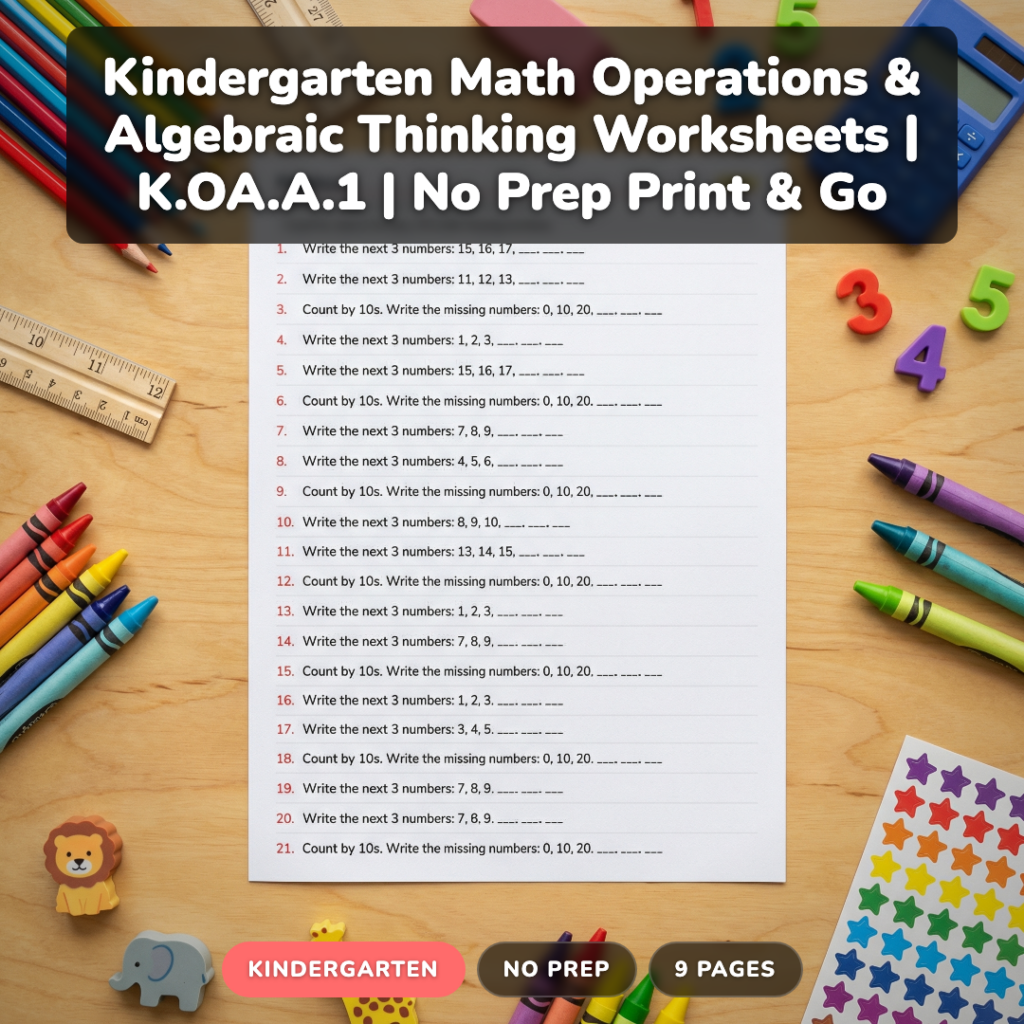
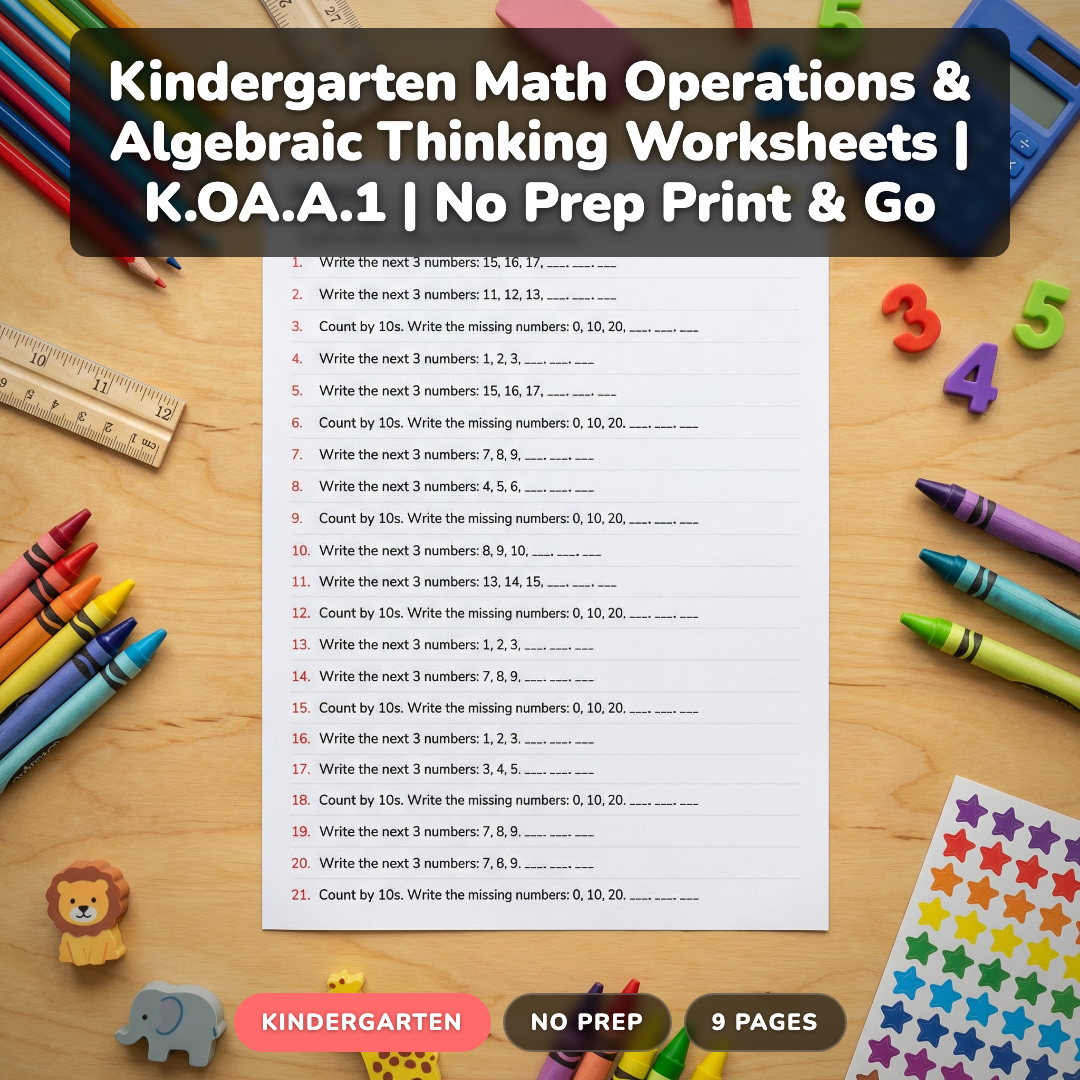
After years of creating my own materials and seeing what actually works in kindergarten classrooms, I put together a comprehensive operations and algebraic thinking worksheet pack that saves you hours of prep time. This 9-page resource includes 79 carefully designed problems across three differentiation levels – 22 practice problems for students who need extra support, 30 on-level problems that align perfectly with kindergarten expectations, and 27 challenge problems for advanced learners.
What makes this resource different is the thoughtful progression within each level. The practice pages start with concrete representations and visual supports, the on-level pages balance pictures with beginning number sentences, and the challenge pages push students to think flexibly about number relationships. Each page includes clear answer keys and can be used for independent work, math centers, homework, or quick assessments.
The pack covers every representation required by the Common Core standard – from object manipulation to drawings to beginning equations – so you can differentiate confidently knowing every student is working at their appropriate level.
Grab a Free Operations Sample to Try
Want to see how these differentiated problems work in your classroom? I’ll send you a free 3-page sample that includes one problem from each level – practice, on-level, and challenge. You’ll also get my quick reference guide for implementing the five strategies above. Drop your email below and I’ll send it right over.
Frequently Asked Questions About Teaching Operations & Algebraic Thinking
When should I introduce the plus and minus symbols in kindergarten?
Introduce symbols only after students demonstrate solid understanding with concrete manipulatives and drawings. Most kindergarteners are ready for symbols by mid-year (January-February) when working with numbers within 5, and by spring for numbers within 10. Always connect symbols back to concrete experiences.
How do I know if my kindergarteners understand addition and subtraction conceptually?
Students show conceptual understanding when they can solve problems using multiple methods (objects, drawings, fingers), explain their thinking in their own words, and recognize that 3 + 2 gives the same answer as 2 + 3. They should also connect addition and subtraction as opposite operations.
What’s the difference between K.OA.A.1 and K.OA.A.2 standards?
CCSS.Math.Content.K.OA.A.1 focuses on representing operations using various methods (objects, drawings, sounds), while K.OA.A.2 specifically addresses solving addition and subtraction word problems within 10. Think of K.OA.A.1 as the foundation that makes K.OA.A.2 possible.
Should kindergarten students memorize addition and subtraction facts?
No, kindergarten students should focus on understanding concepts rather than memorizing facts. Fluency with addition and subtraction facts within 5 becomes an expectation in first grade (1.OA.C.6). Kindergarten is about building number sense and conceptual understanding through hands-on exploration.
How can I assess operations and algebraic thinking in kindergarten?
Use performance-based assessments where students solve problems using manipulatives while you observe their strategies. Ask them to “show me 4 + 2 using these blocks” and listen to their explanations. Avoid paper-and-pencil tests; instead, document their thinking through photos and brief notes about their problem-solving approaches.
Teaching operations and algebraic thinking in kindergarten is all about making abstract concepts concrete through hands-on experiences and multiple representations. When students can physically manipulate objects, act out problems, and see visual models before moving to symbols, they develop the deep understanding needed for future math success.
What’s your go-to strategy for helping kindergarteners understand addition and subtraction? I’d love to hear what works in your classroom!
Don’t forget to grab your free operations sample above – it’s a great way to try these differentiated approaches with your students and see what level works best for each learner in your classroom.