If your 5th graders freeze when they see two rectangular prisms stuck together, you’re not alone. Teaching volume of composite figures is one of those skills that looks straightforward on paper but quickly reveals gaps in spatial reasoning and basic volume concepts. You need strategies that help students visualize, break down complex shapes, and apply volume formulas with confidence.
Key Takeaway
Students master composite volume by learning to decompose complex figures into familiar rectangular prisms, then adding their individual volumes systematically.
Why Volume of Composite Figures Matters in 5th Grade
Volume of composite figures represents the culmination of 5th grade measurement learning. Students must integrate their understanding of volume formulas (V = l × w × h) with spatial decomposition skills. This concept directly addresses CCSS.Math.Content.5.MD.C.5c, which requires students to recognize volume as additive and find volumes of solid figures composed of two non-overlapping right rectangular prisms.
Research from the National Council of Teachers of Mathematics shows that spatial reasoning skills developed through volume work correlate strongly with later success in geometry and algebra. Students who struggle with composite volume often lack fluency with basic volume formulas or have difficulty visualizing 3D shapes from 2D representations.
This skill typically appears in late spring, after students have mastered finding volume of single rectangular prisms. The timing allows teachers to build on established volume concepts while introducing the critical thinking required for shape decomposition.
Looking for a ready-to-go resource? I put together a differentiated volume pack that covers everything below — but first, the teaching strategies that make it work.
Common Volume Misconceptions in 5th Grade
Common Misconception: Students multiply all visible dimensions together, treating composite figures like single rectangular prisms.
Why it happens: They apply the volume formula without recognizing that composite figures require decomposition first.
Quick fix: Use colored blocks to physically separate the two prisms before measuring.
Common Misconception: Students count unit cubes that appear in both prisms, leading to double-counting errors.
Why it happens: They lack clear boundaries between the separate rectangular prisms.
Quick fix: Draw dividing lines on diagrams and use different colors for each prism.
Common Misconception: Students subtract volumes instead of adding them.
Why it happens: They confuse composite volume with surface area or think one prism is ‘cut out’ of another.
Quick fix: Emphasize that both prisms are solid and their volumes combine.
Common Misconception: Students struggle to identify which dimensions belong to which prism in complex diagrams.
Why it happens: 2D representations of 3D shapes can be visually confusing without clear labeling.
Quick fix: Start with simple L-shapes and gradually increase complexity.
4 Research-Backed Strategies for Teaching Volume of Composite Figures
Strategy 1: Physical Decomposition with Unit Cubes
Students build composite figures with unit cubes, then physically separate them into two distinct rectangular prisms. This hands-on approach makes the abstract concept of ‘non-overlapping’ concrete and visible.
What you need:
- Unit cubes (at least 50 per pair)
- Recording sheets
- Two different colored sets of cubes
Steps:
- Give pairs 24 unit cubes and challenge them to build an L-shaped figure
- Ask students to separate their figure into two rectangular prisms using different colored cubes
- Have them measure each prism’s dimensions and calculate individual volumes
- Students add the volumes and verify by counting total unit cubes
- Repeat with different composite shapes, increasing complexity gradually
Strategy 2: Color-Coded Diagram Analysis
Students learn to identify separate prisms within composite figures by color-coding different sections, then systematically finding dimensions and calculating volumes.
What you need:
- Printed composite figure diagrams
- Colored pencils or markers
- Rulers for measuring
- Volume calculation recording sheets
Steps:
- Present a composite figure diagram with all dimensions labeled
- Students color the first rectangular prism one color, second prism another color
- They identify the length, width, and height for each colored section
- Calculate volume of first prism, then second prism
- Add the two volumes for the total composite volume
- Check their work by having partners verify the decomposition
Strategy 3: Real-World Building Design Challenge
Students design buildings or structures using composite rectangular prisms, then calculate total volumes for practical applications like determining material needs or storage capacity.
What you need:
- Graph paper
- Building scenario cards
- Calculators
- Design portfolio sheets
Steps:
- Present real-world scenarios: designing a warehouse with office space, planning a school with gymnasium, etc.
- Students sketch their building design using two connected rectangular prisms
- They label all dimensions based on given constraints
- Calculate volume of each section (storage area, office space, etc.)
- Find total building volume and explain how it meets the scenario requirements
- Present designs to classmates with volume justifications
Strategy 4: Volume Decomposition Game
Students play a partner game where they draw composite figures and challenge each other to find the total volume through strategic decomposition.
What you need:
- Dot paper or isometric paper
- Dice for generating dimensions
- Timer
- Score sheets
Steps:
- Player 1 rolls dice to determine dimensions for two rectangular prisms
- They draw a composite figure connecting these prisms on dot paper
- Player 2 has 3 minutes to decompose the figure and calculate total volume
- Points awarded for correct decomposition (1 point) and correct volume (2 points)
- Players switch roles and repeat
- Game continues for set number of rounds
How to Differentiate Volume of Composite Figures for All Learners
For Students Who Need Extra Support
Start with concrete manipulatives and simple shapes. Use unit cubes exclusively before moving to diagrams. Provide composite figures where one prism is clearly larger than the other (like 4×3×2 combined with 2×2×1). Give students pre-drawn decomposition lines and focus on accurate volume calculations rather than identifying decomposition strategies. Review single rectangular prism volume extensively before attempting composite figures.
For On-Level Students
Students work with standard CCSS.Math.Content.5.MD.C.5c expectations: recognizing volume as additive and solving problems with two non-overlapping rectangular prisms. They should handle figures where decomposition isn’t immediately obvious and work with both unit cubes and 2D diagrams. Include real-world applications and require students to explain their decomposition reasoning in writing.
For Students Ready for a Challenge
Extend to three or more connected prisms, introduce figures where multiple decomposition strategies are possible, or add complications like missing dimensions that must be calculated. Challenge students to create composite figures with specific total volumes or design buildings that meet multiple volume constraints. Connect to surface area calculations or introduce irregular prisms.
A Ready-to-Use Volume Resource for Your Classroom
Teaching volume of composite figures requires a lot of practice problems at just the right difficulty level. You need worksheets that start simple and build complexity, with clear diagrams and real-world contexts that keep students engaged.
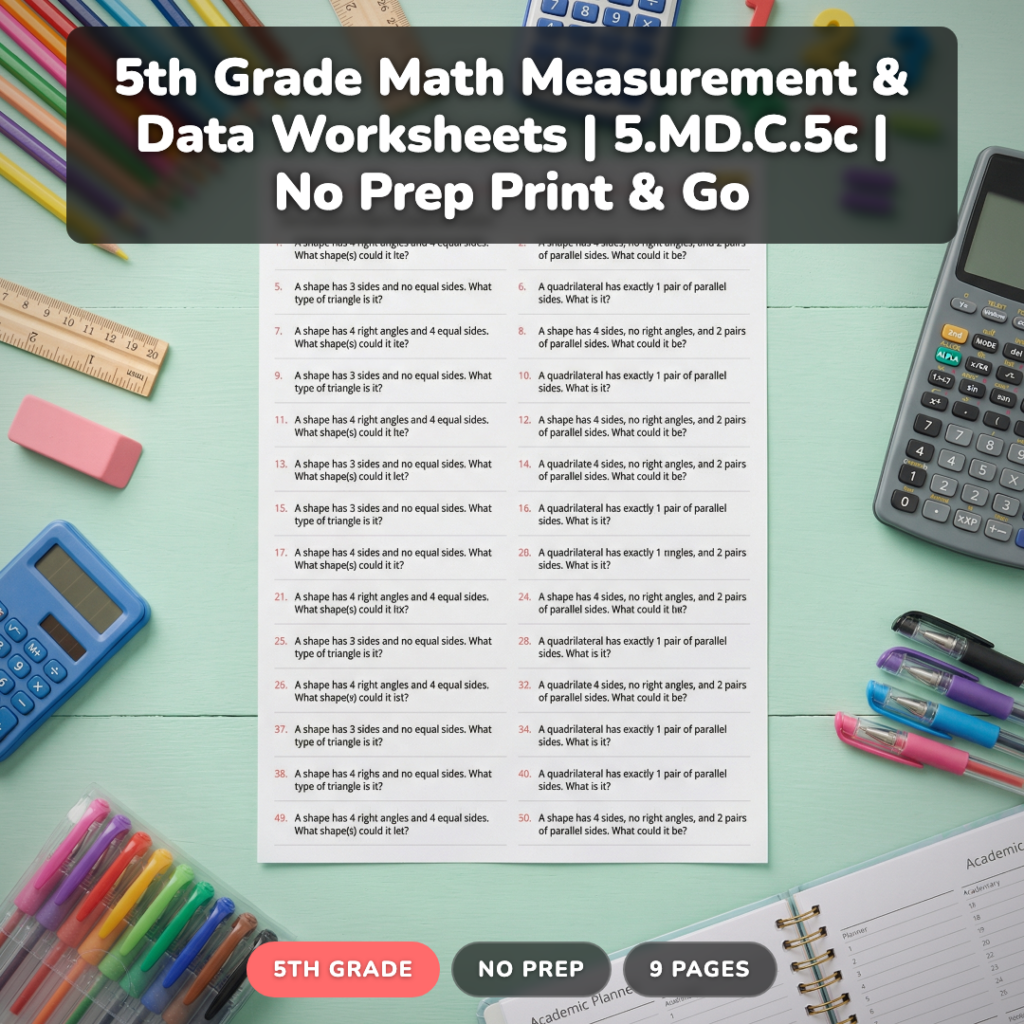
This differentiated volume pack includes 132 problems across three difficulty levels. The practice level focuses on basic decomposition with clearly separated prisms. On-level problems match grade 5 standards with varied orientations and some missing dimensions. The challenge level includes complex figures and multi-step real-world applications.
What makes this resource different is the systematic progression and visual clarity. Each problem includes clean diagrams with appropriate labeling, and answer keys show the decomposition strategy alongside calculations.
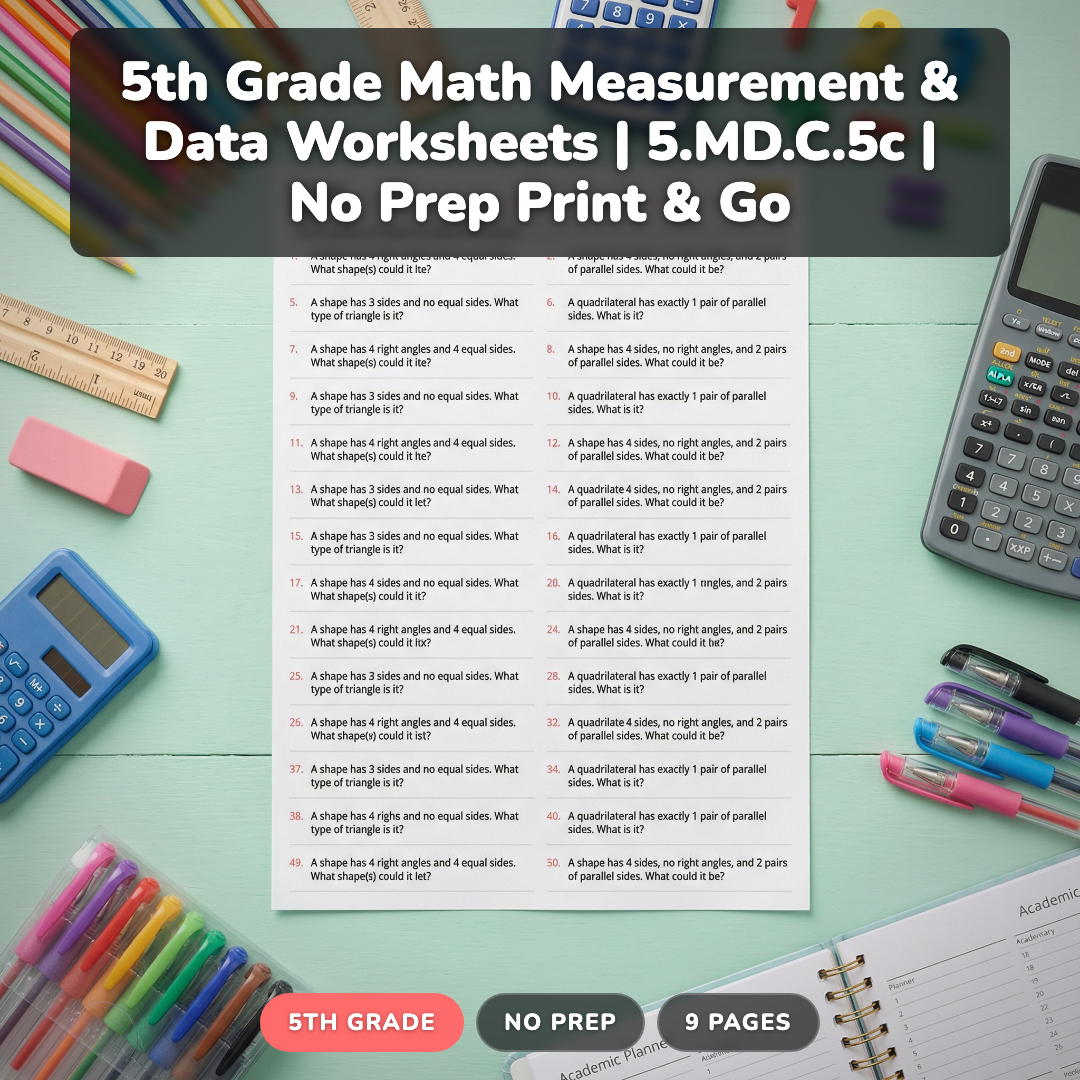
The pack covers everything from basic L-shaped figures to complex building scenarios, with 9 pages of differentiated practice that saves you hours of prep time.
Grab a Free Volume Sample to Try
Want to see how the differentiated approach works? I’ll send you a free sample with problems from each difficulty level, plus the answer key with decomposition strategies shown.
Frequently Asked Questions About Teaching Volume of Composite Figures
When should I introduce volume of composite figures in 5th grade?
Introduce composite volume after students demonstrate fluency with single rectangular prism volume calculations, typically in late spring. Students need solid understanding of V = l × w × h and experience with unit cubes before tackling decomposition strategies.
What’s the best way to help students visualize 2D diagrams of 3D composite figures?
Start with unit cube models, then transition to isometric drawings on dot paper. Use color-coding to distinguish separate prisms and provide multiple views (front, side, top) when possible. Physical manipulation builds spatial reasoning before abstract diagram work.
How do I address students who want to subtract instead of add volumes?
Use language like ‘combining’ or ‘joining’ rather than mathematical terms initially. Show physical models where both prisms are clearly solid and separate. Emphasize that composite figures have more volume than either individual prism, so addition makes sense.
Should students learn multiple decomposition strategies for the same figure?
Yes, but introduce this gradually. Start with obvious decompositions, then show that some figures can be split different ways with the same total volume. This reinforces that volume is additive regardless of how you decompose the figure.
How does CCSS.Math.Content.5.MD.C.5c connect to other 5th grade standards?
This standard builds on 5.MD.C.3 (unit cubes and volume) and 5.MD.C.4 (volume formulas). It connects to 5.OA.A.2 through multi-step problem solving and prepares students for 6th grade surface area and volume work with more complex figures.
Mastering volume of composite figures gives your students a powerful problem-solving tool that extends far beyond 5th grade math. The key is building from concrete experiences to abstract thinking, always emphasizing that volume is additive when figures don’t overlap.
What’s your biggest challenge when teaching composite volume? The free sample resource above includes my favorite scaffolding strategies — grab it and let me know how it works in your classroom!