If your fifth graders look confused when you mention “numerical patterns” or “coordinate planes,” you’re not alone. Standard CCSS.Math.Content.5.OA.B.3 asks students to generate patterns, identify relationships, and graph ordered pairs — three complex skills wrapped into one standard that often leaves both teachers and students feeling overwhelmed.
You need concrete strategies that break down this multi-step process into manageable chunks. This post walks you through four research-backed approaches that help students master pattern generation, relationship identification, and coordinate graphing with confidence.
Key Takeaway
Students master CCSS.Math.Content.5.OA.B.3 when they practice pattern generation with concrete materials before moving to abstract graphing on coordinate planes.
Why Pattern Relationships Matter in 5th Grade
Operations and Algebraic Thinking in fifth grade bridges arithmetic and algebra. Students who master pattern relationships in elementary school score 23% higher on middle school algebra assessments, according to research from the National Council of Teachers of Mathematics. This standard appears mid-year, typically after students have solid addition, subtraction, and basic multiplication skills.
Standard CCSS.Math.Content.5.OA.B.3 requires three distinct but connected skills: generating numerical patterns using given rules, identifying relationships between corresponding terms, and graphing ordered pairs on coordinate planes. Students must understand that patterns follow predictable rules and that these relationships can be visualized graphically.
The timing matters. Most curricula introduce this standard in January or February, giving students time to develop number sense before tackling algebraic thinking concepts that prepare them for 6th grade ratios and proportional relationships.
Looking for a ready-to-go resource? I put together a differentiated pattern and graphing pack that covers everything below — but first, the teaching strategies that make it work.
Common Pattern Misconceptions in 5th Grade
Common Misconception: Students think all patterns increase by the same amount each time.
Why it happens: Previous grade levels emphasized simple addition patterns, so students expect consistent differences.
Quick fix: Start with visual patterns using manipulatives before introducing numerical rules.
Common Misconception: Students believe corresponding terms must be equal (if Pattern A shows 2, 4, 6, Pattern B must also show 2, 4, 6).
Why it happens: They confuse “corresponding” with “identical” and miss the relationship concept.
Quick fix: Use T-charts to show how different rules create different patterns with clear term-by-term relationships.
Common Misconception: Students plot coordinate points randomly instead of using corresponding terms from both patterns.
Why it happens: They don’t connect the abstract coordinate plane to the concrete patterns they generated.
Quick fix: Color-code corresponding terms before graphing, and always start with the first quadrant only.
Common Misconception: Students think the relationship between patterns is always addition or subtraction.
Why it happens: Multiplication and division relationships are less obvious when looking at pattern terms.
Quick fix: Provide sentence frames: “Pattern B is always ___ times Pattern A” or “Pattern B is Pattern A divided by ___.”
4 Research-Backed Strategies for Teaching Pattern Relationships
Strategy 1: Pattern Building with Color-Coded Manipulatives
Students need concrete representations before abstract thinking. This strategy uses physical objects to make pattern rules visible and helps students see relationships between different sequences.
What you need:
- Two colors of counting cubes (red and blue)
- T-chart paper or whiteboards
- Pattern rule cards
Steps:
- Give students two pattern rules: “Start with 3, add 2 each time” and “Start with 6, add 4 each time.”
- Have them build the first pattern with red cubes: 3, 5, 7, 9, 11
- Build the second pattern with blue cubes directly below: 6, 10, 14, 18, 22
- Ask: “What do you notice about the relationship between red and blue numbers?”
- Guide them to see that blue numbers are always double the red numbers
Strategy 2: T-Chart Relationship Detective Work
T-charts organize information visually and help students identify mathematical relationships systematically. This strategy teaches students to look for patterns between corresponding terms rather than just within individual sequences.
What you need:
- Large T-chart templates
- Different colored markers
- Relationship question stems
Steps:
- Create a T-chart with “Pattern A” and “Pattern B” headers
- Generate Pattern A using the rule “multiply by 2”: 2, 4, 6, 8, 10
- Generate Pattern B using the rule “multiply by 3”: 3, 6, 9, 12, 15
- Circle corresponding terms with the same color (2 and 3, 4 and 6, etc.)
- Ask detective questions: “How do you get from Pattern A to Pattern B?” “What’s the relationship?”
- Record the relationship: “Pattern B = Pattern A × 1.5” or “Pattern B is Pattern A plus half of Pattern A”
Strategy 3: Coordinate Plane Story Mapping
Graphing becomes meaningful when students connect abstract coordinates to real-world contexts. This strategy helps students understand that ordered pairs represent relationships, not just random points on a grid.
What you need:
- Large coordinate plane posters
- Sticky notes
- Real-world scenario cards
- Colored pencils
Steps:
- Present a scenario: “Maya saves $3 each week. Tom saves $5 each week.”
- Create patterns: Week 1, 2, 3, 4, 5 vs. Maya’s savings: $3, $6, $9, $12, $15 vs. Tom’s savings: $5, $10, $15, $20, $25
- Form ordered pairs using week and Maya’s savings: (1,3), (2,6), (3,9), (4,12), (5,15)
- Plot points on coordinate plane and connect with a line
- Repeat with Tom’s data using different color
- Compare the two lines and discuss which person saves faster
Strategy 4: Pattern Race Game with Graphing Extension
Games increase engagement while reinforcing mathematical concepts. This strategy combines pattern generation practice with coordinate graphing in a competitive format that students remember.
What you need:
- Pattern rule spinner or cards
- Individual coordinate planes
- Timer
- Pattern recording sheets
Steps:
- Partners spin two different pattern rules (e.g., “start with 1, add 3” and “start with 2, add 6”)
- Each partner generates 5 terms for their assigned pattern
- They work together to identify the relationship between corresponding terms
- Create ordered pairs using corresponding terms from both patterns
- Race to correctly plot all ordered pairs on their coordinate plane
- Check each other’s work and discuss the relationship pattern they see in the graph
How to Differentiate Pattern Work for All Learners
For Students Who Need Extra Support
Start with visual patterns using shapes or colors before moving to numbers. Provide hundreds charts to help students see number patterns clearly. Use simple rules like “add 1” and “add 2” so relationships are obvious (Pattern B is always 1 more than Pattern A). Give students pre-made T-charts with some terms filled in. Focus on first quadrant graphing only, using coordinates from 0-10. Provide sentence frames for describing relationships: “Pattern B is always ___ more than Pattern A.”
For On-Level Students
Use standard CCSS.Math.Content.5.OA.B.3 expectations with rules involving addition, subtraction, and simple multiplication. Students should generate 5-8 terms per pattern and identify relationships like “double,” “triple,” or “5 more than.” They can work with coordinates up to 20 and should be able to explain their thinking using mathematical vocabulary. Provide opportunities to create their own pattern rules and challenge classmates to find relationships.
For Students Ready for a Challenge
Introduce patterns with decimal starting points or fractional rules. Challenge students to work with patterns that involve division relationships or mixed operations. They can explore all four quadrants of the coordinate plane and work with negative numbers. Advanced students can analyze why certain patterns create straight lines while others create curves, connecting to future algebra concepts about linear relationships.
A Ready-to-Use Pattern & Graphing Resource for Your Classroom
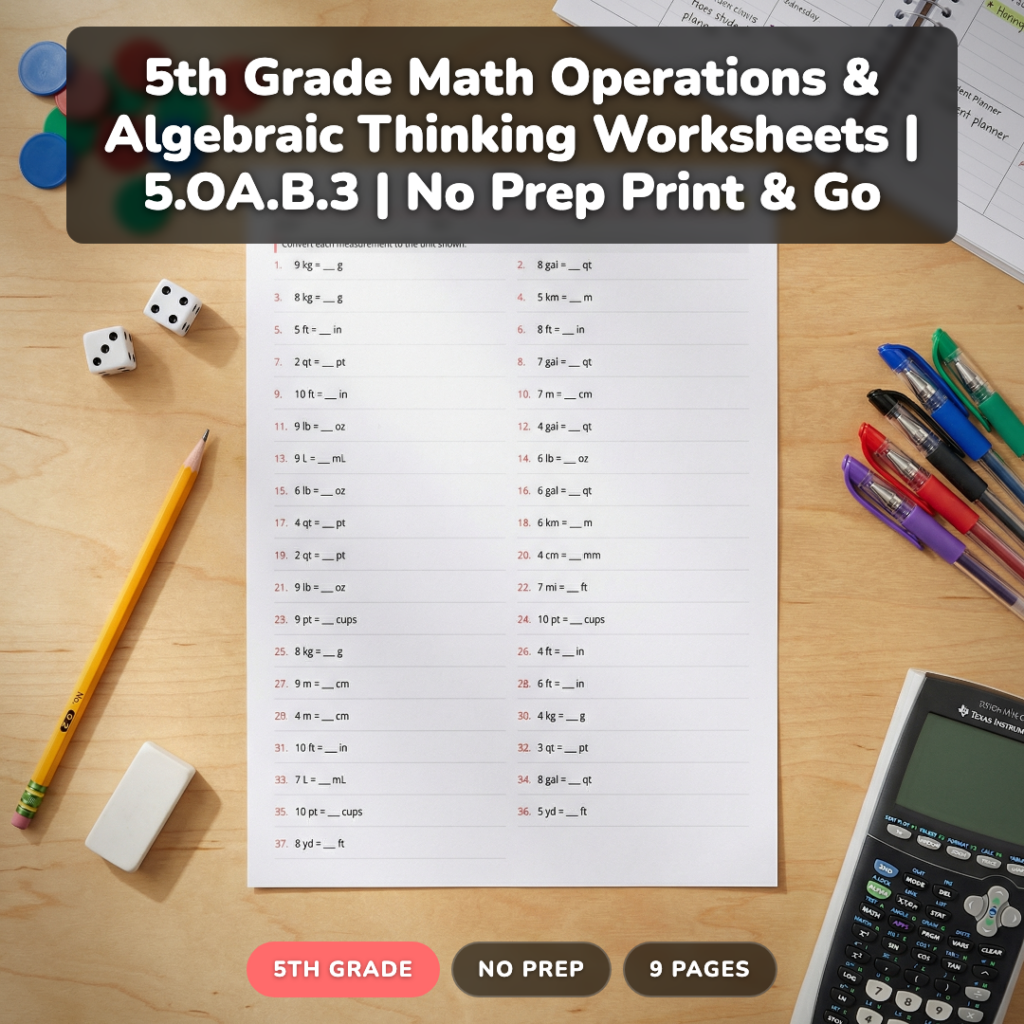
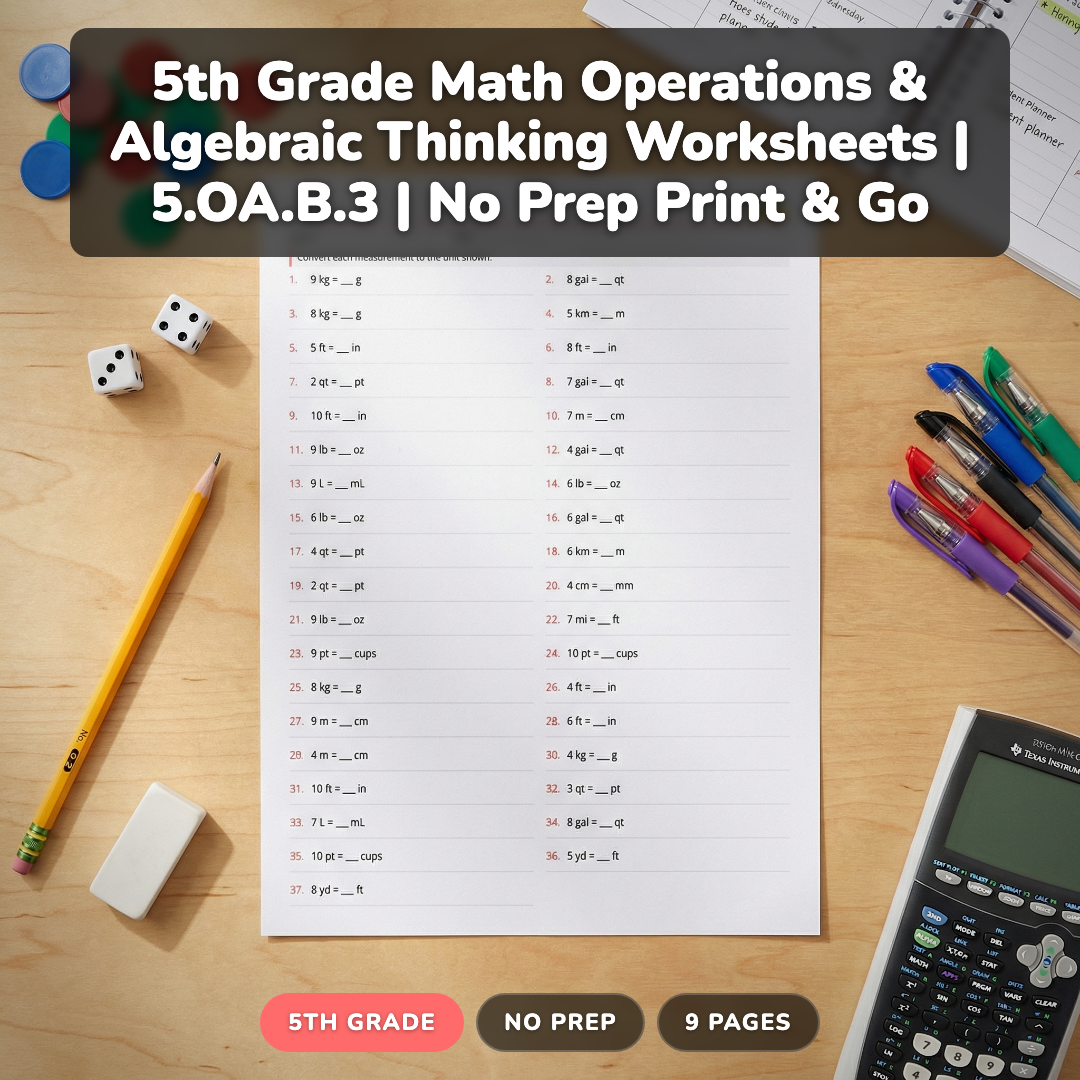
After teaching this standard for several years, I created a comprehensive resource that saves hours of prep time while providing the differentiated practice students need. This 5th Grade Operations & Algebraic Thinking pack includes 132 problems across three difficulty levels, perfect for the range of learners in your classroom.
The resource includes 37 practice problems for students who need extra support, 50 on-level problems that align perfectly with CCSS.Math.Content.5.OA.B.3, and 45 challenge problems for advanced learners. Each level focuses on pattern generation, relationship identification, and coordinate graphing with clear answer keys that show step-by-step solutions.
What makes this different from other pattern worksheets is the systematic progression from concrete pattern building to abstract coordinate graphing, plus built-in differentiation that meets students where they are. The problems include real-world contexts that make the math meaningful, and the format works perfectly for centers, homework, or assessment prep.
You can grab this time-saving resource and start using it tomorrow in your classroom.
Grab a Free Pattern Practice Sheet to Try
Want to see how this approach works with your students? I’ll send you a free sample worksheet that includes pattern generation and graphing practice at all three levels. Drop your email below and I’ll send it right over.
Frequently Asked Questions About Teaching Pattern Relationships
When should I introduce coordinate plane graphing in 5th grade?
Introduce coordinate planes after students can confidently generate numerical patterns and identify relationships between corresponding terms. Most students are ready for graphing in late January or February, following CCSS.Math.Content.5.OA.B.3 timeline recommendations.
What’s the difference between a pattern and a relationship in 5th grade math?
A pattern is a sequence following a rule (like 2, 4, 6, 8). A relationship compares corresponding terms from two patterns (Pattern A: 2, 4, 6 and Pattern B: 4, 8, 12 have the relationship “Pattern B is double Pattern A”).
How do I help students who struggle with coordinate plane plotting?
Start with first quadrant only using whole numbers 0-10. Teach “over first, up second” using the phrase “walk before you climb.” Use colored pencils to trace from axis to point, and always model the first few examples together.
Should 5th graders work with negative coordinates for this standard?
Standard CCSS.Math.Content.5.OA.B.3 focuses on first quadrant graphing. Save negative coordinates for enrichment or 6th grade preparation. Most 5th graders need extensive practice with positive coordinates before adding complexity.
How can I assess if students truly understand pattern relationships?
Give students two patterns and ask them to explain the relationship in words, numbers, and pictures. Students who understand can describe relationships multiple ways and predict what comes next in both patterns accurately.
Teaching pattern relationships and coordinate graphing doesn’t have to feel overwhelming when you break it into concrete steps. Start with manipulatives, move to T-charts, then transition to graphing — and watch your students develop the algebraic thinking skills they’ll need for middle school success.
What’s your biggest challenge when teaching CCSS.Math.Content.5.OA.B.3? And don’t forget to grab that free pattern practice sheet above — it’s a great way to see how these strategies work with your specific students.