If your 5th graders freeze when they see 347 × 28, you’re not alone. Multi-digit multiplication using the standard algorithm is one of the most challenging skills students face in elementary math. When students haven’t mastered this foundational skill, they struggle with fractions, decimals, and algebra in later grades.
This post breaks down five research-backed strategies that help students understand and master multi-digit multiplication. You’ll get concrete activities, common misconception fixes, and differentiation tips that work in real classrooms.
Key Takeaway
Students master multi-digit multiplication when they understand place value relationships before memorizing algorithm steps.
Why Multi-Digit Multiplication Matters in 5th Grade
Multi-digit multiplication bridges elementary arithmetic and middle school algebra. Students who master CCSS.Math.Content.5.NBT.B.5 — fluently multiplying multi-digit whole numbers using the standard algorithm — develop number sense that supports fraction operations, area calculations, and algebraic thinking.
Research from the National Mathematics Advisory Panel shows that students who struggle with multi-digit multiplication in 5th grade are 60% more likely to need remediation in 6th grade algebra concepts. The standard algorithm builds on place value understanding from 4th grade (CCSS.Math.Content.4.NBT.B.5) and prepares students for decimal multiplication in 6th grade.
Timing matters: introduce multi-digit multiplication after students have mastered single-digit facts and place value concepts, typically in October or November. Students need 4-6 weeks of consistent practice to achieve fluency with problems like 2,847 × 39.
Looking for a ready-to-go resource? I put together a differentiated multi-digit multiplication pack that covers everything below — but first, the teaching strategies that make it work.
Common Multi-Digit Multiplication Misconceptions in 5th Grade
Common Misconception: Students multiply each digit separately without considering place value (347 × 28 becomes 3×2, 4×8, 7×2, 8×8).
Why it happens: They apply single-digit multiplication rules to multi-digit problems without understanding positional notation.
Quick fix: Use place value charts and emphasize that 28 means 20 + 8, not just 2 and 8.
Common Misconception: Students forget to add zeros as placeholders when multiplying by tens, hundreds, or thousands.
Why it happens: They focus on individual multiplication facts rather than understanding what each partial product represents.
Quick fix: Connect to money (347 × 20 pennies = 347 × 2 dimes) and use grid paper to show place value positions.
Common Misconception: Students line up digits incorrectly when adding partial products, especially with different-length numbers.
Why it happens: They align by the left edge instead of place value positions.
Quick fix: Use graph paper or place value columns, and teach the “rightmost digit rule” for alignment.
Common Misconception: Students think larger numbers always produce larger products (believing 15 × 23 > 25 × 13).
Why it happens: They don’t understand the relationship between factors and products in multiplication.
Quick fix: Use estimation strategies and have students predict which product will be larger before calculating.
5 Research-Backed Strategies for Teaching Multi-Digit Multiplication
Strategy 1: Area Model Foundation
The area model helps students visualize multi-digit multiplication as finding the area of a rectangle divided into smaller sections. This concrete representation builds conceptual understanding before introducing the abstract algorithm.
What you need:
- Grid paper or pre-drawn rectangles
- Colored pencils or markers
- Base-ten blocks (optional)
Steps:
- Draw a rectangle and label sides with the factors (e.g., 23 × 15)
- Decompose each factor by place value (23 = 20 + 3, 15 = 10 + 5)
- Divide the rectangle into four sections representing each partial product
- Calculate each section: 20×10=200, 20×5=100, 3×10=30, 3×5=15
- Add all partial products: 200 + 100 + 30 + 15 = 345
Strategy 2: Partial Products Method
This strategy breaks multiplication into manageable steps that mirror the area model but use a vertical format that transitions naturally to the standard algorithm.
What you need:
- Place value charts
- Worksheet with organized spaces for partial products
- Different colored pens for each place value
Steps:
- Write the problem vertically (347 × 28)
- Multiply 347 × 8 (ones place): 347 × 8 = 2,776
- Multiply 347 × 20 (tens place): 347 × 20 = 6,940
- Add partial products: 2,776 + 6,940 = 9,716
- Connect to place value: “8 ones times 347” and “2 tens times 347”
Strategy 3: Standard Algorithm with Place Value Emphasis
Teach the traditional algorithm while maintaining place value understanding through explicit connections to previous strategies.
What you need:
- Place value mats
- Step-by-step anchor chart
- Problems with different levels of regrouping
Steps:
- Set up the problem with clear place value columns
- Start with ones: 7 × 8 = 56 (write 6, carry 5 tens)
- Continue with tens: 4 × 8 + 5 = 37 (write 7, carry 3 hundreds)
- Finish first partial product: 3 × 8 + 3 = 27 (write 27)
- Repeat for tens place of multiplier, adding placeholder zero
- Add partial products with careful alignment
Strategy 4: Estimation and Reasonableness Checks
Students develop number sense by estimating products before calculating and checking if their answers make sense.
What you need:
- Rounding reference chart
- Calculator for verification
- Real-world problem contexts
Steps:
- Round both factors to the nearest ten or hundred (347 × 28 ≈ 350 × 30)
- Calculate the estimate (350 × 30 = 10,500)
- Solve the actual problem using chosen method
- Compare actual answer (9,716) to estimate (10,500)
- Discuss reasonableness: “Is 9,716 close to 10,500? Does this make sense?”
Strategy 5: Real-World Application Projects
Connect multiplication to authentic contexts where students see the purpose and develop problem-solving skills alongside computational fluency.
What you need:
- Grocery store flyers or online catalogs
- School supply catalogs
- Sports statistics or attendance data
Steps:
- Present a real scenario: “Our school needs 347 new textbooks at $28 each”
- Have students estimate the total cost first
- Choose appropriate multiplication strategy based on numbers
- Calculate exact answer and verify with estimation
- Discuss the result in context: “Is $9,716 reasonable for textbooks?”
How to Differentiate Multi-Digit Multiplication for All Learners
For Students Who Need Extra Support
Begin with two-digit by one-digit multiplication using base-ten blocks and hundreds charts. Focus on place value understanding before introducing algorithms. Provide multiplication fact practice for automaticity with single digits. Use graph paper to maintain proper alignment and offer problems with minimal regrouping initially. Break complex problems into smaller steps with guided practice at each stage.
For On-Level Students
Practice three-digit by two-digit multiplication using multiple strategies. Students should demonstrate fluency with CCSS.Math.Content.5.NBT.B.5 through varied problem types including those requiring regrouping. Emphasize estimation skills and reasonableness checks. Provide mixed practice with different factor combinations and connect to fraction multiplication concepts.
For Students Ready for a Challenge
Extend to four-digit by three-digit problems and introduce multiplication of larger numbers. Connect to scientific notation concepts and explore patterns in products. Challenge students to find the most efficient strategy for different types of problems and explain their reasoning. Introduce real-world applications involving multiple steps and decision-making.
A Ready-to-Use Multi-Digit Multiplication Resource for Your Classroom
After years of creating multiplication practice materials, I’ve developed a comprehensive resource that addresses all the strategies above while providing the differentiated practice students need to master multi-digit multiplication.
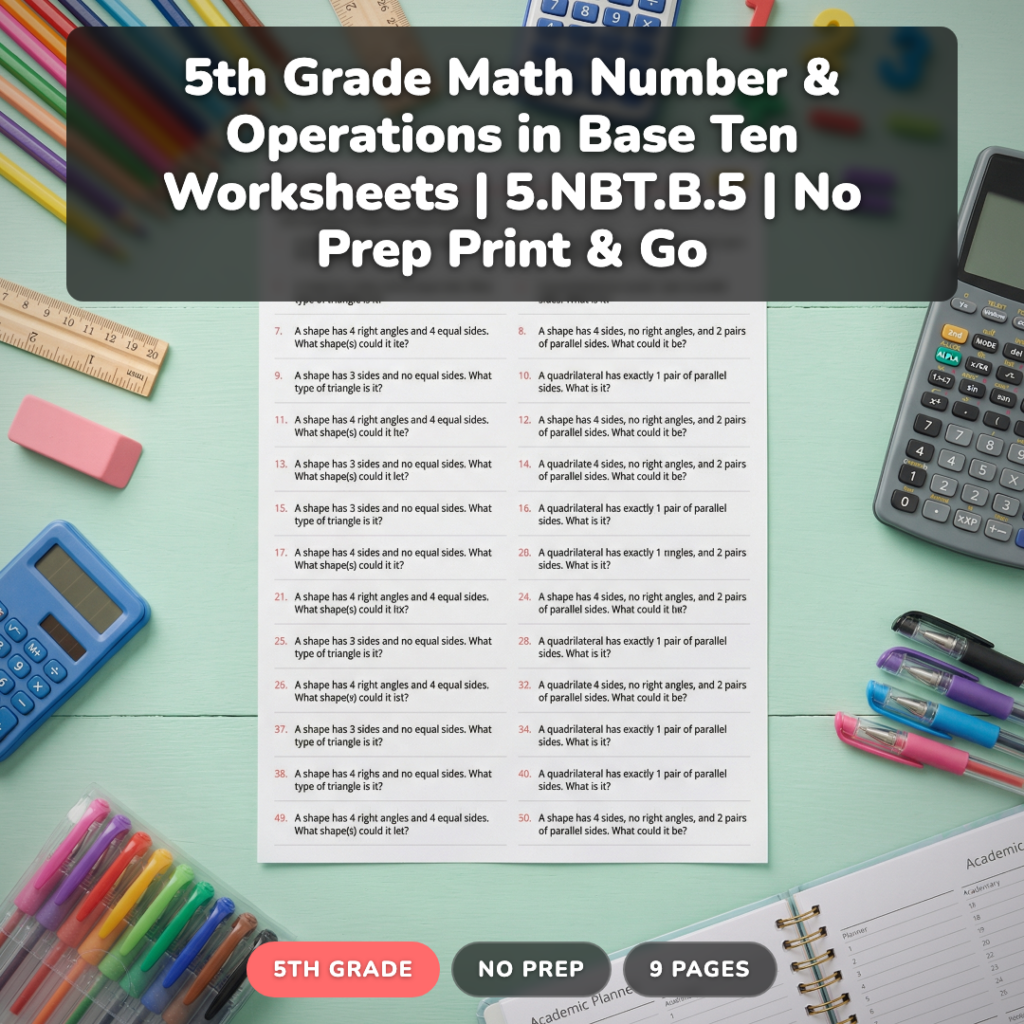
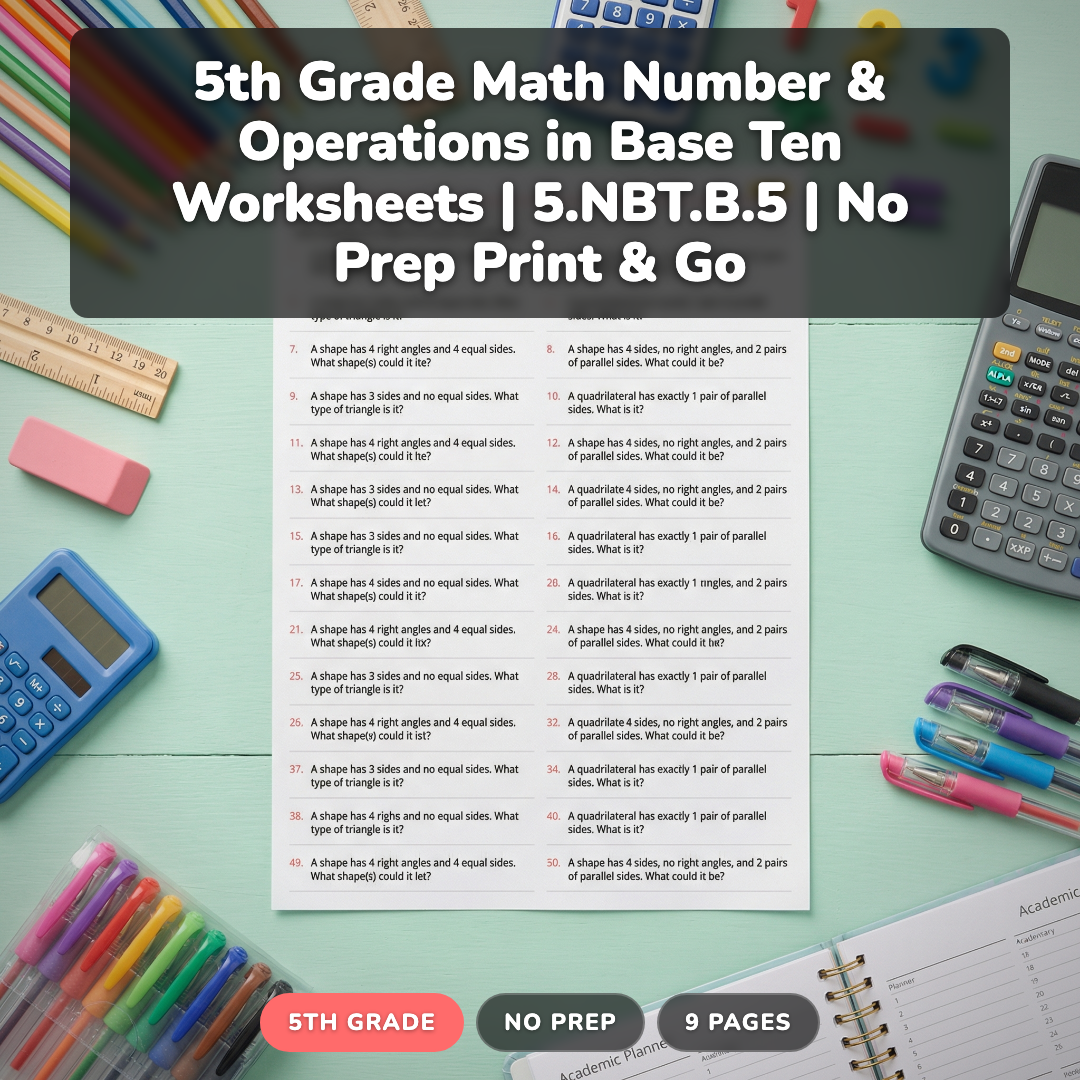
This 5th Grade Number & Operations in Base Ten pack includes 132 carefully crafted problems across three difficulty levels. The Practice level (37 problems) focuses on two-digit by one-digit and simple two-digit by two-digit multiplication. On-Level worksheets (50 problems) target grade-level expectations with three-digit by two-digit problems requiring various amounts of regrouping. Challenge problems (45 problems) extend learning with four-digit factors and real-world applications.
What makes this different from generic worksheets? Each level includes step-by-step examples, estimation practice, and error analysis problems that build conceptual understanding alongside procedural fluency. Answer keys show multiple solution strategies, and the problems progress systematically from concrete to abstract thinking.
The resource saves hours of prep time while ensuring every student gets appropriate practice with multi-digit multiplication. You’ll have everything needed for whole-group instruction, small-group intervention, and independent practice.
Grab a Free Multi-Digit Multiplication Sample to Try
Want to see how these strategies work in practice? I’ll send you a free sample worksheet that includes problems from each difficulty level, plus a step-by-step teaching guide for introducing the area model method.
Frequently Asked Questions About Teaching Multi-Digit Multiplication
When should 5th graders master multi-digit multiplication fluency?
Students should demonstrate fluency with three-digit by two-digit multiplication by mid-year, according to CCSS.Math.Content.5.NBT.B.5. This typically means December or January, allowing time for decimal multiplication later in the year.
What prerequisite skills do students need before learning multi-digit multiplication?
Students must know single-digit multiplication facts automatically, understand place value through thousands, and be able to multiply by multiples of 10. They should also understand regrouping in addition since they’ll add partial products.
Should I teach the area model or standard algorithm first?
Start with the area model to build conceptual understanding, then transition to partial products, and finally the standard algorithm. This progression helps students understand why the algorithm works, not just how to follow steps.
How can I help students who make careless errors in multi-digit multiplication?
Emphasize estimation before calculating and checking reasonableness after. Use graph paper for alignment, teach students to double-check their work systematically, and practice error analysis with common mistake examples.
What’s the difference between fluency and speed in multiplication?
Fluency means accuracy, efficiency, and flexibility with strategies — not just speed. A fluent student can solve 347 × 28 accurately using an appropriate method and explain their thinking, even if they’re not the fastest.
Multi-digit multiplication becomes manageable when students understand the underlying place value concepts and have multiple strategies in their toolkit. Start with concrete models, build to abstract algorithms, and always connect to real-world applications.
What’s your biggest challenge when teaching multi-digit multiplication? Drop your email above for the free sample, and let me know what works in your classroom!