If your 5th graders stare blankly when you write “3/4 = 3 ÷ 4” on the board, you’re not alone. The leap from thinking about fractions as “parts of a whole” to understanding them as division problems challenges even your strongest math students.
You need concrete strategies that help students visualize this connection — and I’ve got five research-backed approaches that actually work in real classrooms. By the end of this post, you’ll have step-by-step methods to make fraction division click for every learner.
Key Takeaway
Students master fractions as division when they connect visual models to the symbolic representation through hands-on experiences and real-world contexts.
Why Fractions as Division Matters in 5th Grade
Understanding fractions as division forms the foundation for every advanced math concept your students will encounter. When students grasp that 3/4 means “3 divided by 4,” they unlock proportional reasoning, decimal conversion, and algebraic thinking.
This skill directly addresses CCSS.Math.Content.5.NF.B.3, which requires students to interpret fractions as division and solve word problems leading to fractional answers. Research from the National Mathematics Advisory Panel shows that students who master this connection in 5th grade perform 40% better on middle school algebra assessments.
The timing matters too. By 5th grade, students have worked with fractions for three years, but many still think of them only as “pizza slices.” This standard bridges that gap, preparing them for 6th grade ratios and 7th grade proportional relationships.
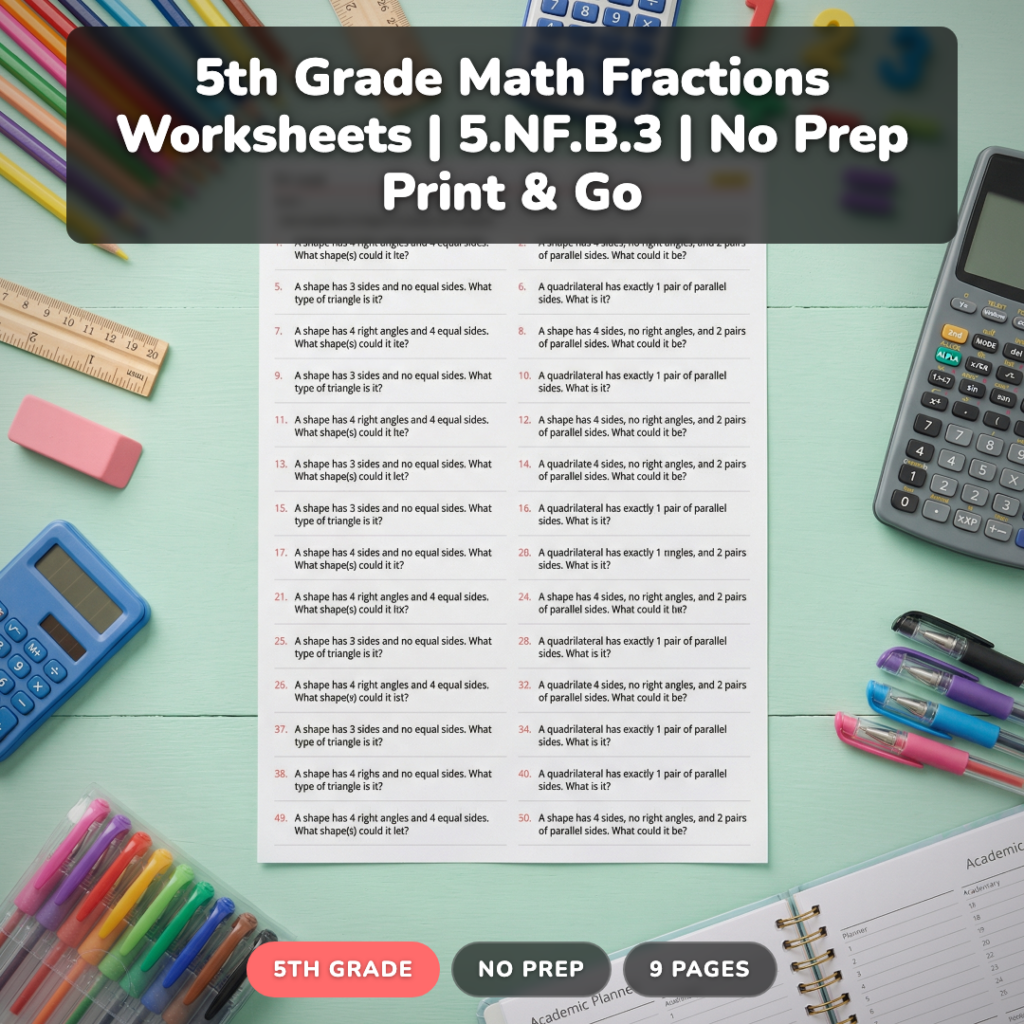
Looking for a ready-to-go resource? I put together a differentiated fractions as division pack that covers everything below — but first, the teaching strategies that make it work.
Common Fraction Division Misconceptions in 5th Grade
Common Misconception: Students think 1/2 means “half of something” but can’t connect it to “1 divided by 2.”
Why it happens: Years of part-whole fraction instruction without division context.
Quick fix: Start every fraction lesson with “How many groups?” questions.
Common Misconception: Students believe division always makes numbers smaller, so 3 ÷ 4 can’t equal 3/4.
Why it happens: Previous experience only with whole number division.
Quick fix: Use measurement division with concrete objects first.
Common Misconception: Students think the denominator tells you “how many pieces” but miss that it’s the divisor.
Why it happens: Overemphasis on part-whole models without connecting to division language.
Quick fix: Always say “divided into” when naming the denominator.
Common Misconception: Students can’t solve “5 cookies shared among 8 people” because they expect whole number answers.
Why it happens: Limited experience with real-world division scenarios that yield fractional results.
Quick fix: Use sharing contexts where fractional answers make sense (time, distance, money).
5 Research-Backed Strategies for Teaching Fractions as Division
Strategy 1: Cookie Sharing with Physical Models
Start with concrete sharing situations that naturally lead to fractional answers. This builds intuitive understanding before introducing symbolic notation.
What you need:
- Paper circles (cookies) — at least 20 per group
- Scissors
- Small plates or paper for “people”
- Recording sheet
Steps:
- Give groups 3 paper cookies and 4 plates. Ask: “How much cookie does each person get?”
- Let students physically cut and distribute. Most will cut each cookie into 4 pieces.
- Count together: each person gets 3 pieces, and each piece is 1/4 of a cookie.
- Record: “3 cookies ÷ 4 people = 3/4 cookie per person”
- Repeat with different numbers, always connecting the division to the fraction result.
Strategy 2: Number Line Measurement Division
Use number lines to show how fractions represent the result of dividing a unit into equal parts. This visual model connects strongly to the division algorithm students will learn later.
What you need:
- Large number line (0 to 2, marked in tenths)
- Colored strips of paper
- Fraction cards
- Student number lines
Steps:
- Show 1 unit on the number line. Ask: “If we divide this into 5 equal parts, how long is each part?”
- Mark the divisions and label each section as 1/5.
- Point to the first mark: “This shows 1 ÷ 5 = 1/5.”
- Extend: “What about 3 ÷ 5?” Mark three sections and label as 3/5.
- Have students create their own examples, always stating the division sentence first.
Strategy 3: Area Model Rectangle Division
Rectangle models help students visualize how division creates fractional parts while maintaining the connection to multiplication facts they already know.
What you need:
- Grid paper or rectangle templates
- Colored pencils
- Multiplication/division fact cards
- Calculator for checking
Steps:
- Draw a rectangle and label it as “1 whole.”
- Ask: “If we divide this into 6 equal parts, what fraction is each part?”
- Divide the rectangle into 6 equal sections, shading one part.
- Write: “1 ÷ 6 = 1/6” and “6 × 1/6 = 1” to show the inverse relationship.
- Progress to examples like 2 ÷ 3, using two rectangles divided into thirds.
Strategy 4: Real-World Word Problem Contexts
Connect fraction division to situations students encounter in daily life. This builds meaning and helps students recognize when to use fractions as division in problem-solving.
What you need:
- Context cards (recipes, sports, money scenarios)
- Measuring tools (rulers, measuring cups)
- Problem-solving graphic organizer
- Real objects when possible
Steps:
- Present: “Maya has 2 hours to complete 5 equal homework assignments. How much time should she spend on each?”
- Guide students to identify the division: 2 ÷ 5
- Model with a timeline, showing 2 hours divided into 5 equal parts.
- Connect to fraction: each assignment takes 2/5 hour.
- Verify by checking: 5 × 2/5 = 2 hours total.
Strategy 5: Interactive Fraction Division Games
Gamification reinforces the connection between fractions and division while providing immediate feedback and multiple practice opportunities.
What you need:
- Division cards (3 ÷ 4, 5 ÷ 8, etc.)
- Fraction cards (3/4, 5/8, etc.)
- Timer
- Point tracking sheet
Steps:
- Create pairs of cards: one showing division (7 ÷ 10) and one showing the equivalent fraction (7/10).
- Students play “Fraction Match” — flip two cards and score points for correct matches.
- Add challenge: students must explain their match using a visual model or real-world context.
- Progress to “Fraction War” where students compare division expressions by converting to decimals.
- End with reflection: students write three division sentences that equal their favorite fraction.
How to Differentiate Fractions as Division for All Learners
For Students Who Need Extra Support
Start with unit fractions (numerator = 1) and concrete contexts. Use physical manipulatives for every problem and focus on the sharing interpretation of division. Provide sentence frames: “___ divided by ___ equals ___” and “Each person gets ___ of the whole.” Review prerequisite skills like equal sharing and basic division facts. Limit denominators to 2, 3, 4, 5, and 10 initially.
For On-Level Students
Work with fractions where the numerator is less than 10 and denominators up to 12. Include both sharing and measurement division contexts. Students should explain their thinking using multiple representations (visual, symbolic, and verbal). Expect mastery of CCSS.Math.Content.5.NF.B.3 standards with support for multi-step word problems involving fractions as division results.
For Students Ready for a Challenge
Explore improper fractions and mixed number results. Connect to decimal equivalents and percent relationships. Challenge students to create their own word problems and teach the concept to younger students. Introduce early algebraic thinking: if a/b = 0.75, what are possible values for a and b? Connect to ratio and proportion concepts they’ll see in 6th grade.
A Ready-to-Use Fractions as Division Resource for Your Classroom
After using these strategies with hundreds of 5th graders, I created a comprehensive resource that saves you hours of prep time while providing the differentiated practice your students need to master fractions as division.
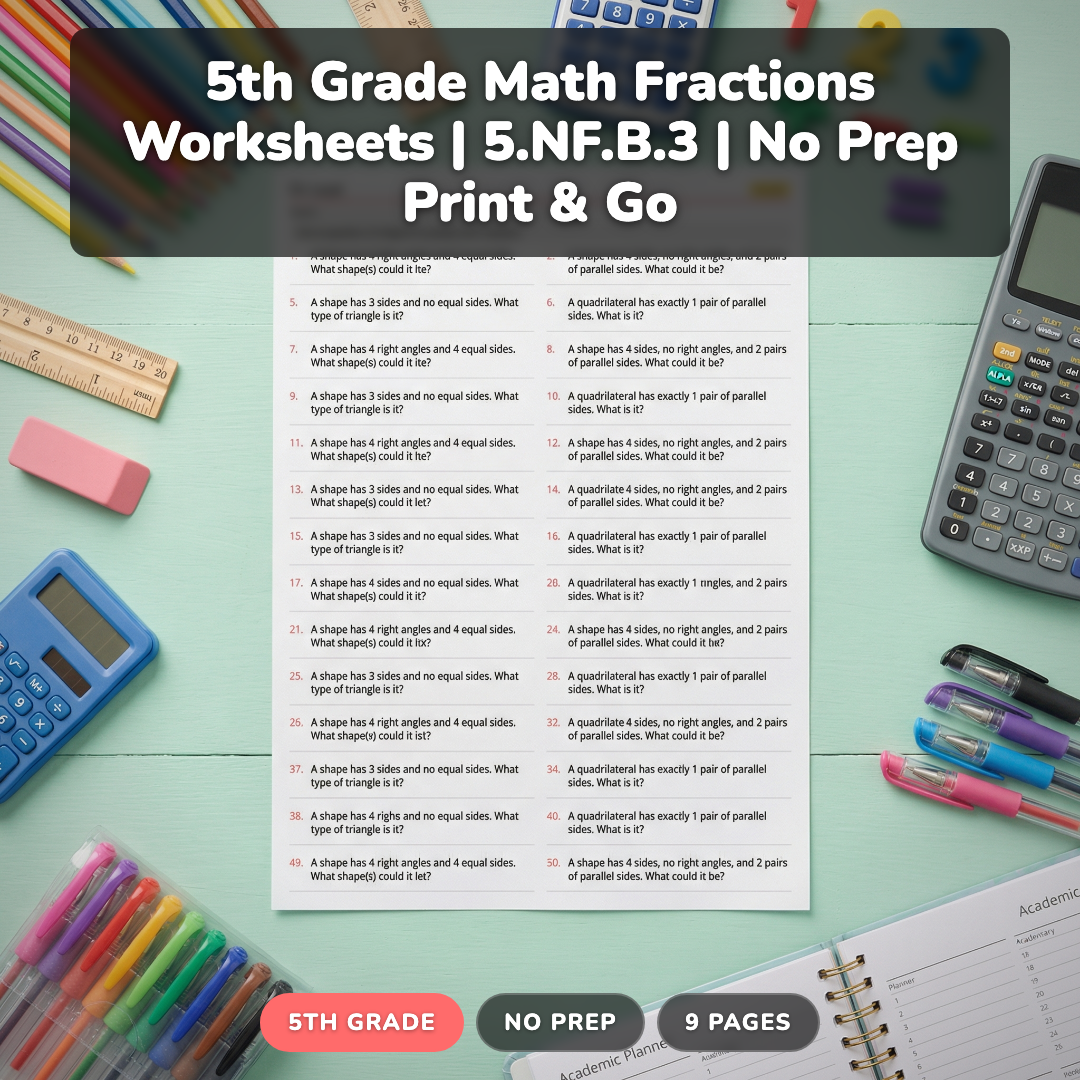
This 9-page resource includes 132 carefully crafted problems across three difficulty levels: 37 practice problems for students needing extra support, 50 on-level problems aligned perfectly with CCSS.Math.Content.5.NF.B.3, and 45 challenge problems for advanced learners. Each level includes word problems, visual models, and symbolic practice.
What sets this apart is the intentional progression — problems move from concrete sharing contexts to abstract division expressions, exactly matching how students develop conceptual understanding. Answer keys are included for quick grading, and each page clearly indicates the difficulty level.
The resource covers everything from basic unit fractions (1 ÷ 4) to complex mixed number scenarios (7 ÷ 3), with visual supports and real-world contexts throughout. Perfect for centers, homework, or assessment preparation.
Grab a Free Fraction Division Worksheet to Try
Want to see how these strategies work in practice? I’ll send you a sample worksheet with 10 problems across all three difficulty levels, plus a teacher guide with step-by-step solutions. Perfect for testing these approaches with your students before diving into the full resource.
Frequently Asked Questions About Teaching Fractions as Division
When should I introduce fractions as division in 5th grade?
Introduce this concept after students have mastered basic fraction operations and understand equivalent fractions. Typically this occurs in the second quarter, building on 4th grade fraction foundations. Students need solid division facts and conceptual understanding of fractions as parts of wholes first.
Why do students struggle to see fractions as division problems?
Students struggle because early fraction instruction emphasizes part-whole relationships without connecting to division. They think of 3/4 as “three pieces of four” rather than “three divided by four.” Consistent use of division language and sharing contexts helps bridge this gap effectively.
How do I help students who think division always makes numbers smaller?
Use measurement division with concrete objects first. Show that when you divide by numbers less than one, results get larger. Start with whole number division by fractions using visual models, then connect to the inverse relationship between multiplication and division systematically.
What’s the best way to connect fractions as division to decimals?
After students understand fractions as division conceptually, use calculators to show that 3 ÷ 4 = 0.75 and 3/4 = 0.75. This concrete connection reinforces that fractions, division, and decimals represent the same mathematical relationships in different forms.
How does CCSS.Math.Content.5.NF.B.3 connect to other 5th grade standards?
This standard directly supports 5.NF.B.4 (multiplying fractions) and 5.NF.B.6 (real-world fraction problems). It also builds toward 6th grade ratio and proportion work. Students who master fractions as division show stronger performance on multi-step problem solving across all domains.
Teaching fractions as division transforms how your 5th graders think about mathematical relationships. When students see that 2/3 means “2 divided by 3,” they unlock deeper understanding that serves them through middle school and beyond.
What’s your biggest challenge when teaching fractions as division? Try the cookie sharing strategy first — it’s the most concrete entry point for students who are struggling with this concept. And don’t forget to grab that free sample worksheet above to see these strategies in action!