If your 5th graders freeze when they see “3 × 2/5” or confidently declare that “4 × 1/3 = 4/12,” you’re not alone. Understanding why fraction multiplication produces the results it does — especially when the product gets smaller — challenges even strong math students. You’ll walk away with five research-backed strategies that help students truly grasp CCSS.Math.Content.5.NF.B.5b and build lasting number sense around fraction operations.
Key Takeaway
Students master fraction multiplication when they understand the “why” behind the size of products through visual models and real-world contexts before memorizing procedures.
Why Fraction Multiplication Matters in 5th Grade
Standard CCSS.Math.Content.5.NF.B.5b asks students to explain why multiplying by fractions greater than 1 makes products larger, while multiplying by fractions less than 1 makes products smaller. This conceptual understanding forms the foundation for all future work with rational numbers, including decimals, percents, and algebraic thinking.
Research from the National Mathematics Advisory Panel shows that students who develop strong fraction sense in elementary school perform significantly better in algebra. Specifically, understanding multiplication’s effect on number size prevents the common middle school error of treating all operations as “making numbers bigger.”
This standard typically appears in late fall or early winter, after students have mastered fraction equivalence and addition/subtraction. You’ll want to spend 2-3 weeks on this concept, as it requires both procedural fluency and deep conceptual understanding.
Looking for a ready-to-go resource? I put together a differentiated fraction multiplication pack that covers everything below — but first, the teaching strategies that make it work.
Common Fraction Multiplication Misconceptions in 5th Grade
Common Misconception: “Multiplication always makes numbers bigger.”
Why it happens: Years of whole number multiplication create this mental model.
Quick fix: Start with repeated addition contexts like “1/4 of a pizza, three times.”
Common Misconception: “3 × 1/4 means 3 + 1/4.”
Why it happens: Students confuse the multiplication symbol with addition.
Quick fix: Use “groups of” language consistently — “3 groups of 1/4.”
Common Misconception: “Fractions greater than 1 don’t exist.”
Why it happens: Early fraction instruction focuses on parts of a whole less than 1.
Quick fix: Introduce improper fractions through real contexts like recipes.
Common Misconception: “You can’t multiply fractions by whole numbers.”
Why it happens: Students see fractions and whole numbers as completely different number types.
Quick fix: Show whole numbers as fractions (4 = 4/1) on number lines.
5 Research-Backed Strategies for Teaching Fraction Multiplication
Strategy 1: Area Model Visualization
Students use rectangular grids to see how multiplying fractions creates areas, making the size relationship between factors and products concrete and visual.
What you need:
- Grid paper or fraction tiles
- Colored pencils or crayons
- Pre-drawn rectangles for struggling students
Steps:
- Draw a rectangle and divide it to represent the first factor (e.g., 2/3 of the rectangle)
- Within that shaded region, divide and shade to represent the second factor (e.g., 1/4 of the 2/3)
- Count the double-shaded squares to find the product
- Compare the product’s size to the original factors
- Discuss: “Is 2/3 × 1/4 larger or smaller than 2/3? Why?”
Strategy 2: Real-World Recipe Scaling
Students multiply recipe ingredients by fractions greater than and less than 1, creating authentic contexts where the size relationships make intuitive sense.
What you need:
- Simple recipe cards (cookies, trail mix, etc.)
- Measuring cups (optional, for demonstration)
- Calculators for checking work
Steps:
- Present a recipe that serves 4 people
- Ask: “How much of each ingredient for 6 people?” (multiply by 3/2)
- Ask: “How much for 2 people?” (multiply by 1/2)
- Calculate ingredient amounts and compare to original recipe
- Discuss: “When did we need more ingredients? Less? Why?”
Strategy 3: Number Line Jumps and Stretches
Students visualize fraction multiplication as stretching or shrinking intervals on a number line, making the size effects physically apparent.
What you need:
- Large number line (floor tape or poster paper)
- Colored markers or sticky notes
- Rulers for measuring
Steps:
- Mark the first factor on the number line (e.g., 3/4)
- If multiplying by a fraction greater than 1, stretch that interval
- If multiplying by a fraction less than 1, shrink that interval
- Mark the product and measure its distance from zero
- Compare: “Is our answer closer to zero or farther away? Why?”
Strategy 4: Fraction Multiplication Sorting
Students predict whether products will be larger or smaller than given numbers, then verify through calculation, building pattern recognition skills.
What you need:
- Pre-written multiplication expressions on cards
- Three sorting mats: “Larger,” “Smaller,” “Equal”
- Answer key for self-checking
Steps:
- Present expressions like “4 × 3/5” without calculating
- Students predict: Will the product be larger or smaller than 4?
- Sort cards into appropriate categories
- Calculate to verify predictions
- Identify patterns: “When do products get smaller? Larger?”
Strategy 5: Benchmark Fraction Comparison
Students use benchmark fractions (1/2, 1, 2) to estimate products quickly, developing number sense before formal algorithms.
What you need:
- Benchmark fraction reference chart
- Estimation recording sheet
- Colored pencils for marking estimates
Steps:
- Identify whether the fraction factor is closest to 0, 1/2, 1, or 2
- Estimate the product using that benchmark
- Record estimate before calculating exact answer
- Calculate actual product and compare to estimate
- Reflect: “Was my estimate reasonable? How close?”
How to Differentiate Fraction Multiplication for All Learners
For Students Who Need Extra Support
Begin with concrete manipulatives like fraction circles or bars. Focus exclusively on unit fractions (1/2, 1/3, 1/4) multiplied by whole numbers until the concept is solid. Use repeated addition language: “1/4 + 1/4 + 1/4 = 3/4” before introducing “3 × 1/4.” Provide visual models for every problem and emphasize the “groups of” interpretation. Review fraction basics if students struggle with equivalence or comparing fractions to 1.
For On-Level Students
Students work with proper fractions multiplied by whole numbers and simple fractions. They should explain their reasoning using both visual models and numerical patterns. Expect mastery of CCSS.Math.Content.5.NF.B.5b through word problems and abstract expressions. Students connect to prior knowledge of whole number multiplication while noting key differences. They use estimation strategies to check reasonableness of answers.
For Students Ready for a Challenge
Introduce mixed numbers and improper fractions as factors. Students explore complex real-world scenarios requiring multiple steps. They investigate patterns with decimal equivalents and make connections to percent problems. Challenge them to create their own word problems demonstrating when products are larger or smaller than factors. Advanced students can explore why the “invert and multiply” rule works for division.
A Ready-to-Use Fraction Multiplication Resource for Your Classroom
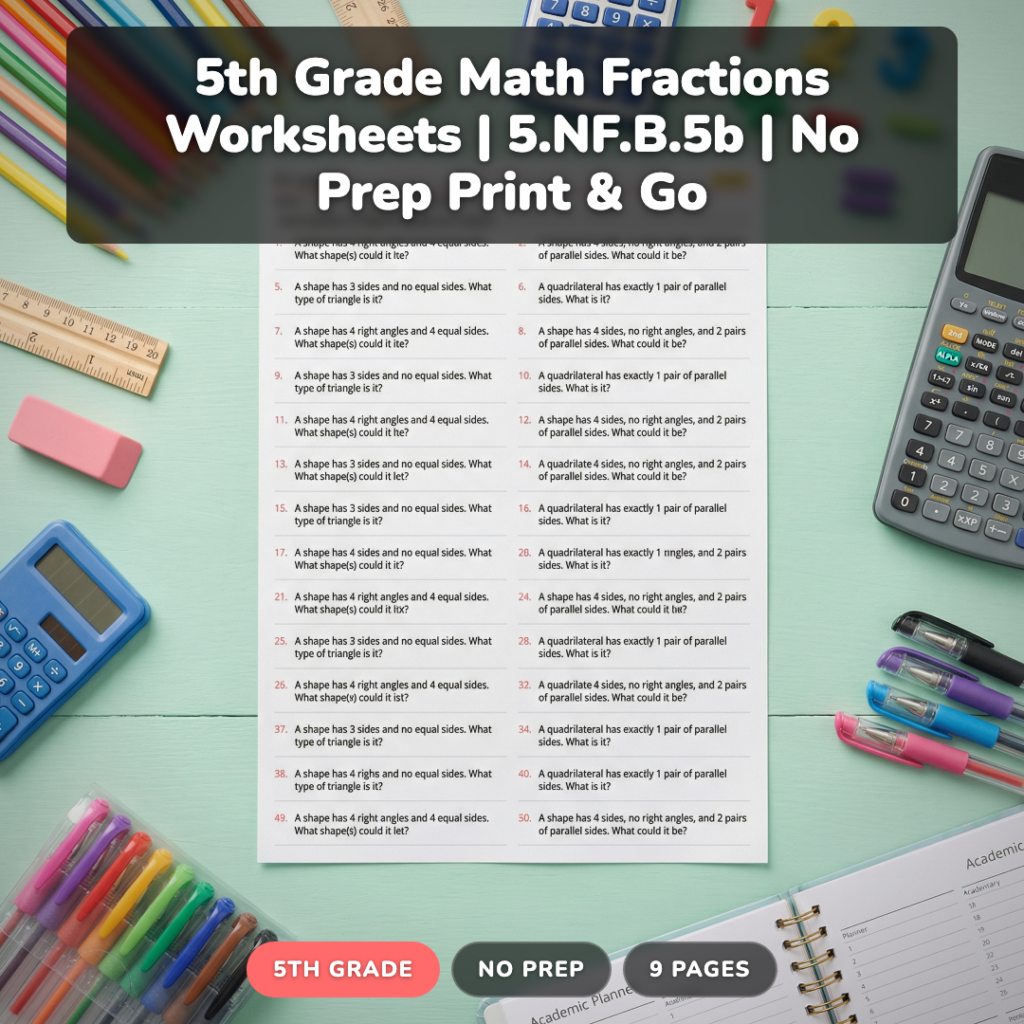
After years of creating fraction materials from scratch, I developed this comprehensive worksheet pack that addresses every aspect of CCSS.Math.Content.5.NF.B.5b. The resource includes 132 carefully scaffolded problems across three difficulty levels, saving you hours of prep time while ensuring every student gets appropriately challenging practice.
The Practice level focuses on whole numbers times unit fractions with visual supports. On-Level problems include proper fractions and simple mixed numbers with word problem contexts. Challenge problems incorporate improper fractions, estimation strategies, and multi-step scenarios. Each level includes detailed answer keys with worked solutions.
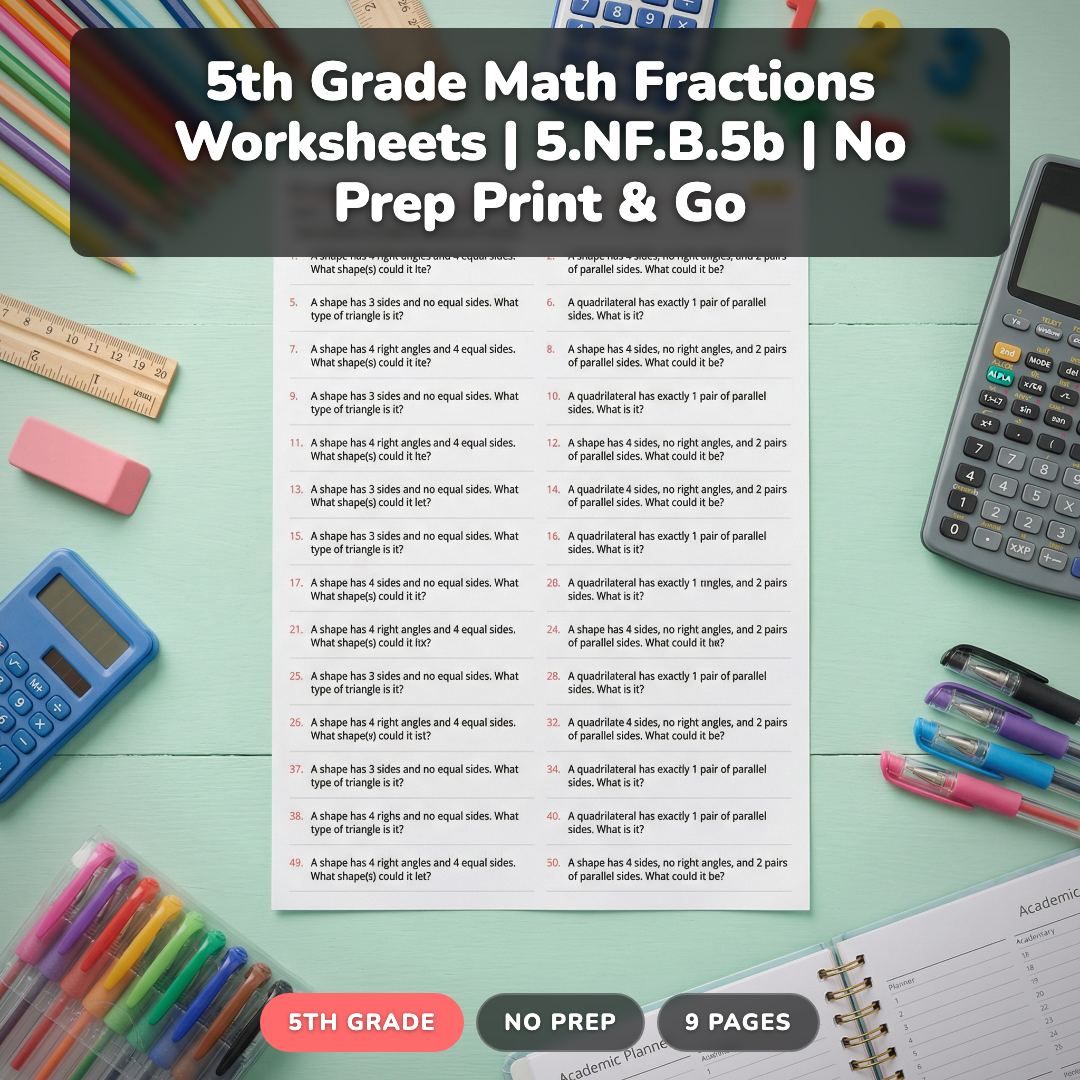
What sets this apart is the intentional progression from concrete to abstract thinking, plus the variety of problem types that prevent students from falling into procedural ruts. You get 9 pages of differentiated practice that actually builds understanding, not just computation skills.
Grab a Free Fraction Multiplication Sample to Try
Want to see how these strategies work in practice? I’ll send you a free sample page from each difficulty level, plus a quick reference guide for explaining why products get larger or smaller. Perfect for trying out the approach with your students before diving into the full resource.
Frequently Asked Questions About Teaching Fraction Multiplication
When should students learn why fraction multiplication affects product size?
Students should understand the conceptual reasons before memorizing algorithms, typically in late fall of 5th grade after mastering fraction equivalence and comparison. CCSS.Math.Content.5.NF.B.5b specifically requires this explanatory understanding alongside computational skills.
What’s the biggest mistake teachers make with this standard?
Rushing to the algorithm without building conceptual understanding first. Students who only memorize “multiply numerators, multiply denominators” struggle with estimation, reasonableness, and connecting fractions to decimals and percents later.
How do you help students who think multiplication always makes numbers bigger?
Use concrete contexts like “half of a pizza” or “quarter of a dollar” where taking a fraction clearly results in less than the original. Visual models and repeated addition help bridge their whole number multiplication experience.
Should students memorize fraction multiplication facts?
Focus on understanding patterns and estimation first. Memorization of common facts (like halves, thirds, fourths) develops naturally through repeated meaningful practice. Avoid isolated drill until conceptual understanding is solid.
How does this connect to middle school algebra?
Understanding how multiplication affects number size prevents errors with negative numbers, variables, and rational expressions. Students who grasp why 0.5 × 4 = 2 easily understand why x × 0.5 represents “half of x” in algebraic contexts.
Building Lasting Fraction Sense
The key to successful fraction multiplication instruction lies in helping students understand the “why” before the “how.” When students can explain why 3 × 1/4 equals 3/4 and why that’s smaller than 3, they’ve developed the number sense that will serve them through algebra and beyond.
What’s your go-to strategy for helping students understand when fraction products get larger or smaller? I’d love to hear what works in your classroom — and don’t forget to grab that free sample to try these approaches with your students.