If your 5th graders freeze when they see “1/3 ÷ 2” or “6 ÷ 1/4,” you’re not alone. Fraction division is one of the most challenging concepts in elementary math, requiring students to apply everything they know about fractions, multiplication, and division in completely new ways. The good news? With the right teaching strategies, your students can master this skill and actually understand why the procedures work.
Key Takeaway
Students succeed with fraction division when they understand the conceptual meaning before memorizing procedures, using visual models and real-world contexts to build number sense.
Why Fraction Division Matters in 5th Grade
Fraction division represents a critical bridge between elementary arithmetic and algebraic thinking. When students master CCSS.Math.Content.5.NF.B.7, they’re not just learning to divide fractions—they’re developing proportional reasoning skills that will serve them in middle school algebra, geometry, and beyond.
This standard specifically focuses on dividing unit fractions by whole numbers (like 1/4 ÷ 3) and whole numbers by unit fractions (like 3 ÷ 1/4). Research from the National Mathematics Advisory Panel shows that students who understand fraction division conceptually perform 40% better on standardized assessments than those who only memorize procedures.
Timing matters too. Most districts introduce this concept in January or February, after students have solid foundations in fraction equivalence, addition, and subtraction. Students need strong number sense with fractions before tackling division operations.
Looking for a ready-to-go resource? I put together a differentiated fraction division pack that covers everything below — but first, the teaching strategies that make it work.
Common Fraction Division Misconceptions in 5th Grade
Common Misconception: Students think 1/2 ÷ 4 means “half of 4” or equals 2.
Why it happens: They confuse division with multiplication, applying whole number division logic.
Quick fix: Use the context “How many groups of 4 can you make from 1/2?” to highlight the impossibility.
Common Misconception: Students believe 6 ÷ 1/3 equals 2 because “6 divided by something should be smaller.”
Why it happens: Whole number division experience creates the expectation that division always makes numbers smaller.
Quick fix: Connect to “How many 1/3s fit into 6 whole things?” using visual models.
Common Misconception: Students flip every fraction in sight when they see division, even when dividing by whole numbers.
Why it happens: They overgeneralize the “invert and multiply” rule without understanding when it applies.
Quick fix: Teach conceptual understanding first, procedures second, emphasizing when to use each approach.
Common Misconception: Students think 1/4 ÷ 2 and 2 ÷ 1/4 give the same answer.
Why it happens: They don’t understand that division isn’t commutative like multiplication.
Quick fix: Use concrete scenarios for each problem type to show the different meanings.
5 Research-Backed Strategies for Teaching Fraction Division
Strategy 1: Start with Sharing Stories
Before any symbols or procedures, students need to understand what fraction division means through real-world contexts. This builds the conceptual foundation that makes procedures meaningful.
What you need:
- Story problem cards
- Manipulatives (fraction bars, circles, or squares)
- Chart paper for recording thinking
Steps:
- Present a sharing story: “Maria has 1/2 of a pizza. She wants to share it equally among 4 friends. How much will each friend get?”
- Have students act out the problem with manipulatives before writing any equations
- Connect the action to the mathematical expression: 1/2 ÷ 4
- Repeat with “measurement” stories: “How many 1/4-cup servings can you make from 3 cups of juice?”
- Chart both problem types and their corresponding division expressions
Strategy 2: Visual Area Models
Area models make fraction division concrete and help students see why the procedures work. This strategy is particularly powerful for visual learners who struggle with abstract algorithms.
What you need:
- Grid paper or pre-drawn rectangles
- Colored pencils or crayons
- Document camera for whole-class modeling
Steps:
- For 1/3 ÷ 4, draw a rectangle and shade 1/3 of it
- Ask: “How can we divide this shaded part into 4 equal groups?”
- Partition the entire rectangle into 12 equal parts (since 3 × 4 = 12)
- Show that 1/3 becomes 4/12, and each group is 1/12
- Connect to the answer: 1/3 ÷ 4 = 1/12
- For 2 ÷ 1/4, draw 2 whole rectangles and ask how many 1/4 pieces fit
Strategy 3: Number Line Jumps
Number lines help students visualize fraction division as repeated subtraction or measurement, making the concept more intuitive than abstract algorithms.
What you need:
- Large number line (0 to 2, marked in twelfths)
- Colored markers or sticky notes
- Individual number line worksheets
Steps:
- For 3 ÷ 1/4, start at 0 and mark 3 on the number line
- Ask: “How many jumps of 1/4 does it take to reach 3?”
- Have students make 1/4 jumps, counting each one
- Record the total number of jumps as the answer: 12
- For 1/2 ÷ 3, mark 1/2 and ask how to divide that distance into 3 equal parts
- Show that each part is 1/6 of the whole unit
Strategy 4: Fraction Bar Manipulation
Physical manipulation with fraction bars allows students to experience fraction division kinesthetically, building muscle memory alongside conceptual understanding.
What you need:
- Fraction bar sets (or paper strips cut into fractions)
- Scissors for creating smaller pieces
- Recording sheets for documenting discoveries
Steps:
- Give students a 1/3 bar for the problem 1/3 ÷ 2
- Ask them to fold or cut it into 2 equal pieces
- Have them identify what fraction each piece represents (1/6)
- For 4 ÷ 1/2, give students 4 whole bars
- Ask how many 1/2 pieces they can make from 4 wholes
- Count the total pieces to find the answer: 8
Strategy 5: Connect to Multiplication
Once students understand fraction division conceptually, connecting it to multiplication helps them see the underlying relationship and prepares them for the standard algorithm.
What you need:
- Multiplication and division fact family cards
- Two-column recording sheets
- Calculator for checking work
Steps:
- Start with a known multiplication: 1/4 × 8 = 2
- Ask: “If 1/4 × 8 = 2, what does 2 ÷ 1/4 equal?”
- Help students see that 2 ÷ 1/4 = 8 (the inverse relationship)
- Practice with multiple examples, building fact families
- Introduce the “multiply by the reciprocal” rule as a shortcut
- Always return to conceptual models when students get confused
How to Differentiate Fraction Division for All Learners
For Students Who Need Extra Support
Focus on unit fractions with small whole numbers (1/2 ÷ 2, 1/4 ÷ 3). Use concrete manipulatives extensively before moving to visual models. Break problems into smaller steps: first identify what the problem is asking, then choose an appropriate model, finally solve and check for reasonableness. Provide reference charts with visual models for common fraction division patterns.
For On-Level Students
Work with unit fractions and whole numbers as outlined in CCSS.Math.Content.5.NF.B.7. Students should fluently move between concrete, visual, and abstract representations. Expect them to explain their reasoning and choose appropriate strategies for different problem types. Practice should include both computation and word problems with real-world contexts.
For Students Ready for a Challenge
Extend to non-unit fractions (2/3 ÷ 4, 5 ÷ 2/3) and mixed numbers. Challenge students to create their own word problems and teach fraction division to younger students. Explore connections to ratio and proportion concepts that preview middle school mathematics. Investigate why the “invert and multiply” algorithm works using algebraic reasoning.
A Ready-to-Use Fraction Division Resource for Your Classroom
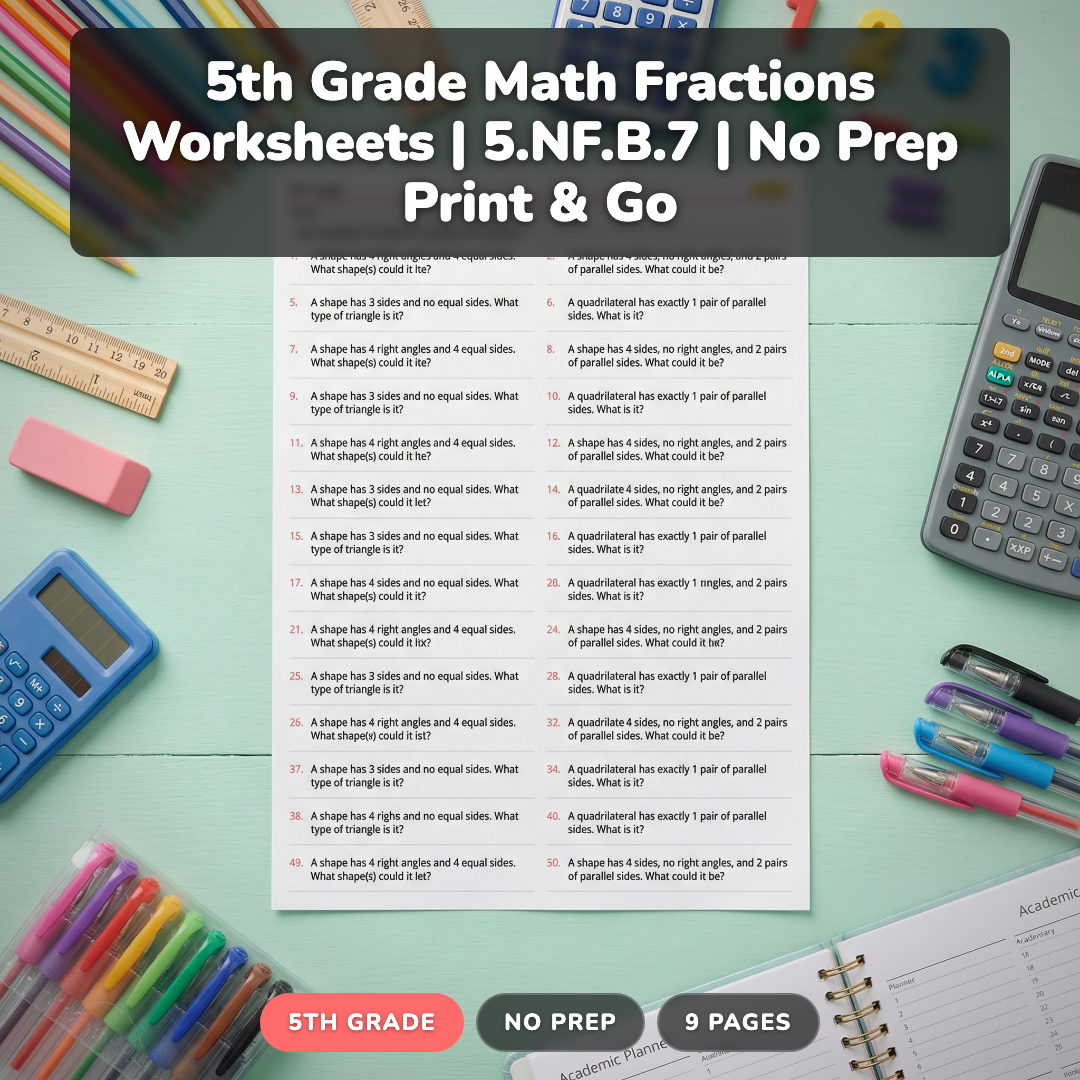
Teaching fraction division requires extensive practice with problems at just the right level for each student. This differentiated fraction division pack includes 132 carefully crafted problems across three difficulty levels: Practice (37 problems for students needing extra support), On-Level (50 problems aligned to grade-level expectations), and Challenge (45 problems for advanced learners).
What makes this resource different? Each level includes both computational practice and word problems, with visual models provided for struggling students and extension activities for advanced learners. The 9-page pack includes detailed answer keys and teaching notes for implementing the strategies above.
The problems progress systematically from concrete contexts to abstract computation, matching the learning progression research recommends for fraction division mastery.
Grab a Free Fraction Division Sample to Try
Want to see how these strategies work in practice? I’ll send you a free sample worksheet with problems at all three levels, plus a visual model reference sheet your students can use during instruction.
Frequently Asked Questions About Teaching Fraction Division
When should I introduce the “invert and multiply” algorithm?
Introduce the algorithm only after students understand fraction division conceptually through visual models and real-world contexts. Most students are ready for the algorithm after 2-3 weeks of conceptual work, but some may need longer with concrete representations.
What’s the difference between 1/2 ÷ 3 and 3 ÷ 1/2?
These represent completely different situations. 1/2 ÷ 3 asks “how much is in each group when 1/2 is shared among 3 groups” (answer: 1/6). 3 ÷ 1/2 asks “how many groups of 1/2 fit into 3” (answer: 6). Use different contexts and models for each type.
How do I help students who keep getting confused about when to flip fractions?
Focus on meaning before procedures. Students who understand what division means (sharing vs. measuring) rarely get confused about algorithms. Use story problems consistently and have students explain what each problem is asking before solving.
What manipulatives work best for fraction division?
Fraction bars or strips work exceptionally well because students can physically cut or fold them. Pattern blocks, fraction circles, and grid paper also work. The key is consistency—use the same manipulative type for several weeks so students focus on concepts, not figuring out new materials.
How does fraction division connect to CCSS.Math.Content.5.NF.B.7?
This standard specifically addresses dividing unit fractions by whole numbers and whole numbers by unit fractions. It builds on 5th grade multiplication of fractions and prepares students for 6th grade general fraction division. Focus on these two cases before extending to other fraction types.
Fraction division doesn’t have to be the stumbling block that derails your students’ math confidence. When you build understanding through concrete experiences and visual models before introducing algorithms, students develop both procedural fluency and conceptual understanding that lasts. What’s your go-to strategy for making fraction division click with your students?
Remember to grab your free fraction division sample above—it’s a great way to try these strategies with your class before diving into more extensive practice.