If your 5th graders freeze when they see “1/4 ÷ 3” or “8 ÷ 1/2,” you’re not alone. Fraction division is where many students hit their first major math wall. The good news? With the right visual models and step-by-step approach, you can help every student understand why we “multiply by the reciprocal” instead of just memorizing the rule.
Key Takeaway
Students master fraction division when they see the “how many groups” or “how much in each group” story behind every problem before learning the algorithm.
Why 5th Grade Fraction Division Matters
Standard CCSS.Math.Content.5.NF.B.7c asks students to solve real-world problems involving division of unit fractions by whole numbers and whole numbers by unit fractions. This isn’t just about computation—it’s about developing number sense that will support algebra and beyond.
Research from the National Mathematics Advisory Panel shows that fraction understanding in elementary school is the strongest predictor of algebra success in high school. Students who master the conceptual foundation of fraction division score 30% higher on standardized assessments compared to those who only memorize procedures.
This standard typically appears in late fall or winter, after students have solid understanding of fraction multiplication (5.NF.B.4-6). Students need strong visual fraction models and experience with “groups of” and “groups in” division scenarios before tackling these problems.
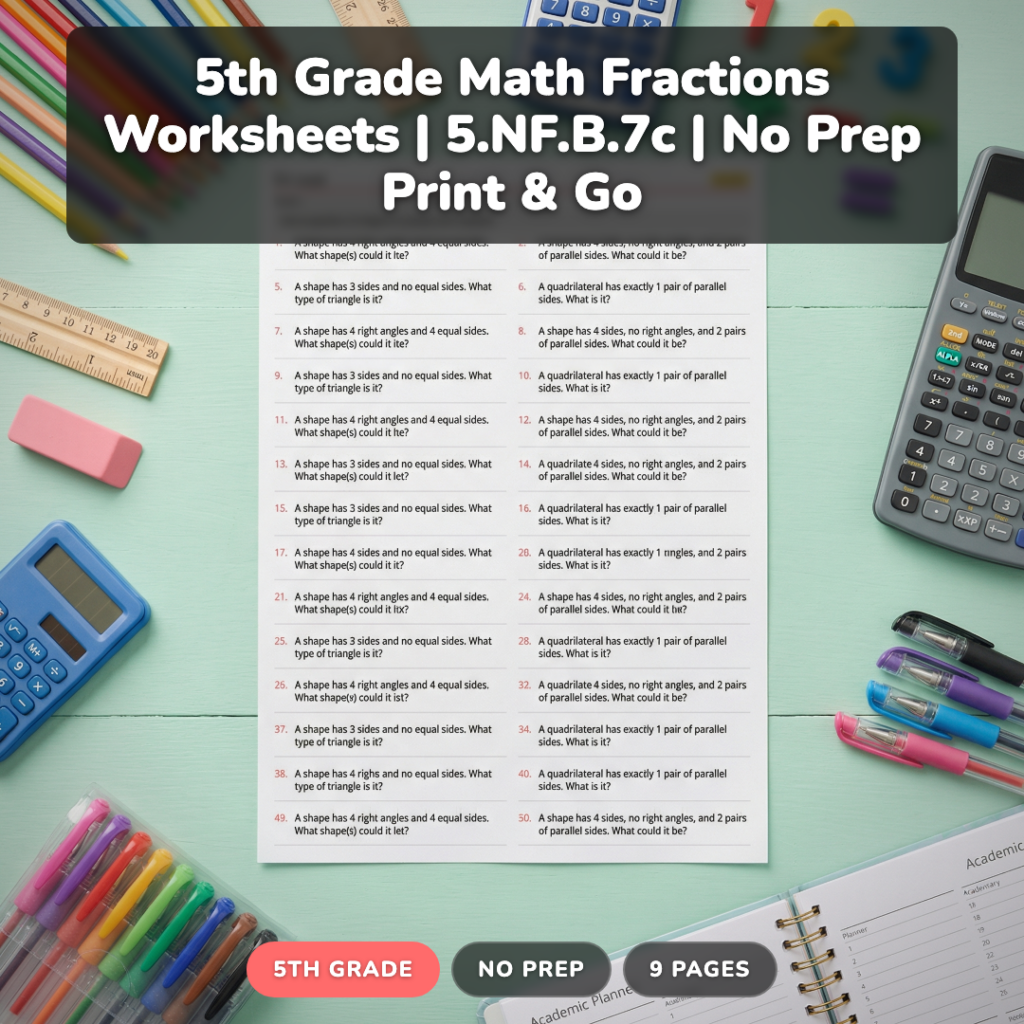
Looking for a ready-to-go resource? I put together a differentiated fraction division pack with 132 problems across three levels—but first, the teaching strategies that make it work.
Common Fraction Division Misconceptions in 5th Grade
Common Misconception: Students think 1/2 ÷ 4 means “take half of 4.”
Why it happens: They confuse division with multiplication and apply the “of” language incorrectly.
Quick fix: Always start with the division story: “How many groups of 4 can you make from 1/2?”
Common Misconception: When dividing a whole number by a unit fraction (like 8 ÷ 1/3), students divide normally and get a smaller answer.
Why it happens: They expect division to always make numbers smaller, based on whole number experience.
Quick fix: Use the “How many 1/3s fit into 8?” language and visual models to show why the answer is larger.
Common Misconception: Students flip both fractions when they see any fraction division problem.
Why it happens: They overgeneralize the “invert and multiply” rule without understanding when it applies.
Quick fix: Teach the two types separately: unit fraction ÷ whole number vs. whole number ÷ unit fraction.
Common Misconception: Students can’t connect word problems to division expressions.
Why it happens: Fraction division contexts are less familiar than whole number division scenarios.
Quick fix: Practice translating between “sharing” and “grouping” language consistently.
5 Research-Backed Strategies for Teaching Fraction Division
Strategy 1: The Rectangle Model for Visual Division
This concrete approach helps students see exactly what’s happening when they divide fractions. Students draw rectangles and partition them to represent both division scenarios visually.
What you need:
- Grid paper or rectangle templates
- Colored pencils or markers
- Fraction division problems written as word problems
Steps:
- Start with 1/2 ÷ 3: “If you have 1/2 of a pizza and want to share it equally among 3 people, how much does each person get?”
- Draw a rectangle and shade 1/2 of it
- Divide the shaded portion into 3 equal parts
- Count the size of each part (1/6) and verify with the class
- Try 4 ÷ 1/2: “How many 1/2-cup servings can you make from 4 cups?”
- Draw 4 rectangles, divide each in half, count the halves (8)
Strategy 2: Number Line Jumps for Unit Fraction Division
Number lines make the “how many groups” question crystal clear, especially for whole number ÷ unit fraction problems where students need to see why answers get larger.
What you need:
- Large number line (0-10) posted or drawn
- Sticky notes or magnetic markers
- Individual number line strips for students
Steps:
- Pose the problem: 6 ÷ 1/3 = “How many 1/3s are in 6?”
- Mark 0 and 6 on the number line
- Have students make jumps of 1/3: 1/3, 2/3, 1, 1 1/3, 1 2/3, 2…
- Count the jumps together (18 jumps of 1/3)
- Connect to multiplication: 18 × 1/3 = 6 ✓
- Try 1/4 ÷ 2 using the same process with smaller jumps
Strategy 3: The Sharing vs. Grouping Story Sort
Students need to distinguish between the two types of division scenarios before they can solve them. This sorting activity builds that conceptual foundation.
What you need:
- Word problem cards (mix of both division types)
- Two sorting mats labeled “Sharing” and “Grouping”
- Chart paper for recording patterns
Steps:
- Read problem: “Maria has 3/4 cup of flour. She wants to divide it equally into 2 bowls.”
- Ask: “Are we sharing a known amount into groups, or finding how many groups we can make?”
- Sort into “Sharing” (3/4 ÷ 2) and discuss the answer will be smaller
- Try: “How many 1/4-cup scoops can you make from 3 cups of flour?”
- Sort into “Grouping” (3 ÷ 1/4) and predict the answer will be larger
- Create class charts showing the patterns for each type
Strategy 4: Manipulative Division with Fraction Circles
Hands-on manipulation helps kinesthetic learners understand fraction division through physical partitioning and grouping actions.
What you need:
- Fraction circle sets (halves, thirds, fourths, sixths)
- Whole circle bases
- Small plates or sorting mats
- Recording sheets
Steps:
- Model 1/2 ÷ 4: Take out one 1/2 piece
- Ask: “How can we divide this 1/2 into 4 equal parts?”
- Trade the 1/2 piece for equivalent eighths (four 1/8 pieces)
- Group the 1/8 pieces into 4 equal shares (each gets 1/8)
- Try 2 ÷ 1/3: Use 2 whole circles, count how many 1/3 pieces cover them
- Record both the manipulative work and the numerical equation
Strategy 5: Real-World Problem Creation Workshop
Students deepen understanding by creating their own word problems, forcing them to think about when and why fraction division occurs in real life.
What you need:
- Scenario cards (cooking, crafts, sports, etc.)
- Problem template sheets
- Peer review checklists
- Calculator for checking work
Steps:
- Give each pair a scenario card (“Baking cookies”)
- Have them write one sharing problem: “2/3 cup sugar divided equally into 4 batches”
- Write one grouping problem: “How many 1/4-cup servings from 5 cups of milk?”
- Pairs solve each other’s problems using visual models
- Discuss which scenarios naturally lead to each division type
- Create a class book of “Real Fraction Division Problems”
How to Differentiate Fraction Division for All Learners
For Students Who Need Extra Support
Start with unit fractions only (1/2, 1/3, 1/4) and whole numbers 1-5. Use pre-drawn visual models and provide the division story language explicitly. Focus on one type of division (sharing OR grouping) for several days before introducing the second type. Offer multiplication fact practice since fraction division relies heavily on knowing reciprocals.
For On-Level Students
Work with unit fractions and whole numbers up to 10, as required by CCSS.Math.Content.5.NF.B.7c. Students should move between visual models, equations, and word problems fluently. Expect them to explain their reasoning and check answers using multiplication. Provide mixed practice with both division types within the same lesson.
For Students Ready for a Challenge
Extend to non-unit fractions (like 2/3 ÷ 4) or larger whole numbers. Challenge students to find multiple solution methods for the same problem. Have them create word problems for younger students and explain why their answers make sense. Connect to decimal division and early algebraic thinking.
A Ready-to-Use Fraction Division Resource for Your Classroom
After teaching fraction division for years, I know how time-consuming it is to create problems at just the right level for each student. You need practice problems that build from concrete scenarios to abstract computation, with enough variety to keep students engaged.
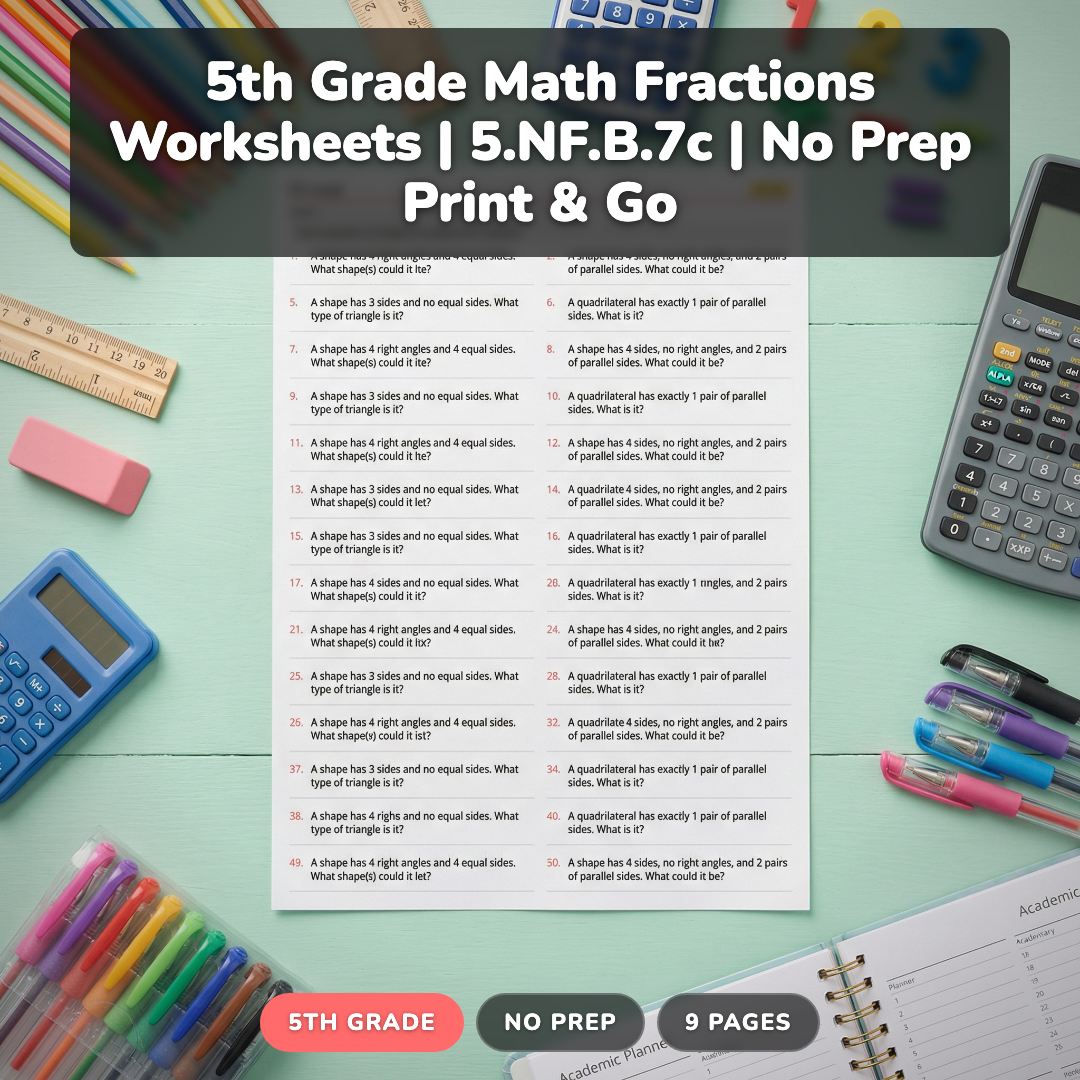
That’s exactly what you’ll find in this differentiated fraction division pack. It includes 132 carefully crafted problems across three levels: 37 practice problems for students building foundational understanding, 50 on-level problems aligned to standard 5.NF.B.7c, and 45 challenge problems for advanced learners.
Each level includes both sharing and grouping scenarios, real-world contexts, and space for visual models. The problems progress logically from simple unit fractions with small whole numbers to more complex scenarios. Complete answer keys save you grading time, and the no-prep format means you can print and use immediately.
Whether you’re introducing the concept or providing extra practice, this resource gives you everything you need for successful fraction division instruction.
Grab a Free Fraction Division Sample to Try
Want to see the teaching approach in action? I’ll send you a free sample with problems from each level, plus visual model templates you can use with any fraction division lesson.
Frequently Asked Questions About Teaching Fraction Division
When should I introduce the “invert and multiply” algorithm?
Introduce the algorithm only after students understand the conceptual foundation through visual models and word problems. Most students are ready for the shortcut after 2-3 weeks of concrete work with fraction division scenarios and can explain why it works.
What’s the difference between 1/2 ÷ 3 and 3 ÷ 1/2 for students?
The first asks “how much in each group” (sharing 1/2 into 3 parts = 1/6 each). The second asks “how many groups” (how many 1/2s in 3 = 6). Students need different visual models and language for each type.
How do I help students who confuse fraction division with multiplication?
Always start with the division story before showing numbers. Ask “Are we finding how many groups or how much in each group?” Use consistent language and visual models. Practice translating word problems to equations before computing.
What prerequisite skills do students need for fraction division?
Students need solid fraction equivalence, fraction multiplication, and understanding of whole number division as both sharing and grouping. They should recognize unit fractions and work comfortably with visual fraction models like rectangles and number lines.
How long should I spend on fraction division in 5th grade?
Plan 2-3 weeks for initial instruction with ongoing spiral review. Spend the first week on conceptual understanding with visual models, the second week on connecting to algorithms, and the third week on mixed practice and real-world applications.
Teaching fraction division successfully comes down to helping students see the story behind each problem before jumping to computation. When students understand whether they’re sharing or grouping, the math makes sense and the algorithms become tools rather than mysteries.
What’s your go-to strategy for helping students visualize fraction division? I’d love to hear what works in your classroom! And don’t forget to grab that free sample pack above—it’s a great way to try these strategies with your students.