If your 5th graders freeze when they see 0.456 compared to 0.46, you’re not alone. Decimal comparison trips up even strong math students because it challenges everything they know about whole numbers. The good news? With the right strategies, you can help students master CCSS.Math.Content.5.NBT.A.3b and build confidence with decimal place value.
Key Takeaway
Students master decimal comparison when they understand place value relationships, not just memorize rules.
Why Decimal Comparison Matters in 5th Grade
Decimal comparison forms the foundation for all future decimal operations. According to the National Assessment of Educational Progress, only 47% of 8th graders can correctly order decimals to the hundredths place, indicating that many students never fully grasp this concept in elementary school.
The CCSS.Math.Content.5.NBT.A.3b standard requires students to compare decimals to thousandths using place value understanding, not rote memorization. This skill typically appears in the second quarter after students have worked with decimal place value and before moving into decimal operations.
Research from the University of Wisconsin shows that students who master decimal comparison through place value reasoning perform 23% better on fraction comparison tasks, demonstrating the interconnected nature of rational number understanding.
Looking for a ready-to-go resource? I put together a differentiated decimal comparison pack with 132 problems across three levels — but first, the teaching strategies that make it work.
Common Decimal Comparison Misconceptions in 5th Grade
Common Misconception: Students think 0.8 is less than 0.75 because 8 < 75.
Why it happens: They apply whole number thinking to decimal comparison.
Quick fix: Use place value charts and emphasize that 0.8 = 0.80.
Common Misconception: Students believe longer decimals are always larger (0.1234 > 0.5).
Why it happens: They confuse the number of digits with magnitude.
Quick fix: Connect to money — $0.50 vs $0.12 makes the relationship clear.
Common Misconception: Students think you compare decimals digit by digit from right to left.
Why it happens: They reverse the whole number comparison process.
Quick fix: Always start comparisons at the decimal point and move right.
Common Misconception: Students assume 0.6 = 0.60 = 0.600 are different numbers.
Why it happens: They don’t understand equivalent decimal representations.
Quick fix: Use base-ten blocks to show physical equivalence.
5 Research-Backed Strategies for Teaching Decimal Comparison
Strategy 1: Place Value Chart Alignment
Students align decimals in a place value chart to compare digit by digit, starting from the left. This visual strategy eliminates the confusion of comparing different decimal lengths and reinforces place value understanding.
What you need:
- Place value charts (ones, tenths, hundredths, thousandths)
- Decimal number cards
- Colored pencils or markers
Steps:
- Give students two decimals to compare (start with tenths, progress to thousandths)
- Have them write each decimal in the place value chart, aligning the decimal points
- Circle the leftmost place where digits differ
- Compare those digits to determine which decimal is greater
- Record the comparison using >, =, or < symbols
Strategy 2: Number Line Visualization
Students plot decimals on number lines to see their relative positions. This strategy builds number sense and helps students understand that decimal comparison is about position, not the number of digits.
What you need:
- Number lines marked in tenths, hundredths, or thousandths
- Sticky notes or decimal cards
- Rulers or straightedges
Steps:
- Provide a number line appropriate for the decimals being compared
- Students locate and mark the first decimal on the number line
- Students locate and mark the second decimal on the number line
- Compare positions: the decimal farther right is greater
- Write the comparison statement with correct symbols
Strategy 3: Money Connection Method
Students convert decimals to money amounts to leverage their real-world understanding of currency. This concrete connection makes abstract decimal relationships tangible and meaningful.
What you need:
- Play money (bills and coins)
- Decimal-to-money conversion charts
- Calculator for verification
Steps:
- Convert each decimal to a dollar amount (0.45 becomes $0.45)
- Have students count out the money using bills and coins
- Compare the physical amounts — which pile is worth more?
- Connect back to the original decimals with comparison symbols
- Practice with multiple examples, gradually removing the physical money
Strategy 4: Zero-Padding Technique
Students add zeros to make decimals the same length before comparing. This strategy directly addresses the misconception that longer decimals are larger and reinforces equivalent decimal representations.
What you need:
- Worksheets with decimal pairs
- Pencils and erasers
- Place value reference charts
Steps:
- Present two decimals of different lengths (0.7 and 0.65)
- Add zeros to make both decimals the same length (0.70 and 0.65)
- Compare digit by digit from left to right
- Identify the first place where digits differ
- Use the larger digit to determine which decimal is greater
Strategy 5: Base-Ten Block Modeling
Students use base-ten blocks to represent decimal values physically. This hands-on approach makes decimal place value concrete and helps students see why 0.3 is greater than 0.25 through physical manipulation.
What you need:
- Base-ten blocks (flats = ones, rods = tenths, units = hundredths)
- Decimal mats or place value mats
- Recording sheets
Steps:
- Establish block values (flat = 1, rod = 0.1, unit = 0.01)
- Have students build the first decimal with blocks
- Build the second decimal with blocks
- Compare the physical representations — which has more total value?
- Record the comparison and connect to symbolic representation
How to Differentiate Decimal Comparison for All Learners
For Students Who Need Extra Support
Start with tenths only and use concrete materials extensively. Provide place value charts with decimal points already marked and focus on one comparison at a time. Review fraction-decimal connections (0.5 = 1/2) to build on existing knowledge. Use consistent language: ‘Which pile has more?’ rather than abstract comparison vocabulary.
For On-Level Students
Work systematically through tenths, hundredths, then thousandths as outlined in CCSS.Math.Content.5.NBT.A.3b. Include mixed practice with different decimal lengths and require students to explain their reasoning. Introduce ordering sets of three decimals and connecting to real-world contexts like sports statistics or measurement.
For Students Ready for a Challenge
Extend to ten-thousandths and beyond, include negative decimals, and connect to scientific notation. Challenge them to create their own decimal comparison problems or find real-world examples where precise decimal comparison matters (Olympic times, GPS coordinates, financial calculations).
A Ready-to-Use Decimal Comparison Resource for Your Classroom
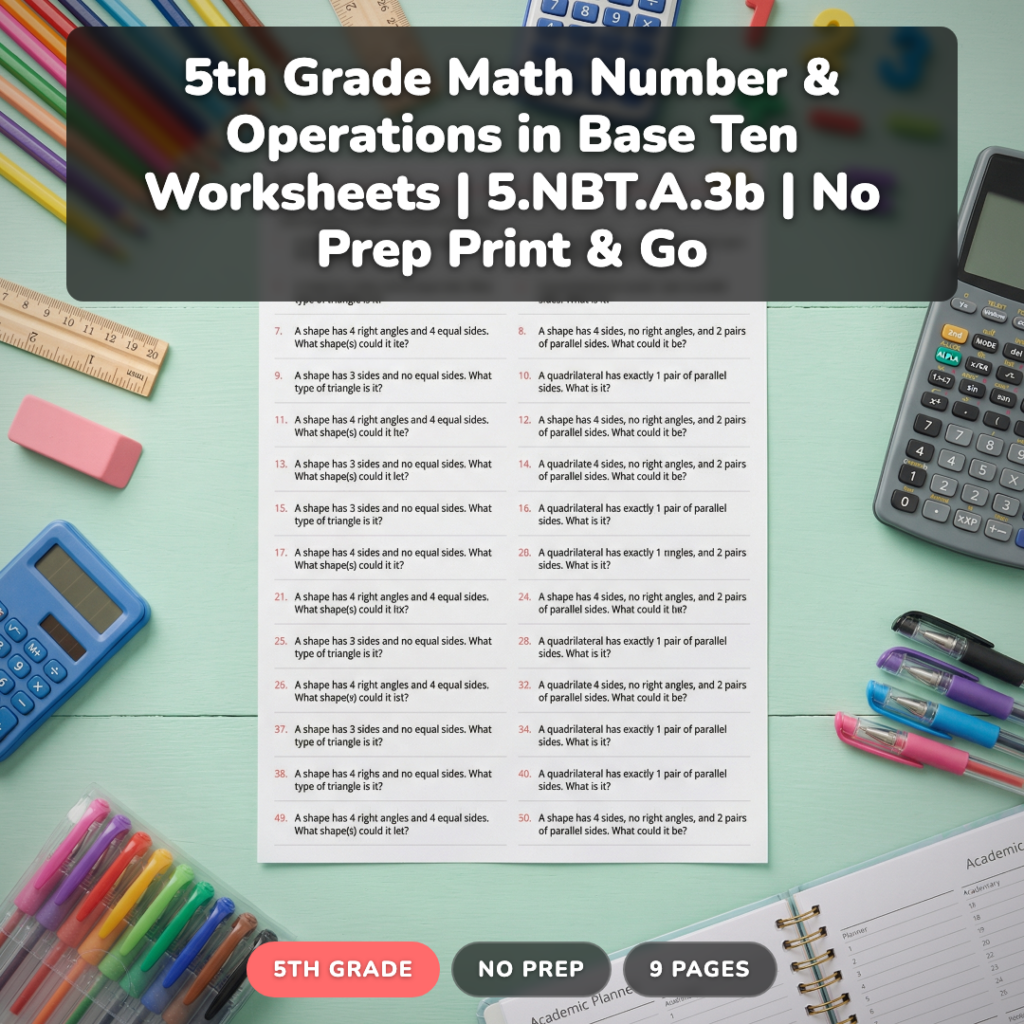
After years of teaching decimal comparison, I created a comprehensive resource that addresses every level of learner in your classroom. This 9-page packet includes 132 carefully crafted problems across three differentiation levels: Practice (37 problems), On-Level (50 problems), and Challenge (45 problems).
What makes this resource different is the systematic progression within each level. Practice problems focus on tenths and hundredths with clear place value support. On-Level problems include the full range of thousandths comparison required by the standard. Challenge problems extend learning with complex multi-decimal ordering and real-world applications.
Each page includes answer keys and can be used for independent practice, homework, or assessment. The problems are designed to prevent common misconceptions while building genuine understanding of decimal place value relationships.
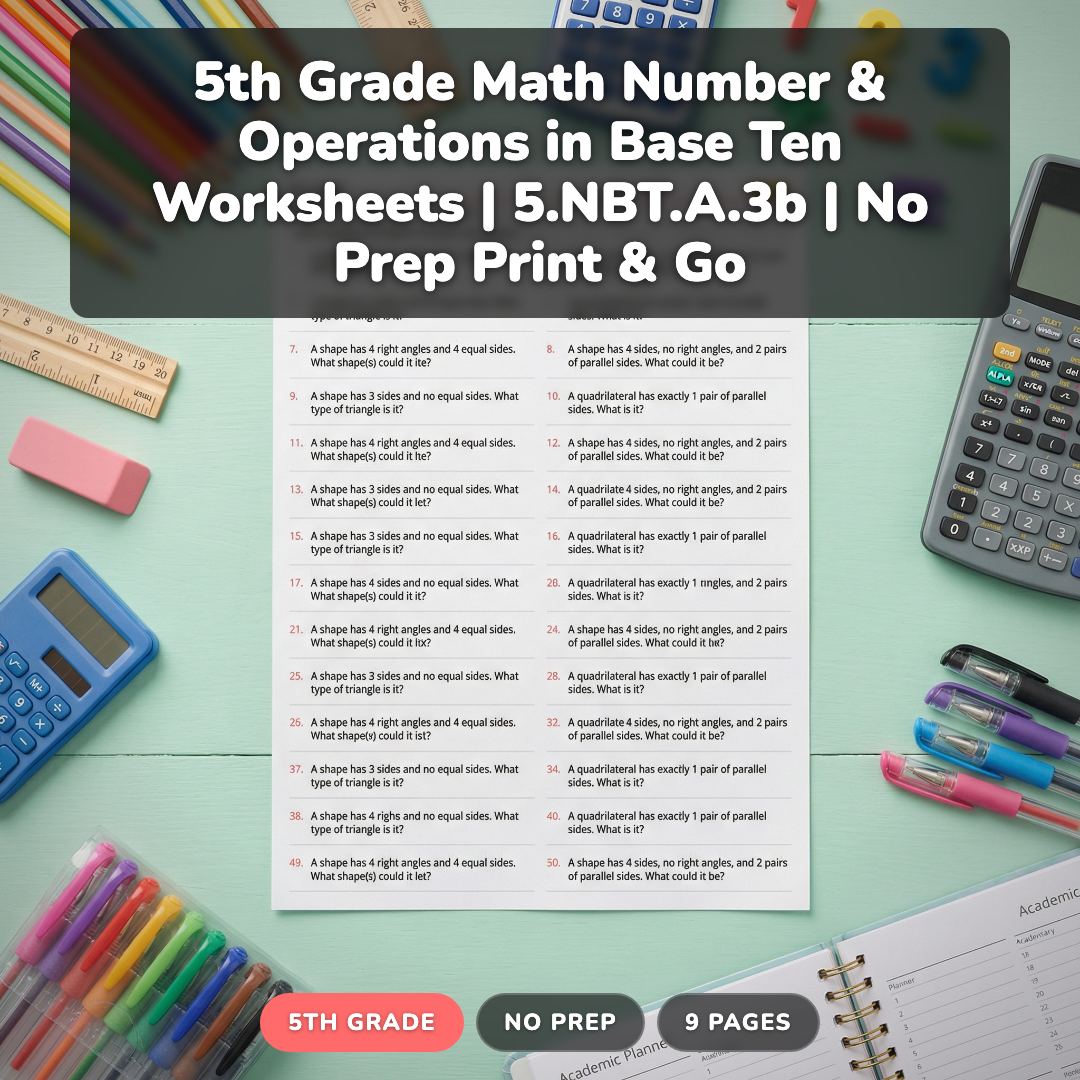
You can grab this time-saving resource that covers all your decimal comparison needs for the year.
Grab a Free Decimal Comparison Sample to Try
Want to see how these strategies work in practice? I’ll send you a free sample page from the resource plus a quick reference guide for teaching decimal comparison. Perfect for trying out the approach with your students before diving into the full resource.
Frequently Asked Questions About Teaching Decimal Comparison
What’s the biggest mistake students make when comparing decimals?
Students apply whole number thinking, believing that 0.8 < 0.75 because 8 < 75. They need explicit instruction that decimal comparison works left-to-right from the decimal point, focusing on place value rather than the total number of digits.
Should I teach decimal comparison before or after decimal addition?
Always teach comparison first. Students need solid place value understanding and comparison skills before attempting operations. CCSS.Math.Content.5.NBT.A.3b comes before addition/subtraction standards for this reason. Comparison builds the foundation for all decimal work.
How do I help students who think longer decimals are always bigger?
Use money connections consistently. $0.50 vs $0.123 makes it clear that more digits doesn’t mean more value. Also use number lines to show position relationships and base-ten blocks for concrete comparison experiences.
What’s the best way to introduce thousandths comparison?
Start with hundredths mastery, then extend one place at a time. Use the zero-padding technique heavily (0.45 becomes 0.450) so students see the pattern. Connect to measurement contexts like track times where thousandths matter for real comparisons.
How much practice do students typically need with decimal comparison?
Most students need 3-4 weeks of consistent practice across different contexts. Start with 10-15 problems daily, focusing on one decimal place at a time. Mix in review problems once students show understanding to maintain skills throughout the year.
Decimal comparison doesn’t have to be the stumbling block that derails your students’ math confidence. With systematic place value instruction and plenty of concrete experiences, your 5th graders will master this essential skill and be ready for middle school mathematics.
What’s your go-to strategy for helping students visualize decimal relationships? The hands-on approaches often surprise teachers with how quickly they work.