Planning a full year of differentiated 5th grade math instruction across five domains and 40 Common Core standards feels overwhelming. You need worksheets that meet every student where they are, review games that actually reinforce learning, and resources that cover everything from complex fractions to coordinate planes. This complete guide walks you through every 5th grade math domain with specific teaching strategies, then shows you how one comprehensive bundle can simplify your entire year of math planning.
Key Takeaway
5th grade math covers 40 Common Core standards across five domains, requiring differentiated instruction that bridges elementary concepts with middle school readiness.
5th Grade Math: What Students Need to Master This Year
Fifth grade represents a pivotal year in mathematical development where students transition from concrete elementary concepts to abstract middle school thinking. This year, students tackle 40 Common Core standards across five critical domains that build the foundation for algebraic reasoning and geometric thinking.
Operations & Algebraic Thinking (OA) focuses on writing and interpreting numerical expressions with parentheses and analyzing patterns. Number & Operations in Base Ten (NBT) extends place value understanding to decimals and develops fluency with multi-digit operations. Number & Operations — Fractions (NF) deepens fraction concepts through addition, subtraction, multiplication, and division while connecting fractions to decimals. Measurement & Data (MD) introduces volume concepts and advances data interpretation skills. Geometry (G) explores coordinate planes and classifies two-dimensional figures by their properties.
Students at this age (typically 10-11 years old) are developing abstract reasoning abilities while still benefiting from hands-on, visual approaches. They’re ready for more complex problem-solving but need scaffolded practice to build confidence with challenging concepts like fraction operations and coordinate graphing.
Need ready-to-go resources for every standard below? I put together a complete 5th grade math bundle with worksheets and review games for each one — but first, here’s your domain-by-domain guide.
Operations & Algebraic Thinking: What 5th Grade Students Learn
OA: Building Algebraic Reasoning Foundation
Fifth graders develop early algebraic thinking through numerical expressions and pattern analysis. This domain covers three standards: writing expressions with parentheses (CCSS.Math.Content.5.OA.A.1), interpreting expressions without evaluating (CCSS.Math.Content.5.OA.A.2), and analyzing number patterns (CCSS.Math.Content.5.OA.B.3).
Students learn to write expressions like “3 × (4 + 2)” and understand that parentheses change the order of operations. They interpret expressions by describing what each part represents without calculating the final answer. Pattern work involves identifying rules in number sequences and extending them logically.
Common struggles include remembering order of operations and distinguishing between evaluating and interpreting expressions. Students often want to calculate everything immediately rather than analyzing the structure first. Worksheets with visual grouping symbols and games that reward pattern recognition help reinforce these abstract concepts through concrete practice.
Number & Operations in Base Ten: What 5th Grade Students Learn
NBT: Extending Place Value and Operations
This domain builds on place value understanding by extending to decimals and developing fluency with multi-digit operations. Nine standards cover place value patterns (CCSS.Math.Content.5.NBT.A.1), decimal comparisons, rounding, multiplication, and division strategies.
Students learn that decimal place values follow the same pattern as whole numbers but continue to the right of the decimal point. They compare decimals using place value understanding, round decimals to any place, and develop efficient strategies for multiplying and dividing whole numbers and decimals.
Key challenges include understanding decimal place value relationships and maintaining accuracy in multi-step calculations. Students often struggle with decimal comparisons (thinking 0.5 is less than 0.45) and lose track of decimal placement during operations. Structured worksheets with place value emphasis and interactive games that provide immediate feedback help students master these foundational skills.
Number & Operations — Fractions: What 5th Grade Students Learn
NF: Mastering Fraction Operations
The most extensive domain in 5th grade, covering 14 standards that develop complete fraction fluency. Students add and subtract fractions with unlike denominators, multiply and divide fractions, and connect fractions to decimals through CCSS.Math.Content.5.NF.A.1 through CCSS.Math.Content.5.NF.B.7.
Students master adding and subtracting fractions by finding common denominators, understanding this process through visual models and real-world contexts. They learn that multiplying fractions means finding a part of a part, while dividing fractions involves determining how many groups fit into a whole. The connection between fractions and decimals becomes explicit as students convert between forms.
This domain presents the most significant challenges for 5th graders. Students struggle with finding common denominators, understanding division of fractions conceptually, and maintaining accuracy across multi-step problems. Many students rely on memorized procedures without understanding, leading to errors when problems become more complex. Differentiated worksheets that progress from visual models to abstract algorithms, combined with review games that reinforce conceptual understanding, provide the repeated practice students need.
Measurement & Data: What 5th Grade Students Learn
MD: Volume and Data Analysis
This domain introduces volume concepts and advances data interpretation through 10 standards. Students learn to measure volume using unit cubes (CCSS.Math.Content.5.MD.C.3), apply volume formulas (CCSS.Math.Content.5.MD.C.5), and work with line plots containing fractional data.
Students develop understanding that volume measures the space inside three-dimensional figures, connecting this concept to their previous work with area. They learn that volume can be calculated by counting unit cubes or using formulas for rectangular prisms. Data work focuses on creating and interpreting line plots with fractional measurements.
Volume concepts challenge students because they require three-dimensional thinking that’s difficult to visualize. Students often confuse volume with area or struggle to apply formulas correctly when dimensions aren’t clearly labeled. Line plot work with fractions combines two challenging concepts. Interactive worksheets that provide visual scaffolds and games that let students manipulate virtual manipulatives help bridge these conceptual gaps.
For detailed strategies and free resources for each standard, see our posts on teaching volume concepts in 5th grade, volume measurement strategies, advanced volume teaching techniques, volume of composite figures strategies, and volume measurement fundamentals.
Geometry: What 5th Grade Students Learn
G: Coordinate Planes and Shape Classification
Geometry in 5th grade introduces coordinate planes and advances shape analysis through four standards. Students plot points on coordinate grids (CCSS.Math.Content.5.G.A.1) and classify two-dimensional figures based on their properties (CCSS.Math.Content.5.G.B.3 and CCSS.Math.Content.5.G.B.4).
Students learn to navigate coordinate planes using ordered pairs, understanding that the first number indicates horizontal movement and the second indicates vertical movement. They analyze geometric figures by identifying properties like parallel sides, right angles, and symmetry, then use these properties to classify shapes into hierarchical categories.
Coordinate plane work challenges students because it requires spatial reasoning and attention to order (x-coordinate before y-coordinate). Shape classification becomes complex when students must understand that a square is also a rectangle and a rhombus. Many students memorize coordinate plotting without understanding the underlying system. Structured worksheets that build from simple to complex coordinate work and games that provide visual feedback help students develop these spatial reasoning skills.
For detailed strategies and free resources for each standard, see our posts on coordinate plane teaching strategies, geometry classification techniques, and advanced geometry strategies.
What’s in the 5th Grade Complete Math Bundle?
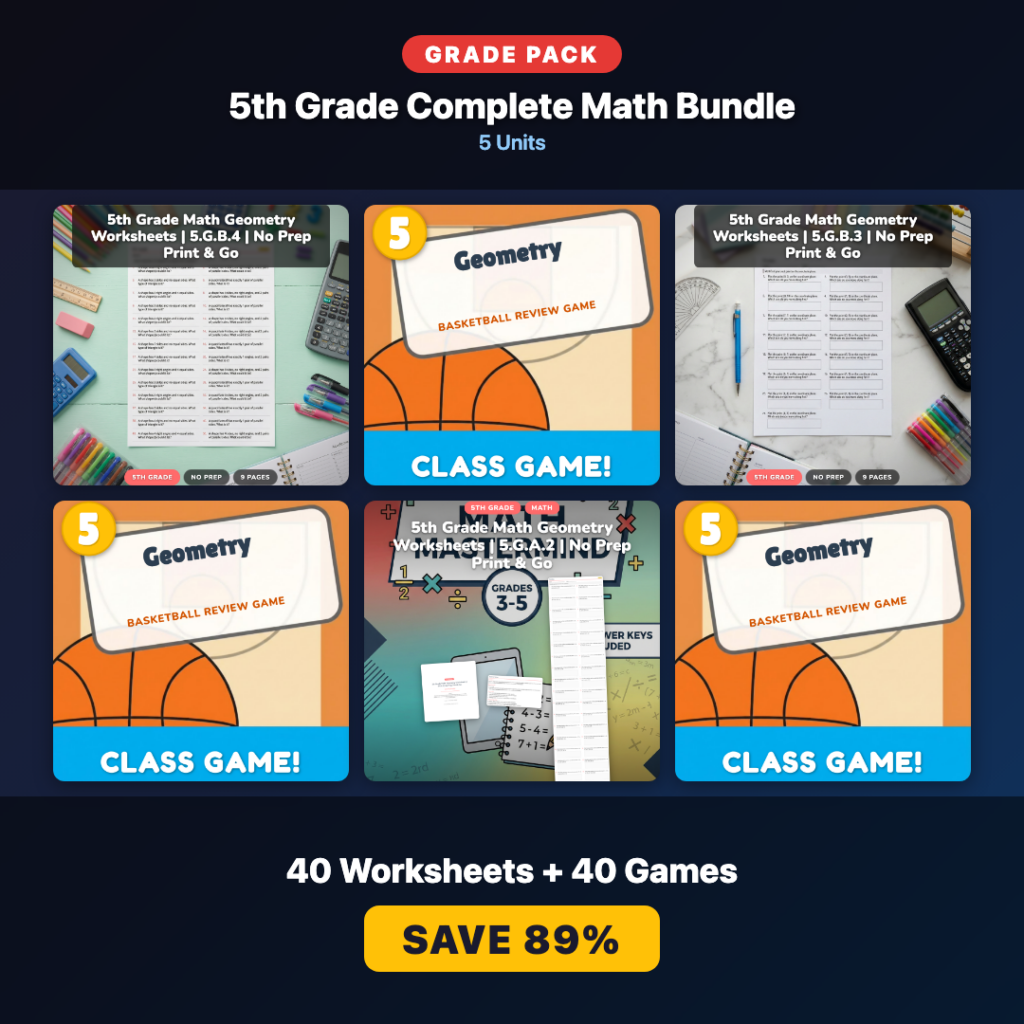
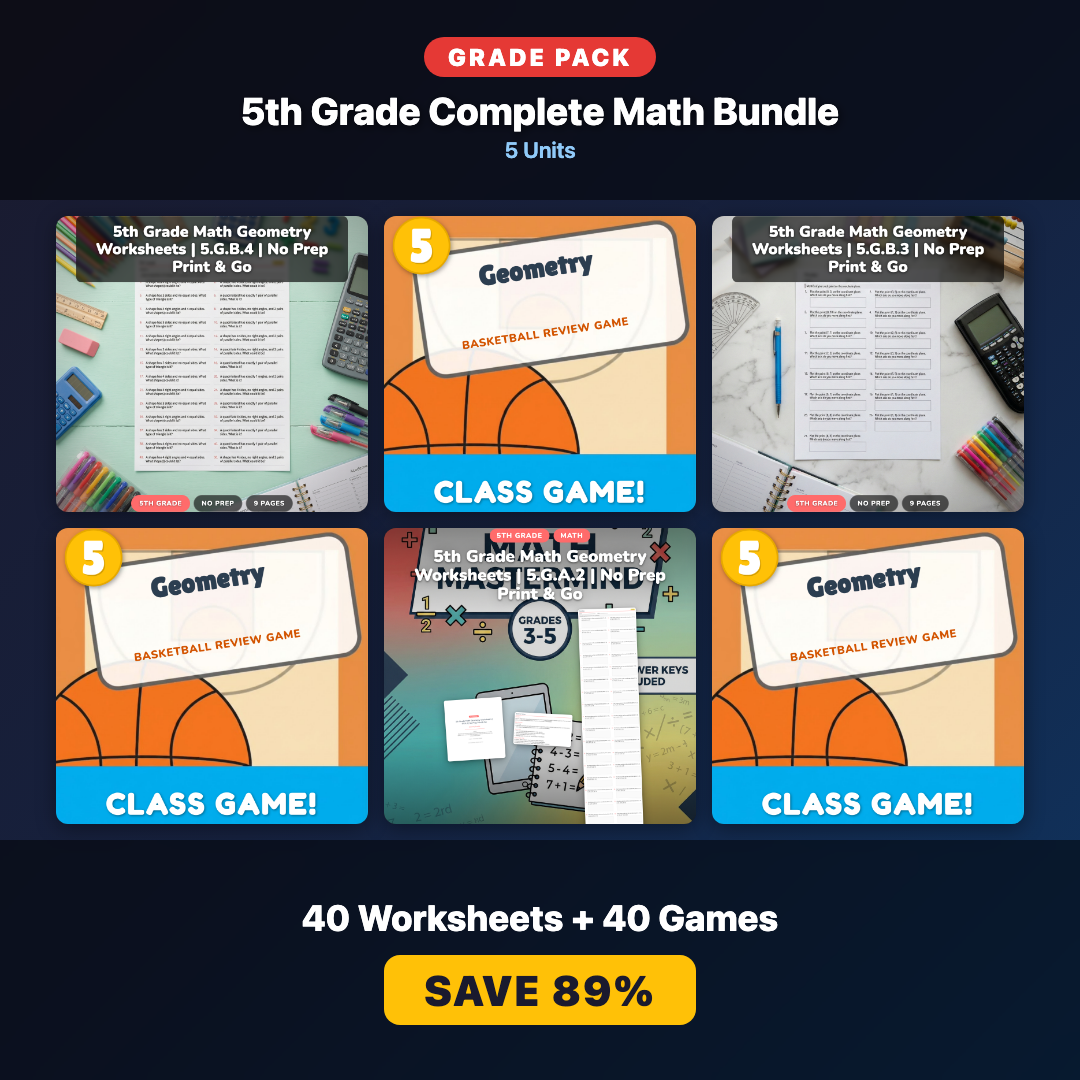
40 Differentiated Worksheet Sets
Each worksheet set targets one specific Common Core standard with three differentiation levels to meet every student’s needs. You get color PDFs for engaging visual appeal, black-and-white versions for easy copying, complete answer keys for quick grading, and Google Slides versions for digital learning. Every set includes 4-6 pages of practice problems, from basic skill building to complex application problems. With over 1,000 total pages, you have enough practice materials to last the entire school year.
40 Interactive Basketball Review Games
These HTML5 games work seamlessly on Smartboards, Chromebooks, and iPads without any downloads or installations. Each game includes three difficulty levels (beginner, intermediate, advanced) with 60+ questions per game, totaling over 2,400 practice questions across all standards. The two-team competition format gets students excited about math review while providing immediate feedback on their answers. Try the free demo game to see how engaging these reviews can be.
Bundle Savings
Purchasing these resources individually would cost $240.00, but the complete bundle is just $27.00 — that’s 89% savings and works out to only $0.68 per standard. For schools needing multiple teacher access, the school license option is available for $40.50. This investment covers your entire year of 5th grade math instruction with professional-quality resources.
5 Ways to Use This Bundle All Year Long
1. Daily Practice & Warm-Ups
Start each math block with targeted worksheet pages that review previous learning or preview new concepts. The three difficulty levels let you assign appropriate practice while students work independently, giving you time for small group instruction or individual conferences.
2. Test Prep & Review
Before unit assessments or state testing, pull up the basketball games for each standard you’re reviewing. The competitive format motivates students to engage with challenging problems while the immediate feedback helps identify areas needing additional support.
3. Math Centers & Stations
Set up Chromebook stations where students rotate through different games while other groups work on hands-on activities or teacher-led instruction. The games run independently, requiring minimal teacher management while providing meaningful practice.
4. Sub Plans
Leave a basketball game and corresponding worksheet for easy substitute coverage. The games are self-explanatory and engaging enough to keep students on task, while worksheets provide quiet practice options for different learning preferences.
5. Differentiated Small Groups
Use the three difficulty levels strategically during guided math groups. Struggling students start with beginner level worksheets and games, while advanced learners tackle challenging problems that extend their thinking beyond grade-level expectations.
Supporting Every Learner in 5th Grade Math
For Struggling Students
Start with beginner-level worksheets that include visual scaffolds and step-by-step guidance. Use the games’ immediate feedback to build confidence before moving to paper-and-pencil work. Pair struggling students with math buddies during game time to provide peer support and encouragement.
For On-Level Students
Use intermediate-level materials for independent practice and homework assignments. These students can work through most worksheet problems independently while using games for review and reinforcement. Encourage them to explain their thinking to struggling peers during collaborative activities.
For Advanced Students
Challenge advanced learners with the most difficult worksheet problems and encourage them to create their own similar problems. Use games as quick reviews before moving to extension activities that connect standards across domains, like using coordinate planes to graph fraction relationships.
Get the Complete 5th Grade Math Bundle
This comprehensive bundle eliminates the stress of planning differentiated instruction for 40 Common Core standards. You get everything needed for a full year of 5th grade math: 40 worksheet sets with three difficulty levels each, 40 interactive review games, complete answer keys, and digital versions for modern classrooms. At just $0.68 per standard, this bundle pays for itself with the time you save on planning and preparation.
Stop spending hours searching for quality math resources. Get worksheets, games, and activities for every 5th grade standard in one comprehensive download.
Want to see the quality before purchasing? Try our free demo basketball game and experience how engaging these reviews can be for your students.
Try a Free Sample First
Not ready to commit? Drop your email below and I’ll send you a free 5th grade fraction worksheet pack with three differentiation levels plus answer keys. See the quality and format before investing in the complete bundle.
Frequently Asked Questions About 5th Grade Math Resources
What standards does this bundle cover?
The bundle covers all 40 Common Core 5th grade math standards across five domains: Operations & Algebraic Thinking (3 standards), Number & Operations in Base Ten (9 standards), Number & Operations — Fractions (14 standards), Measurement & Data (10 standards), and Geometry (4 standards).
How do the basketball review games work?
These HTML5 games run in any web browser without downloads. Students choose their team, select difficulty level, and answer math questions to score points. Each correct answer moves their team closer to the basket. Games include 60+ questions with immediate feedback and work on Smartboards, Chromebooks, and iPads.
Can I use these on Chromebooks and iPads?
Yes! The basketball games are HTML5-based and work on any device with a web browser. Worksheets come in PDF format for printing and Google Slides format for digital assignments. Everything is designed for modern classroom technology including 1:1 device environments.
Is there a school license option?
Yes, the school license costs $40.50 and allows unlimited teachers at one school site to use all materials. This includes sharing with substitute teachers, specialists, and tutors. The license covers printing unlimited copies and using digital versions with any number of students.
Do the worksheets include answer keys?
Every worksheet set includes complete answer keys with step-by-step solutions where appropriate. This makes grading quick and helps you identify common student errors. Answer keys also support parent volunteers and substitute teachers who may need guidance on problem solutions.
How are the three difficulty levels different?
Beginner level includes visual scaffolds, fewer problems, and step-by-step guidance. Intermediate level matches typical grade-level expectations with standard problem formats. Advanced level includes challenging applications, multi-step problems, and extension questions that connect multiple concepts within each standard.
This complete 5th grade math bundle transforms your planning from overwhelming to organized, giving you confidence that every standard is covered with engaging, differentiated materials. Your students get the practice they need while you reclaim hours of preparation time each week.
Ready to simplify your math instruction? Try the free demo game today and see why teachers love these resources. Looking for other grade levels? Check out our 4th grade complete math bundle for seamless vertical alignment.