If your fourth graders freeze when they hear “parallel lines” or struggle to identify right triangles, you’re not alone. Teaching geometry concepts like classifying two-dimensional figures can feel overwhelming when students confuse basic properties or rely solely on visual appearance rather than mathematical attributes.
You’ll walk away from this post with five research-backed strategies that help students master CCSS.Math.Content.4.G.A.2 — plus practical tips for differentiating instruction and addressing the most common misconceptions that trip up fourth graders.
Key Takeaway
Students learn geometry best when they can manipulate physical shapes, verbalize properties, and connect visual patterns to mathematical vocabulary through structured practice.
Why 4th Grade Geometry Matters
Fourth grade geometry marks a critical shift from simply naming shapes to analyzing their properties. Students must classify two-dimensional figures based on parallel lines, perpendicular lines, and angle measurements — skills that build the foundation for middle school geometry and spatial reasoning.
The CCSS.Math.Content.4.G.A.2 standard requires students to move beyond visual recognition to mathematical classification. Research from the National Council of Teachers of Mathematics shows that students who master geometric reasoning in elementary grades perform 23% better on high school geometry assessments compared to peers who learned through rote memorization.
This standard typically appears in the spring semester, after students have solid number sense and basic fraction understanding. It connects directly to measurement standards (4.MD.C.5 and 4.MD.C.6) and prepares students for fifth grade’s coordinate geometry work.
Looking for a ready-to-go resource? I put together a differentiated 4th grade geometry pack that covers everything below — but first, the teaching strategies that make it work.
Common Geometry Misconceptions in 4th Grade
Common Misconception: A rotated square is a different shape (like a diamond).
Why it happens: Students rely on visual orientation rather than mathematical properties.
Quick fix: Use physical manipulatives to rotate shapes while counting sides and angles together.
Common Misconception: All four-sided figures are squares or rectangles.
Why it happens: Limited exposure to parallelograms, rhombi, and trapezoids in early grades.
Quick fix: Create a shape hierarchy chart showing how squares are special rectangles, rectangles are special parallelograms, etc.
Common Misconception: Parallel lines must be horizontal.
Why it happens: Most textbook examples show horizontal parallel lines.
Quick fix: Use geoboards and rubber bands to create parallel lines in all orientations.
Common Misconception: Right triangles must have the right angle at the bottom.
Why it happens: Students memorize visual patterns rather than understanding the 90-degree angle property.
Quick fix: Use corner testers (folded index cards) to check for right angles in various orientations.
5 Research-Backed Strategies for Teaching 4th Grade Geometry
Strategy 1: The Attribute Detective Game
Transform geometry classification into an engaging mystery-solving activity where students use mathematical clues to identify shapes. This strategy builds systematic thinking and reinforces the connection between properties and shape names.
What you need:
- Shape cards with various quadrilaterals and triangles
- Attribute clue cards (“has 4 equal sides,” “has 2 pairs of parallel lines”)
- Detective notebooks for recording findings
- Magnifying glasses (optional but fun)
Steps:
- Place shape cards face down on tables
- Read attribute clues one at a time (“I have exactly one pair of parallel sides”)
- Students eliminate shapes that don’t match and record their reasoning
- Continue until only one shape remains
- Reveal the mystery shape and verify properties together
Strategy 2: Geoboard Parallel and Perpendicular Construction
Hands-on construction helps students internalize the definitions of parallel and perpendicular lines while developing spatial reasoning skills. The tactile experience reinforces concepts better than worksheet practice alone.
What you need:
- Geoboards (one per student or pair)
- Colored rubber bands
- Recording sheets with dot grids
- Rulers for checking perpendicular lines
Steps:
- Start by creating one line segment with a rubber band
- Challenge students to create a parallel line using a different colored band
- Test by measuring the distance between lines at multiple points
- Create perpendicular lines using the corner of an index card to check 90-degree angles
- Build quadrilaterals by combining parallel and perpendicular line pairs
- Record successful constructions on dot grid paper
Strategy 3: Right Triangle Scavenger Hunt
Real-world connections help students recognize right triangles in various orientations and contexts. This strategy moves beyond textbook examples to develop flexible geometric thinking.
What you need:
- Corner testers (folded index cards or paper)
- Clipboards and recording sheets
- Digital cameras or tablets (optional)
- Classroom objects with triangular faces
Steps:
- Create corner testers by folding index cards to form perfect right angles
- Hunt around the classroom for triangular shapes
- Test each triangle by placing the corner tester against each angle
- Record findings: “Triangle found on _____ has/doesn’t have a right angle”
- Photograph or sketch right triangles in different orientations
- Share discoveries and discuss why orientation doesn’t change the right angle property
Strategy 4: Shape Family Tree Creation
Visual hierarchies help students understand the relationships between different quadrilaterals and how properties nest within each other. This strategy addresses the common misconception that shapes are completely separate categories.
What you need:
- Large poster paper or whiteboard space
- Shape cutouts in different sizes and orientations
- Colored markers
- Property definition cards
Steps:
- Start with “quadrilateral” at the top as the parent category
- Sort shapes into groups based on parallel line properties
- Create branches for parallelograms, trapezoids, and irregular quadrilaterals
- Continue subdividing: rectangles and rhombi under parallelograms
- Place squares at the intersection of rectangles and rhombi
- Label each level with defining properties
- Test the hierarchy by checking if shapes inherit all parent properties
Strategy 5: Geometry Talk Routine
Structured mathematical discourse helps students articulate geometric reasoning and builds academic vocabulary. Regular practice with precise language strengthens conceptual understanding and prepares students for mathematical argumentation.
What you need:
- Daily geometry warm-up slides
- Sentence frames posted on walls
- Partner talk cards
- Vocabulary word bank
Steps:
- Display a shape or set of shapes for 30 seconds
- Students use sentence frames: “I notice that…,” “This shape has…,” “I can classify this as… because…”
- Partner share using academic vocabulary (parallel, perpendicular, right angle, acute, obtuse)
- Whole group discussion with justification requirements
- Record key observations and mathematical language on anchor charts
How to Differentiate 4th Grade Geometry for All Learners
For Students Who Need Extra Support
Begin with concrete manipulatives and focus on one property at a time. Use shape sorting activities before moving to classification tasks. Provide vocabulary cards with visual examples and encourage students to trace shapes while naming properties. Pre-teach key terms (parallel, perpendicular, right angle) through hands-on exploration before formal lessons.
For On-Level Students
Practice systematic classification using the CCSS.Math.Content.4.G.A.2 requirements. Students should identify parallel lines, perpendicular lines, and right triangles in various orientations. Use mixed practice that requires justification: “How do you know this is a rectangle?” Focus on connecting visual properties to mathematical definitions.
For Students Ready for a Challenge
Extend to real-world applications and cross-curricular connections. Challenge students to find geometric properties in architecture, art, and nature. Introduce concepts like congruence and similarity. Have them create their own shape classification systems or design buildings using specific geometric requirements.
A Ready-to-Use 4th Grade Geometry Resource for Your Classroom
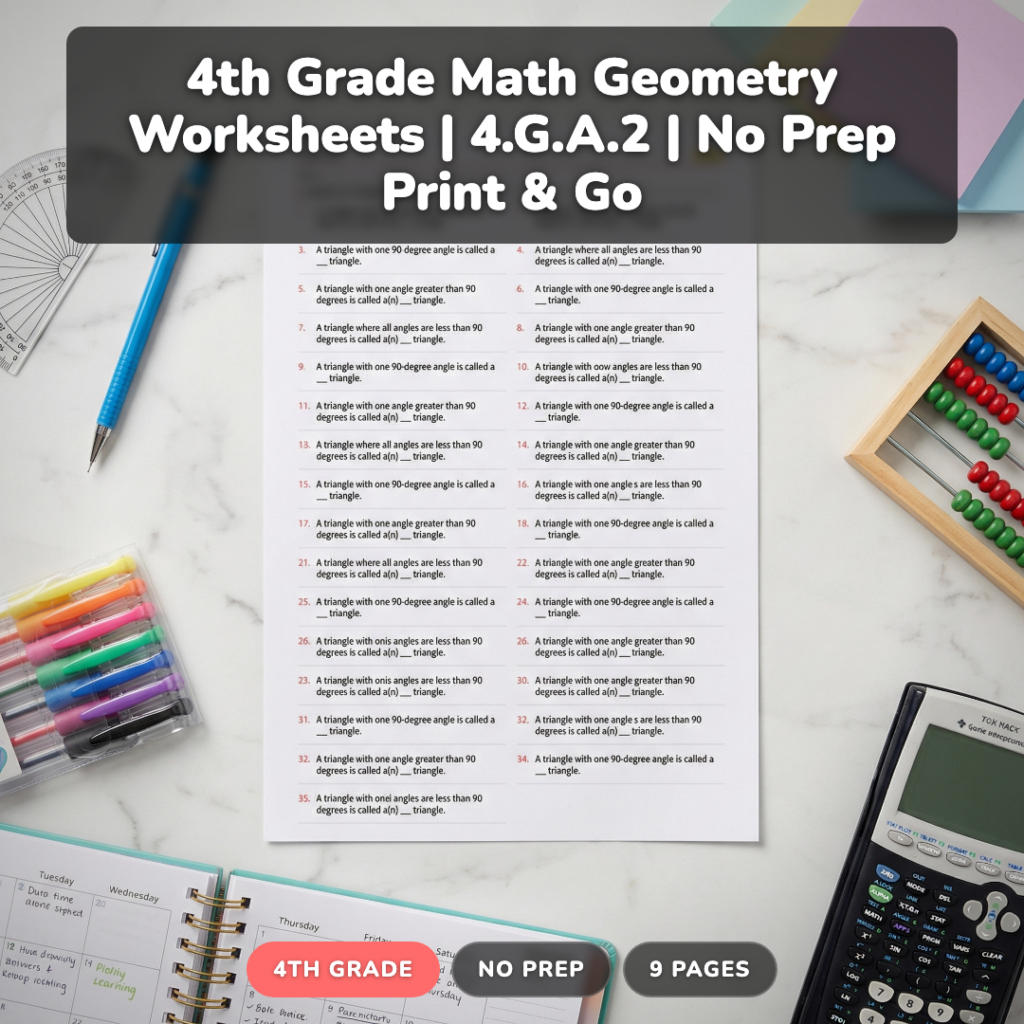
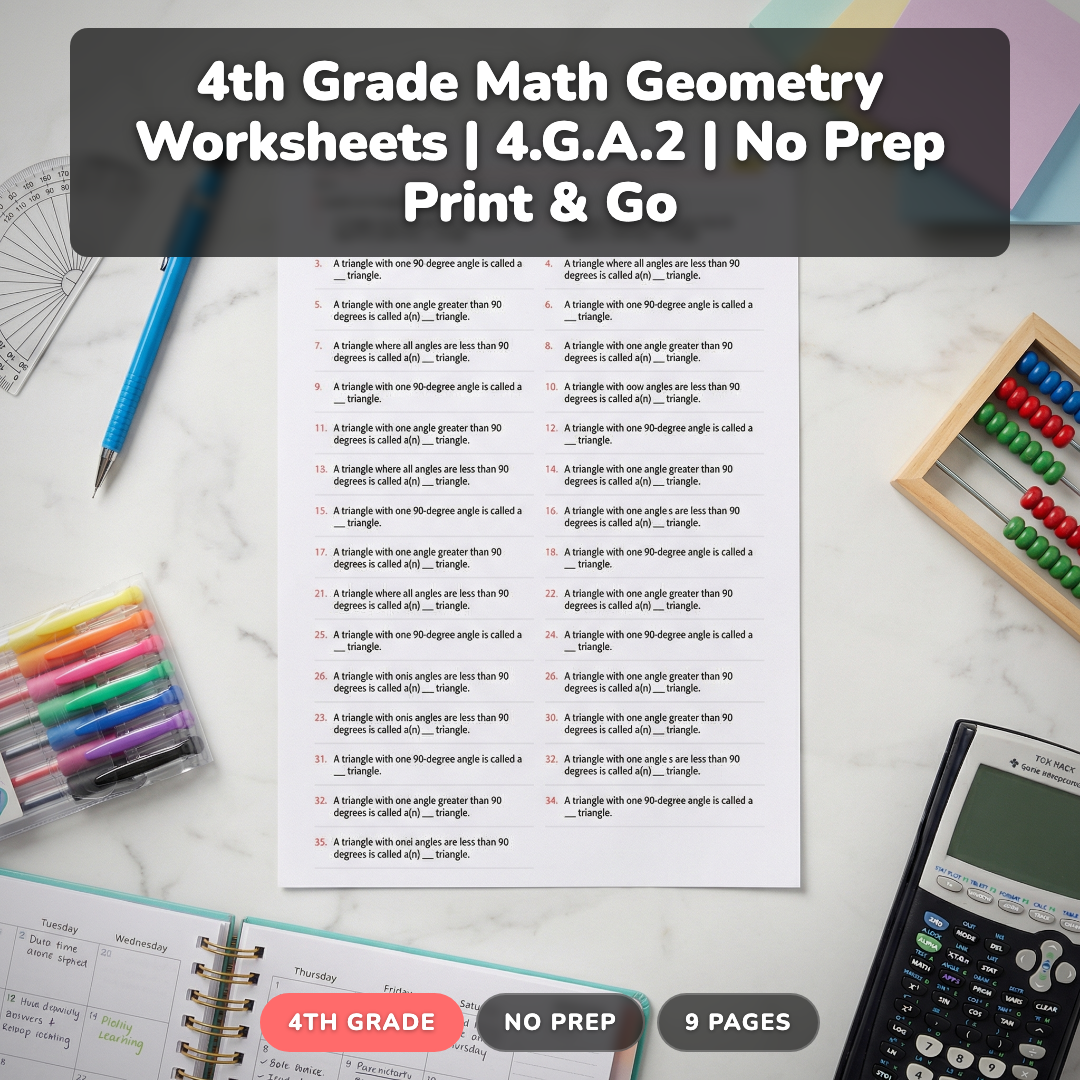
Teaching geometry classification effectively requires extensive practice with varied examples — and creating enough differentiated problems takes hours of prep time. That’s exactly why I developed this comprehensive geometry worksheet pack that covers all aspects of CCSS.Math.Content.4.G.A.2.
This 9-page resource includes 132 carefully crafted problems across three difficulty levels: 37 practice problems for students needing extra support, 50 on-level problems for grade-level expectations, and 45 challenge problems for advanced learners. Each level includes answer keys and focuses on different aspects of the standard — from basic parallel line identification to complex right triangle recognition in various orientations.
What makes this resource different is the systematic progression and real variety in problem types. Students work with shapes in multiple orientations, practice using mathematical vocabulary, and develop classification skills through structured practice that builds confidence.
Grab a Free Geometry Practice Sheet to Try
Want to see how differentiated geometry practice works? I’ll send you a free sample worksheet with problems from each difficulty level, plus an answer key and teaching tips.
Frequently Asked Questions About Teaching 4th Grade Geometry
What’s the difference between parallel and perpendicular lines that 4th graders need to know?
Parallel lines never intersect and stay the same distance apart forever. Perpendicular lines intersect at exactly 90-degree angles (right angles). Students should identify both in various orientations, not just horizontal/vertical examples.
How do I help students recognize right triangles in different orientations?
Use corner testers (folded index cards) to check for 90-degree angles regardless of position. Emphasize that the right angle property doesn’t change when the triangle rotates. Practice with triangles pointing in all directions.
What manipulatives work best for teaching 4th grade geometry concepts?
Geoboards with rubber bands, pattern blocks, and tangrams are most effective. These allow hands-on exploration of properties while building spatial reasoning. Avoid relying solely on worksheets for initial concept development.
When should I introduce the formal names for quadrilaterals like rhombus and parallelogram?
Introduce names after students understand the properties. Start with “four-sided figure with two pairs of parallel sides” before teaching “parallelogram.” This builds conceptual understanding before vocabulary memorization.
How does 4th grade geometry connect to other math standards?
Geometry connects directly to measurement standards 4.MD.C.5 and 4.MD.C.6 (angle measurement) and prepares students for 5th grade coordinate geometry. It also reinforces logical reasoning skills used throughout mathematics.
Teaching geometry classification doesn’t have to be a struggle when you have the right strategies and resources. Focus on hands-on exploration, mathematical discourse, and systematic practice to help your students master these essential skills.
What’s your biggest challenge when teaching geometry concepts? Drop your email above to grab that free practice sheet, and let me know how these strategies work in your classroom!