If your fourth graders look confused when you mention perpendicular lines or freeze when asked to identify an obtuse angle, you’re not alone. Geometry can feel abstract to 9-year-olds who are still developing spatial reasoning skills. The good news? With the right teaching strategies, you can make points, lines, angles, and their relationships click for every student in your classroom.
Key Takeaway
Fourth grade geometry success comes from connecting abstract concepts to concrete experiences through hands-on exploration, visual models, and real-world connections.
Why 4th Grade Geometry Matters
Geometry in fourth grade marks a crucial transition from basic shape recognition to understanding geometric relationships and properties. CCSS.Math.Content.4.G.A.1 requires students to draw and identify points, lines, line segments, rays, angles, and parallel/perpendicular relationships — foundational skills that support measurement, coordinate graphing, and advanced geometry concepts in later grades.
Research from the National Council of Teachers of Mathematics shows that students who master geometric vocabulary and spatial relationships in elementary school perform 23% better on high school geometry assessments. This standard typically appears mid-year, after students have developed number sense and before diving into fraction operations.
The timing is intentional: fourth graders have the fine motor skills needed for precise drawing and the cognitive development to understand abstract relationships. They can think beyond “this looks like a triangle” to “this triangle has a right angle and two perpendicular sides.”
Looking for a ready-to-go resource? I put together a differentiated 4th grade geometry pack that covers everything below — but first, the teaching strategies that make it work.
Common Geometry Misconceptions in 4th Grade
Understanding where students typically struggle helps you address confusion before it becomes entrenched. Here are the most frequent misconceptions I’ve encountered:
Common Misconception: Students think rays and line segments are the same thing.
Why it happens: Both appear as “lines” on paper, and students focus on appearance rather than mathematical definition.
Quick fix: Use arrows and endpoints consistently, emphasizing that rays “go on forever” in one direction.
Common Misconception: Students believe parallel lines must be horizontal.
Why it happens: Most textbook examples show horizontal parallel lines, creating a visual prototype.
Quick fix: Show parallel lines in all orientations — vertical, diagonal, and slanted.
Common Misconception: Students confuse acute and obtuse angles based on arm length rather than opening size.
Why it happens: They focus on how “pointy” an angle looks instead of measuring the space between rays.
Quick fix: Use angle opening gestures with arms and compare to a right angle benchmark.
Common Misconception: Students think perpendicular lines must form a “+” shape.
Why it happens: Initial examples often show intersecting lines in standard position.
Quick fix: Demonstrate perpendicular relationships in various orientations using manipulatives.
5 Research-Backed Strategies for Teaching 4th Grade Geometry
Strategy 1: Geometry Scavenger Hunt with Real Objects
Transform your classroom into a geometry laboratory where students hunt for examples of geometric elements in everyday objects. This strategy builds the critical connection between abstract concepts and concrete reality.
What you need:
- Clipboards and recording sheets
- Colored pencils or markers
- Classroom objects (books, desks, wall decorations)
- Digital camera or tablets (optional)
Steps:
- Create teams of 3-4 students with mixed ability levels
- Give each team a recording sheet with categories: points, line segments, parallel lines, perpendicular lines, right angles, acute angles, obtuse angles
- Set a 15-minute timer for the hunt around the classroom
- Students sketch or photograph examples they find
- Teams share discoveries and explain their reasoning
- Create a class anchor chart with the best examples
Strategy 2: Human Geometry with Body Movements
Kinesthetic learning makes abstract concepts memorable by engaging students’ whole bodies in geometric relationships. This approach particularly helps students who struggle with traditional paper-and-pencil geometry.
What you need:
- Open floor space
- Masking tape or yarn
- Index cards with geometry terms
- Timer
Steps:
- Students work in pairs to “become” geometric elements
- For parallel lines: partners stand arm’s length apart, facing the same direction
- For perpendicular lines: one student lies down, partner stands crossing at right angle
- For angles: students use their arms to show acute, right, and obtuse angles
- Call out terms and watch students quickly form the shapes
- Add challenge by calling combinations: “Show me two parallel lines with a perpendicular line crossing both”
Strategy 3: Geoboard Construction and Analysis
Geoboards provide the perfect bridge between concrete manipulation and abstract understanding. Students can physically create geometric elements while developing precise mathematical language.
What you need:
- Physical geoboards or virtual geoboard app
- Rubber bands in different colors
- Recording sheets for sketching
- Rulers for verification
Steps:
- Introduce each geometric element systematically, starting with points (pegs)
- Demonstrate how to create line segments by stretching bands between pegs
- Show parallel lines using same-colored bands that never intersect
- Create perpendicular lines with different colored bands meeting at right angles
- Challenge students to build specific angle types and justify their classifications
- Have students sketch their creations and label all geometric elements
Strategy 4: Angle Detective with Benchmarking
Students become angle detectives, using right angles as their benchmark to classify all other angles. This strategy builds number sense for geometric measurement and develops critical comparison skills.
What you need:
- Right angle tools (index cards, book corners)
- Angle cards or protractors
- “Detective” magnifying glasses (optional but engaging)
- Recording sheets with angle sorting categories
Steps:
- Establish right angle as the “standard” using familiar objects like book corners
- Teach the comparison method: angles smaller than right angle = acute, larger = obtuse
- Present mystery angles one at a time
- Students use their right angle tool to compare and classify
- Record findings with reasoning: “This angle is obtuse because it’s wider than my book corner”
- Progress to identifying angles within complex shapes and real-world images
Strategy 5: Geometry Art Integration Project
Combine geometry instruction with art creation, allowing students to apply their understanding while creating something beautiful and personally meaningful.
What you need:
- Large construction paper or poster board
- Rulers and straightedges
- Colored pencils, markers, or crayons
- Geometry vocabulary checklist
Steps:
- Students design original artwork that must include specific geometric elements
- Provide a checklist: 2 parallel lines, 2 perpendicular lines, 1 acute angle, 1 obtuse angle, 3 line segments, 1 ray
- Students sketch their design first, labeling all geometric elements
- Create the final artwork using rulers for precision
- Present artwork to classmates, explaining the geometric elements included
- Display with geometry labels for ongoing reference
How to Differentiate 4th Grade Geometry for All Learners
For Students Who Need Extra Support
These students benefit from concrete manipulatives and simplified vocabulary. Start with physical models before moving to drawings. Provide reference cards with visual examples of each geometric element. Use colored highlighting to distinguish different types of lines and angles. Break complex tasks into smaller steps, focusing on one geometric element at a time. Consider pairing these students with strong spatial thinkers for peer support.
For On-Level Students
These students can handle the full CCSS.Math.Content.4.G.A.1 expectations with standard support. They should practice drawing geometric elements accurately, identify multiple elements within single figures, and use precise mathematical vocabulary. Provide opportunities for independent practice with immediate feedback. Encourage them to explain their reasoning when classifying angles or identifying parallel/perpendicular relationships.
For Students Ready for a Challenge
Advanced students need extensions that deepen their understanding without moving to fifth-grade content. Challenge them to find geometric relationships in complex figures, create their own geometry problems for classmates, or explore how geometric principles apply in architecture and design. Introduce concepts like intersecting lines creating multiple angles, or have them investigate why perpendicular lines always create right angles.
A Ready-to-Use 4th Grade Geometry Resource for Your Classroom
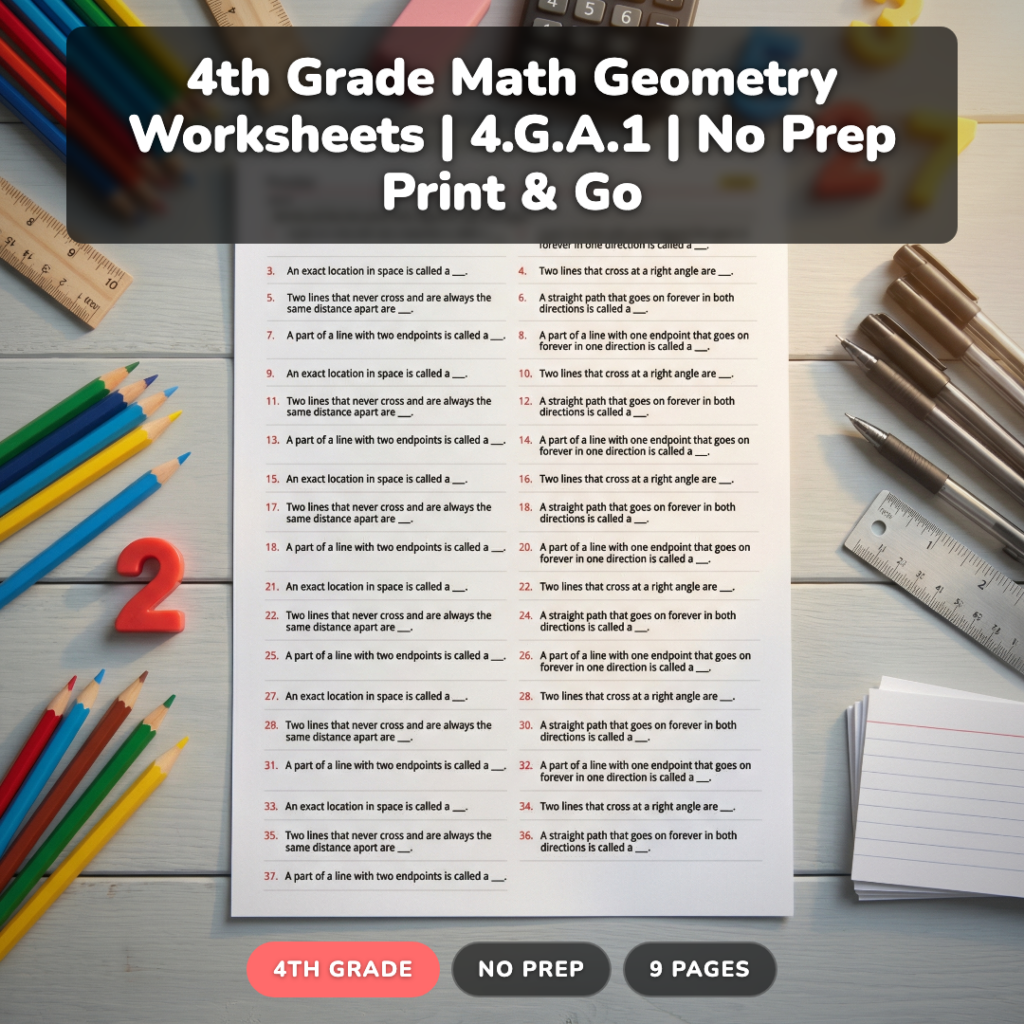
After years of creating geometry materials from scratch, I developed a comprehensive resource that addresses every aspect of CCSS.Math.Content.4.G.A.1 while saving you hours of prep time. This 9-page differentiated pack includes 132 carefully crafted problems across three difficulty levels.
The Practice level (37 problems) focuses on basic identification and drawing skills with visual supports. The On-Level section (50 problems) covers grade-level expectations with varied problem types. The Challenge level (45 problems) pushes students to apply their knowledge in complex, multi-step scenarios.
What sets this resource apart is the intentional progression within each level — students build confidence with simpler problems before tackling more complex geometric relationships. Complete answer keys save you grading time, and the no-prep format means you can use it immediately for whole group instruction, math centers, or homework.
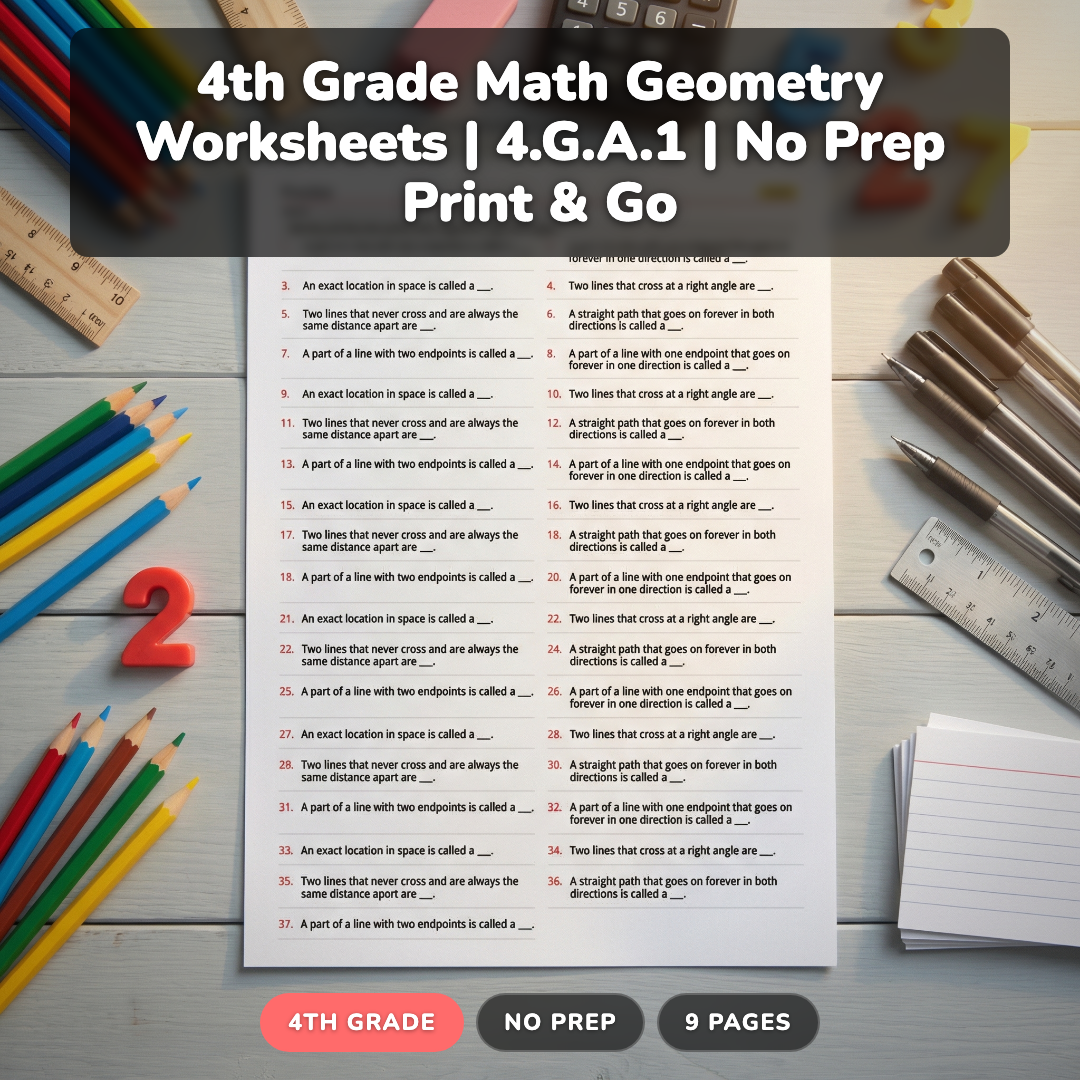
Each level includes clear directions, visual examples, and problems that spiral from basic identification to real-world application. The differentiated approach means every student in your classroom can work at their appropriate challenge level.
Grab a Free Geometry Practice Page to Try
Want to see the quality and format before committing? I’ll send you a free sample page that includes problems from each difficulty level, plus an answer key. Perfect for trying out the format with your students.
Frequently Asked Questions About Teaching 4th Grade Geometry
When should I introduce geometry vocabulary in 4th grade?
Introduce geometry vocabulary systematically throughout the unit, starting with concrete examples before abstract definitions. Begin with points and line segments in week one, add parallel and perpendicular relationships in week two, then focus on angle types in week three for optimal retention.
How can I help students remember the difference between rays and line segments?
Use consistent visual cues: always draw arrows on rays and dots on line segment endpoints. Create memorable phrases like “rays race away forever” and “segments stop at both ends.” Practice with hand gestures where students point for rays and clap for endpoints.
What’s the best way to assess 4th grade geometry understanding?
Use a combination of drawing tasks, identification activities, and verbal explanations. Have students draw examples of each geometric element, identify them in complex figures, and explain their reasoning. This multi-modal approach reveals both procedural and conceptual understanding.
Should 4th graders use protractors for angle measurement?
While CCSS.Math.Content.4.G.A.1 doesn’t require protractor use, introducing them as a tool for verification can deepen understanding. Focus on classification (acute, right, obtuse) through comparison rather than precise measurement, which is emphasized more in 5th grade standards.
How do I connect geometry to other 4th grade math topics?
Geometry naturally connects to measurement (perimeter and area), fractions (parts of circles and angles), and coordinate graphing. Use geometric shapes when teaching area concepts, and reference parallel/perpendicular relationships when introducing coordinate planes later in the year.
Teaching 4th grade geometry successfully comes down to making abstract concepts concrete through hands-on exploration and real-world connections. When students can see, touch, and create geometric elements, they develop the spatial reasoning and vocabulary needed for future math success.
What’s your favorite strategy for helping students visualize geometric relationships? Try the free sample above and see how differentiated practice can transform your geometry instruction.