Planning a full year of 4th grade math instruction across 37 different standards feels overwhelming. Between fractions that suddenly get complex, multi-step word problems, and geometry concepts that require spatial reasoning, you’re juggling five major domains while trying to differentiate for learners at every level. You need resources that cover every standard, work for every student, and save you hours of prep time.
This comprehensive guide breaks down the entire 4th grade math curriculum domain by domain, giving you specific teaching strategies for each area plus ready-to-use resources that make planning effortless. By the end, you’ll have a clear roadmap for the year and access to worksheets and review games for every single standard.
Key Takeaway
4th grade math covers 37 standards across five domains, requiring systematic instruction in fractions, multi-digit operations, measurement, geometry, and algebraic thinking.
4th Grade Math: What Students Need to Master This Year
Fourth grade marks a critical transition in mathematical thinking. Students move from concrete operations to more abstract reasoning, tackling complex fractions, multi-digit multiplication and division, and geometric concepts that require spatial visualization. The Common Core framework organizes these skills into five distinct domains, each building essential foundations for middle school mathematics.
Operations & Algebraic Thinking (5 standards) focuses on multi-step problem solving and pattern recognition. Number & Operations in Base Ten (6 standards) develops fluency with large numbers and algorithms. Number & Operations — Fractions (14 standards) — the largest domain — introduces equivalent fractions, comparison, and basic operations. Measurement & Data (9 standards) combines practical measurement with data interpretation and geometric measurement. Geometry (3 standards) explores shapes, symmetry, and angle concepts.
Students at this age (typically 9-10 years old) are developing abstract thinking skills but still benefit from hands-on manipulatives and visual representations. They can handle more independent work but need structured practice to build automaticity with new algorithms and concepts.
Need ready-to-go resources for every standard below? I put together a complete 4th grade math bundle with worksheets and review games for each one — but first, here’s your domain-by-domain guide.
Operations & Algebraic Thinking: What 4th Grade Students Learn
Operations & Algebraic Thinking in 4th grade centers on multi-step problem solving and multiplicative reasoning. Students interpret remainders in division problems, solve multi-step word problems using the four operations, and identify arithmetic patterns including those that follow given rules.
Multi-Step Problem Solving: Building Mathematical Reasoning
Key standards include CCSS.Math.Content.4.OA.A.3 (multi-step word problems) and CCSS.Math.Content.4.OA.A.2 (comparison problems using multiplication and division). Students learn to break complex problems into smaller steps and choose appropriate operations.
The biggest challenge students face is determining which operation to use when problems involve multiple steps. They often want to use every number given or struggle to identify the hidden question in two-step problems. Worksheets with guided practice help students recognize problem types, while interactive games reinforce operation selection through immediate feedback.
Factor pairs and prime/composite numbers (CCSS.Math.Content.4.OA.B.4) introduce number theory concepts that connect to fraction work later in the year. Students need plenty of practice with arrays and factor rainbows to visualize these relationships.
Number & Operations in Base Ten: What 4th Grade Students Learn
Number & Operations in Base Ten develops fluency with large numbers and standard algorithms. Students read and write multi-digit numbers, compare them using place value understanding, and perform operations with numbers up to 1,000,000.
Multi-Digit Operations: Building Computational Fluency
Standards CCSS.Math.Content.4.NBT.B.4 (addition and subtraction) and CCSS.Math.Content.4.NBT.B.5 (multiplication) require students to use place value understanding and properties of operations. The standard algorithm becomes the focus, but students must understand why it works.
Rounding (CCSS.Math.Content.4.NBT.A.3) becomes more sophisticated as students round to any place value and use rounding to estimate. Many students struggle with rounding when the digit is 5 or when multiple places are affected. Visual number lines and consistent rules help build accuracy.
Long division with remainders (CCSS.Math.Content.4.NBT.B.6) often proves challenging because it combines multiple skills: multiplication facts, subtraction, and place value. Students need extensive practice with single-digit divisors before attempting more complex problems.
Number & Operations — Fractions: What 4th Grade Students Learn
Number & Operations — Fractions is the largest domain in 4th grade with 14 standards, representing a major conceptual leap. Students develop understanding of fraction equivalence, comparison, and begin adding and subtracting fractions with like denominators.
Equivalent Fractions: The Foundation for All Fraction Work
Standards CCSS.Math.Content.4.NF.A.1 and CCSS.Math.Content.4.NF.A.2 establish equivalent fractions and comparison skills. Students must understand that fractions represent equal parts of a whole and that the same quantity can be expressed multiple ways.
Mixed numbers and improper fractions (CCSS.Math.Content.4.NF.B.3c) challenge students to think about fractions greater than one. Many students struggle with the conversion process and understanding why 5/4 equals 1 1/4. Hands-on activities with circles or rectangles help make this concrete.
Adding and subtracting fractions with like denominators (CCSS.Math.Content.4.NF.B.3a and CCSS.Math.Content.4.NF.B.3b) requires students to understand that you combine or separate parts, not wholes. Common errors include adding denominators or treating fractions like whole numbers.
Decimal notation for fractions with denominators of 10 and 100 (CCSS.Math.Content.4.NF.C.6 and CCSS.Math.Content.4.NF.C.7) connects fraction and decimal understanding. Students learn that 0.3 and 3/10 represent the same quantity, laying groundwork for decimal operations in 5th grade.
Measurement & Data: What 4th Grade Students Learn
Measurement & Data combines practical measurement skills with data interpretation and introduces geometric measurement concepts. Students work with units of measurement, solve problems involving measurement, and explore angles as geometric and measurement concepts.
Unit Conversions: Connecting Real-World Applications
Standard CCSS.Math.Content.4.MD.A.1 requires students to convert between units within the same measurement system. Students learn that 1 foot equals 12 inches and apply this to solve real-world problems involving measurement.
Area and perimeter formulas (CCSS.Math.Content.4.MD.A.3) become more sophisticated as students apply them to real-world contexts. Students often confuse these concepts, so explicit instruction on when to use each formula is essential. Rectangle problems that require finding missing dimensions challenge students to work backwards from given information.
Angle measurement introduces protractors and degree units (CCSS.Math.Content.4.MD.C.5, CCSS.Math.Content.4.MD.C.6, and CCSS.Math.Content.4.MD.C.7). Students learn that angles are measured in degrees, practice using protractors, and solve problems involving angle addition and subtraction.
For detailed strategies and free resources for angle measurement, see our posts on teaching angle concepts and classification, angle measurement with protractors, and solving angle addition and subtraction problems.
Line plots with fractional data (CCSS.Math.Content.4.MD.B.4) connect measurement and fractions as students collect data, create displays, and solve problems using the information. This standard reinforces fraction concepts while developing data analysis skills.
Geometry: What 4th Grade Students Learn
Geometry in 4th grade focuses on classifying shapes, understanding symmetry, and connecting geometric concepts to real-world applications. Students analyze two-dimensional figures based on their properties and explore lines of symmetry.
Shape Classification: Moving Beyond Basic Recognition
Standards CCSS.Math.Content.4.G.A.1 and CCSS.Math.Content.4.G.A.2 require students to classify shapes based on properties like parallel sides, perpendicular lines, and specific angle types. Students move from simply naming shapes to analyzing their characteristics.
Line symmetry (CCSS.Math.Content.4.G.A.3) challenges students to identify and draw lines of symmetry in two-dimensional figures. Many students initially confuse symmetry with congruence or struggle to visualize how shapes look when folded. Hands-on activities with paper folding and mirrors help develop this spatial reasoning skill.
For comprehensive strategies and activities for geometry instruction, see our posts on drawing and identifying lines and angles in geometric figures, classifying shapes by their properties, and teaching symmetry concepts effectively.
What’s in the 4th Grade Complete Math Bundle?
37 Differentiated Worksheet Sets
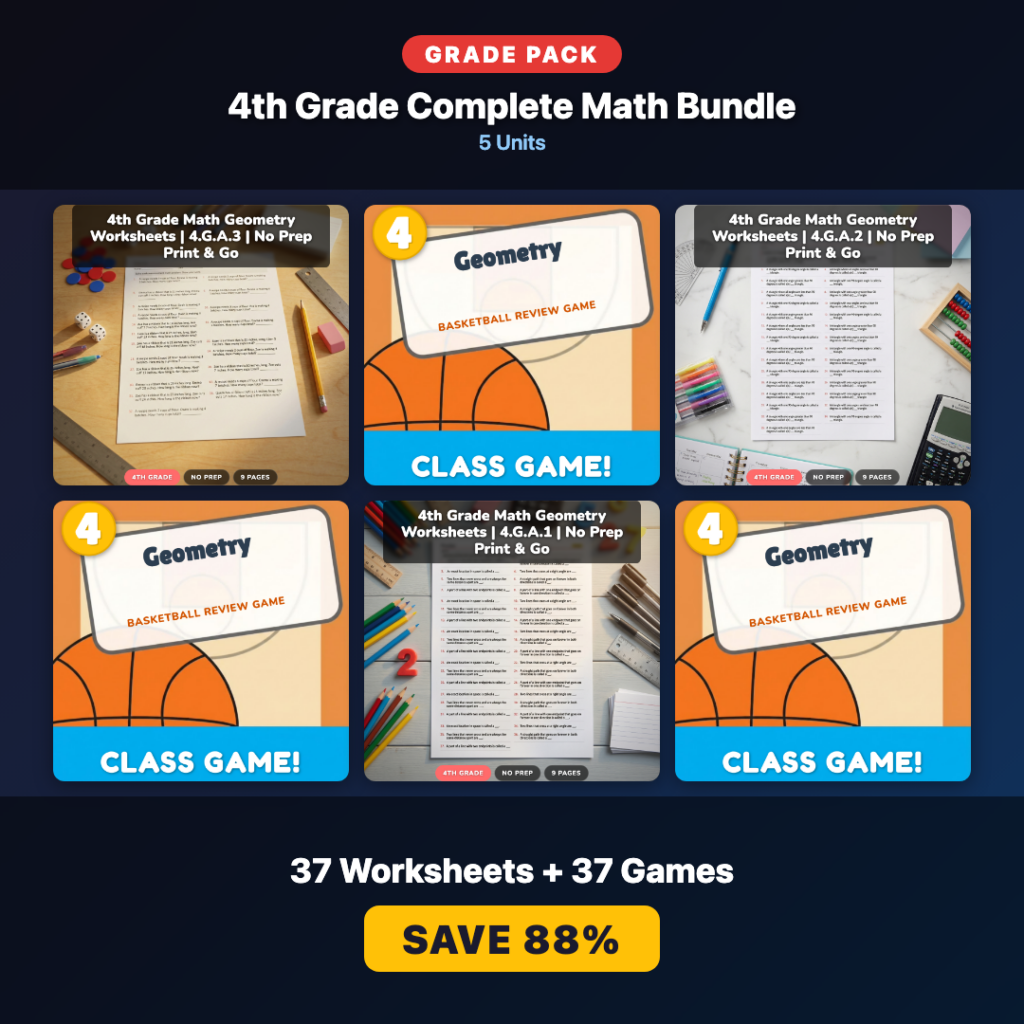
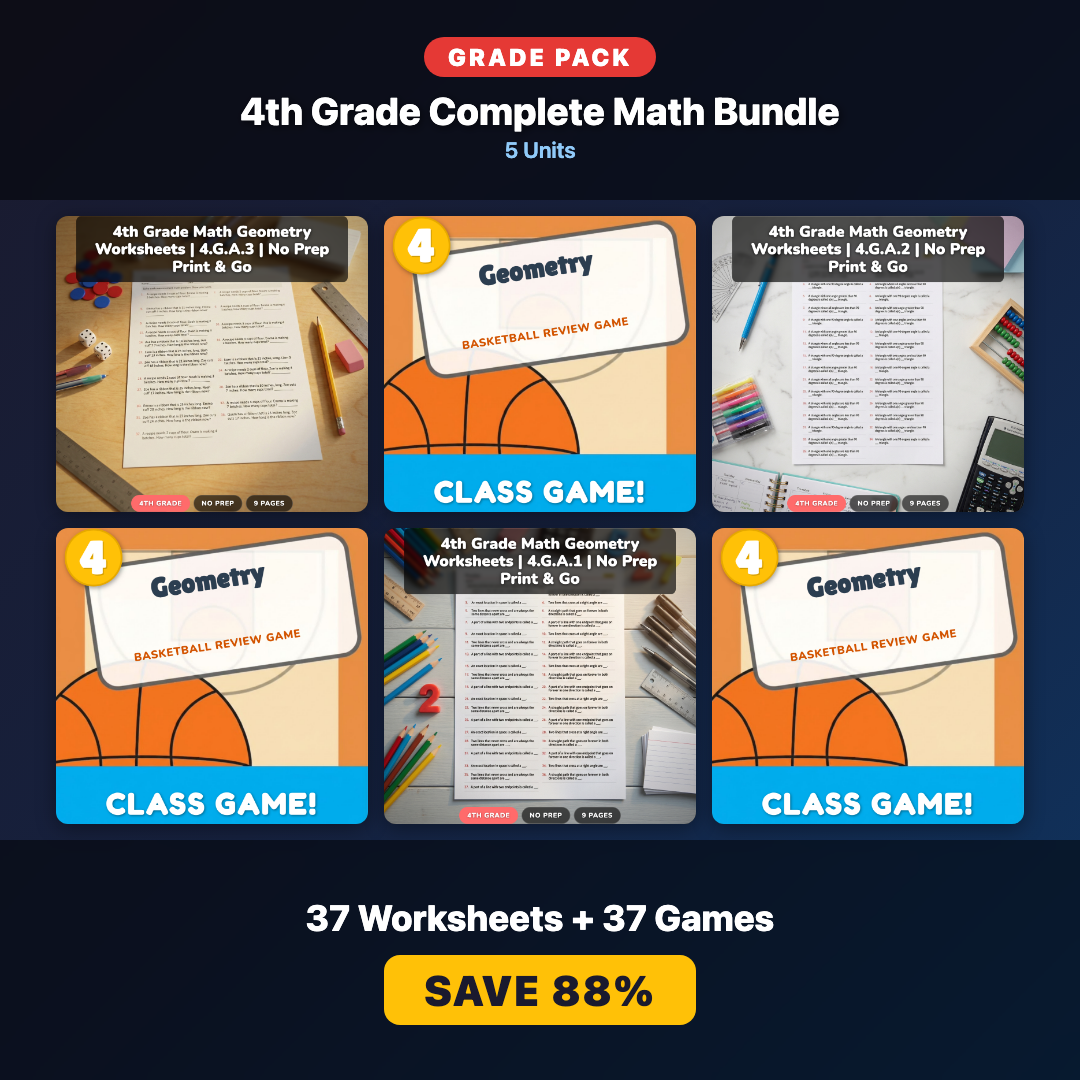
Each worksheet set covers one specific Common Core standard with three difficulty levels to meet every learner’s needs. You get the color PDF version for projection or interactive whiteboards, a black-and-white version for easy copying, complete answer keys for quick grading, and Google Slides versions for digital learning. Every set includes 6-8 pages of practice problems, from basic skill building to complex application problems. With over 999+ total pages, you have enough practice material for the entire school year plus extra review and remediation.
37 Interactive Basketball Review Games
Every standard gets its own HTML5 basketball review game that works on any device — Smartboards, Chromebooks, iPads, or computers. Each game includes three difficulty levels matching your worksheet differentiation, 2-team competition mode to boost engagement, and immediate feedback to support learning. Students answer math questions to earn basketball shots, making review time the highlight of your math block. Try the free demo game to see how they work. With 2,221+ total questions across all games, you have endless review material for test prep, math centers, or sub plans.
Bundle Savings
Purchasing each resource individually would cost $222.00, but the complete bundle is just $27.00 — that’s 88% savings and less than $0.73 per standard. The school license option at $40.50 allows unlimited use across your entire building, making it perfect for grade-level teams or math coaches. Compare that to traditional workbooks that cost $15-20 per student and only cover basic skills.
5 Ways to Use This Bundle All Year Long
1. Daily Practice & Warm-Ups
Start each math lesson with 5-10 problems from previous standards to maintain skills. The differentiated levels let you target specific student needs without creating separate materials for different groups.
2. Test Prep & Review
Use the basketball games for fun review sessions before assessments. Students stay motivated while practicing essential skills, and the immediate feedback helps identify areas needing more support.
3. Math Centers & Stations
Set up Chromebook stations with different games for independent practice. Students can work at their level while you conduct small group instruction with other learners.
4. Sub Plans
Leave a basketball game and corresponding worksheet for easy substitute coverage. The games are self-explanatory and the worksheets provide structured practice that any sub can manage.
5. Differentiated Small Groups
Use the three difficulty levels to target instruction precisely. Struggling students start with level 1 while advanced learners tackle level 3 extensions, all working on the same standard.
Supporting Every Learner in 4th Grade Math
For Struggling Students
Start with Level 1 worksheets that break skills into smaller steps with visual supports. Use manipulatives alongside the practice problems and allow extra time for the basketball games. The immediate feedback in games helps build confidence while identifying specific misconceptions to address.
For On-Level Students
Level 2 worksheets provide grade-appropriate practice with mixed problem types. Students can work independently on most activities while you support other learners. The basketball games reinforce skills while maintaining engagement through friendly competition.
For Advanced Students
Level 3 worksheets include challenge problems and multi-step applications that extend thinking. Encourage these students to explain their reasoning and make connections between different math concepts. Use the games as quick skill checks before moving to enrichment activities.
Get the Complete 4th Grade Math Bundle
Stop spending hours creating materials from scratch. This bundle gives you everything you need for a full year of 4th grade math instruction — 37 differentiated worksheet sets, 37 interactive review games, and complete coverage of every Common Core standard. Your students get engaging practice that builds real understanding, and you get your evenings back.
Get the Complete Bundle on TpT
Want to try before you buy? Check out the free demo basketball game to see how engaging these resources are for your students.
Try a Free Sample First
Not ready to commit? Drop your email below and I’ll send you a free sample worksheet pack with problems from different 4th grade domains. See the quality and differentiation for yourself before purchasing the full bundle.
Frequently Asked Questions About 4th Grade Math Resources
What standards does this bundle cover?
The bundle covers all 37 Common Core math standards for 4th grade across five domains: Operations & Algebraic Thinking, Number & Operations in Base Ten, Number & Operations — Fractions, Measurement & Data, and Geometry. Each standard gets its own worksheet set and basketball game.
How do the basketball review games work?
Students answer math questions to earn basketball shots. Correct answers result in successful shots while incorrect answers miss the basket. Games include three difficulty levels, 2-team competition mode, and work on any device with internet access. Try the free demo to see them in action.
Can I use these on Chromebooks and iPads?
Yes! The basketball games are HTML5-based and work on any device with a web browser — Chromebooks, iPads, computers, and interactive whiteboards. The Google Slides versions of worksheets work perfectly for digital assignments too.
Is there a school license option?
Absolutely! The school license costs $40.50 and allows unlimited use across your entire building. This is perfect for grade-level teams, math coaches, or schools wanting to ensure all 4th grade teachers have access to these resources.
Do the worksheets include answer keys?
Every worksheet set includes complete answer keys for quick and easy grading. You also get both color and black-and-white versions of each worksheet, plus Google Slides versions for digital use.
How much prep time will this save me?
Teachers report saving 5-8 hours per week on math planning and prep. Instead of searching for resources and creating materials from scratch, you have everything ready to print or project. The differentiated levels eliminate the need to create separate materials for different ability groups.
Teaching 4th grade math doesn’t have to consume your evenings and weekends. With one comprehensive bundle covering every standard, you can focus on what matters most — helping your students develop deep mathematical understanding. The combination of systematic practice and interactive review creates the perfect balance for building both skills and confidence.
What’s your biggest challenge with 4th grade math instruction? Share in the comments below, and don’t forget to try the free demo game to see how these resources can transform your math block. Looking for other grade levels? Check out our 3rd grade math bundle for additional resources.