If your fourth graders look at a protractor like it’s an alien artifact, you’re not alone. Teaching angle measurement is one of those skills that can make even confident math students suddenly doubt themselves. The good news? With the right strategies and plenty of hands-on practice, your students will be measuring and sketching angles like pros.
Key Takeaway
Fourth graders master angle measurement when they understand angles as turns and rotations before diving into protractor precision.
Why Angle Measurement Matters in Fourth Grade
Angle measurement sits at the intersection of geometry and measurement, making it a critical bridge skill in fourth grade mathematics. According to CCSS.Math.Content.4.MD.C.6, students must measure angles in whole-number degrees using a protractor and sketch angles of specified measure. This standard typically appears in the spring semester, after students have solid foundations in basic geometry concepts like identifying angles and understanding degrees as units of measurement.
Research from the National Council of Teachers of Mathematics shows that students who master angle measurement in fourth grade perform 23% better on geometry assessments in middle school. The skill connects directly to future work with triangles, polygons, and coordinate geometry. More immediately, it reinforces the concept that angles are measurable attributes, just like length and weight.
Looking for a ready-to-go resource? I put together a differentiated angle measurement pack with 132 problems across three levels — but first, the teaching strategies that make it work.
Common Angle Misconceptions in Fourth Grade
Understanding where students typically struggle helps you address problems before they become ingrained habits. Here are the most frequent misconceptions I see in fourth grade classrooms:
Common Misconception: Students think longer rays make bigger angles.
Why it happens: They confuse the length of the rays with the amount of opening between them.
Quick fix: Use paper fans or scissors to show that opening width, not arm length, determines angle size.
Common Misconception: Students always start measuring from the bottom of the protractor.
Why it happens: They treat protractors like rulers with a fixed starting point.
Quick fix: Practice aligning the vertex and one ray first, then finding where the second ray intersects the scale.
Common Misconception: Students confuse the inner and outer scales on the protractor.
Why it happens: Most protractors have two number scales, and students don’t know which to use.
Quick fix: Teach them to estimate first (is it acute, right, or obtuse?) to check if their measurement makes sense.
Common Misconception: Students think all angles start at 0 degrees.
Why it happens: They don’t understand that angle measurement shows the amount of rotation between two rays.
Quick fix: Use body movements to show angles as turns — quarter turn (90°), half turn (180°), three-quarter turn (270°).
5 Research-Backed Strategies for Teaching Angle Measurement
Strategy 1: Body Angle Warm-Ups
Start every angle lesson by having students become human angles. This kinesthetic approach helps students internalize that angles represent amounts of turning or rotation, not just static shapes on paper.
What you need:
- Open floor space
- Angle reference cards (30°, 45°, 90°, 120°, 180°)
- Timer
Steps:
- Have students stand with arms straight out to their sides (180° angle)
- Call out angle measurements and have them adjust their arm positions
- Start with benchmark angles: 90° (one arm up, one forward), 45° (halfway between), 30° (small opening)
- Add movement: ‘Start at 90° and turn to 120°’ to show angle measurement as rotation
- Partner check: students face each other and mirror angle positions
Strategy 2: Paper Plate Protractor Construction
Building their own protractors helps students understand how angle measurement tools work, making commercial protractors less mysterious when they encounter them.
What you need:
- Paper plates (one per student)
- Rulers
- Markers
- Brass fasteners
- Pre-marked degree templates
Steps:
- Students fold paper plates in half, then in half again to create 90° sections
- Mark the center point and draw lines to the edge at each fold
- Use the template to add 30°, 45°, and 60° marks between the 90° lines
- Attach a brass fastener at the center with a paper arrow
- Practice measuring classroom objects: door openings, book covers, scissors
- Compare measurements with commercial protractors for accuracy
Strategy 3: Angle Scavenger Hunt with Estimation
This strategy combines measurement practice with real-world application, helping students see angles everywhere while building estimation skills that support accurate protractor use.
What you need:
- Clipboards and recording sheets
- Small protractors
- Digital cameras or tablets
- Angle hunt checklist
Steps:
- Create teams of 2-3 students with mixed ability levels
- Give each team a checklist: find one acute angle, one right angle, one obtuse angle
- Students estimate each angle first, then measure with protractors
- Take photos of interesting angles for class discussion
- Record both estimates and actual measurements on data sheets
- Debrief by comparing estimates to measurements and discussing strategies
Strategy 4: Digital Angle Drawing with Feedback
Using technology allows students to sketch angles with immediate feedback, helping them develop the spatial reasoning needed for accurate angle construction without protractors.
What you need:
- Tablets or computers
- GeoGebra or similar geometry software
- Angle challenge cards
- Partner check sheets
Steps:
- Students open GeoGebra and learn to use the angle tool
- Start with challenge: ‘Draw a 45° angle’ and check measurement immediately
- Progress through angle cards: 30°, 60°, 120°, 150°
- Partners take turns: one draws, one guesses the measurement before checking
- Create angle art: designs using specific angle measurements
- Export and print favorite creations for classroom display
Strategy 5: Protractor Precision Practice with Self-Correction
This systematic approach teaches proper protractor technique while building independence through self-checking methods that don’t rely on teacher confirmation.
What you need:
- Large demonstration protractor
- Individual protractors
- Angle worksheets with answer keys
- Colored pencils
- Estimation reference chart
Steps:
- Model the three-step process: align vertex, align one ray with 0°, read where second ray crosses
- Students practice on large projected angles first, calling out each step
- Move to individual practice with immediate self-checking against answer keys
- Use colored pencils to mark vertex and rays before measuring
- Track accuracy on personal data sheets to monitor improvement
- Celebrate when students achieve 80% accuracy on 10 consecutive problems
How to Differentiate Angle Measurement for All Learners
For Students Who Need Extra Support
Start with concrete manipulatives before introducing protractors. Use angle builders with snap-together pieces, pattern blocks for creating specific angles, and plenty of estimation practice with benchmark angles (30°, 45°, 90°, 120°, 180°). Provide protractors with only one scale and clear vertex markers. Break protractor use into separate steps: first just aligning the vertex, then aligning one ray, finally reading the measurement. Allow extra time and provide pre-drawn angles for measurement practice.
For On-Level Students
These students should master the complete CCSS.Math.Content.4.MD.C.6 expectations: measuring angles in whole-number degrees and sketching angles of specified measure. Provide mixed practice with both measuring existing angles and drawing new ones. Include word problems that require angle measurement, such as finding missing angles in simple geometric figures. Use standard protractors with both inner and outer scales, teaching students to choose the appropriate scale based on their estimation.
For Students Ready for a Challenge
Extend learning by introducing angle relationships: complementary angles (sum to 90°), supplementary angles (sum to 180°), and angles around a point (sum to 360°). Challenge them to measure angles in irregular polygons, create geometric art with specific angle requirements, or solve multi-step problems involving angle measurement. Introduce reflex angles (greater than 180°) and discuss how to measure them using standard protractors.
A Ready-to-Use Angle Measurement Resource for Your Classroom
After years of teaching angle measurement, I’ve learned that students need lots of varied practice at different difficulty levels. That’s why I created a comprehensive angle measurement pack that takes the guesswork out of differentiation. The resource includes 132 problems across three carefully scaffolded levels: Practice (37 problems), On-Level (50 problems), and Challenge (45 problems).
What makes this resource different is the intentional progression. Practice level focuses on measuring angles with clear vertex markings and benchmark angles. On-Level includes both measuring and sketching angles with whole-number degrees. Challenge level adds angle relationships, multi-step problems, and real-world applications. Each level includes answer keys and can be used for centers, homework, or assessment preparation.
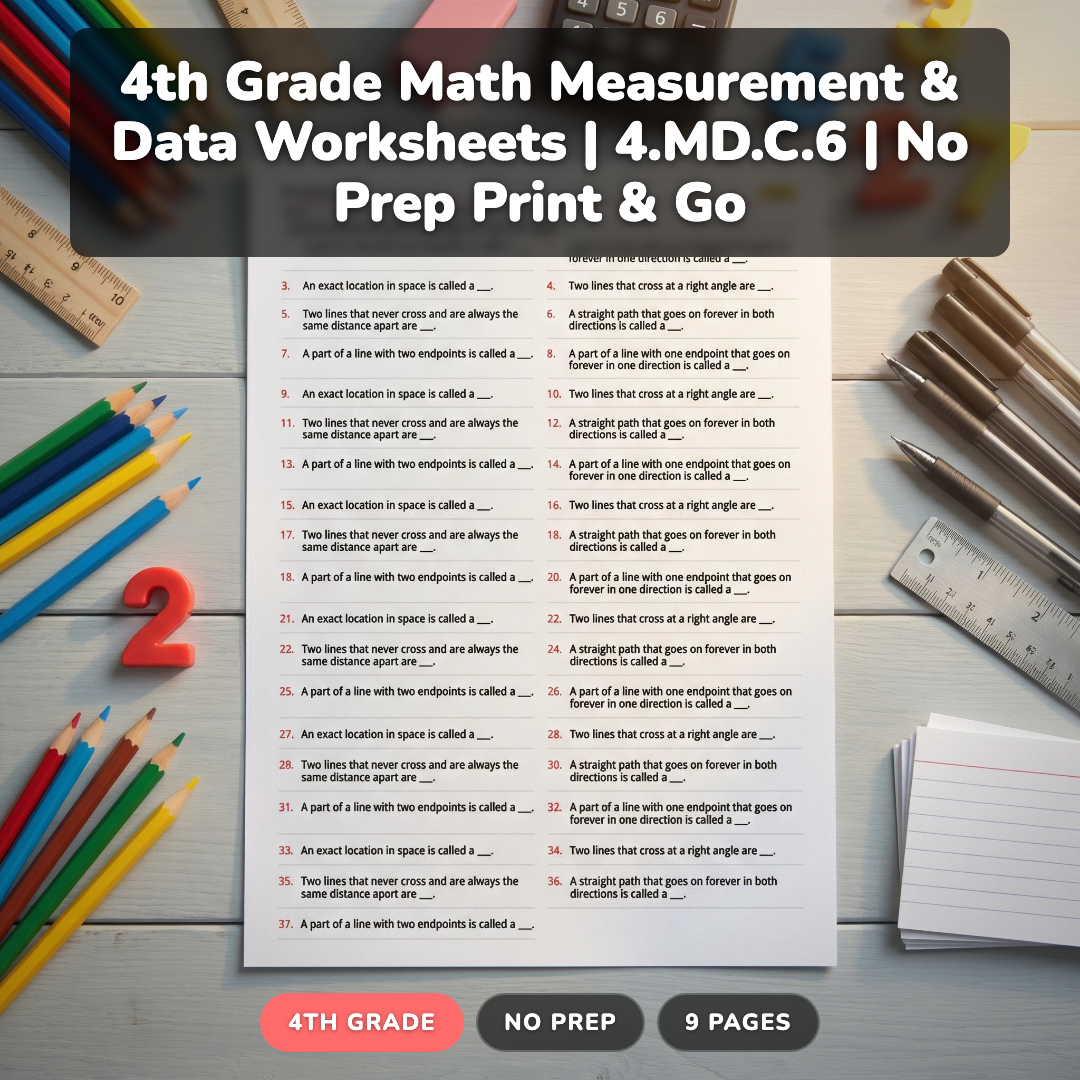
The pack covers everything you need to address CCSS.Math.Content.4.MD.C.6 with confidence, whether you’re introducing protractors for the first time or providing extra practice for struggling students. At 9 pages total, it’s substantial enough for multiple weeks of practice but focused enough to avoid overwhelming students.
Grab a Free Angle Measurement Sample to Try
Want to see how the differentiated approach works? I’ll send you a free sample with one problem from each level, plus my protractor tips reference sheet that students can keep at their desks. Drop your email below and I’ll send it right over.
Frequently Asked Questions About Teaching Angle Measurement
What’s the best type of protractor for fourth graders?
Clear plastic protractors with large, easy-to-read numbers work best. Avoid protractors with both inner and outer scales until students master basic measurement. The 6-inch size provides good precision without being unwieldy for small hands.
Should I teach angle sketching before or after measurement?
Start with measurement using pre-drawn angles, then move to sketching. Students need to understand what different angle sizes look like before they can accurately draw them. Estimation practice bridges both skills effectively.
How do I help students who consistently read the wrong scale?
Teach estimation first. If they estimate 45° but read 135°, they’ll know something’s wrong. Use protractors with only one scale initially, or cover one scale with tape until they’re confident with the process.
What prerequisite skills do students need before learning protractor use?
Students should identify acute, right, and obtuse angles, understand that angles are formed by two rays sharing a vertex, and have experience with benchmark angles (90°, 180°). Number line skills for reading measurements are also essential.
How much practice time should I plan for angle measurement mastery?
Most students need 2-3 weeks of daily practice, starting with 10-15 minutes of hands-on activities and building to independent practice. Struggling students may need additional small-group instruction and extended practice time.
Teaching angle measurement doesn’t have to feel like an uphill battle. When you start with concrete experiences, build estimation skills, and provide plenty of differentiated practice, students develop both the conceptual understanding and procedural fluency they need for success. Remember to grab your free angle measurement sample above — it’s a great way to test these strategies with your students before diving into the full unit.
What’s your biggest challenge when teaching angle measurement? I’d love to hear about your experiences and any creative strategies you’ve discovered in your classroom.