If your second graders can count to 100 but freeze when you ask them to explain why 34 + 28 = 62, you’re not alone. Understanding place value and explaining mathematical reasoning are two very different skills — and CCSS.Math.Content.2.NBT.B.9 requires both.
This post breaks down exactly how to teach students to explain their thinking about addition and subtraction strategies using place value concepts. You’ll get five research-backed strategies, differentiation tips, and solutions to the most common misconceptions that trip up second graders.
Key Takeaway
Students master place value reasoning when they can connect concrete manipulatives to abstract number strategies through guided practice and mathematical discourse.
Why Place Value Reasoning Matters in 2nd Grade
The CCSS.Math.Content.2.NBT.B.9 standard asks students to do more than just get the right answer — they must explain WHY their addition and subtraction strategies work using place value understanding. This cognitive leap from procedural fluency to conceptual reasoning sets the foundation for all future math learning.
Research from the National Council of Teachers of Mathematics shows that students who can articulate their mathematical thinking score 23% higher on problem-solving assessments. Place value reasoning typically develops between January and April of second grade, after students have solid number recognition and basic addition facts.
This standard connects directly to CCSS.Math.Content.2.NBT.A.1 (understanding place value) and CCSS.Math.Content.2.NBT.B.5 (fluently adding within 100). Students need to understand that the digit 4 in 34 represents 4 ones, while the 3 represents 3 tens, before they can explain why breaking apart numbers makes addition easier.
Looking for a ready-to-go resource? I put together a differentiated place value reasoning pack that covers everything below — but first, the teaching strategies that make it work.
Common Place Value Misconceptions in 2nd Grade
Understanding student misconceptions helps you address them before they become deeply rooted. Here are the four most common errors second graders make when explaining place value strategies:
Common Misconception: Students say “I added the big numbers first” instead of identifying tens and ones.
Why it happens: They focus on visual size rather than place value position.
Quick fix: Use base-ten blocks consistently and require students to name “tens” and “ones” explicitly.
Common Misconception: Students think regrouping “makes new numbers appear.”
Why it happens: They don’t understand that 10 ones equals 1 ten — same amount, different form.
Quick fix: Trade 10 individual blocks for 1 ten-rod repeatedly until the equivalence clicks.
Common Misconception: Students explain strategies by restating the algorithm instead of the reasoning.
Why it happens: They memorize steps without understanding the mathematical principles.
Quick fix: Always ask “Why does that work?” and require them to reference tens and ones in their explanation.
Common Misconception: Students think you can only solve problems one “right” way.
Why it happens: Traditional math instruction emphasized single methods over flexible thinking.
Quick fix: Show multiple strategies for the same problem and celebrate different approaches that work.
5 Research-Backed Strategies for Teaching Place Value Reasoning
Strategy 1: Think-Aloud with Base-Ten Blocks
Model your mathematical thinking out loud while manipulating concrete materials. This strategy builds the connection between physical actions and verbal explanations that students need for CCSS.Math.Content.2.NBT.B.9.
What you need:
- Base-ten blocks (ones cubes and tens rods)
- Document camera or magnetic blocks for whole-group viewing
- Chart paper for recording thinking
Steps:
- Present a problem like 27 + 35 with blocks visible
- Say: “I have 2 tens and 7 ones, plus 3 tens and 5 ones”
- Physically separate tens and ones while counting aloud
- Combine like groups: “2 tens plus 3 tens makes 5 tens”
- Continue: “7 ones plus 5 ones makes 12 ones”
- Trade 10 ones for 1 ten: “12 ones is the same as 1 ten and 2 ones”
- Conclude: “5 tens plus 1 ten plus 2 ones equals 6 tens and 2 ones, or 62”
Strategy 2: Number Talk Discussions
Structured conversations where students share and compare different solution strategies build mathematical discourse skills while reinforcing place value concepts.
What you need:
- Whiteboard or chart paper
- Different colored markers
- Timer (5-10 minutes per discussion)
Steps:
- Present one problem: 48 – 23
- Give students 2 minutes of silent think time
- Ask: “Who solved this a different way?”
- Record each strategy visually on the board
- For each method, ask: “Why does this work?”
- Guide students to identify place value in each explanation
- Connect strategies: “How are these methods similar?”
Strategy 3: Place Value Journals with Sentence Starters
Written explanations help students organize their thinking and provide assessment evidence of their reasoning skills.
What you need:
- Math journals or notebook paper
- Sentence starter anchor chart
- Colored pencils for tens/ones coding
Steps:
- Provide sentence starters: “First, I broke apart…” “The tens…” “The ones…”
- Students solve 42 + 29 using any strategy
- They write their explanation using sentence starters
- Students draw or use numbers to show their thinking
- Partners read explanations aloud and ask clarifying questions
- Revise explanations based on partner feedback
Strategy 4: Strategy Comparison Charts
Visual organizers help students analyze multiple approaches to the same problem and identify the role of place value in each method.
What you need:
- Large chart paper divided into columns
- Problem cards with multi-step solutions
- Sticky notes for student contributions
Steps:
- Create three columns: “Breaking Apart,” “Adding Up,” “Traditional Algorithm”
- Solve 56 + 37 using all three methods
- Students identify where place value appears in each strategy
- Highlight tens and ones with different colors
- Discuss: “Which method helps you see place value most clearly?”
- Students vote on their preferred method and explain why
Strategy 5: Error Analysis Activities
Examining incorrect solutions helps students identify place value misconceptions and strengthen their own reasoning skills.
What you need:
- Pre-made incorrect solutions
- Red pens for marking errors
- “Fix It” worksheets
Steps:
- Show an incorrect solution: 45 + 28 = 613 (student added 4+2=6, 5+8=13)
- Ask: “What went wrong here?”
- Students identify the place value error in pairs
- Guide discussion: “Why can’t 5 + 8 equal 13 in the ones place?”
- Students correct the solution with proper place value reasoning
- They write an explanation of what the original student should have done
How to Differentiate Place Value Reasoning for All Learners
For Students Who Need Extra Support
These students benefit from extended concrete manipulation and simplified number ranges. Start with two-digit addition without regrouping using numbers under 50. Provide base-ten blocks for every problem and use consistent mathematical vocabulary. Give sentence frames like “__ tens plus __ tens equals __ tens” to structure their explanations. Focus on one strategy at a time for at least a week before introducing alternatives.
For On-Level Students
These students work with the full range of two-digit numbers and tackle problems requiring regrouping. They should explain their thinking using mathematical vocabulary without sentence starters within 2-3 months of instruction. Encourage them to try multiple strategies for the same problem and identify which method they prefer. They can work independently on practice problems and check their reasoning with partners.
For Students Ready for a Challenge
Advanced students explore three-digit numbers and make connections to future learning. They can analyze why certain strategies work better for specific types of problems and create their own word problems that require place value reasoning. Challenge them to teach their strategies to struggling classmates or find patterns in when regrouping is necessary. Connect their learning to early multiplication concepts using arrays and place value.
A Ready-to-Use Place Value Reasoning Resource for Your Classroom
Teaching place value reasoning requires tons of differentiated practice problems — and creating them from scratch takes hours you don’t have. That’s exactly why I developed this comprehensive Number & Operations in Base Ten worksheet pack aligned to CCSS.Math.Content.2.NBT.B.9.
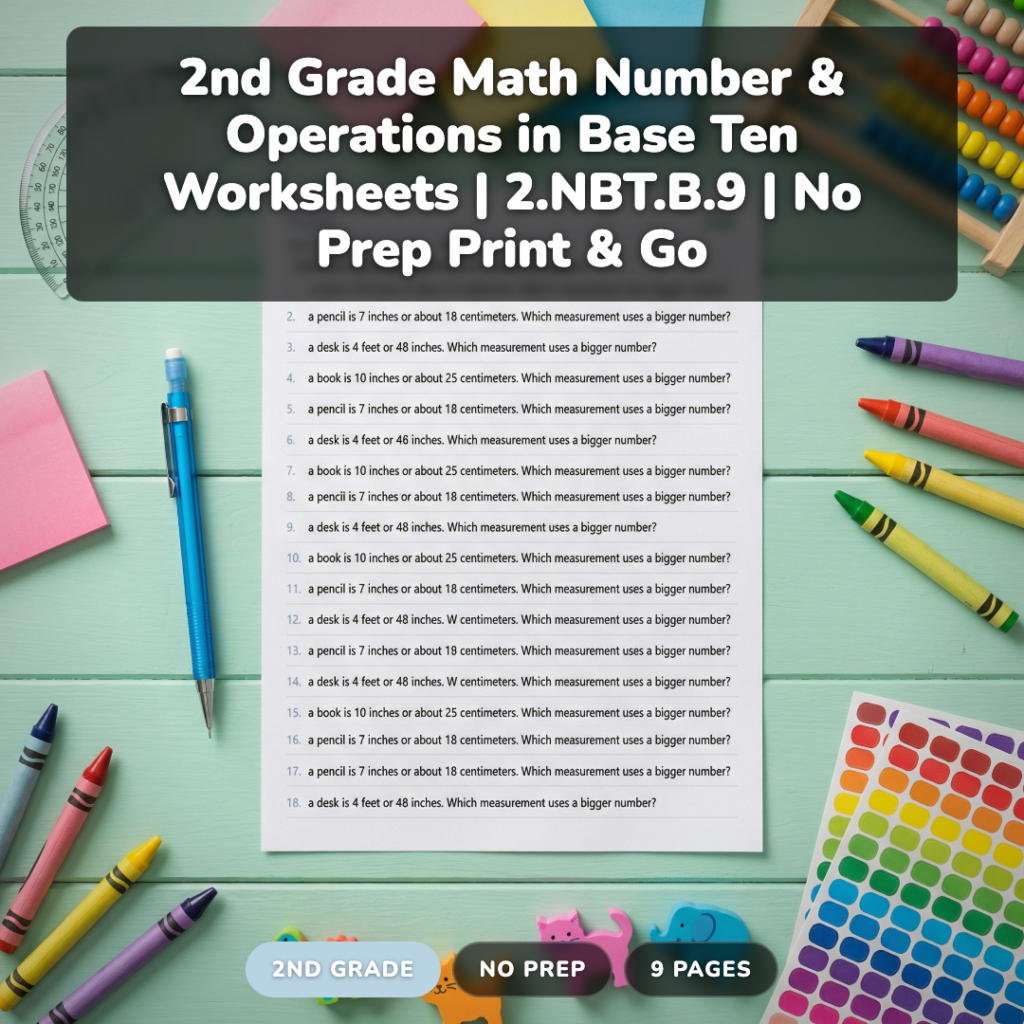
This 9-page resource includes 106 carefully crafted problems across three difficulty levels: 30 practice problems for students building foundational skills, 40 on-level problems for grade-level expectations, and 36 challenge problems for advanced learners. Each level includes answer keys and focuses specifically on explaining addition and subtraction strategies using place value reasoning.
What makes this resource different is the intentional progression from concrete to abstract thinking. Practice problems include visual supports and sentence starters, on-level problems require independent explanations, and challenge problems push students to compare multiple strategies and identify the most efficient approach.
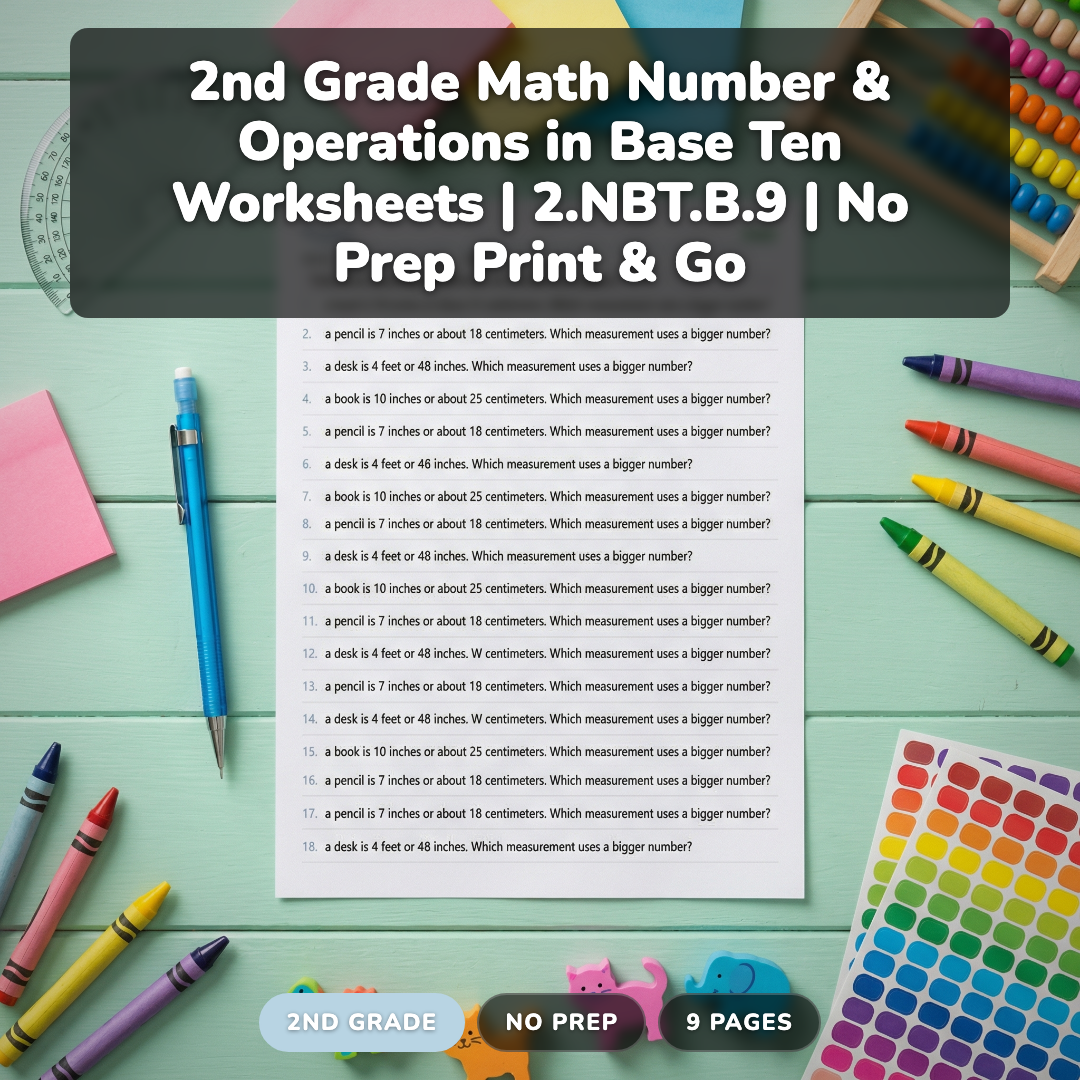
The resource saves you hours of prep time while ensuring every student gets appropriate practice with place value reasoning. Problems are formatted for easy printing and include clear directions students can follow independently.
Grab a Free Place Value Sample to Try
Want to see how these differentiated problems work in your classroom? I’ll send you a free sample with one problem from each difficulty level, plus the teaching tips that make them effective. Perfect for trying out the format before committing to the full resource.
Frequently Asked Questions About Teaching Place Value Reasoning
When should students master explaining place value strategies?
Most second graders can explain simple addition strategies by February and tackle regrouping explanations by April. Students need solid place value understanding (CCSS.Math.Content.2.NBT.A.1) before mastering CCSS.Math.Content.2.NBT.B.9. Allow 6-8 weeks of consistent practice for most students to show proficiency.
What if students can solve problems but can’t explain their thinking?
This indicates procedural fluency without conceptual understanding. Return to concrete manipulatives and require verbal explanations during every problem-solving session. Use sentence starters and think-aloud modeling until students internalize the mathematical language needed for explanations.
How do I assess place value reasoning effectively?
Use a combination of written explanations, verbal conferences, and problem-solving observations. Look for correct use of place value vocabulary, logical reasoning sequences, and ability to identify errors in others’ work. Students should demonstrate understanding across multiple strategies, not just one preferred method.
Should I teach the standard algorithm for addition and subtraction?
Focus on place value understanding first through decomposition and other strategies. The standard algorithm can be introduced after students thoroughly understand regrouping concepts, typically in late second grade or early third grade. Premature algorithm instruction often undermines place value reasoning development.
How does this standard connect to other 2nd grade math skills?
CCSS.Math.Content.2.NBT.B.9 builds directly on place value understanding (2.NBT.A.1-4) and supports fluency standards (2.NBT.B.5-8). Students use these reasoning skills in measurement, data analysis, and early multiplication concepts throughout the year.
Building Strong Mathematical Thinkers
Teaching students to explain their mathematical reasoning transforms them from answer-getters into mathematical thinkers. When second graders can articulate why their place value strategies work, they develop the foundation for algebraic thinking and problem-solving success in later grades.
What’s your biggest challenge when teaching place value reasoning? Try one of these strategies this week and let me know how it goes. And don’t forget to grab that free sample to see differentiated place value problems in action!