If your second graders freeze when you ask “Is 17 odd or even?” or randomly guess instead of using a strategy, you’re not alone. Teaching odd and even numbers seems straightforward until you realize students need concrete understanding, not just memorization. You’ll discover five research-backed strategies that build genuine number sense and make CCSS.Math.Content.2.OA.C.3 click for every student.
Key Takeaway
Students master odd and even numbers when they physically manipulate objects, see visual patterns, and connect counting by 2s to pairing — not through rote memorization.
Why Odd and Even Numbers Matter in 2nd Grade
Understanding odd and even numbers forms the foundation for algebraic thinking in elementary mathematics. This concept appears in CCSS.Math.Content.2.OA.C.3, which requires students to determine whether groups up to 20 have odd or even members through pairing or skip counting, plus write equations showing even numbers as sums of equal addends.
Research from the National Council of Teachers of Mathematics shows that students who master odd/even concepts in 2nd grade demonstrate stronger pattern recognition and algebraic reasoning in later grades. The skill typically appears in late fall or winter, after students are comfortable with numbers to 20 and basic addition facts.
This standard connects directly to CCSS.Math.Content.2.NBT.A.2 (counting by 2s, 5s, 10s) and prepares students for multiplication concepts in 3rd grade. Students need approximately 3-4 weeks of consistent practice to internalize these concepts, moving from concrete manipulation to abstract understanding.
Looking for a ready-to-go resource? I put together a differentiated odd and even practice pack that covers everything below — but first, the teaching strategies that make it work.
Common Odd and Even Misconceptions in 2nd Grade
Common Misconception: Students think odd numbers are “weird” or “bad” numbers.
Why it happens: The word “odd” has negative connotations in everyday language.
Quick fix: Use neutral language like “numbers that can pair up” versus “numbers with one left over.”
Common Misconception: Students memorize “2, 4, 6, 8 are even” without understanding why.
Why it happens: They’re taught to recite patterns instead of exploring the underlying structure.
Quick fix: Always start with physical objects before introducing number patterns.
Common Misconception: Students think larger numbers can’t be odd or even.
Why it happens: They only practice with single-digit numbers during initial instruction.
Quick fix: Include teen numbers from the beginning, emphasizing the ones digit pattern.
Common Misconception: Students confuse “pairing” with “grouping” and make groups of 3 or 4.
Why it happens: They haven’t internalized that pairs always mean groups of exactly 2.
Quick fix: Use consistent language: “Find a partner for each object” rather than “make groups.”
5 Research-Backed Strategies for Teaching Odd and Even Numbers
Strategy 1: Partner Pairing with Manipulatives
Students physically pair objects to discover odd and even patterns. This concrete approach builds foundational understanding before moving to abstract concepts.
What you need:
- Counting bears, blocks, or beans (20 per student)
- Small paper plates or circles for pairing areas
- Recording sheet with numbers 1-20
Steps:
- Give students 8 counting bears and ask them to “find a partner for each bear”
- Students place pairs on separate plates or in circles
- Ask: “Did every bear find a partner?” Record results
- Repeat with different quantities, having students predict first
- Introduce vocabulary: “When everyone has a partner, we call it an even number”
- Try with 9 bears: “One bear doesn’t have a partner — this is an odd number”
Strategy 2: Number Line Hop Patterns
Students use movement and visual patterns on a number line to internalize odd/even sequences through skip counting by 2s.
What you need:
- Floor number line or tape with numbers 0-20
- Two different colored markers or sticky notes
- Chart paper for recording patterns
Steps:
- Start at 0 and have students hop by 2s: “0, 2, 4, 6, 8…”
- Place blue markers on each number they land on
- Ask: “What do you notice about these numbers?”
- Repeat starting from 1: “1, 3, 5, 7, 9…” using red markers
- Compare the two patterns: blue numbers are even, red are odd
- Test new numbers: “If I hop by 2s from 0, will I land on 15? Why not?”
Strategy 3: Ten Frame Even/Odd Visualization
Ten frames help students see the visual structure of odd and even numbers, connecting to place value understanding they’ll need in future grades.
What you need:
- Ten frames (printed or drawn)
- Two-color counters or dots
- Anchor chart paper
Steps:
- Show 6 counters in a ten frame, filling from left to right
- Ask: “Can you make pairs with these counters?” Students circle pairs
- Demonstrate: “6 makes 3 complete pairs — it’s even”
- Try 7 counters: “One counter can’t make a pair — it’s odd”
- Create class anchor chart showing ten frame examples of each
- Practice with numbers 11-20, emphasizing the ones digit pattern
Strategy 4: Even Number Equation Building
Students write equations showing even numbers as sums of equal addends, directly addressing the second part of CCSS.Math.Content.2.OA.C.3.
What you need:
- Dominoes or dot cards
- Equation recording sheets
- Connecting cubes in two colors
Steps:
- Show 8 connecting cubes arranged as 4 red + 4 blue
- Ask: “How can we write this as an equation?” (4 + 4 = 8)
- Try different arrangements: 2 + 2 + 2 + 2 = 8, or 1 + 1 + 1 + 1 + 1 + 1 + 1 + 1 = 8
- Emphasize: “Even numbers can always be written as equal groups”
- Test with odd numbers: “Can we write 7 as equal addends? Why not?”
- Students create equation collections for even numbers 2-20
Strategy 5: Real-World Odd and Even Investigations
Students apply odd/even concepts to classroom situations, building connections between mathematical concepts and daily life.
What you need:
- Classroom objects for counting
- Investigation recording sheets
- Digital camera or clipboards
Steps:
- Pose problems: “We need to pair up for partner reading. Do we have an even or odd number of students today?”
- Students count and determine if anyone will work alone
- Extend to other scenarios: “Can we share 15 crackers equally between 2 tables?”
- Create class investigations: count windows, chairs, books on a shelf
- Record findings and explain reasoning using mathematical language
- Connect back to equations: “18 students = 9 + 9, so everyone has a partner”
How to Differentiate Odd and Even Numbers for All Learners
For Students Who Need Extra Support
Begin with quantities under 10 and provide extra practice with physical pairing. Use larger manipulatives like jumbo counting bears or blocks for easier handling. Focus on the concrete experience before introducing mathematical vocabulary. Provide hundreds charts with even numbers pre-highlighted so students can see the pattern. Review counting by 2s daily as a warm-up activity.
For On-Level Students
Work with the full range of numbers 1-20 as specified in the standard. Practice both pairing objects and counting by 2s strategies. Include writing simple equations for even numbers (4 + 4 = 8). Use ten frames and number lines for visual reinforcement. Connect to real-world situations where odd/even matters, like pairing for activities or sharing equally.
For Students Ready for a Challenge
Extend patterns to numbers beyond 20, discovering that only the ones digit determines odd/even status. Explore multiple equation representations for the same even number (8 = 4 + 4 = 2 + 2 + 2 + 2). Investigate odd/even sums: What happens when you add two even numbers? Two odd numbers? One even and one odd? Connect to early multiplication concepts by showing that even numbers are always “2 groups of something.”
A Ready-to-Use Odd and Even Resource for Your Classroom
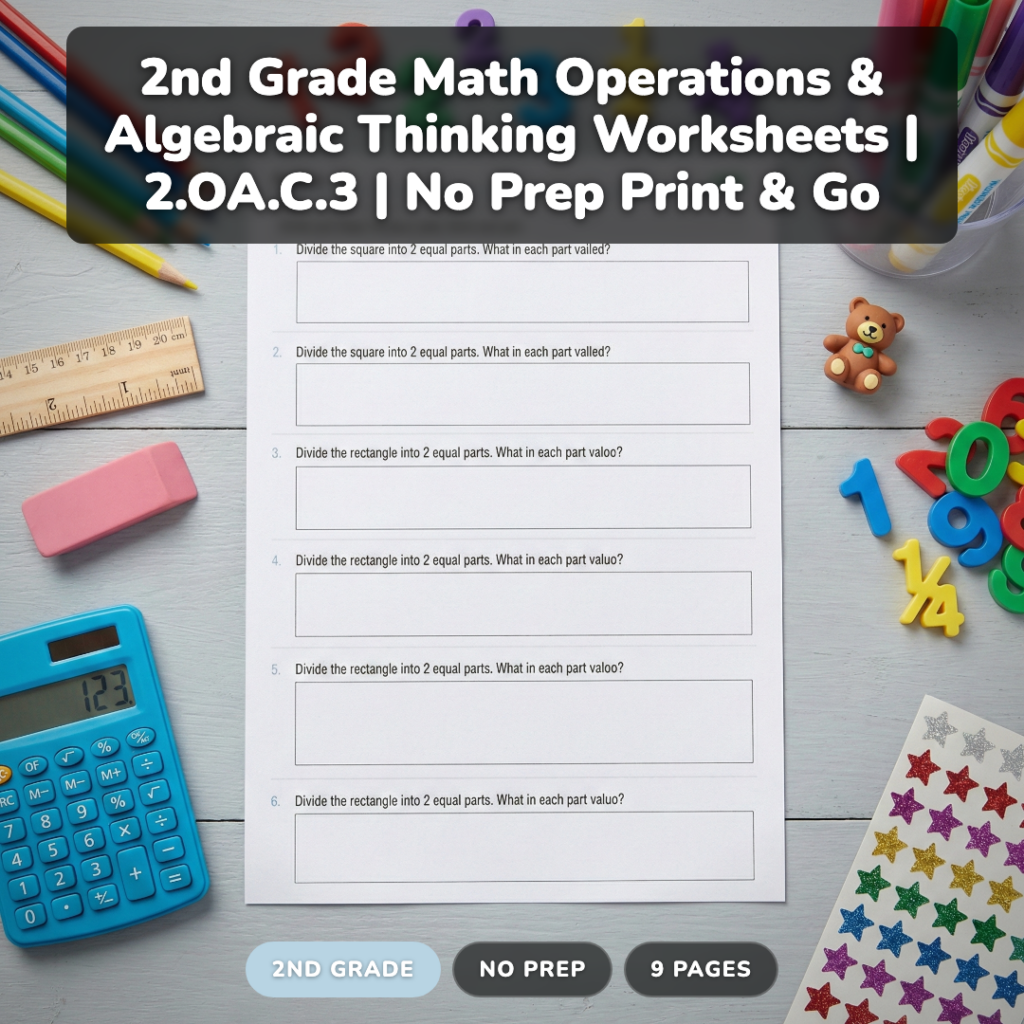
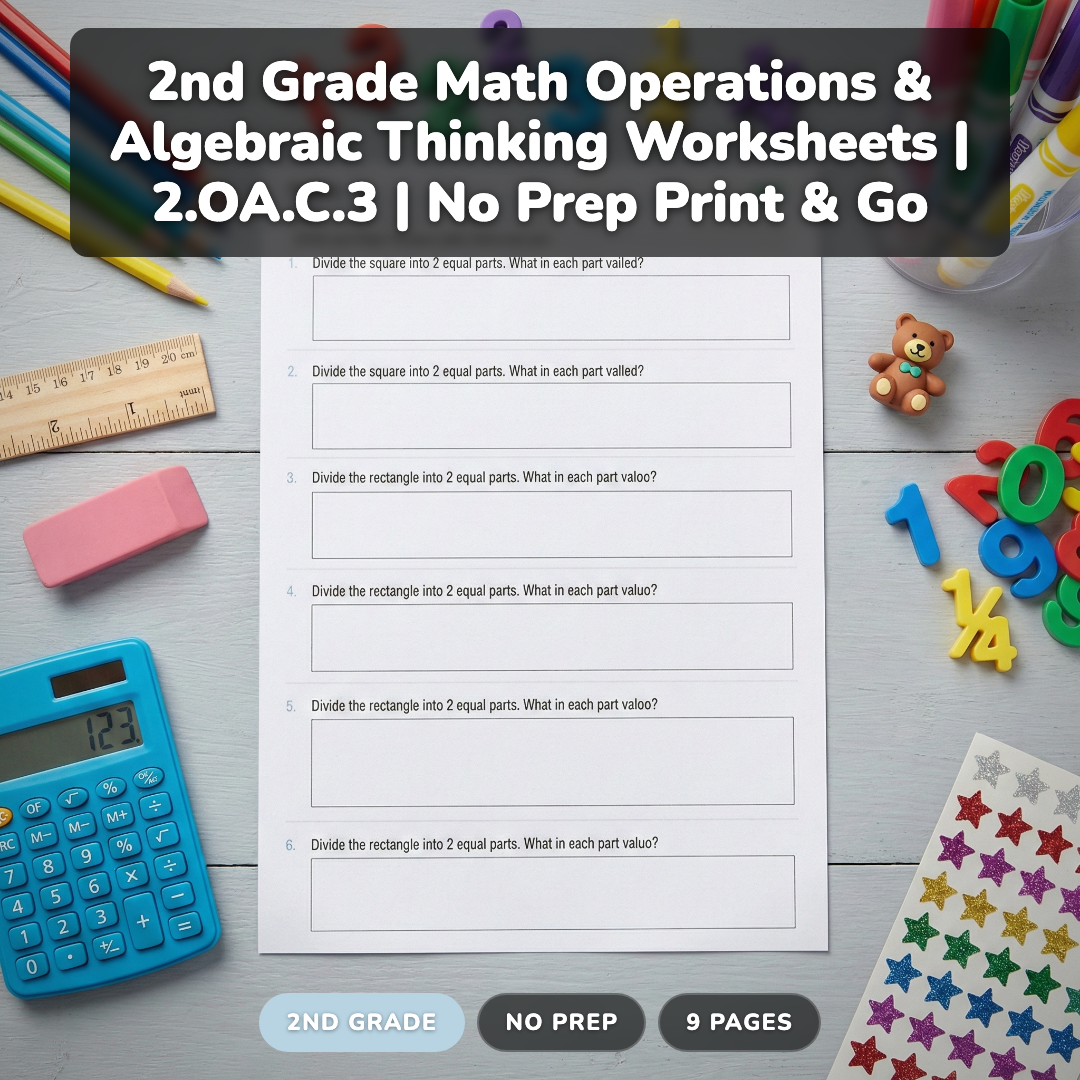
After years of creating odd and even activities from scratch, I developed a comprehensive worksheet pack that saves hours of prep time while providing the differentiated practice students need. This 9-page resource includes 106 problems across three difficulty levels: Practice (30 problems), On-Level (40 problems), and Challenge (36 problems).
What makes this resource different is the careful progression from concrete pairing activities to abstract number recognition. Students start with visual dot patterns, move to circling pairs, then identify odd/even numbers independently. The Challenge level includes equation writing and pattern extension — perfect for early finishers or advanced learners.
Each level includes answer keys and aligns directly with CCSS.Math.Content.2.OA.C.3. The no-prep format means you can print and use immediately for centers, homework, or assessment preparation.
Grab a Free Odd and Even Practice Sheet to Try
Want to see how these strategies work in practice? I’ll send you a free sample worksheet that includes pairing activities and number identification — perfect for testing these approaches with your students before diving into the full resource.
Frequently Asked Questions About Teaching Odd and Even Numbers
When should I introduce odd and even numbers in 2nd grade?
Introduce odd and even concepts after students are comfortable with numbers to 20 and can count by 2s. This typically occurs in late fall or early winter, following CCSS.Math.Content.2.NBT.A.2 skip counting skills.
Should students memorize which numbers are odd or even?
No, students should understand the concept through pairing and skip counting strategies first. Once they understand why numbers are odd or even, pattern recognition naturally follows without rote memorization.
How do I help students who confuse odd and even?
Return to concrete manipulation with physical objects. Have students physically pair items and see if any are left over. Use consistent language: “pairs” for even, “one left over” for odd.
What’s the connection between even numbers and addition equations?
Even numbers can always be written as sums of equal addends (4 + 4 = 8, 3 + 3 = 6). This builds foundation for understanding multiplication as repeated addition in 3rd grade.
How long does it take students to master odd and even concepts?
Most 2nd graders need 3-4 weeks of consistent practice to move from concrete manipulation to abstract number recognition. Provide daily warm-up activities during this period for best results.
Teaching odd and even numbers successfully comes down to giving students concrete experiences before abstract practice. Start with physical pairing, add visual patterns, then move to number recognition — your students will build genuine understanding that lasts.
What’s your favorite strategy for helping students remember odd and even numbers? Try the free practice sheet above and let me know how these approaches work in your classroom!