If your second graders stare blankly at number lines or randomly guess where numbers belong, you’re not alone. Teaching number line concepts requires more than just pointing to marks on a line. You need concrete strategies that help students visualize numbers as distances and understand how addition and subtraction work spatially.
Key Takeaway
Second graders master number lines when they start with physical movement, connect to concrete objects, and gradually build to abstract number relationships.
Why Number Lines Matter in 2nd Grade Math
Number lines form the foundation for understanding place value, addition, subtraction, and eventually fractions in later grades. CCSS.Math.Content.2.MD.B.6 specifically requires students to represent whole numbers as lengths from 0 and show addition and subtraction within 100 on number line diagrams.
Research from the National Council of Teachers of Mathematics shows that students who master number line reasoning in elementary grades demonstrate stronger algebraic thinking in middle school. The visual-spatial representation helps bridge the gap between concrete counting and abstract number relationships.
This standard typically appears in the spring semester after students have solid addition and subtraction facts within 20. Students need to understand that numbers represent quantities and that the distance between numbers remains constant on a properly scaled number line.
Looking for a ready-to-go resource? I put together a differentiated number line practice pack that covers everything below — but first, the teaching strategies that make it work.
Common Number Line Misconceptions in 2nd Grade
Common Misconception: Students count the tick marks instead of the spaces between them.
Why it happens: They focus on discrete objects rather than continuous measurement.
Quick fix: Use physical steps on a floor number line, emphasizing the journey between numbers.
Common Misconception: Students think larger numbers are always to the left because they read from left to right.
Why it happens: Reading habits interfere with mathematical directionality.
Quick fix: Connect to familiar contexts like house addresses or thermometers.
Common Misconception: Students believe all number lines start at 1 instead of 0.
Why it happens: Counting typically starts with 1 in daily life.
Quick fix: Emphasize that 0 represents the starting point before any counting begins.
Common Misconception: Students add by moving the wrong direction or counting incorrectly.
Why it happens: They haven’t internalized that addition means moving right (forward).
Quick fix: Use consistent language like ‘jump forward to add’ and ‘jump backward to subtract.’
5 Research-Backed Strategies for Teaching Number Lines
Strategy 1: Human Number Line Movement
Transform your classroom floor into a giant number line where students physically experience number relationships. This kinesthetic approach helps students internalize the spatial nature of numbers before working with paper-and-pencil tasks.
What you need:
- Masking tape or floor number line
- Number cards 0-20
- Small objects for counting
Steps:
- Create a number line on the floor using tape, marking positions 0-20
- Have students stand at 0 and take steps to reach different numbers
- Practice addition by starting at one number and taking steps forward
- Practice subtraction by starting at a number and taking steps backward
- Ask students to explain what they notice about the distances between numbers
Strategy 2: Clothesline Number Display
Create a visual number line that students can manipulate and reference throughout the day. This strategy builds number sense while serving as a permanent classroom tool for problem-solving.
What you need:
- Clothesline or string
- Clothespins
- Number cards (laminated)
- Blank cards for student additions
Steps:
- String a clothesline across one wall of your classroom
- Start with just 0, 5, and 10 attached with clothespins
- Ask students where other numbers belong and clip them in place
- Use for daily number talks: ‘What number comes between 7 and 9?’
- Add new numbers weekly as students suggest logical placements
Strategy 3: Number Line Estimation Games
Develop students’ number sense through estimation activities that require them to think about relative position and distance rather than just counting.
What you need:
- Number lines with some numbers missing
- Sticky notes
- Timer
- Number cards
Steps:
- Show a number line with only 0 and 20 marked
- Ask students to estimate where 10 belongs and place a sticky note
- Reveal the actual position and discuss how close estimates were
- Repeat with other numbers, gradually adding more reference points
- Challenge students to explain their reasoning: ‘How did you know 15 goes there?’
Strategy 4: Addition and Subtraction Jumps
Teach students to visualize addition and subtraction as movements on the number line, building the foundation for more complex operations and algebraic thinking.
What you need:
- Individual number line strips (0-20)
- Small manipulatives as ‘jumpers’
- Addition and subtraction word problems
- Colored pencils or crayons
Steps:
- Start with a simple addition problem like 5 + 3
- Show students how to place their ‘jumper’ at 5
- Count 3 jumps forward, landing on 8
- Draw arrows to show the movement and record the equation
- Repeat with subtraction, emphasizing backward movement
- Progress to word problems requiring students to identify the starting point and direction
Strategy 5: Real-World Number Line Connections
Connect number line concepts to familiar objects and situations that students encounter outside school, making the mathematical concept meaningful and memorable.
What you need:
- Photos of thermometers, rulers, measuring tapes
- Actual measuring tools
- Chart paper
- Student journals
Steps:
- Show students a thermometer and discuss how it’s like a vertical number line
- Examine rulers and measuring tapes as horizontal number lines
- Take a ‘number line walk’ around school, identifying examples (room numbers, playground equipment)
- Create a class chart of ‘Number Lines in Our World’
- Have students draw their own real-world number line examples in math journals
How to Differentiate Number Line Instruction for All Learners
For Students Who Need Extra Support
Begin with concrete manipulatives and shorter number lines (0-10). Use consistent language and provide physical models students can touch and move. Offer number lines with pre-marked intervals and use larger spacing between numbers. Review counting skills and one-to-one correspondence if needed. Provide sentence frames like ‘I start at ___ and move ___ spaces to reach ___.’
For On-Level Students
Work with number lines 0-20, progressing to 0-100 by year’s end. Practice both horizontal and vertical orientations. Include missing number activities and simple addition/subtraction within 20. Students should explain their reasoning and make connections between different number line representations. Focus on CCSS.Math.Content.2.MD.B.6 expectations for representing sums and differences within 100.
For Students Ready for a Challenge
Extend to number lines beyond 100, introduce skip counting patterns (by 2s, 5s, 10s), and explore negative numbers in context (temperature). Challenge students to create their own number line problems, work with multiple operations, and make connections to fractions using number lines divided into equal parts. Encourage them to find and explain patterns in number relationships.
A Ready-to-Use Number Line Resource for Your Classroom
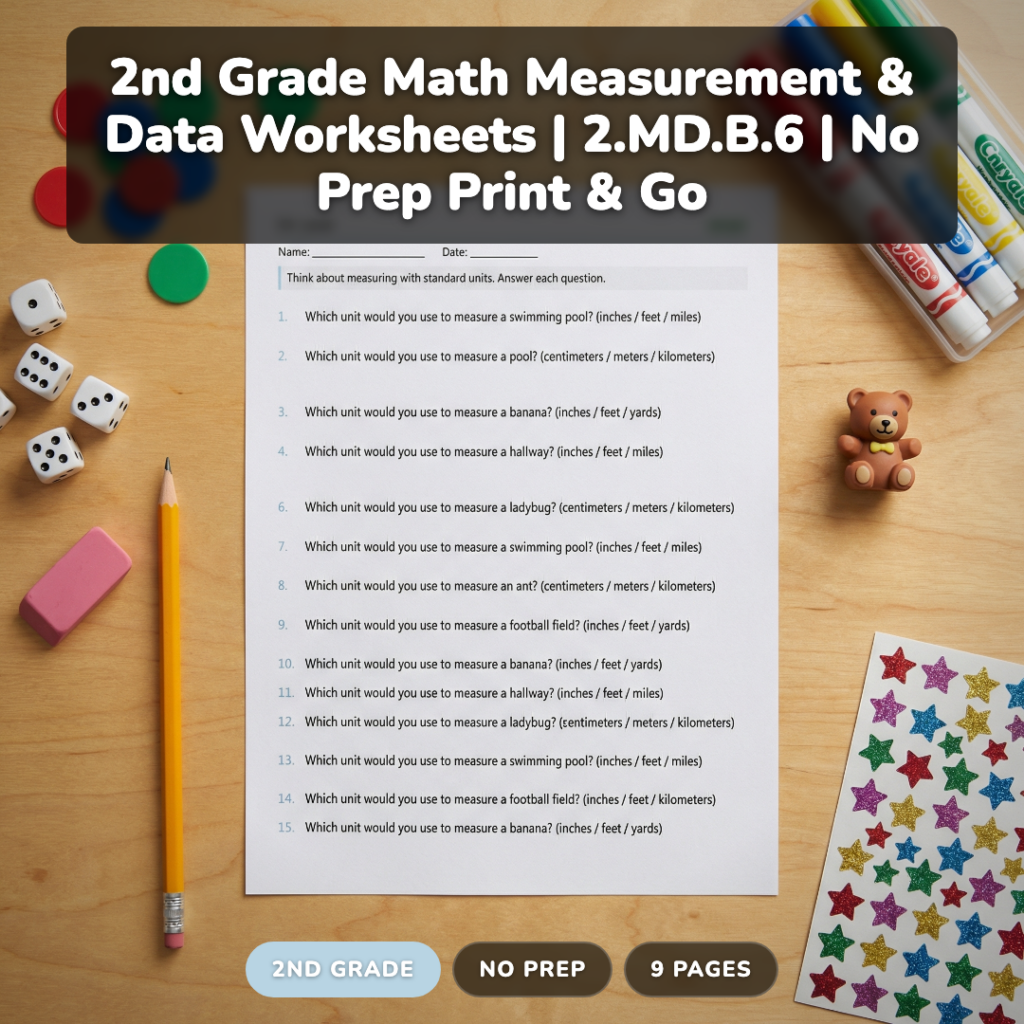
Teaching number lines effectively requires plenty of practice at different levels, which means lots of prep time creating differentiated worksheets. This number line practice pack takes care of that preparation for you, with 106 problems across three difficulty levels that align perfectly with second-grade standards.
The resource includes 30 practice problems for students building foundational skills, 40 on-level problems for grade-appropriate work, and 36 challenge problems for advanced learners. Each level focuses on representing numbers as lengths from 0 and showing addition and subtraction within 100, exactly what CCSS.Math.Content.2.MD.B.6 requires.
What makes this different from generic worksheets is the careful progression within each level and the inclusion of both number placement and operation problems. Students aren’t just filling in missing numbers — they’re solving real problems that require number line reasoning.
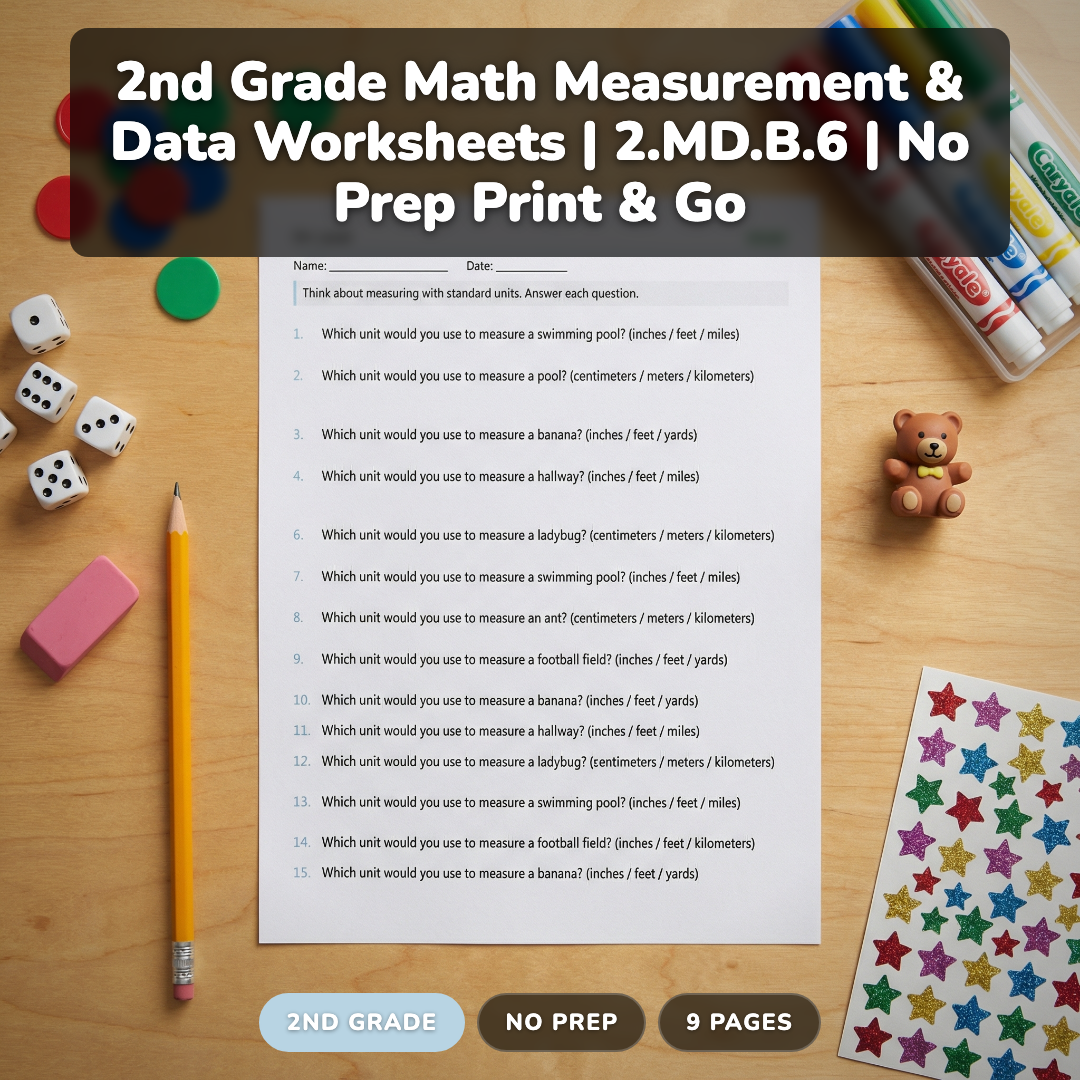
The 9-page pack is completely no-prep — just print and go. Perfect for math centers, homework, or assessment preparation.
Grab a Free Number Line Practice Sheet to Try
Want to see the quality before you buy? I’ll send you a free sample worksheet that includes problems from each difficulty level, plus answer keys. Perfect for trying out these strategies with your students.
Frequently Asked Questions About Teaching Number Lines
When should I introduce number lines in 2nd grade?
Introduce number lines after students have solid counting skills and basic addition/subtraction facts within 10. This typically happens in late fall or early spring, depending on your curriculum pacing and student readiness levels.
Should number lines always start at 0?
Yes, for 2nd grade instruction. Starting at 0 helps students understand that numbers represent distances from a reference point. Later grades will explore number lines with different starting points, but 0 provides the clearest foundation.
How do I help students who confuse addition and subtraction directions?
Use consistent directional language and physical movement. Always say ‘add means jump forward’ and ‘subtract means jump backward.’ Practice with floor number lines where students physically move their bodies before transitioning to paper activities.
What’s the difference between a number line and a ruler?
Number lines show number relationships and positions, while rulers measure length. Both use the same concept of equal intervals, but number lines focus on number sense rather than measurement units like inches or centimeters.
How can I assess student understanding of number lines?
Watch for students correctly placing numbers, explaining their reasoning, and accurately showing addition/subtraction movements. Ask them to estimate positions and justify their thinking rather than just checking final answers.
Number line mastery sets your students up for success with more complex math concepts throughout elementary school. Start with movement and concrete experiences, then gradually build to the abstract thinking that makes this such a powerful mathematical tool.
What’s your favorite way to introduce number lines to second graders? Try the free sample worksheet and see which strategies work best for your students.