If your second graders freeze when they see 347 > 259, you’re not alone. Comparing three-digit numbers is one of those skills that seems simple to adults but requires students to coordinate multiple concepts: place value understanding, digit comparison, and symbol recognition. The good news? With the right strategies, your students can master this foundational skill and build confidence for more complex math ahead.
Key Takeaway
Successful number comparison starts with solid place value understanding — students must see numbers as collections of hundreds, tens, and ones, not just isolated digits.
Why Number Comparison Matters in Second Grade
Number comparison sits at the heart of second grade mathematics. When students master CCSS.Math.Content.2.NBT.A.4 — comparing two three-digit numbers based on meanings of hundreds, tens, and ones digits using >, =, and < symbols — they're building the foundation for addition, subtraction, and number sense that will serve them through elementary school.
This standard typically appears in the second quarter of second grade, after students have developed solid two-digit number understanding. Research from the National Council of Teachers of Mathematics shows that students who struggle with number comparison often lack conceptual understanding of place value, relying instead on memorized rules that break down with larger numbers.
The comparison skill directly connects to several other second grade standards: understanding place value (2.NBT.A.1), reading and writing numbers to 1000 (2.NBT.A.3), and mental math strategies (2.NBT.B.8). Students who master comparison early show 23% better performance on end-of-year assessments, according to a 2019 study by the Institute of Education Sciences.
Looking for a ready-to-go resource? I put together a differentiated number comparison pack that covers everything below — but first, the teaching strategies that make it work.
Common Number Comparison Misconceptions in 2nd Grade
Understanding where students go wrong helps you target your instruction more effectively. Here are the most frequent misconceptions I see in second grade classrooms:
Common Misconception: Students think 95 is greater than 123 because 9 > 1.
Why it happens: They compare only the first digits without considering place value.
Quick fix: Use place value charts to show that 123 has 1 hundred while 95 has 0 hundreds.
Common Misconception: Students believe longer numbers are always bigger.
Why it happens: They confuse physical length with numerical value.
Quick fix: Show examples like 99 < 100 using base-ten blocks to demonstrate that fewer blocks can represent a larger number.
Common Misconception: Students reverse the inequality symbols, writing 45 > 67.
Why it happens: They haven’t developed a reliable strategy for remembering symbol direction.
Quick fix: Teach the “alligator mouth” or “Pac-Man” strategy — the open mouth always eats the bigger number.
Common Misconception: Students compare numbers digit by digit from right to left.
Why it happens: They apply reading patterns (left to right) incorrectly to place value comparison.
Quick fix: Explicitly teach the “hundreds first” rule with visual place value supports.
5 Research-Backed Strategies for Teaching Number Comparison
Strategy 1: Place Value Mat Comparison
This concrete strategy helps students visualize the value of each digit position. Students use physical manipulatives to build numbers before comparing them, making abstract concepts tangible.
What you need:
- Place value mats (hundreds, tens, ones columns)
- Base-ten blocks or counting bears
- Number cards
- Comparison symbol cards (>, <, =)
Steps:
- Give each student two number cards (like 245 and 238)
- Have them build both numbers using manipulatives on place value mats
- Start comparison in the hundreds column: “Do both numbers have the same hundreds?”
- If yes, move to tens; if no, determine which is greater
- Place the correct symbol between the numbers
- Practice with 5-6 number pairs per session
Strategy 2: Number Line Positioning
Visual learners benefit from seeing numbers in sequence on a number line. This strategy reinforces that numbers to the right are always greater than numbers to the left.
What you need:
- Large classroom number line (0-1000)
- Sticky notes or number cards
- Individual student number lines
Steps:
- Write two three-digit numbers on the board
- Ask students to locate both numbers on their number lines
- Have volunteers place the numbers on the classroom number line
- Discuss which number appears further right (greater value)
- Write the comparison using the appropriate symbol
- Repeat with numbers that are closer together to increase difficulty
Strategy 3: The “Hundreds First” Anchor Chart Method
This systematic approach teaches students to compare place values in order, preventing the common mistake of comparing digits randomly. Students learn a reliable process they can apply independently.
What you need:
- Anchor chart with comparison steps
- Highlighters in three colors
- Student recording sheets
Steps:
- Create an anchor chart showing: “1. Compare hundreds, 2. If same, compare tens, 3. If same, compare ones”
- Model with an example like 456 vs 423
- Have students highlight hundreds digits in one color
- Compare: 4 hundreds = 4 hundreds, so move to tens
- Highlight tens digits in a second color
- Compare: 5 tens > 2 tens, so 456 > 423
- Practice with multiple examples, verbalizing each step
Strategy 4: Number Comparison War Game
This engaging partner activity provides repeated practice in a game format. Students stay motivated while building fluency with comparison symbols and place value reasoning.
What you need:
- Deck of three-digit number cards
- Comparison symbol reference sheet
- Recording sheets for tracking wins
Steps:
- Partners sit facing each other with a deck of number cards
- Each player draws one card simultaneously
- Both players say their numbers aloud
- Together, they determine which number is greater
- The player with the greater number keeps both cards
- Play continues for 10 rounds, then count collected cards
- Debrief by discussing strategies used
Strategy 5: Real-World Number Detective
Connecting number comparison to authentic contexts helps students see the relevance of this skill. Students compare prices, distances, populations, and other meaningful numbers from their environment.
What you need:
- Grocery store flyers or catalogs
- Maps with distance charts
- Population data for local cities
- Student detective notebooks
Steps:
- Present a real scenario: “Which costs more — a $245 bike or a $289 scooter?”
- Students work in pairs to compare the numbers
- They write the comparison statement in their detective notebooks
- Share findings with the class, explaining their reasoning
- Introduce new scenarios with different contexts
- Students create their own comparison problems using real data
How to Differentiate Number Comparison for All Learners
For Students Who Need Extra Support
Begin with two-digit number comparisons to build confidence. Use concrete manipulatives extensively — base-ten blocks, counting bears, or bundled straws. Provide place value charts with clear column headers. Practice comparing numbers that differ significantly (like 156 vs 289) before moving to closer numbers. Review prerequisite skills like counting by 10s and 100s. Consider using number lines with every 10 marked for easier navigation.
For On-Level Students
Focus on three-digit numbers as outlined in CCSS.Math.Content.2.NBT.A.4. Practice with a mix of number pairs — some differing in hundreds, others in tens or ones. Include numbers with zeros in various positions (205 vs 250). Use both concrete materials and abstract symbols. Encourage students to explain their thinking using place value vocabulary. Provide independent practice with immediate feedback.
For Students Ready for a Challenge
Introduce four-digit numbers or decimal comparisons. Have students create their own comparison problems and teach them to classmates. Explore patterns in number comparison (all numbers starting with 3 are greater than numbers starting with 2). Connect to real-world applications like comparing sports statistics or scientific measurements. Challenge them to find the smallest and largest possible three-digit numbers using given digits.
A Ready-to-Use Number Comparison Resource for Your Classroom
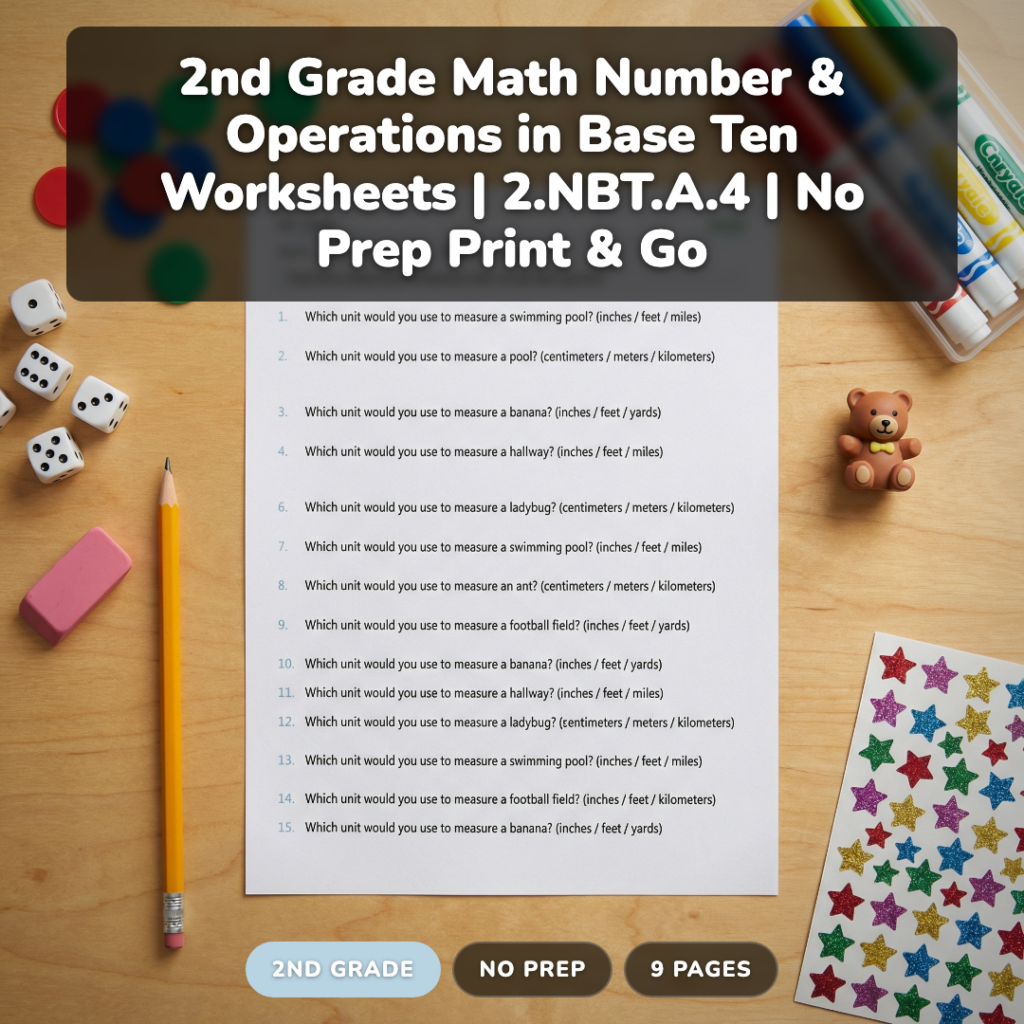
After years of creating comparison activities from scratch, I developed a comprehensive resource that saves hours of prep time while providing the differentiated practice students need. This 2nd Grade Number & Operations in Base Ten Worksheets pack includes 106 carefully designed problems across three difficulty levels.
The resource includes 30 practice problems for students building foundational skills, 40 on-level problems aligned to grade-level expectations, and 36 challenge problems for advanced learners. Each level uses the same comparison concepts but adjusts complexity — practice problems use numbers that differ significantly, while challenge problems include numbers with zeros and require deeper place value understanding.
What sets this apart is the systematic progression within each level. Problems start with concrete comparisons and gradually move toward abstract symbol use. Answer keys are included for quick checking, and the no-prep format means you can differentiate instantly based on your daily observations.
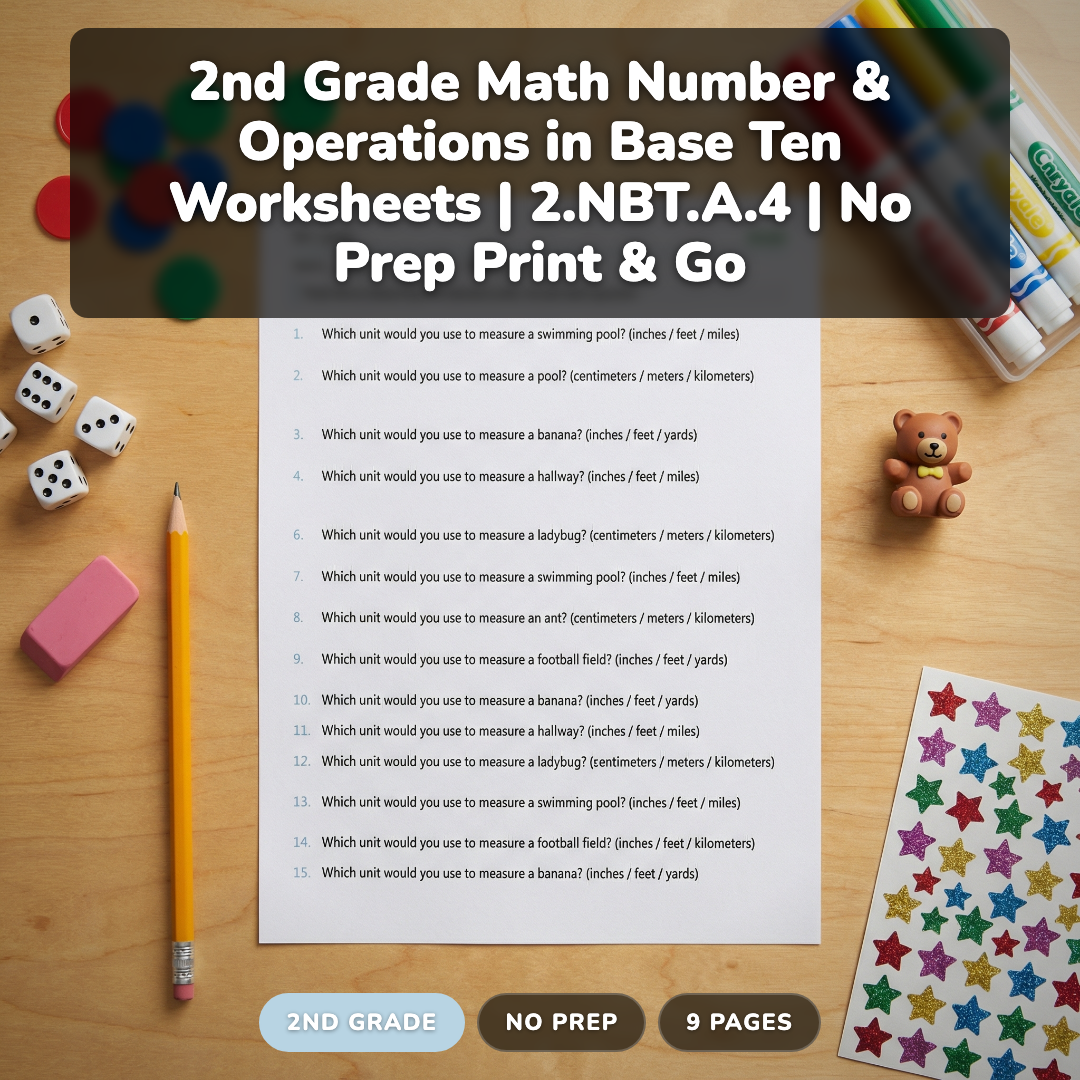
The pack covers everything from basic three-digit comparisons to complex multi-step problems, giving you flexibility to meet every student’s needs without creating multiple resources.
Grab a Free Number Comparison Sample to Try
Want to see how these strategies work in practice? I’ll send you a free sample worksheet with problems from each difficulty level, plus a quick reference guide for the “Hundreds First” method. Perfect for trying out the approach before diving in.
Frequently Asked Questions About Teaching Number Comparison
When should I introduce three-digit number comparison in second grade?
Most students are ready for three-digit comparison in the second quarter, after mastering two-digit place value. Ensure students can identify hundreds, tens, and ones in three-digit numbers before beginning comparison work per CCSS.Math.Content.2.NBT.A.4.
How do I help students remember which direction the inequality symbols point?
The “alligator mouth” strategy works best — teach students that the open mouth always “eats” the bigger number. Practice with concrete numbers first, then move to abstract symbols. Consistent daily practice for 2-3 weeks builds automatic recall.
What should I do when students compare numbers digit by digit incorrectly?
Use place value mats with physical manipulatives to show why hundreds matter most. Have students build numbers with base-ten blocks, then compare the hundreds columns first. Explicitly teach the left-to-right comparison rule with visual supports.
How can I assess if students truly understand number comparison concepts?
Ask students to explain their thinking aloud, not just write answers. Present numbers where common misconceptions would lead to wrong answers (like 95 vs 123). Students should identify place values and explain why hundreds determine the comparison.
Should second graders work with numbers beyond 999 for comparison practice?
Stick to three-digit numbers as specified in the standard. Focus on mastery within this range, including numbers with zeros in different positions. Four-digit numbers can be introduced as enrichment for advanced students only after three-digit mastery.
Teaching number comparison successfully comes down to building strong place value understanding first, then providing systematic practice with the right level of challenge. When students can confidently compare three-digit numbers using mathematical reasoning rather than memorized tricks, they’re ready for the more complex mathematical thinking ahead.
What’s your go-to strategy for helping students remember the comparison symbols? I’d love to hear what works in your classroom!