If your second graders still count on their fingers for 8 + 5 or freeze when they see subtraction problems like 13 – 6, you’re not alone. Building mental math fluency is one of the biggest challenges in second grade — but with the right strategies, your students can master addition and subtraction within 20 by year’s end.
Key Takeaway
Mental math fluency develops through systematic practice with number relationships, not memorization of isolated facts.
Why Mental Math Matters in Second Grade
Mental math fluency forms the foundation for all future mathematical learning. When students can quickly recall basic facts within 20, they free up cognitive space to tackle multi-step problems, place value concepts, and algebraic thinking in later grades.
The CCSS.Math.Content.2.OA.B.2 standard requires students to fluently add and subtract within 20 using mental strategies, with automatic recall of all single-digit addition combinations by year’s end. Research from the National Research Council shows that students who achieve fact fluency by third grade are significantly more likely to succeed in advanced mathematics.
This skill typically develops between February and May of second grade, building on the foundational strategies learned in first grade. Students need approximately 15-20 minutes of daily fact practice using varied approaches to reach fluency.
Looking for a ready-to-go resource? I put together a differentiated mental math practice pack that covers everything below — but first, the teaching strategies that make it work.
Common Mental Math Misconceptions in 2nd Grade
Common Misconception: Students think they must count up from the smaller number in subtraction (13 – 6 = count up 6 from 7).
Why it happens: They apply addition strategies incorrectly to subtraction problems.
Quick fix: Teach ‘count back’ and ‘think addition’ as separate, distinct strategies.
Common Misconception: Students believe doubles facts (6 + 6) are harder than near-doubles (6 + 7).
Why it happens: They haven’t made the connection between doubles and near-doubles.
Quick fix: Explicitly teach doubles first, then show how near-doubles are ‘one more’ than doubles.
Common Misconception: Students think ‘make 10’ only works with addition, not subtraction.
Why it happens: They see these as completely different operations rather than inverse relationships.
Quick fix: Use ten frames to show both 8 + 2 = 10 and 10 – 2 = 8 visually.
Common Misconception: Students believe they need to memorize every single fact individually.
Why it happens: They don’t understand how fact families and number relationships reduce the total facts to learn.
Quick fix: Show how knowing 3 + 5 = 8 automatically gives them 5 + 3, 8 – 3, and 8 – 5.
5 Research-Backed Strategies for Teaching Mental Math
Strategy 1: Ten Frame Visualization for Make-10 Facts
Ten frames help students visualize number relationships and develop the critical ‘make 10′ strategy. This approach builds on students’ natural base-10 understanding and creates mental images they can recall during computation.
What you need:
- Large ten frames (poster-size for whole group)
- Individual ten frames and counters for each student
- Make-10 fact cards (8 + 2, 7 + 3, 6 + 4, 9 + 1)
Steps:
- Show 8 + 5 on the ten frame by placing 8 counters, then adding 5 more
- Point out that 2 of the 5 counters ‘complete’ the ten frame
- Rewrite as 8 + 2 + 3 = 10 + 3 = 13
- Practice with similar problems, always showing the decomposition visually
- Gradually remove the physical manipulatives as students internalize the pattern
Strategy 2: Doubles and Near-Doubles Mastery
Doubles facts are typically the easiest for students to learn and remember. Once mastered, they become anchors for solving near-doubles problems through the ‘one more’ or ‘one less’ strategy.
What you need:
- Domino cards showing doubles (2+2, 3+3, 4+4, etc.)
- Near-doubles recording sheet
- Small manipulatives for modeling
Steps:
- Teach all doubles facts to automaticity first (use songs, chants, visual patterns)
- Introduce near-doubles by showing 6 + 6 = 12, then 6 + 7
- Explicitly state: ‘6 + 7 is just one more than 6 + 6, so it’s 13’
- Practice identifying the doubles fact hidden in each near-doubles problem
- Create anchor charts showing doubles and their related near-doubles
Strategy 3: Count-Back Subtraction with Number Lines
Number lines provide a visual model for subtraction that helps students move beyond counting all objects. This strategy is particularly effective for subtraction problems within 10.
What you need:
- Large classroom number line (0-20)
- Individual number line strips for students
- Small game pieces or counters to use as markers
Steps:
- Start with problems like 9 – 3 where students count back small amounts
- Place a marker on 9, then ‘hop back’ 3 spaces while counting
- Emphasize the counting pattern: ‘9… 8, 7, 6’
- Gradually increase to larger numbers while keeping the subtrahend small (15 – 4)
- Connect to mental strategies by having students visualize the number line
Strategy 4: Fact Family Triangles for Relationship Building
Fact family triangles help students understand the inverse relationship between addition and subtraction, reducing the total number of facts they need to memorize by showing how four facts are really just one relationship.
What you need:
- Fact family triangle cards (with sum at top, addends at bottom)
- Blank triangles for student practice
- Fact family sorting mats
Steps:
- Show a triangle with 8 at top, 3 and 5 at the bottom corners
- Cover different numbers to create the four related facts: 3 + 5, 5 + 3, 8 – 3, 8 – 5
- Emphasize that knowing one fact gives you four facts automatically
- Practice with multiple fact families, starting with easier combinations
- Have students create their own fact family triangles
Strategy 5: Think-Addition for Subtraction Fluency
Teaching students to reframe subtraction as ‘what do I add to get this answer?’ leverages their stronger addition skills and builds algebraic thinking aligned with CCSS.Math.Content.2.OA.B.2.
What you need:
- Think-addition problem cards
- Recording sheets with both subtraction and addition formats
- Manipulatives for modeling missing addends
Steps:
- Present 13 – 5 as ‘What plus 5 equals 13?’
- Model with manipulatives: start with 5, add until you reach 13
- Write both formats: 13 – 5 = ? and 5 + ? = 13
- Practice identifying the ‘missing addend’ in various problems
- Connect to fact families students already know
How to Differentiate Mental Math for All Learners
For Students Who Need Extra Support
Focus on building number sense before speed. These students benefit from extended work with concrete manipulatives and visual models. Start with facts to 10 before moving to 20. Provide hundreds charts and ten frames as permanent supports. Break practice into smaller chunks (5-10 problems) and celebrate incremental progress. Review prerequisite skills like counting on and number recognition regularly.
For On-Level Students
These students should master all addition facts within 20 by year’s end, with growing automaticity on subtraction facts. Provide balanced practice across all strategies. Use timed exercises sparingly and focus on accuracy before speed. Incorporate word problems that require mental math application. Encourage students to explain their thinking and try multiple strategies for the same problem.
For Students Ready for a Challenge
Extend learning with facts beyond 20, three-addend problems, and real-world applications. Introduce early multiplication concepts through repeated addition. Have them create their own fact family stories and teach strategies to classmates. Explore patterns in the addition table and investigate why certain strategies work. Connect mental math to money problems and measurement.
A Ready-to-Use Mental Math Resource for Your Classroom
After teaching mental math strategies for years, I created a comprehensive practice pack that takes the guesswork out of differentiation. This resource includes 106 carefully designed problems across three difficulty levels, ensuring every student gets appropriate practice.
The Practice level focuses on facts within 10 with visual supports. On-Level problems cover all facts within 20 using the strategies above. Challenge problems extend learning with three addends and application problems. Each level includes answer keys and can be used for independent work, homework, or assessment.
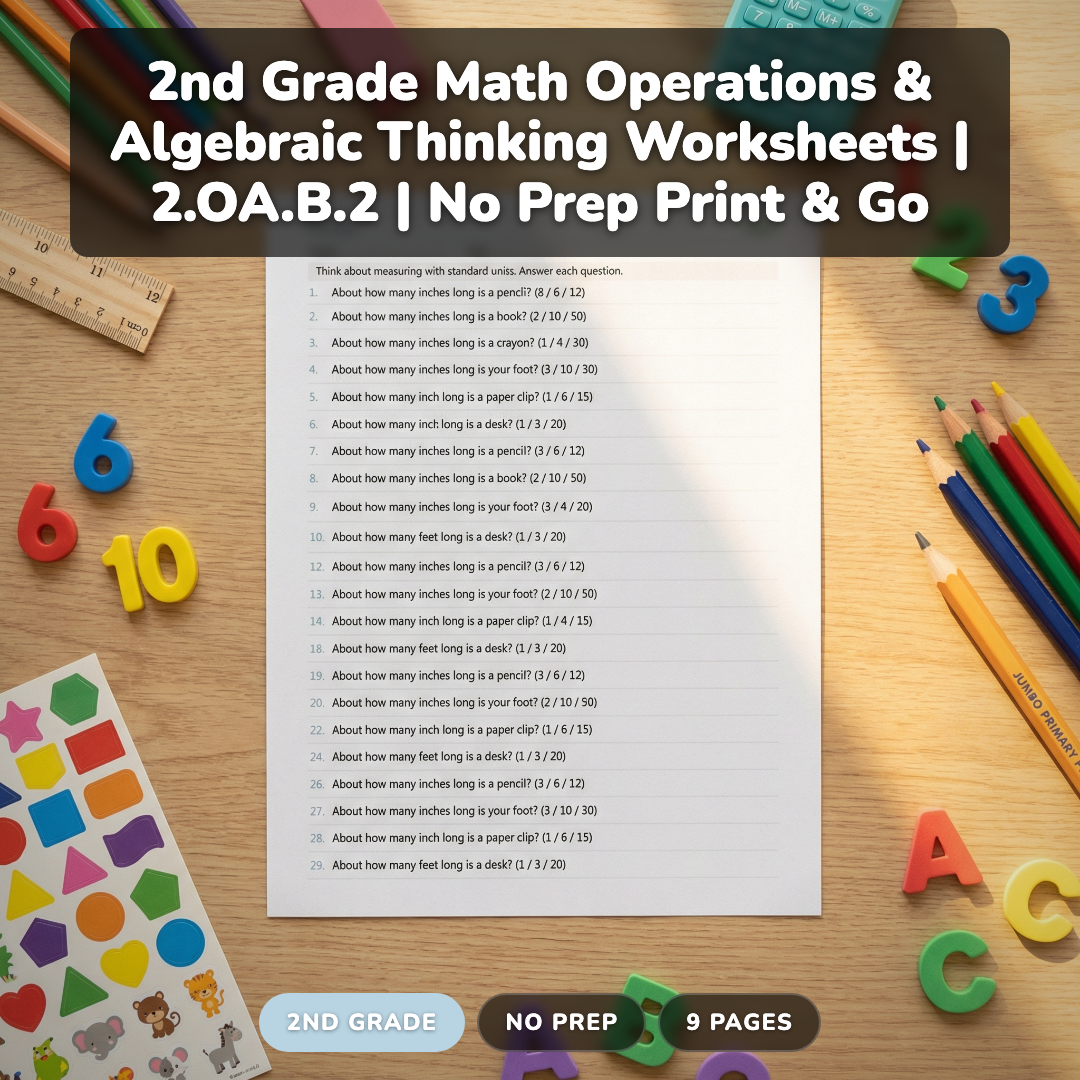
What makes this different from other fact practice? Every problem is designed around a specific mental math strategy, not random drill. Students build understanding while developing fluency, and you get instant differentiation without extra prep time.
Grab a Free Mental Math Sample to Try
Want to see how these strategies work in practice? I’ll send you a free sample pack with ten problems from each difficulty level, plus a strategy reference sheet for your classroom. Drop your email below and I’ll send it right over.
Frequently Asked Questions About Teaching Mental Math
How long should daily fact practice last in second grade?
Research recommends 10-15 minutes of focused fact practice daily. This can be broken into shorter segments throughout the day — 5 minutes during morning work, 5 minutes before dismissal, and practice embedded in other math activities.
Should I use timed tests for mental math fluency?
Timed tests can increase anxiety and aren’t recommended as the primary assessment method. Instead, use brief, low-pressure checks like ‘Around the World’ games or individual conferences to gauge progress toward automaticity.
What if students rely too heavily on counting strategies?
Gradually remove counting supports while teaching more efficient strategies. Explicitly show why doubles or make-10 is faster than counting. Celebrate when students use advanced strategies, even if they make errors initially.
How do I help students who have memorized facts without understanding?
Use concrete manipulatives and visual models to build conceptual understanding. Have them explain their thinking and show multiple ways to solve the same problem. Connect memorized facts to number relationships and patterns.
When should students achieve fluency with addition and subtraction facts?
According to CCSS.Math.Content.2.OA.B.2, students should know all single-digit addition combinations from memory by the end of second grade. Most students achieve this between March and May with consistent practice.
Building mental math fluency takes time and consistent practice, but these strategies will help your students develop both speed and understanding. Remember that every student progresses at their own pace — celebrate growth and keep the focus on building number sense alongside memorization.
What’s your go-to strategy for teaching mental math facts? I’d love to hear what works in your classroom! And don’t forget to grab that free sample pack to try these strategies with your students.