If your second graders freeze when they see measurement word problems, you’re not alone. These problems require students to juggle multiple skills at once — reading comprehension, addition and subtraction, and understanding units of measurement. The good news? With the right teaching strategies, your students can master CCSS.Math.Content.2.MD.B.5 and feel confident solving real-world measurement problems.
Key Takeaway
Second graders need concrete experiences and visual models before they can solve abstract measurement word problems successfully.
Why Measurement Word Problems Matter in 2nd Grade
Measurement word problems bridge the gap between abstract math and real-world applications. According to the Common Core State Standards, CCSS.Math.Content.2.MD.B.5 requires students to use addition and subtraction within 100 to solve word problems involving lengths in the same units. This standard typically appears in the spring semester after students have mastered basic addition and subtraction facts.
Research from the National Council of Teachers of Mathematics shows that students who struggle with measurement word problems often lack experience connecting mathematical operations to real-world contexts. These problems require students to identify the unknown quantity, choose the correct operation, and represent their thinking with drawings or equations.
The timing of this standard is crucial — it builds on students’ understanding of standard and non-standard units (2.MD.A.1-4) while preparing them for more complex multi-step problems in third grade. Students need approximately 15-20 hours of instruction and practice to develop fluency with measurement word problems.
Looking for a ready-to-go resource? I put together a differentiated measurement word problems pack that covers everything below — but first, the teaching strategies that make it work.
Common Measurement Word Problems Misconceptions in 2nd Grade
Understanding where students typically struggle helps you address misconceptions before they become ingrained habits. Here are the four most common misconceptions I see in second grade classrooms:
Common Misconception: Students always add when they see two numbers in a word problem.
Why it happens: Many early word problems involve addition, so students develop a pattern of adding without analyzing the problem structure.
Quick fix: Teach students to identify what’s happening in the story before looking at numbers.
Common Misconception: Students ignore units of measurement or mix different units.
Why it happens: They focus on the numbers and operations while overlooking the measurement context.
Quick fix: Have students circle or highlight the units in every problem before solving.
Common Misconception: Students can’t determine which number represents the unknown.
Why it happens: The unknown isn’t always at the end of the problem, and students haven’t learned to identify what the question is asking.
Quick fix: Practice underlining the question and identifying what you need to find before solving.
Common Misconception: Students struggle to represent their thinking with drawings or equations.
Why it happens: They haven’t had enough practice connecting concrete models to abstract representations.
Quick fix: Start with physical manipulatives, then move to drawings, then to equations.
5 Research-Backed Strategies for Teaching Measurement Word Problems
Strategy 1: Act It Out with Real Measurements
Before students can solve abstract problems on paper, they need hands-on experience with actual measuring. This concrete approach helps students understand what addition and subtraction mean in measurement contexts.
What you need:
- Measuring tapes or rulers
- Yarn or string
- Sticky notes for labeling
- Classroom objects to measure
Steps:
- Present a real scenario: ‘Sarah’s desk is 24 inches long. Tom’s desk is 18 inches long. How much longer is Sarah’s desk?’
- Have students physically measure two desks or use pre-cut yarn pieces
- Students lay the pieces side by side to see the difference
- Measure the difference and connect it to subtraction: 24 – 18 = 6 inches
- Record the equation and draw a picture to match
Strategy 2: Problem Structure Analysis with Color Coding
Students need explicit instruction in identifying problem types and the relationships between quantities. Color coding helps them visually organize information and choose the correct operation.
What you need:
- Colored pencils or highlighters
- Problem analysis chart
- Laminated word problem cards
Steps:
- Read the problem aloud together
- Highlight known quantities in blue
- Highlight the unknown quantity in yellow
- Circle the units in green
- Underline action words (longer, shorter, total, difference) in red
- Determine if you’re finding a total (addition) or a difference (subtraction)
- Write the equation with a symbol for the unknown
Strategy 3: Drawing Bar Models for Measurement
Bar models (also called tape diagrams) provide a visual bridge between concrete experiences and abstract equations. They’re particularly effective for measurement problems because they show the relationship between parts and wholes.
What you need:
- Grid paper or pre-drawn bar model templates
- Rulers for drawing neat bars
- Different colored pencils
Steps:
- Read the problem and identify what you know and what you need to find
- Draw a bar for each known quantity, labeling the length
- If finding a total, draw bars end-to-end; if finding a difference, draw bars aligned
- Mark the unknown with a question mark or variable
- Write the matching equation
- Solve and check your answer against the model
Strategy 4: Measurement Word Problem Sorts
Sorting activities help students recognize patterns in problem types without the pressure of solving. This builds their ability to quickly identify whether a problem requires addition or subtraction.
What you need:
- Word problem cards (without numbers initially)
- Sorting mats labeled ‘Addition’ and ‘Subtraction’
- Timer for partner challenges
Steps:
- Start with story situations without numbers: ‘The ribbon was long. Then it was cut shorter.’
- Students sort by operation type based on the action in the story
- Add numbers and have students sort again
- Discuss why certain keywords or situations suggest addition vs. subtraction
- Create a class chart of ‘addition situations’ and ‘subtraction situations’
Strategy 5: Real-World Measurement Investigations
Connecting measurement problems to students’ lives increases engagement and helps them see the relevance of these skills. This strategy works particularly well for end-of-unit application.
What you need:
- Measuring tools (rulers, measuring tapes)
- Recording sheets
- Clipboards for mobility
- Calculator for checking (optional)
Steps:
- Assign measurement investigations: ‘How much taller are you than your desk?’
- Students collect real data by measuring
- They write word problems based on their measurements
- Partners solve each other’s problems
- Compare solutions and discuss strategies used
- Share interesting discoveries with the class
How to Differentiate Measurement Word Problems for All Learners
For Students Who Need Extra Support
Students below grade level benefit from additional scaffolding and concrete experiences. Start with problems using smaller numbers (within 20) and provide manipulatives for every problem. Use sentence frames like ‘I need to find ___’ and ‘I will ___ because ___.’ Offer problems with the unknown in the same position consistently before introducing variation. Consider providing a number line or hundred chart for computation support.
For On-Level Students
Grade-level students should work with numbers within 100 as specified in CCSS.Math.Content.2.MD.B.5. They can handle problems where the unknown appears in different positions (beginning, middle, or end). Encourage multiple solution strategies and have students explain their reasoning. Provide opportunities for both drawing and equation representations. These students should be comfortable with standard units like inches, feet, and centimeters.
For Students Ready for a Challenge
Advanced students can tackle multi-step problems involving three or more measurements, create their own word problems for classmates to solve, and work with mixed units (converting feet to inches). Challenge them to solve problems using multiple methods and explain which strategy is most efficient. They can also explore real-world applications like planning a garden layout or measuring for classroom improvements.
A Ready-to-Use Measurement Word Problems Resource for Your Classroom
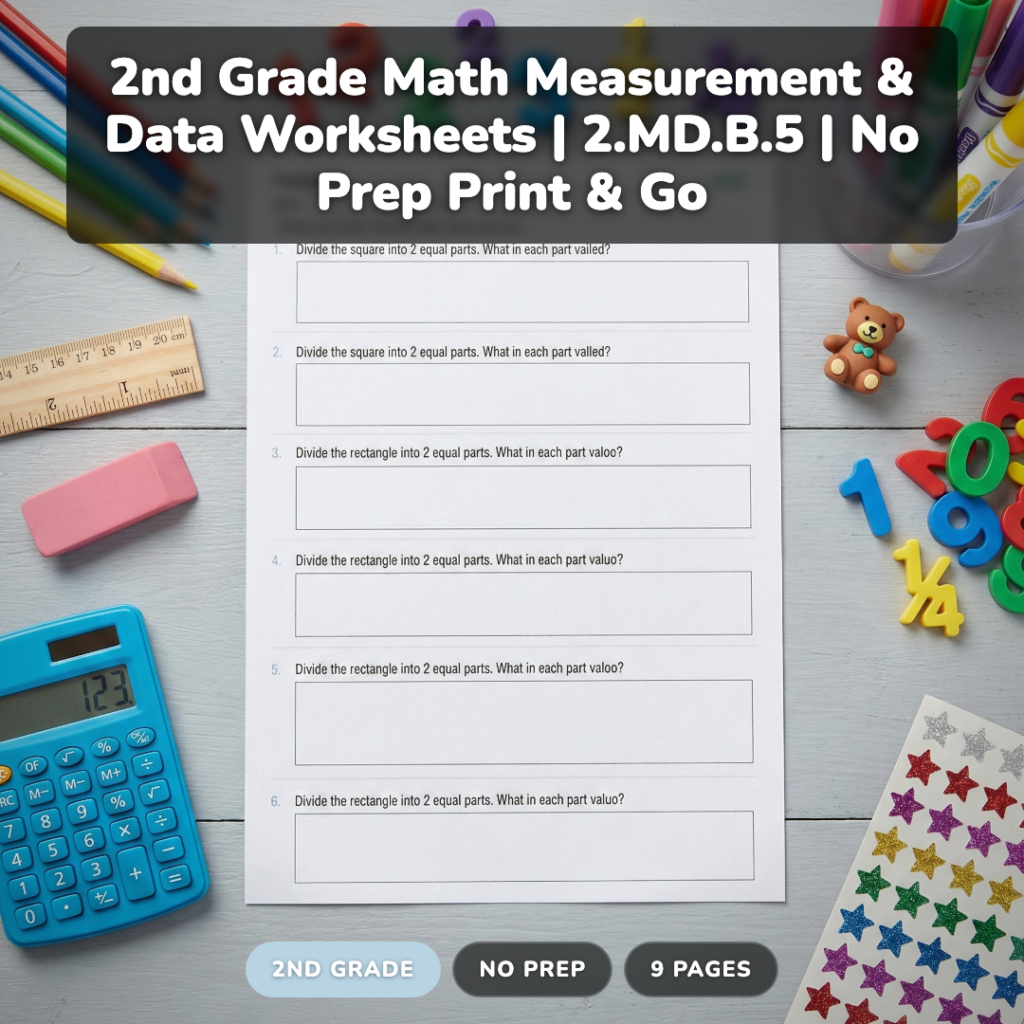
After years of creating measurement word problems from scratch, I developed a comprehensive resource that saves hours of prep time while providing the differentiation your students need. This measurement and data worksheet pack includes 106 carefully crafted problems across three difficulty levels.
The practice level features 30 problems with numbers within 50, perfect for students who need additional support. The on-level section contains 40 problems using numbers within 100, directly aligned with CCSS.Math.Content.2.MD.B.5. The challenge level offers 36 problems with multi-step scenarios and larger numbers for your advanced learners.
What makes this resource different is the intentional progression of problem types. Each level includes problems with the unknown in different positions, various measurement contexts (length, height, distance), and both addition and subtraction scenarios. Answer keys are included for quick grading, and the problems are designed to be used for independent practice, homework, or assessment.
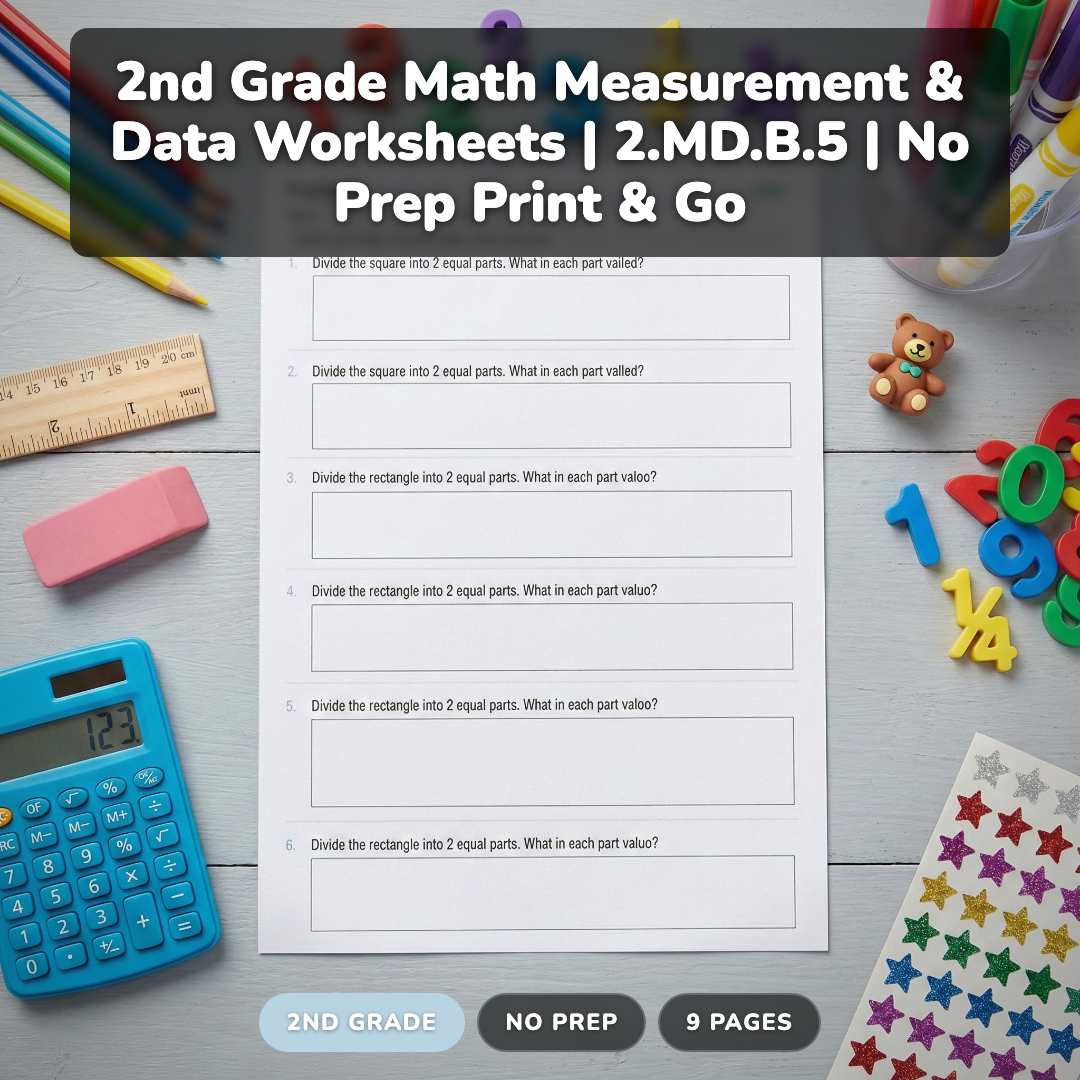
The 9-page pack is completely no-prep — just print and go. You can use individual pages for targeted practice or the entire set for comprehensive review.
Grab a Free Measurement Word Problems Sample to Try
Want to see the quality and format before committing? I’ll send you a free sample page with 5 measurement word problems at different difficulty levels, plus an answer key and teaching tips.
Frequently Asked Questions About Teaching Measurement Word Problems
When should I introduce measurement word problems in 2nd grade?
Introduce measurement word problems after students have mastered basic addition and subtraction within 100 and understand standard measurement units. This typically occurs in late winter or early spring, following instruction on 2.MD.A.1-4 standards.
What’s the difference between 2nd grade and 3rd grade measurement problems?
Second grade problems use single-step addition or subtraction with the same units throughout. Third grade problems may involve multi-step operations, different units requiring conversion, or more complex reasoning about measurement relationships.
How can I help students who struggle with reading the word problems?
Read problems aloud, highlight key information with different colors, and provide sentence frames for organizing their thinking. Start with problems that have simpler vocabulary and shorter sentences before progressing to more complex language.
Should students always draw pictures for measurement word problems?
Drawing supports understanding, especially for visual learners, but students should gradually move toward more efficient strategies. Encourage drawings when learning new problem types, then allow choice of representation methods as students gain confidence.
How many measurement word problems should students practice daily?
Start with 2-3 problems during initial instruction, building to 5-8 problems for independent practice. Quality practice with discussion and reflection is more valuable than large quantities of problems completed quickly.
Building Confident Problem Solvers
Teaching measurement word problems successfully requires patience, scaffolding, and plenty of hands-on experiences. When students can connect abstract problems to real-world situations and use multiple representations to show their thinking, they develop both computational skills and mathematical reasoning.
What’s your favorite strategy for helping students tackle measurement word problems? Remember to grab your free sample problems above — they’re perfect for trying out these strategies with your class.
Looking for more 2nd grade math resources? Check out our addition and subtraction strategy guide for building the foundation skills these problems require.