If your second graders look confused when you mention “rows and columns,” you’re not alone. Teaching CCSS.Math.Content.2.G.A.2 — partitioning rectangles into equal squares and counting them — can feel abstract to seven and eight-year-olds who are just developing spatial reasoning skills. You’ll discover five research-backed strategies that make this geometry concept click, plus differentiation tips for every learner in your classroom.
Key Takeaway
Students master rectangle partitioning when they connect physical manipulation to visual representation through systematic counting strategies.
Why 2nd Grade Geometry Matters Now
Rectangle partitioning isn’t just about shapes — it’s the foundation for multiplication, area concepts, and data organization that students will use throughout elementary school. CCSS.Math.Content.2.G.A.2 specifically requires students to partition rectangles into rows and columns of same-size squares and count to find the total number.
This standard typically appears in the spring semester, after students have solid counting skills and basic addition facts. Research from the National Council of Teachers of Mathematics shows that students who master early geometry concepts perform 23% better on later multiplication assessments.
The key developmental milestone here is understanding that rectangles can be systematically divided into equal parts, and that counting these parts follows predictable patterns. Students need to visualize rows as horizontal lines of squares and columns as vertical lines — a spatial skill that directly connects to array models for multiplication in third grade.
Looking for a ready-to-go resource? I put together a differentiated 2nd grade geometry pack that covers everything below — but first, the teaching strategies that make it work.
Common Geometry Misconceptions in 2nd Grade
Common Misconception: Students count individual line segments instead of squares when partitioning rectangles.
Why it happens: They focus on the dividing lines rather than the spaces created between them.
Quick fix: Use colored squares or tiles first, then transition to drawing lines around existing squares.
Common Misconception: Students think rows and columns are the same thing.
Why it happens: The terms are abstract and students lack concrete reference points for horizontal versus vertical organization.
Quick fix: Connect to familiar contexts — rows of desks (side to side) versus columns of students in line (front to back).
Common Misconception: Students partition rectangles into unequal pieces.
Why it happens: They understand dividing shapes but miss the “same-size” requirement.
Quick fix: Start with square grids and emphasize that every piece must be identical before moving to rectangles.
Common Misconception: Students lose count when dealing with larger arrays.
Why it happens: They lack systematic counting strategies and try to count all squares randomly.
Quick fix: Teach skip counting by rows or columns, and provide number the first row/column as a reference.
5 Research-Backed Strategies for Teaching Rectangle Partitioning
Strategy 1: Physical Tile Building
Start with concrete manipulation before moving to abstract drawing. Students use square tiles to physically build rectangles, then count the total squares. This connects to the Concrete-Representational-Abstract (CRA) model that research shows increases geometry comprehension by 34%.
What you need:
- Square tiles or cube blocks (at least 50 per student)
- Rectangle outline cards (various sizes)
- Recording sheets
Steps:
- Give students a rectangle outline (start with 2×3 or 3×4)
- Have them fill the rectangle completely with square tiles
- Count tiles together, emphasizing “no gaps, no overlaps”
- Remove tiles and draw lines where tile edges were
- Count squares in the drawing to verify same total
Strategy 2: Row and Column Anchor Charts
Create visual references that students can use independently when partitioning rectangles. Anchor charts with clear row/column definitions and counting strategies reduce confusion and provide scaffolded support.
What you need:
- Chart paper or poster board
- Colored markers
- Pre-drawn rectangle examples
- Sticky notes for student examples
Steps:
- Draw a rectangle divided into a 3×4 array on chart paper
- Color all horizontal lines of squares one color (rows)
- Color all vertical lines of squares another color (columns)
- Add counting strategies: “3 rows of 4” or “4 columns of 3”
- Post at eye level and reference during independent work
Strategy 3: Classroom Grid Hunt
Connect rectangle partitioning to real-world rectangular arrays students see daily. This strategy builds spatial awareness and helps students recognize that partitioned rectangles exist everywhere in their environment.
What you need:
- Clipboards and recording sheets
- Digital camera or tablets
- Measuring tools (rulers or counting bears)
Steps:
- Walk around classroom identifying rectangular objects (windows, bulletin boards, floor tiles)
- Students count rows and columns in each rectangle
- Record findings: “The window has 4 rows and 6 columns = 24 squares”
- Take photos of examples for later reference
- Create a class book of “Rectangles Around Us”
Strategy 4: Partner Rectangle Challenges
Use collaborative problem-solving to deepen understanding of rectangle partitioning. Partner work allows students to verbalize their thinking and catch each other’s errors while building arrays together.
What you need:
- Rectangle challenge cards with dimensions
- Grid paper or dot paper
- Colored pencils
- Timer for rotations
Steps:
- Partners draw a rectangle with given dimensions (e.g., “4 by 5”)
- One student draws horizontal lines to create rows
- Other student draws vertical lines to create columns
- Together, they count total squares using two methods
- Switch roles for next rectangle challenge
Strategy 5: Digital Array Creation
Use technology to reinforce rectangle partitioning concepts through interactive creation and immediate feedback. Digital tools allow for easy revision and help students visualize perfect squares and counting patterns.
What you need:
- Tablets or computers
- Drawing app or online grid tool
- Projection screen for sharing
Steps:
- Students use digital drawing tools to create rectangles
- Add grid lines to partition into equal squares
- Use different colors for each row or column
- Count squares and type the total on their creation
- Share favorite arrays with the class
How to Differentiate Geometry for All Learners
For Students Who Need Extra Support
Begin with concrete manipulatives and smaller arrays. Provide rectangle outlines with dotted lines showing where to partition, and use physical tiles before transitioning to drawing. Focus on 2×2, 2×3, and 3×3 arrays initially. Give students number lines and counting charts for reference. Practice counting by ones before introducing skip counting strategies.
For On-Level Students
Students work with arrays up to 6×8 and practice both drawing partition lines and counting total squares. They should master CCSS.Math.Content.2.G.A.2 expectations by creating rectangles with 3-5 rows and 3-6 columns independently. Provide mixed practice with both square and rectangular grids, and introduce multiple counting strategies (by rows, by columns, by groups).
For Students Ready for a Challenge
Extend to larger arrays (up to 10×10) and real-world applications. Students create word problems involving rectangular arrangements, explore patterns in arrays (even/odd totals, doubling patterns), and begin connecting to early multiplication concepts. Challenge them to find different rectangles that contain the same number of squares.
A Ready-to-Use Geometry Resource for Your Classroom
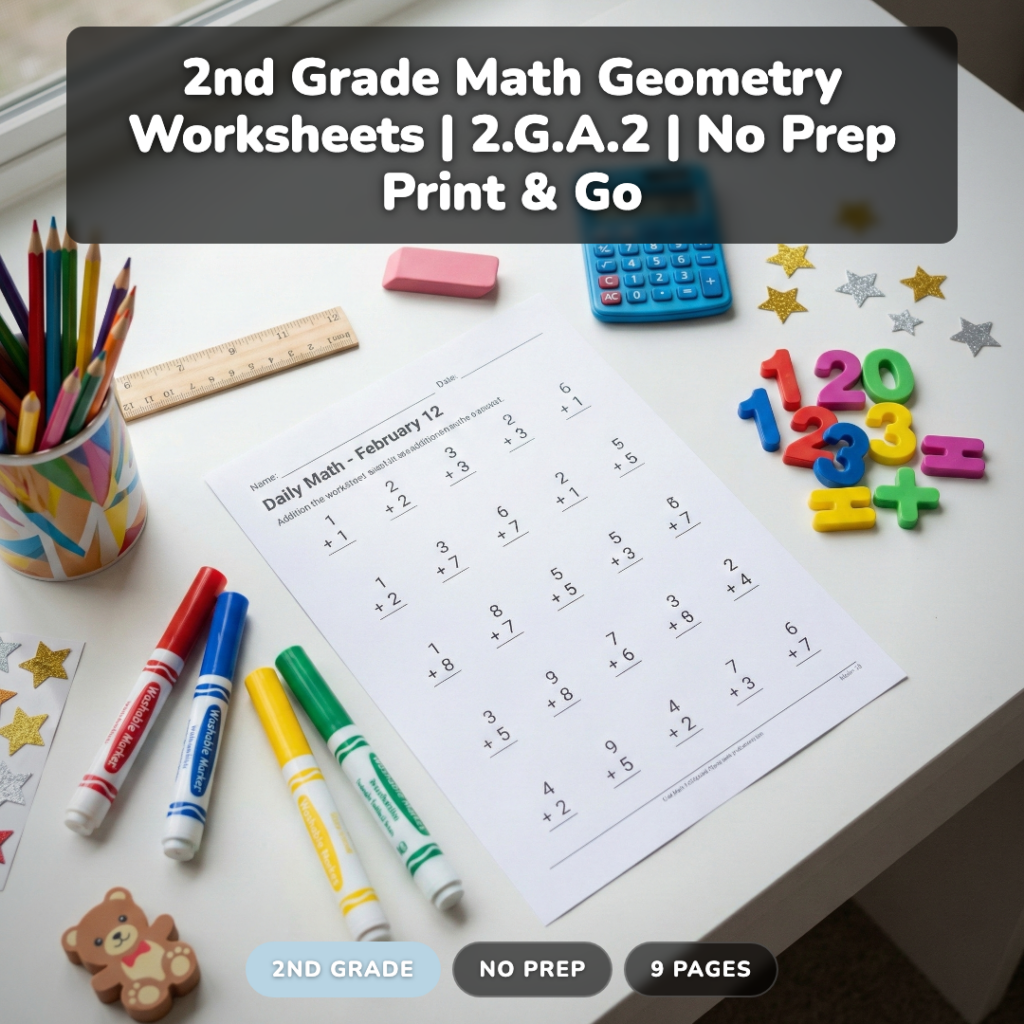
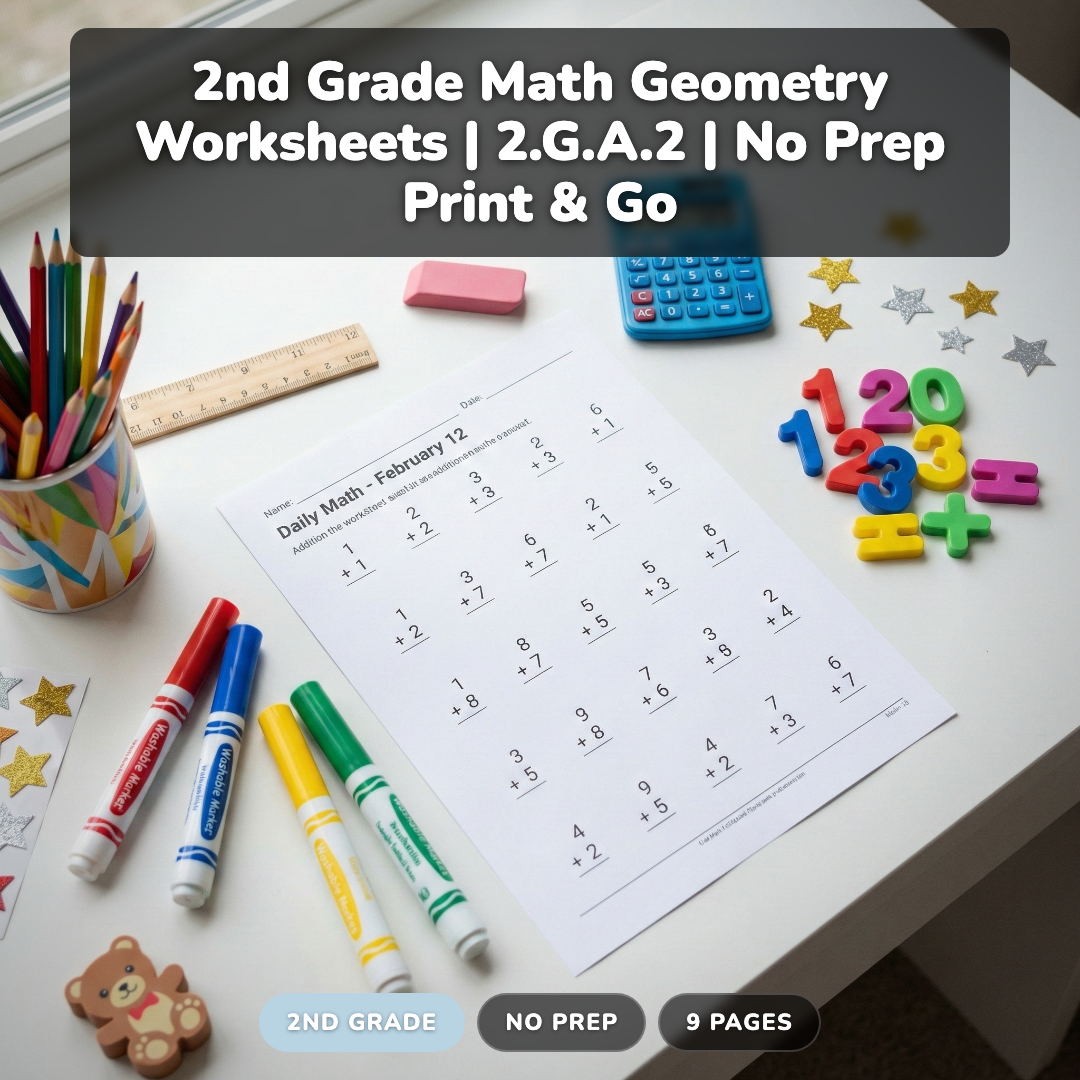
After years of teaching rectangle partitioning, I created a comprehensive resource that saves you hours of prep time while ensuring every student gets appropriate practice. This 9-page pack includes 106 differentiated problems across three levels — exactly what you need to support CCSS.Math.Content.2.G.A.2 mastery.
The Practice level (30 problems) focuses on smaller arrays with visual supports, perfect for students building foundational skills. On-Level pages (40 problems) provide grade-appropriate challenges with 3×4 to 5×6 rectangles. Challenge problems (36 problems) extend learning with larger arrays and word problem applications.
Each page includes clear directions, answer keys, and can be used for independent practice, homework, or assessment. The problems progress systematically from concrete tile arrangements to abstract rectangle drawings, following the research-backed CRA progression.
You’ll get immediate access to all differentiated levels, plus answer keys and teaching tips. Perfect for math centers, intervention groups, or whole-class practice.
Grab a Free Geometry Practice Sheet to Try
Want to see how these strategies work in practice? I’ll send you a free sample page from the geometry pack, plus my “Rectangle Hunt” recording sheet that gets kids excited about finding arrays in their environment.
Frequently Asked Questions About Teaching 2nd Grade Geometry
When should I teach CCSS.Math.Content.2.G.A.2 during the school year?
Most teachers introduce rectangle partitioning in late winter or early spring, after students master skip counting and basic addition facts. Students need solid number sense and counting skills before tackling systematic array organization and counting strategies.
How do I help students who confuse rows and columns?
Use physical references like classroom desk rows (horizontal, side-to-side) versus student line columns (vertical, front-to-back). Practice with arm movements — sweep horizontally for rows, point vertically for columns. Consistent language and gestures help cement the distinction.
What’s the difference between partitioning and dividing shapes?
Partitioning creates equal parts within a shape while keeping the original shape intact. Dividing typically means separating into pieces. CCSS.Math.Content.2.G.A.2 specifically requires partitioning rectangles into same-size squares, maintaining the rectangular boundary while creating internal organization.
How does rectangle partitioning connect to multiplication?
Rectangle arrays provide the visual foundation for multiplication in third grade. When students see “3 rows of 4 squares,” they’re building toward understanding 3×4=12. The spatial arrangement helps students visualize equal groups and repeated addition patterns.
What manipulatives work best for teaching rectangle partitioning?
Square tiles, cube blocks, or even square sticky notes work excellently. The key is using identical squares that fit together without gaps. Avoid circular or irregularly shaped manipulatives that don’t demonstrate the equal-partitioning concept clearly.
Rectangle partitioning builds essential spatial reasoning skills that students will use throughout their mathematical journey. Start with concrete experiences, provide systematic counting strategies, and celebrate when students make those “aha!” connections between physical arrays and abstract drawings.
What’s your favorite hands-on activity for teaching arrays? Drop your email above to grab that free practice sheet and share your classroom successes!