Planning a full year of 2nd grade math feels overwhelming when you’re staring at 28 Common Core standards across four major domains. You need differentiated worksheets for every skill, interactive review games that actually engage 7 and 8-year-olds, and resources that work whether you’re teaching in-person or hybrid. Instead of spending hours searching for quality materials that align with each standard, you want one comprehensive solution that covers everything from basic addition to complex word problems.
This complete guide walks you through every 2nd grade math domain with specific teaching strategies, common student challenges, and ready-to-use classroom activities. By the end, you’ll have a clear roadmap for the entire year plus access to resources that make daily planning effortless.
Key Takeaway
2nd grade math builds critical foundational skills across 28 standards in four domains: Operations & Algebraic Thinking, Number & Operations in Base Ten, Measurement & Data, and Geometry.
2nd Grade Math: What Students Need to Master This Year
Second grade marks a pivotal transition where students move from concrete counting to abstract mathematical thinking. This year, your students will master place value to 1,000, develop fluency with addition and subtraction within 100, and begin working with data representation and geometric reasoning.
The Common Core framework organizes 2nd grade math into four key domains: Operations & Algebraic Thinking (OA) focuses on word problems and mental math strategies, Number & Operations in Base Ten (NBT) builds place value understanding and computational fluency, Measurement & Data (MD) introduces standard units and data analysis, and Geometry (G) develops spatial reasoning with shapes and equal shares.
Students enter 2nd grade with basic counting and simple addition skills from 1st grade. By year’s end, they’ll confidently solve two-step word problems, understand place value to the hundreds place, and work with standard measurement units. This foundation prepares them for multiplication concepts and fractions in 3rd grade.
Developmentally, 7 and 8-year-olds learn best through hands-on manipulation, visual representations, and interactive practice. They’re building stamina for longer problem-solving tasks while still needing frequent movement and varied activities to maintain focus.
Need ready-to-go resources for every standard below? I put together a complete 2nd grade math bundle with worksheets and review games for each one — but first, here’s your domain-by-domain guide.
Operations & Algebraic Thinking: Building Problem-Solving Skills
Operations & Algebraic Thinking in 2nd grade centers on word problem strategies and developing fluency with addition and subtraction facts. Students learn to represent and solve one-step and two-step word problems, work with arrays as foundations for multiplication, and determine whether equations are true or false.
OA Standards: Word Problems & Mental Math
Key standards include CCSS.Math.Content.2.OA.A.1 (two-step word problems), CCSS.Math.Content.2.OA.A.2 (mental addition and subtraction), CCSS.Math.Content.2.OA.B.2 (addition and subtraction fluency), and CCSS.Math.Content.2.OA.C.3 (determining odd and even numbers).
The biggest challenge students face in this domain is translating word problems into mathematical operations. Many 2nd graders can compute accurately but struggle to determine what operation a story problem requires. Start with simple one-step problems using familiar contexts like classroom supplies or playground scenarios.
Interactive practice through games helps students develop automaticity with addition and subtraction facts within 20. When students can recall these facts quickly, they have more mental capacity available for problem-solving strategies and multi-step thinking.
Worksheets that provide systematic practice with different problem types — join, separate, compare, and part-whole — help students recognize patterns in word problem structures. Games that present problems in sports contexts, like basketball scenarios, tap into students’ natural competitiveness while reinforcing mathematical thinking.
Number & Operations in Base Ten: Mastering Place Value
Number & Operations in Base Ten forms the mathematical backbone of 2nd grade, with 11 standards covering place value understanding, counting patterns, and computational strategies. Students extend their number sense to 1,000 and develop efficient methods for adding and subtracting two-digit numbers.
NBT Standards: Place Value & Computation
Core standards include CCSS.Math.Content.2.NBT.A.1 (place value to 1,000), CCSS.Math.Content.2.NBT.A.2 (counting by 5s, 10s, and 100s), CCSS.Math.Content.2.NBT.B.5 (fluent addition and subtraction within 100), and CCSS.Math.Content.2.NBT.B.7 (adding and subtracting within 1,000).
Place value misconceptions run deep in 2nd grade. Students often think the “2” in “23” represents 2 instead of 20, or they struggle to understand why 300 + 40 + 7 equals 347. Building conceptual understanding through manipulatives before moving to abstract algorithms prevents these persistent errors.
The transition from counting strategies to place value strategies marks a major cognitive leap. Students who still count on their fingers for 27 + 35 need explicit instruction in decomposing numbers by place value: 20 + 30 = 50, then 7 + 5 = 12, then 50 + 12 = 62.
Games that focus on place value comparisons — greater than, less than, ordering numbers — help students internalize the relative magnitude of three-digit numbers. Worksheets with number line activities support students in visualizing number relationships and developing number sense beyond rote memorization.
Measurement & Data: Connecting Math to Real Life
Measurement & Data encompasses 10 standards that connect mathematics to students’ daily experiences through length, time, money, and data analysis. This domain helps students see math as a practical tool for understanding their world.
MD Standards: Measurement & Data Analysis
Essential standards include CCSS.Math.Content.2.MD.A.1 (measuring with standard units), CCSS.Math.Content.2.MD.C.7 (telling time), CCSS.Math.Content.2.MD.C.8 (money problems), and CCSS.Math.Content.2.MD.D.10 (drawing and interpreting graphs).
Time concepts challenge many 2nd graders because they require understanding multiple systems simultaneously — 60 minutes in an hour, 12 hours on a clock face, and the relationship between analog and digital displays. For detailed strategies and free resources for each standard, see our posts on teaching time to 2nd grade students and developing money skills in 2nd grade.
Money skills require both computational fluency and real-world application. Students need to count mixed coins, compare values, and solve word problems involving purchases and change. The abstract nature of money values — why a smaller dime is worth more than a larger penny — requires explicit instruction and repeated practice.
Data analysis begins with simple picture graphs and bar graphs where students collect, organize, and interpret information. Start with topics students care about: favorite foods, pets, or sports teams. This personal connection makes the mathematical work meaningful.
For comprehensive strategies on measurement topics, explore our guides on using number lines effectively, creating and interpreting line plots, and teaching data and graphs.
Geometry: Developing Spatial Reasoning
Geometry in 2nd grade builds spatial reasoning through shape analysis and equal shares concepts. Students identify and describe geometric attributes, work with composite shapes, and partition shapes into equal parts.
Geometry Standards: Shapes & Equal Shares
The three geometry standards are CCSS.Math.Content.2.G.A.1 (recognizing and drawing shapes), CCSS.Math.Content.2.G.A.2 (partitioning rectangles), and CCSS.Math.Content.2.G.A.3 (equal shares in circles and rectangles).
Equal shares concepts lay crucial groundwork for fraction understanding in later grades. Students learn that equal shares have the same area even if they look different, and they develop vocabulary for halves, thirds, and fourths. This conceptual foundation prevents common fraction misconceptions.
Shape identification moves beyond simple naming to analyzing attributes. Students describe shapes by their number of sides, angles, and other geometric properties. They also work with composite shapes, understanding how triangles can combine to form hexagons or how rectangles create larger rectangular shapes.
For detailed teaching strategies in this domain, see our comprehensive guides on 2nd grade geometry fundamentals, partitioning shapes effectively, and teaching equal shares concepts.
What’s in the 2nd Grade Complete Math Bundle?
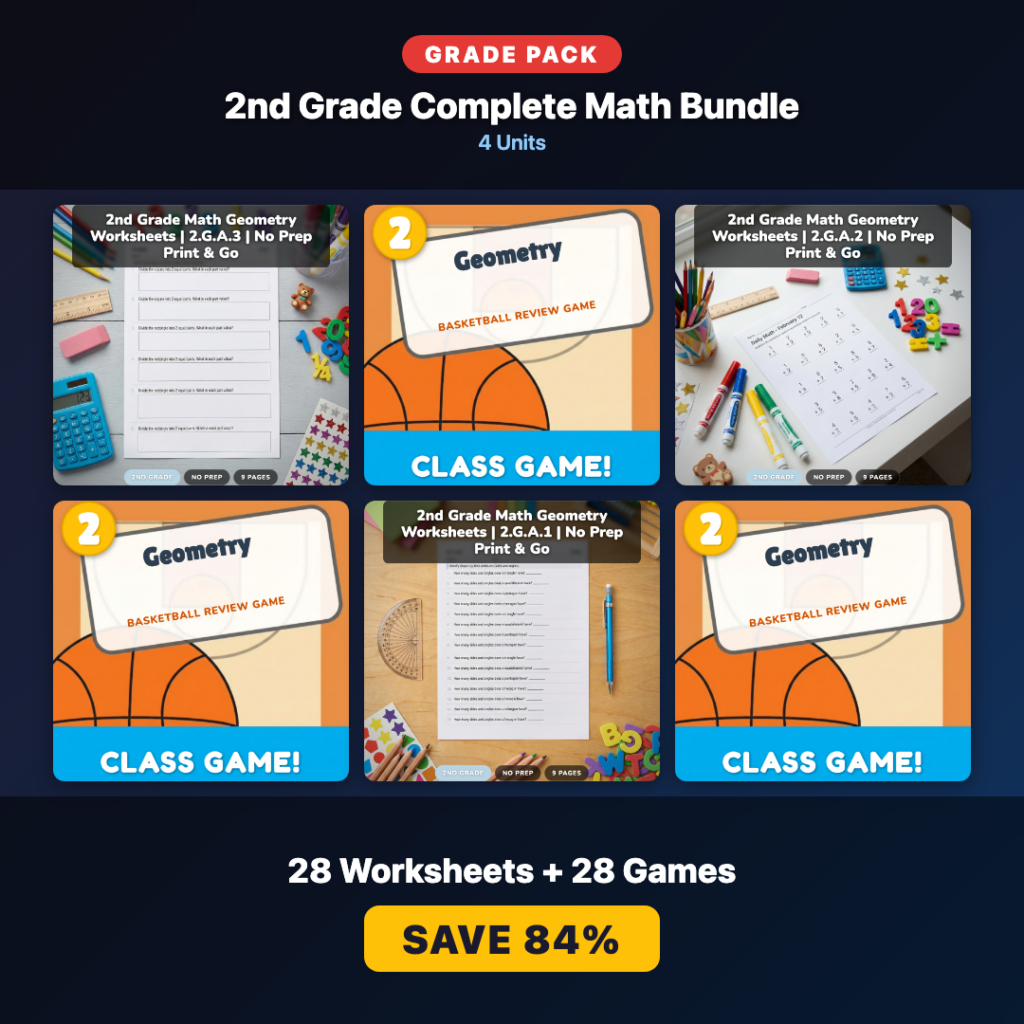
28 Differentiated Worksheet Sets
Each worksheet set targets one specific Common Core standard with multiple practice formats. You get a full-color PDF version for engaging visual practice, a black-and-white version for easy photocopying, complete answer keys for quick grading, and Google Slides versions for digital learning. Every set includes three difficulty levels to support struggling learners, challenge advanced students, and provide appropriate practice for on-level students.
With over 999+ total pages across all sets, you have enough practice materials for daily warm-ups, homework assignments, math centers, and assessment preparation throughout the entire school year.
28 Interactive Basketball Review Games
Each game corresponds to one Common Core standard and includes 60 questions across three difficulty levels. The HTML5 format works seamlessly on Smartboards, Chromebooks, iPads, and any device with a web browser. Students compete in two teams, answering questions to score basketball shots.
Try the free demo game to see how engaging these review sessions become. With 1,680+ total questions across all 28 games, you have comprehensive review materials for every standard.
Bundle Savings
Purchasing each worksheet set and game individually would cost $168.00. The complete bundle is just $27.00 — an 84% savings that works out to less than $1 per standard. For schools needing multiple teacher access, the school license is $40.50, providing incredible value for grade-level teams or entire elementary schools.
5 Ways to Use This Bundle All Year Long
1. Daily Practice & Warm-Ups
Start each math lesson with a quick worksheet page targeting the previous day’s learning or spiraling back to earlier standards. The varied difficulty levels let you differentiate morning work based on student needs while maintaining consistent practice routines.
2. Test Prep & Review
Before unit assessments or state testing, use the basketball games for high-energy review sessions. Students stay engaged while getting targeted practice on specific standards, and you can quickly identify areas needing reteaching based on game performance.
3. Math Centers & Stations
Set up Chromebook stations with different games while other groups work on worksheet activities. The self-paced nature of both resources allows students to work independently while you provide small-group instruction to those needing extra support.
4. Sub Plans
Leave clear instructions for substitutes with a worksheet set and corresponding game. The answer keys and self-explanatory game format ensure productive learning time even when you’re unexpectedly absent, with minimal prep work required.
5. Differentiated Small Groups
Use the three difficulty levels to target instruction during guided math groups. Struggling students start with level 1 worksheets and games, while advanced learners tackle level 3 challenges, ensuring every student works within their zone of proximal development.
Supporting Every Learner in 2nd Grade Math
For Struggling Students
Begin with level 1 worksheets that provide extra visual supports and smaller number ranges. Use manipulatives alongside worksheet practice, and allow extra time for game completion. Focus on one skill at a time rather than mixing concepts, and provide frequent positive feedback to build confidence.
For On-Level Students
Level 2 materials provide grade-appropriate challenge with standard number ranges and problem complexity. Encourage independent work while checking in periodically. Use games as motivation for completing worksheet practice, and gradually increase expectations for speed and accuracy.
For Advanced Students
Level 3 worksheets include larger numbers, multi-step problems, and extension questions that connect across domains. Challenge these students to explain their thinking, create their own problems, and help struggling classmates during partner work. Use games to maintain engagement while they wait for classmates to finish.
Get the Complete 2nd Grade Math Bundle
This comprehensive bundle eliminates the guesswork from 2nd grade math planning. With 28 worksheet sets, 28 interactive games, and complete coverage of every Common Core standard, you have everything needed for successful math instruction all year long. The 84% savings compared to individual purchases makes this an exceptional value for any 2nd grade teacher.
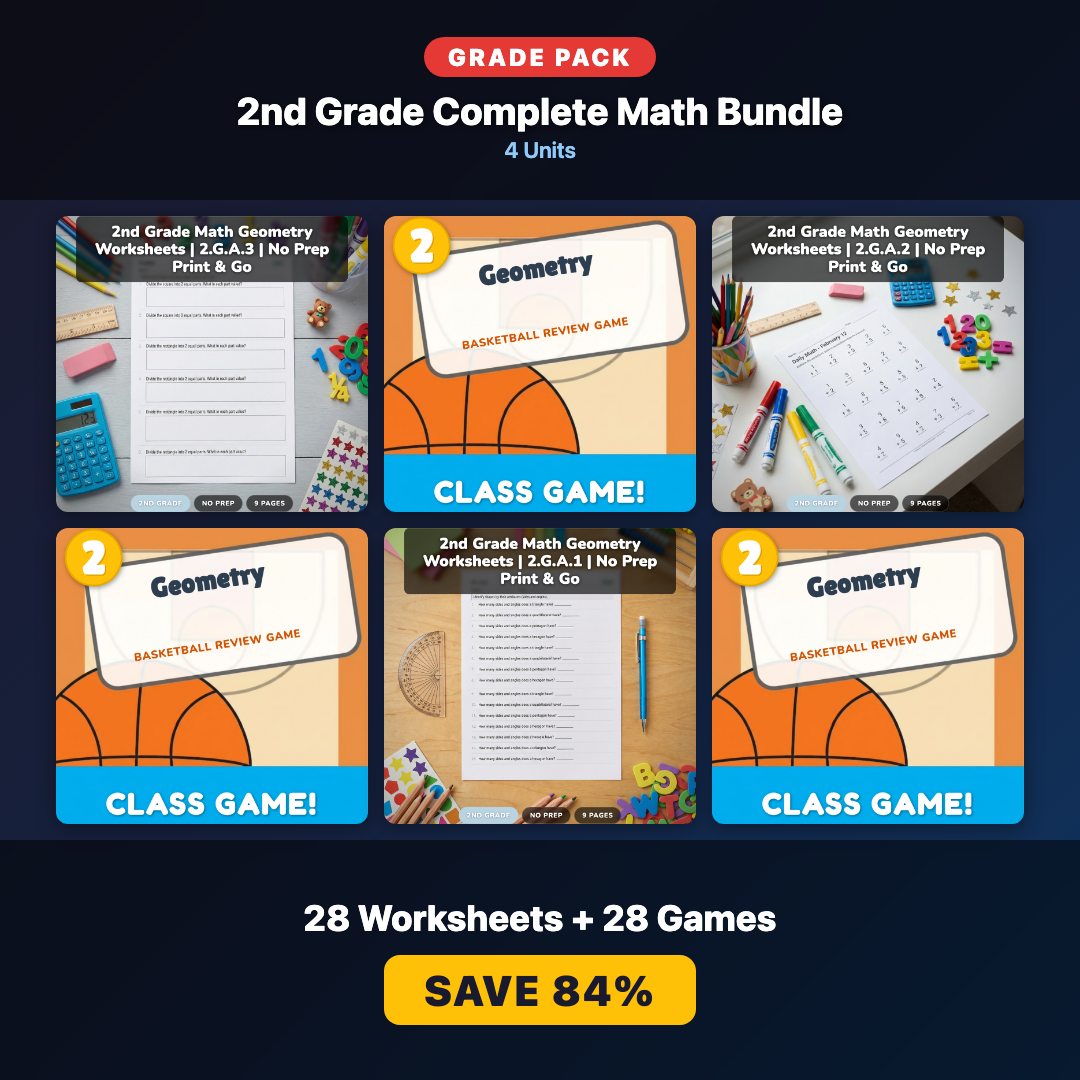
Get instant access to all 28 worksheet sets and basketball review games covering every 2nd grade Common Core math standard. Over 999+ pages of differentiated practice plus 1,680+ interactive game questions for just $27.
Want to try before you buy? Check out the free demo game to see how engaging these review sessions become for your students.
Try a Free Sample First
Not ready to commit? Drop your email below and I’ll send you a free sample worksheet pack plus access to a demo basketball game so you can see the quality for yourself.
Frequently Asked Questions About 2nd Grade Math Resources
What standards does this bundle cover?
The bundle covers all 28 Common Core State Standards for 2nd grade mathematics across four domains: Operations & Algebraic Thinking (4 standards), Number & Operations in Base Ten (11 standards), Measurement & Data (10 standards), and Geometry (3 standards). Each standard gets its own worksheet set and basketball review game.
How do the basketball review games work?
Each game presents 60 questions across three difficulty levels in a fun basketball theme. Students compete in two teams, answering math questions to score shots. The HTML5 format works on any device with a web browser, including Smartboards, Chromebooks, and iPads. Try the free demo to see it in action.
Can I use these on Chromebooks and iPads?
Yes! The basketball games use HTML5 technology that works seamlessly across all devices and platforms. The worksheet PDFs open in any browser, and the Google Slides versions are perfect for digital assignments. No special software or apps required.
Is there a school license option?
Absolutely. The school license costs $40.50 and allows unlimited use across your entire school building. This is perfect for grade-level teams, math coaches, or administrators wanting to provide consistent resources for all 2nd grade teachers. Contact me for district-wide licensing options.
Do the worksheets include answer keys?
Every worksheet set includes complete answer keys for quick and accurate grading. You’ll spend less time checking work and more time analyzing student understanding. The keys also help when training parent volunteers or substitute teachers to assist with math instruction.
How are the three difficulty levels different?
Level 1 uses smaller numbers, provides more visual supports, and includes fewer problems per page. Level 2 represents grade-level expectations with standard number ranges and problem complexity. Level 3 challenges students with larger numbers, multi-step problems, and extension questions that connect across mathematical domains.
Ready to Transform Your 2nd Grade Math Instruction?
With one comprehensive bundle, you get every resource needed to teach 2nd grade math confidently and effectively. From daily practice worksheets to engaging review games, everything aligns perfectly with Common Core standards while providing the differentiation your diverse learners need.
What’s your biggest challenge when planning 2nd grade math lessons? Finding quality materials, differentiating for all learners, or keeping students engaged during practice time?
Start with the free demo game to see how these resources can transform your math instruction, and don’t forget to grab your free sample worksheet pack above.