If your second graders freeze when they see three-digit addition and subtraction problems, you’re not alone. The jump from two-digit to three-digit operations feels enormous to 8-year-olds who are still building place value understanding. You need concrete strategies that help students see the patterns and connections that make these problems manageable.
Key Takeaway
Students master 3-digit addition and subtraction when they understand that you add hundreds to hundreds, tens to tens, and ones to ones—with concrete models first, then abstract strategies.
Why 3-Digit Operations Matter in 2nd Grade
Second grade marks a critical transition in mathematical thinking. Students move from counting-based strategies to place value reasoning, setting the foundation for all future arithmetic. CCSS.Math.Content.2.NBT.B.7 requires students to add and subtract within 1000 using multiple strategies—concrete models, drawings, and written methods—while understanding the underlying place value principles.
Research from the National Council of Teachers of Mathematics shows that students who develop strong place value understanding in second grade perform significantly better on standardized assessments through fifth grade. The key is connecting concrete experiences with abstract symbols before rushing to algorithms.
This standard builds directly on 2.NBT.B.5 (fluently add and subtract within 100) and prepares students for 3.NBT.A.2 (fluently add and subtract within 1000). Students need extensive practice with composing and decomposing tens and hundreds—the mental flexibility that prevents common errors like “borrowing” incorrectly.
Looking for a ready-to-go resource? I put together a differentiated 3-digit operations pack with 106 problems across three difficulty levels—but first, the teaching strategies that make it work.
Common 3-Digit Math Misconceptions in 2nd Grade
Common Misconception: Students subtract the smaller digit from the larger digit in each place value column, regardless of position.
Why it happens: They apply the “take away” model literally without understanding regrouping.
Quick fix: Use base-ten blocks to show when you need to “trade” a hundred for ten tens.
Common Misconception: Students think 400 + 300 = 700, but 427 + 356 requires completely different thinking.
Why it happens: They don’t see the connection between place value patterns and multi-digit operations.
Quick fix: Start every lesson with “friendly numbers” (multiples of 100) before adding complexity.
Common Misconception: Students line up digits incorrectly when writing vertical problems, especially with different numbers of digits.
Why it happens: They focus on the total number of digits rather than place value alignment.
Quick fix: Use grid paper or place value charts until proper alignment becomes automatic.
Common Misconception: Students think “carrying” and “borrowing” are magical tricks rather than logical place value moves.
Why it happens: They learn algorithms without conceptual understanding.
Quick fix: Always connect regrouping to concrete models before introducing the shortcut notation.
7 Research-Backed Strategies for Teaching 3-Digit Operations
Strategy 1: Base-Ten Block Building
Students physically manipulate hundreds flats, tens rods, and unit cubes to solve problems before writing anything down. This concrete foundation prevents abstract misconceptions.
What you need:
- Base-ten blocks (or virtual manipulatives)
- Place value mats
- Recording sheets
Steps:
- Give students a problem like 245 + 167
- Have them build both numbers with blocks on place value mats
- Combine like pieces (ones with ones, tens with tens, hundreds with hundreds)
- Trade 10 ones for 1 ten rod when needed
- Count the final result and record the written equation
Strategy 2: Expanded Form Bridge Method
Students break apart numbers by place value, solve simpler problems, then combine results. This strategy builds number sense and mental math skills simultaneously.
What you need:
- Expanded form anchor chart
- Whiteboard or paper
- Number line (optional)
Steps:
- Write the problem: 456 + 278
- Expand both numbers: 400 + 50 + 6 and 200 + 70 + 8
- Add like place values: 400 + 200 = 600, 50 + 70 = 120, 6 + 8 = 14
- Combine partial sums: 600 + 120 + 14 = 734
- Check by building with manipulatives if needed
Strategy 3: Number Line Jumping
Students visualize addition and subtraction as movements along a number line, making the operations concrete and directional.
What you need:
- Large floor number line or virtual number line
- Sticky notes for marking jumps
- Recording sheets
Steps:
- Start at the first number (e.g., 234)
- Make “friendly jumps” by place value: +200, +30, +7 for adding 237
- Mark each jump with a sticky note
- Record the strategy: 234 + 200 = 434, 434 + 30 = 464, 464 + 7 = 471
- Verify the total jump distance matches the second addend
Strategy 4: Place Value Chart Method
Students organize their thinking using visual charts that reinforce the “like adds to like” principle essential for CCSS.Math.Content.2.NBT.B.7.
What you need:
- Three-column place value charts (hundreds, tens, ones)
- Colored pencils or markers
- Laminated charts for repeated use
Steps:
- Write both numbers in the place value chart, aligning digits carefully
- Circle or highlight like place values with the same color
- Add within each column, starting with ones
- Regroup when totals exceed 9 (trade 10 ones for 1 ten)
- Write the final answer below, checking that place values align
Strategy 5: Estimation and Check System
Students develop number sense by predicting reasonable answers before calculating, then checking their work against their estimates.
What you need:
- “Estimate and Check” recording sheets
- Calculators for verification (optional)
- Rounding anchor chart
Steps:
- Round both numbers to the nearest hundred: 456 + 278 becomes 500 + 300
- Calculate the estimate: 500 + 300 = 800
- Solve the exact problem using any strategy
- Compare the exact answer to the estimate—it should be close
- If the answer seems unreasonable, recalculate and check for errors
Strategy 6: Story Problem Connections
Students solve addition and subtraction in meaningful contexts, connecting abstract operations to real-world situations they understand.
What you need:
- Context-rich word problems
- Drawing paper
- Problem-solving strategy poster
Steps:
- Read a problem: “The school collected 345 cans in October and 267 cans in November for the food drive.”
- Draw or visualize the situation (two groups of cans)
- Identify the operation needed (addition to find total cans)
- Solve using any strategy learned
- Check if the answer makes sense in context
Strategy 7: Mental Math Building Blocks
Students develop fluency with “friendly numbers” and compensation strategies that build toward mental calculation skills.
What you need:
- “Friendly numbers” anchor chart
- Quick-flash cards
- Mental math journals
Steps:
- Start with multiples of 100: 300 + 400, 600 – 200
- Add multiples of 10: 320 + 450, 680 – 230
- Use compensation: for 298 + 156, think 300 + 156 – 2
- Practice “making tens”: 347 + 125 = 347 + 123 + 2 = 470 + 2 = 472
- Record strategies in math journals for future reference
How to Differentiate 3-Digit Operations for All Learners
For Students Who Need Extra Support
Focus on building place value understanding before introducing algorithms. Use base-ten blocks for every problem until students can visualize the trading process mentally. Start with problems that don’t require regrouping (245 + 132) before introducing more complex examples. Provide place value charts with visual cues and allow extended time for concrete manipulation. Review 2-digit addition and subtraction fluency as needed—many struggles with 3-digit operations stem from gaps in foundational skills.
For On-Level Students
Students working at grade level should master multiple strategies and choose appropriate methods for different problem types. They should explain their thinking clearly and connect concrete models to written methods. Provide mixed practice with both addition and subtraction, including problems that require regrouping. These students benefit from comparing different solution strategies and discussing efficiency. Regular formative assessment helps identify when they’re ready to move toward more abstract thinking.
For Students Ready for a Challenge
Advanced students can explore patterns in 3-digit operations and make connections to algebraic thinking. Challenge them with problems involving multiple addends (234 + 156 + 278) or missing addend problems (__ + 267 = 534). Introduce early concepts of 4-digit addition and subtraction, or explore different number systems. These students can become peer tutors, explaining strategies to classmates and creating their own word problems with realistic contexts.
A Ready-to-Use 3-Digit Operations Resource for Your Classroom
Teaching 3-digit addition and subtraction effectively requires extensive practice opportunities, but creating differentiated worksheets takes hours you don’t have. You need problems that progress logically from concrete to abstract, with built-in scaffolding for different ability levels.
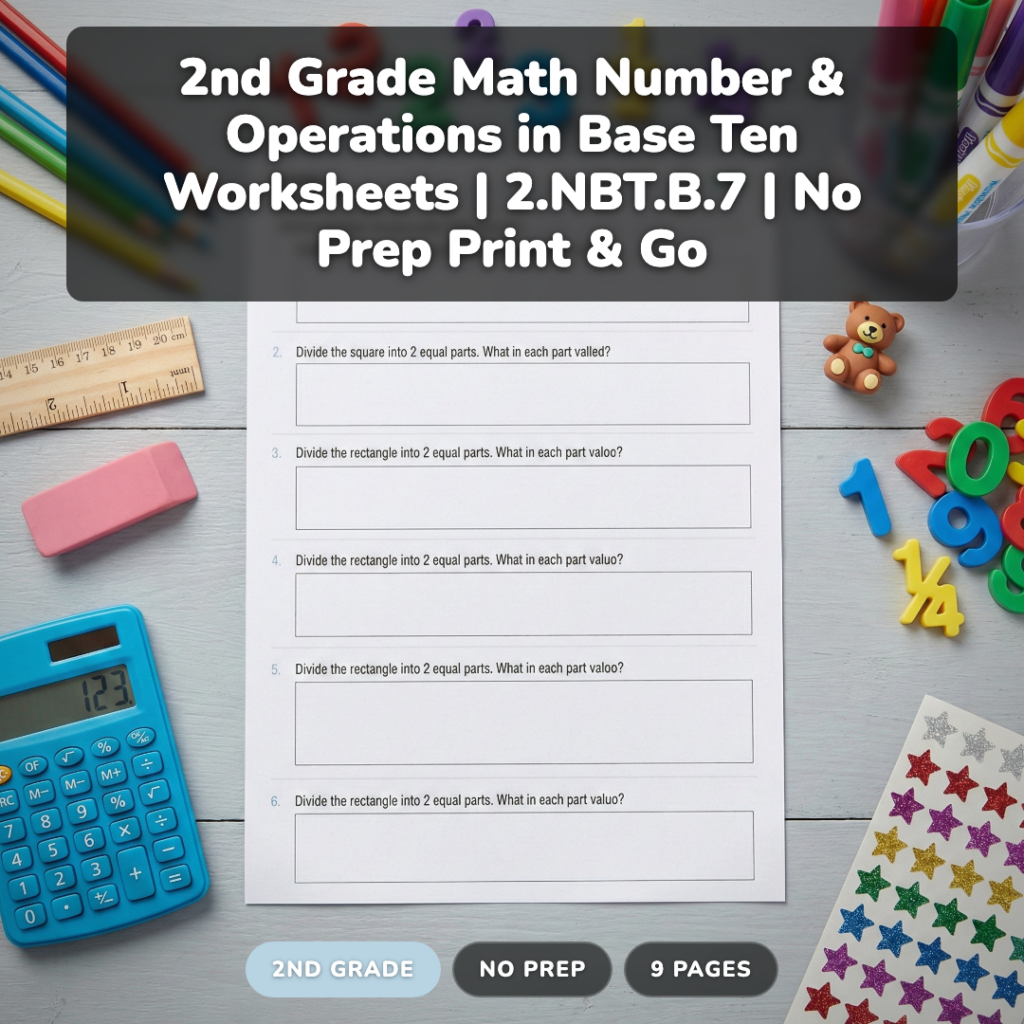
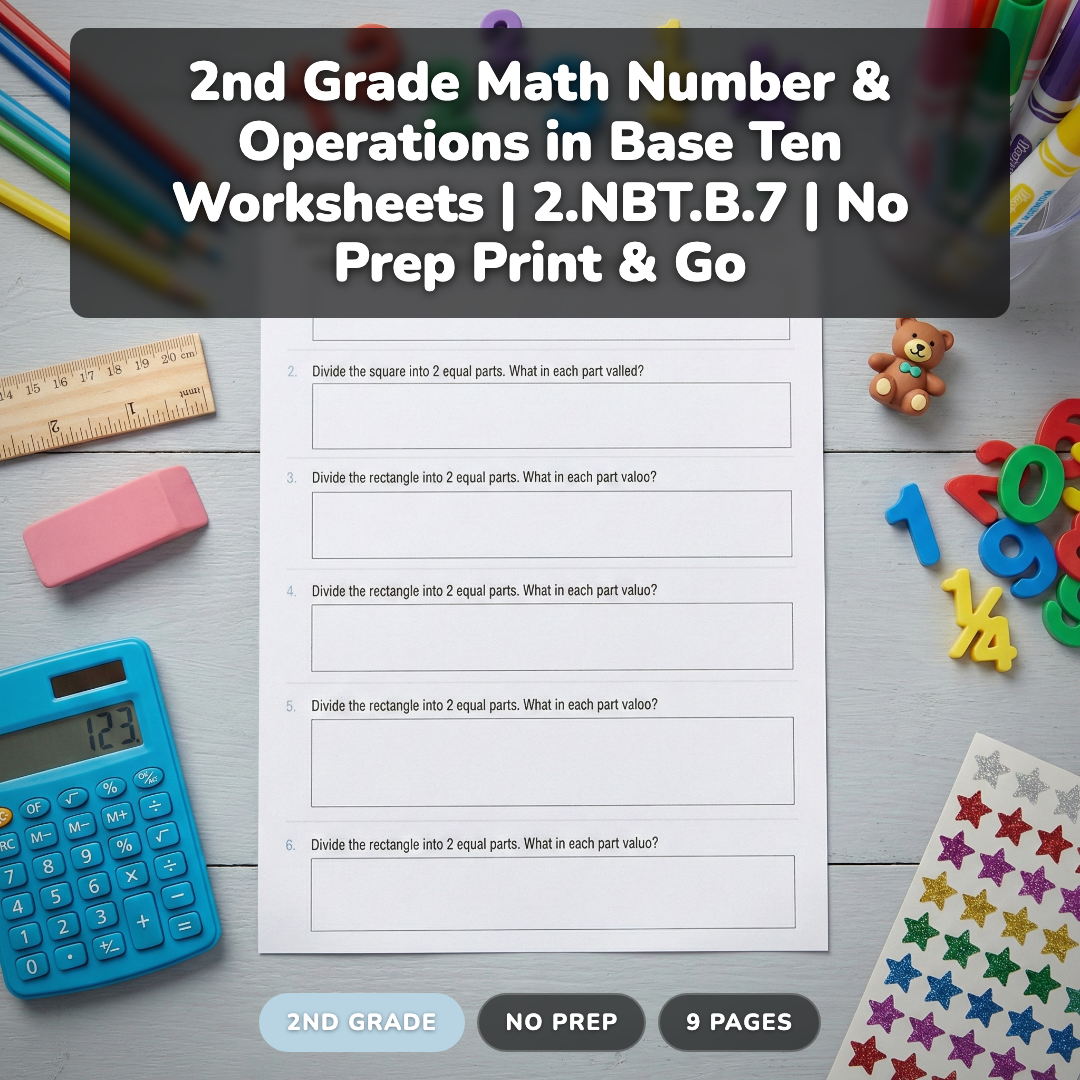
This comprehensive Number & Operations in Base Ten resource provides 106 carefully crafted problems across three differentiation levels. The Practice level (30 problems) focuses on building conceptual understanding with visual supports. On-Level problems (40 problems) provide grade-appropriate practice with mixed problem types. Challenge problems (36 problems) extend thinking with multi-step applications and pattern recognition.
Each level includes answer keys and aligns directly with CCSS.Math.Content.2.NBT.B.7 expectations. The problems progress from concrete models to abstract strategies, supporting the natural learning progression your students need. At 9 total pages, it’s substantial enough for centers, homework, and assessment without overwhelming preparation time.
The resource saves hours of prep time while ensuring your students get the differentiated practice they need to master 3-digit operations with understanding.
Grab a Free 3-Digit Operations Sample to Try
Want to see the quality and differentiation before you buy? I’ll send you a free sample with problems from each level, plus a place value strategy guide that shows exactly how to introduce these concepts step-by-step.
Frequently Asked Questions About Teaching 3-Digit Operations
When should 2nd graders start working with 3-digit addition and subtraction?
Most students are ready for 3-digit operations after mastering 2-digit addition and subtraction with regrouping, typically in late fall or winter of 2nd grade. CCSS.Math.Content.2.NBT.B.7 expects this skill by year-end, but pacing should match your students’ place value understanding rather than calendar dates.
Should I teach the standard algorithm or alternative strategies first?
Research supports teaching multiple strategies before the standard algorithm. Students need concrete experiences with base-ten blocks, expanded form, and number lines to understand why regrouping works. The algorithm becomes meaningful when students see it as a shortcut for strategies they already understand conceptually.
How do I help students who still struggle with 2-digit operations?
Students must be fluent with 2-digit addition and subtraction before attempting 3-digit problems. Provide intensive intervention with base-ten blocks and place value charts for 2-digit work first. Consider using 2.NBT.B.5 activities to build this foundation before moving to more complex problems within 1000.
What’s the difference between composing and decomposing in this standard?
Composing means combining smaller units into larger ones (10 ones become 1 ten). Decomposing means breaking larger units into smaller ones (1 hundred becomes 10 tens). Students need to understand both processes to handle regrouping in addition and subtraction problems successfully.
How many problems should 2nd graders practice daily?
Quality matters more than quantity. Students benefit from 5-8 thoughtfully chosen problems daily, with a mix of concrete modeling, strategy practice, and written work. Focus on understanding rather than speed—fluency develops naturally when conceptual understanding is solid.
Building Confident 3-Digit Mathematicians
Success with 3-digit operations builds the foundation for all future arithmetic learning. When students understand that math follows logical patterns—hundreds with hundreds, tens with tens, ones with ones—they develop the number sense that carries them through multiplication, division, and beyond.
What’s your biggest challenge when teaching 3-digit addition and subtraction? Remember to grab your free sample problems above—they’ll give you a head start on differentiated practice that actually works.